

Artificial intelligence and cryptocurrency are two of the most influential technologies shaping the digital economy. AI is changing how software analyzes information, creates content, automates decisions, and interacts with people, while blockchain technology offers decentralized networks for transferring value, verifying ownership, coordinating participants, and recording data.
As these technologies begin to overlap, a new category of projects and applications is emerging. AI agents can interact with blockchains, decentralized networks can provide infrastructure for AI, cryptocurrencies can be used to pay for computational resources, and blockchain systems can help establish ownership and provenance in an increasingly AI-generated world.
The combination is promising, but it also comes with considerable hype. Understanding where AI and crypto genuinely complement each other is essential for separating practical applications from projects that simply combine two popular technological trends.
Why AI and Crypto Are Coming Together
AI and blockchain were originally developed to solve very different problems.
Artificial intelligence focuses primarily on processing information. Modern AI systems can recognize patterns, generate text and images, analyze large datasets, make predictions, and perform increasingly complex tasks.
Blockchain technology focuses on coordination and verification. It allows participants who may not trust one another to maintain shared records, transfer digital assets, execute smart contracts, and verify transactions without relying entirely on a central authority.
These capabilities can complement each other.
AI can provide intelligence and automation, while blockchain can provide assets, payments, ownership, identity, and verifiable transactions. In some applications, the blockchain becomes the economic infrastructure that allows AI systems to interact with people, services, and other machines.
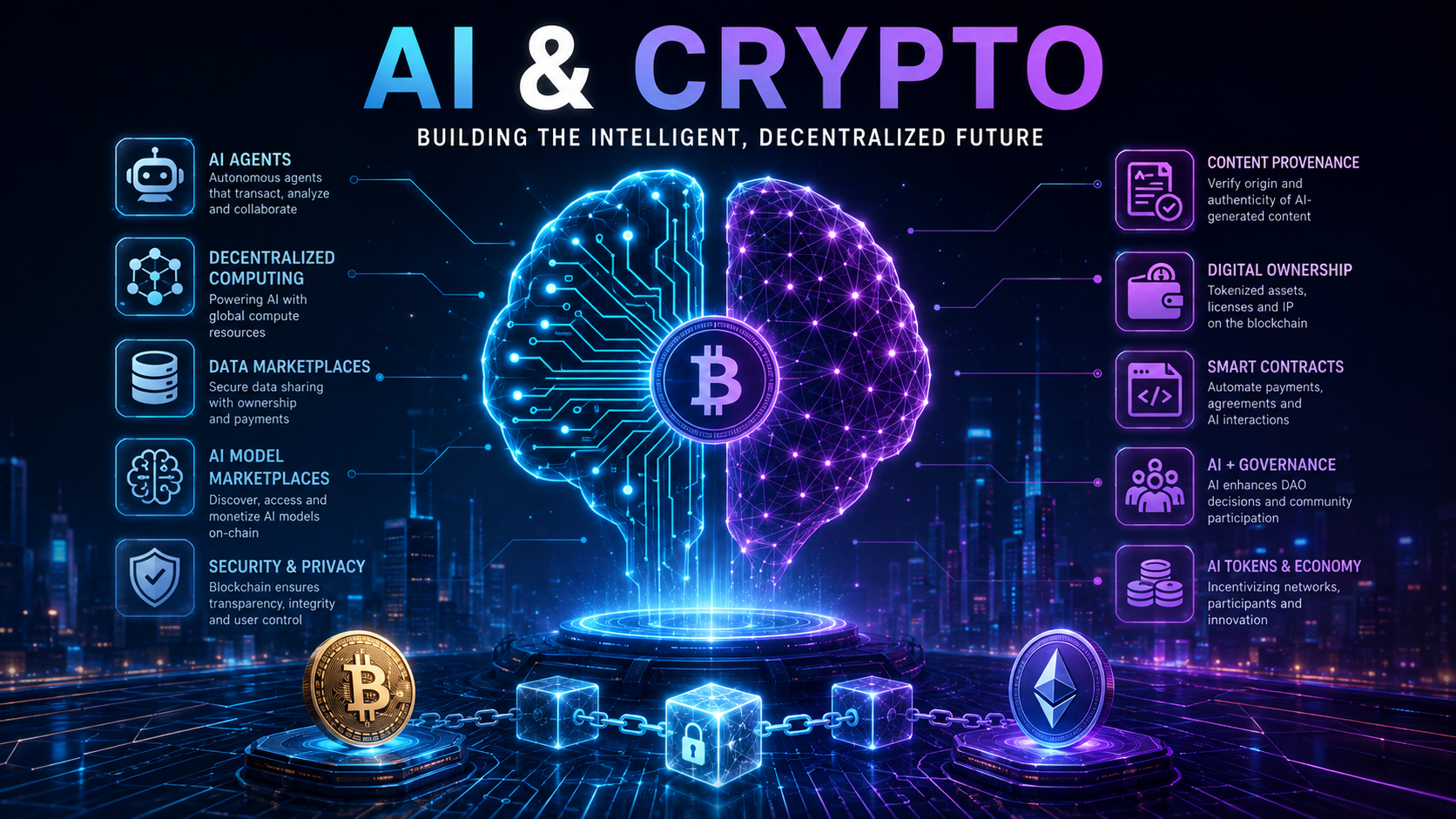
AI Agents and Cryptocurrency
One of the most interesting areas connecting AI and crypto is the development of autonomous AI agents.
An AI agent is software designed to perform tasks with varying degrees of independence. Instead of simply answering a question, an agent might research information, use external services, interact with applications, or coordinate several steps toward a particular objective.
Cryptocurrency potentially gives these agents another capability: the ability to transact.
An AI agent could theoretically control a blockchain wallet and use digital assets to pay for services, receive payments, interact with smart contracts, or exchange value with other agents.
For example, an autonomous agent might purchase access to computing resources, pay for an API request, acquire data, or compensate another agent for completing a specialized task.
This creates the possibility of machine-to-machine economies where software can exchange value without requiring a traditional bank account or payment card for every interaction.
However, giving autonomous software control over valuable assets introduces significant security questions. Wallet permissions, spending limits, compromised agents, malicious instructions, and smart contract vulnerabilities all need to be carefully considered.
Decentralized Computing for AI
Modern AI systems require enormous amounts of computational power.
Training large models can require specialized GPUs and substantial infrastructure, while running those models for millions of users also consumes significant computing resources.
Most large-scale AI infrastructure is currently operated by major technology and cloud computing companies. Crypto projects are exploring whether decentralized networks can provide an alternative marketplace for computational resources.
In these systems, participants can contribute computing capacity to a network and potentially receive cryptocurrency in return. Developers or AI applications can then purchase access to those resources.
The idea is similar to other decentralized infrastructure networks: instead of relying entirely on centralized data centers, unused or specialized hardware from many independent providers can potentially be coordinated through an open marketplace.
Whether decentralized computing can compete with highly optimized centralized infrastructure depends on factors such as cost, latency, reliability, hardware availability, and network efficiency.
Decentralized AI Model Marketplaces
Another potential application involves marketplaces for AI models.
Developers spend significant time and resources creating specialized machine-learning models. Blockchain-based marketplaces could provide mechanisms for publishing, discovering, licensing, and paying for access to those models.
Smart contracts could automate parts of the process.
A developer might make an AI service available through a decentralized marketplace and receive cryptocurrency whenever another application uses it. Different models could also be combined into larger systems, allowing specialized AI services to interact with one another.
The broader concept is to create more open AI ecosystems where developers can participate without depending entirely on a single centralized platform.
Data Marketplaces for AI
AI models depend heavily on data.
High-quality datasets can be expensive to collect, organize, verify, and maintain. At the same time, individuals and organizations generate enormous quantities of potentially useful information.
Blockchain-based data marketplaces attempt to create systems where data can be exchanged while ownership, permissions, and payments are managed through decentralized infrastructure.
In theory, data providers could decide how their information is used and receive compensation when it contributes to AI applications.
Privacy remains one of the largest challenges.
Public blockchains are generally unsuitable for storing sensitive personal information directly. Practical systems therefore need additional technologies such as encryption, off-chain storage, privacy-preserving computation, or zero-knowledge proofs.
Blockchain and the Problem of AI-Generated Content
Generative AI has dramatically lowered the cost of producing text, images, audio, video, and other digital content.
This creates opportunities for creators, but it also makes determining the origin of digital information increasingly difficult.
Blockchain technology may contribute to systems for recording provenance.
For example, a creator could cryptographically register information about an original work, creating a timestamped record associated with a particular wallet or identity. Later modifications or transfers could potentially be recorded as well.
This does not automatically prove that information is true, nor can a blockchain determine whether someone falsely registered content they did not create.
However, cryptographic records can become one component of broader systems designed to establish when content was created, where it originated, and how it has changed.
Digital Ownership in an AI-Generated World
AI also raises complicated questions about digital ownership.
If millions of images, songs, virtual objects, characters, and other assets can be generated almost instantly, simply possessing a digital file becomes less meaningful.
Blockchain-based assets can provide another layer of distinction by representing ownership or access rights independently of the underlying media file.
This concept extends beyond NFTs as collectibles.
Blockchain infrastructure could potentially manage licenses, memberships, usage permissions, royalties, access credentials, or other rights associated with AI-generated and human-created content.
Whether blockchain is necessary for a particular application depends on whether decentralized ownership or transferability provides a meaningful advantage over a conventional database.
AI Can Also Improve Blockchain Applications
The relationship works in both directions.
Blockchain infrastructure can provide capabilities to AI applications, but AI can also make cryptocurrency and blockchain systems easier to use.
Crypto wallets remain complicated for many users. Understanding transaction fees, addresses, networks, token approvals, staking, decentralized exchanges, and smart contracts requires considerable knowledge.
AI-powered interfaces could help translate this complexity into more natural interactions.
Instead of navigating numerous interfaces manually, a user might describe an intended action in ordinary language. An AI assistant could explain the necessary steps, identify potential risks, and prepare transactions for the user to review.
AI can also assist with blockchain analytics by examining large quantities of on-chain data and identifying patterns that would be difficult to detect manually.
AI for Smart Contract Development and Security
Smart contracts are another area where AI could have a significant impact.
Developers can already use AI coding tools to help write, explain, test, and review software. Similar tools can assist developers working with smart contracts.
AI systems may help identify suspicious code patterns, explain complicated contract logic, generate tests, or highlight potential vulnerabilities.
However, AI-generated code should not automatically be considered secure.
Smart contracts can control substantial amounts of cryptocurrency, and even a small programming mistake can have serious financial consequences. AI should therefore complement professional auditing, testing, and security practices rather than replace them.
Decentralized Governance and AI
Decentralized autonomous organizations, or DAOs, may also incorporate AI.
DAOs often face large volumes of governance proposals, discussions, voting data, treasury information, and community feedback. AI systems could summarize proposals, analyze previous governance decisions, identify relevant discussions, or help participants understand complicated topics before voting.
More advanced systems could potentially delegate limited operational responsibilities to AI agents.
This introduces an important governance question: how much authority should autonomous software have?
Using AI to organize information is very different from allowing an AI system to independently control a treasury or execute governance decisions. Communities experimenting with these technologies will need transparent rules, safeguards, and clearly defined limits.
The Rise of AI-Related Crypto Tokens
The growth of artificial intelligence has also created a large category of AI-related cryptocurrencies.
These tokens may serve very different purposes.
Some provide access to decentralized computing networks. Others are used for AI marketplaces, data services, autonomous agents, governance, payments, or incentives.
There are also tokens whose connection to artificial intelligence is primarily marketing.
The term "AI token" therefore says very little about what a cryptocurrency actually does.
Before evaluating an AI-related crypto project, it is important to understand the underlying product. What role does blockchain technology play? Why is a token necessary? Who actually uses the network? Does the project provide a functioning service?
These questions are more useful than simply looking at whether a project is associated with artificial intelligence.
The Oracle Problem Still Matters
AI cannot automatically solve one of blockchain's fundamental limitations: blockchains cannot independently verify everything happening outside their networks.
If an AI model provides information to a smart contract, the blockchain still needs some reason to trust that information.
An AI system could produce incorrect information, use outdated data, be manipulated, or generate different answers to the same question.
This makes reliable data sources, oracle networks, cryptographic verification, and carefully designed trust mechanisms important when connecting AI systems with smart contracts.
Combining AI with blockchain does not eliminate the need to understand where information originates.
Privacy Is a Major Challenge
AI and blockchain have very different relationships with data.
AI systems often benefit from having access to large datasets. Public blockchains, meanwhile, are designed to permanently replicate information across many computers.
Combining the two carelessly could create serious privacy problems.
Sensitive information should generally not be placed directly on a public blockchain simply because an AI application needs access to it.
Future systems may increasingly rely on technologies that allow information to be processed or verified without publicly exposing the underlying data.
Zero-knowledge proofs, secure computing environments, encryption, and decentralized identity technologies could all contribute to this area.
Security Risks Increase When AI Controls Assets
Traditional AI mistakes can be inconvenient. AI mistakes involving cryptocurrency can be expensive.
If an AI assistant generates an incorrect answer, a user can usually ignore it. If an autonomous agent sends cryptocurrency to the wrong address or interacts with a malicious smart contract, the transaction may be irreversible.
This makes permission management particularly important.
AI agents controlling crypto assets may require spending limits, restricted smart contract permissions, transaction simulations, human approval thresholds, emergency controls, and other safeguards.
The more autonomous these systems become, the more important their security architecture becomes as well.
Separating Innovation From Hype
AI and crypto are both technologies surrounded by enormous amounts of speculation.
Combining them naturally creates even more.
A project does not become useful simply because it includes artificial intelligence, blockchain technology, and a token. In many situations, a conventional database or centralized AI service may be simpler, cheaper, and faster.
The strongest applications are likely to emerge where decentralization provides a specific advantage.
That could include open marketplaces, censorship resistance, digital ownership, global payments, decentralized infrastructure, transparent incentives, or coordination between participants who do not fully trust one another.
The important question is not whether AI and blockchain can be combined. They clearly can.
The question is whether combining them solves a real problem better than existing alternatives.
What the Future Could Look Like
The intersection between AI and cryptocurrency is still developing.
In the future, AI agents may routinely maintain wallets, purchase digital services, interact with smart contracts, and coordinate with other autonomous systems. Decentralized networks may provide computing power, data, models, storage, and payment infrastructure for those agents.
At the same time, blockchain technology could become increasingly important for verifying ownership, identity, permissions, and provenance as AI makes digital content easier to create and manipulate.
Many experiments will fail, and some ideas currently receiving significant attention may ultimately prove unnecessary.
Others could become fundamental infrastructure for a digital economy where humans, organizations, and autonomous software increasingly interact with one another.
AI and Crypto Are Still an Experiment
AI and crypto represent two different visions of how digital systems can evolve. Artificial intelligence makes software more capable and autonomous, while blockchain technology makes digital ownership and coordination possible without requiring every interaction to pass through the same centralized intermediary.
Bringing these technologies together creates intriguing possibilities, from autonomous economic agents and decentralized computing networks to AI marketplaces and verifiable digital content.
But the combination also magnifies existing challenges involving security, privacy, trust, scalability, and speculation.
For users exploring this emerging space, understanding the technology and the communities behind individual projects is more valuable than following the latest AI narrative. The most important developments will ultimately be those that demonstrate genuine utility, sustainable participation, and a clear reason for AI and blockchain to work together.



Pick your reaction
Post your comment