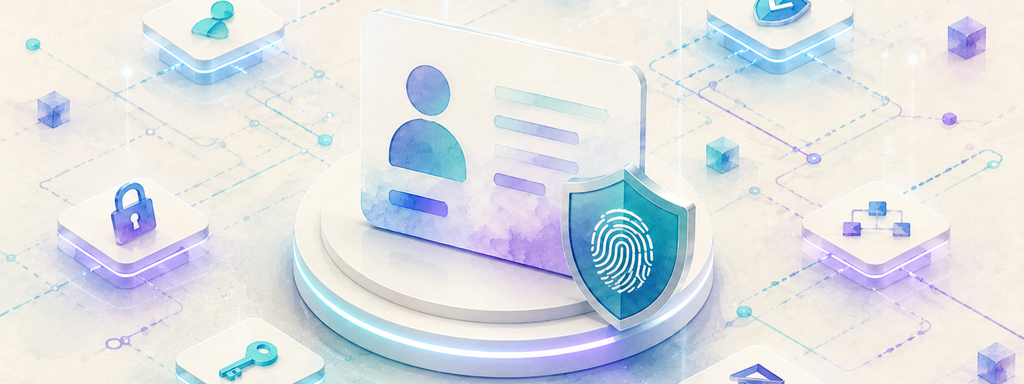

Every time you create an online account, verify your age, sign in to a service, or submit personal information, you're relying on some form of digital identity. Today, this information is typically stored by governments, companies, or online platforms, making it vulnerable to data breaches, identity theft, and misuse.
Blockchain technology offers a different approach by giving individuals greater ownership and control over their digital identities.
In this article, we'll explore what blockchain-based digital identity is, how it works, its advantages, its challenges, and why many believe it could become an important part of the future internet.
What Is Digital Identity?
A digital identity is the collection of information that represents a person, organization, or device online. It may include:
- Your name
- Date of birth
- Government-issued ID
- Driver's license
- Passport information
- Email address
- Phone number
- Educational certificates
- Professional licenses
- Membership credentials
Today, these records are usually stored in centralized databases managed by different organizations. As a result, your personal information often exists in dozens or even hundreds of separate systems.
The Problems with Traditional Digital Identity
The current identity system has several weaknesses.
Centralized Storage
Large databases become attractive targets for hackers. When a company suffers a data breach, millions of users can have their personal information exposed.
Repeated Verification
You often need to prove your identity repeatedly for different services, even though the same information has already been verified elsewhere.
Limited User Control
Most people have little visibility into who has access to their personal information or how it's being shared.
Identity Theft
Criminals who obtain enough personal data may impersonate victims, open financial accounts, or commit fraud.
Fragmentation
Different organizations maintain separate copies of your identity information, increasing complexity and inconsistencies.
How Blockchain Can Improve Digital Identity
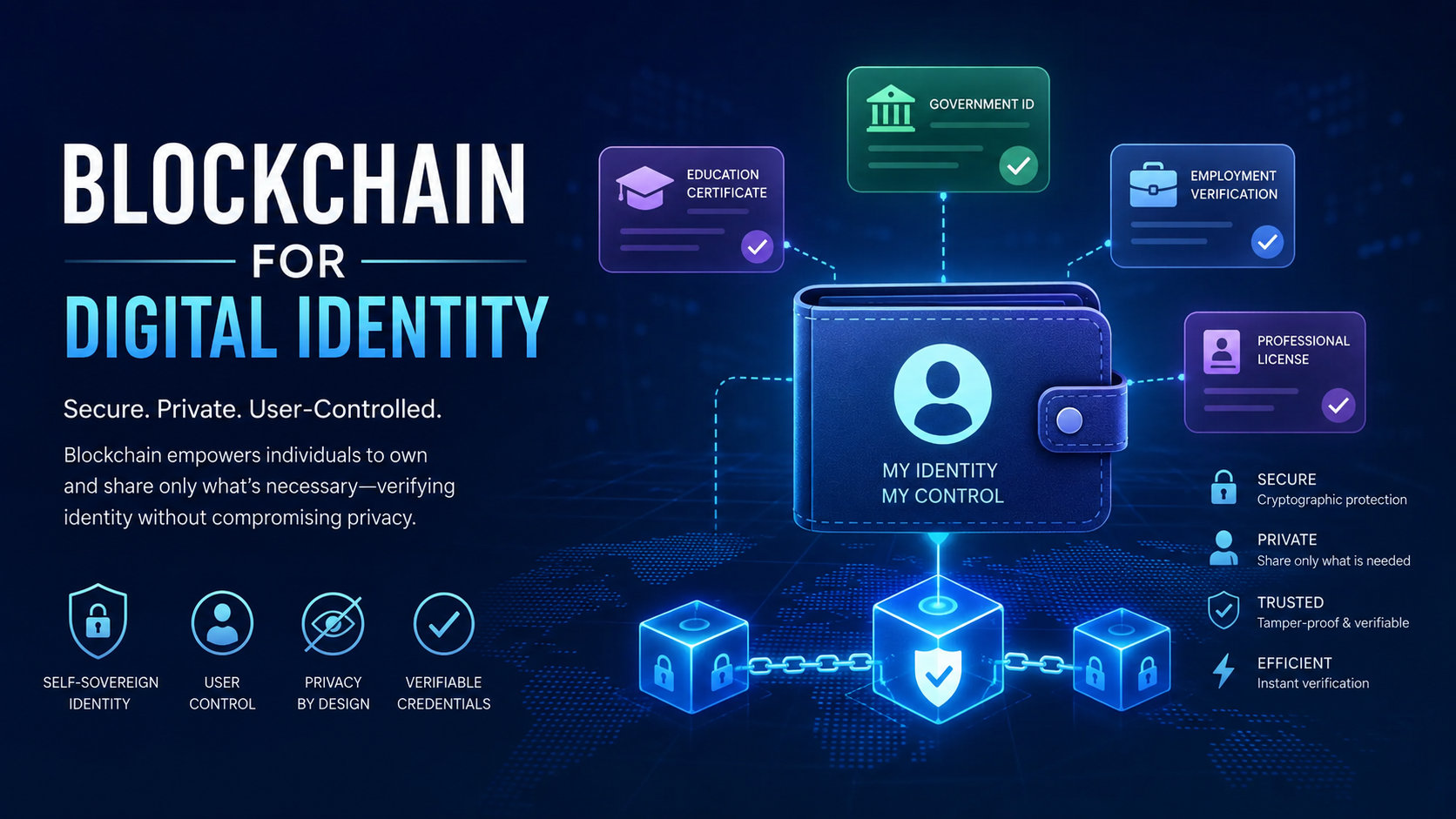
Blockchain enables a model known as self-sovereign identity (SSI), where individuals control their own digital credentials instead of relying entirely on centralized databases.
Rather than storing sensitive personal information directly on the blockchain, blockchain networks are typically used to verify the authenticity and integrity of credentials.
In many systems:
- Personal data remains with the user.
- Credentials are stored in a secure digital wallet.
- Blockchain stores cryptographic proofs or references.
- Organizations can verify credentials without accessing unnecessary personal information.
This creates a more privacy-focused identity system.
How Blockchain-Based Identity Works
Although implementations differ, the general process follows several steps.
1. Identity Issuance
A trusted organization issues a digital credential.
Examples include:
- Governments issuing digital IDs
- Universities issuing diplomas
- Employers issuing employment verification
- Professional organizations issuing certifications
The credential is digitally signed using cryptography.
2. Storage
The individual stores the credential in a secure digital identity wallet.
Unlike traditional systems, the organization doesn't necessarily need to store ongoing copies of the credential.
3. Verification
When another organization needs proof of identity, the user chooses which credential to share.
Instead of uploading multiple documents, the user can present a cryptographically verifiable credential.
4. Validation
The receiving organization checks the blockchain to verify that:
- The credential was issued by a trusted authority.
- It hasn't been altered.
- It hasn't been revoked.
- It remains valid.
This process can often be completed within seconds.
What Is a Decentralized Identity (DID)?
A Decentralized Identifier (DID) is a unique identifier that belongs to an individual rather than a centralized organization.
Unlike usernames controlled by websites, DIDs are owned by their holders.
This means:
- No single company controls your identity.
- Your identifier can work across multiple services.
- You maintain control over your credentials.
DIDs are becoming an important standard within blockchain-based identity systems.
Verifiable Credentials
A Verifiable Credential (VC) is a digitally signed document that proves something about a person.
Examples include:
- University degrees
- Professional certificates
- Employee identification
- Medical qualifications
- Age verification
- Residency status
- Business licenses
Because these credentials are cryptographically signed, organizations can verify them without needing to contact the original issuer every time.
Privacy Advantages
One of blockchain identity's biggest strengths is selective disclosure.
Instead of revealing your full identity, you can often prove only the specific information required.
Examples include:
- Proving you're over 18 without revealing your birth date.
- Confirming residency without exposing your full address.
- Demonstrating employment without sharing salary information.
This reduces unnecessary data sharing while improving privacy.
Real-World Use Cases
Blockchain-based digital identity has applications across many industries.
Government Services
Governments are exploring digital identity systems for:
- National ID cards
- Digital passports
- Tax services
- Public service access
- Online voting in certain scenarios
Healthcare
Patients could securely manage medical records and share them with healthcare providers when needed.
This could improve interoperability while protecting sensitive health information.
Education
Universities can issue tamper-resistant diplomas and certificates.
Employers can verify educational credentials almost instantly.
Financial Services
Banks and financial institutions spend significant resources on Know Your Customer (KYC) verification.
Blockchain credentials could simplify onboarding while helping institutions meet regulatory requirements.
Employment
Job applicants could prove:
- Degrees
- Certifications
- Work history
- Professional licenses
without repeatedly requesting paper documentation.
Travel
Digital travel credentials could simplify airport check-in, immigration, and border verification.
Benefits of Blockchain for Digital Identity
Several advantages make blockchain attractive for identity management.
Better Security
Cryptographic signatures make credentials extremely difficult to forge or modify.
Greater Privacy
Users decide which information to share rather than exposing entire identity documents.
Reduced Fraud
Verified credentials are much harder for criminals to counterfeit.
User Ownership
Individuals gain greater control over their personal information.
Faster Verification
Organizations can validate credentials almost instantly.
Lower Administrative Costs
Automated verification reduces paperwork and manual review.
Global Compatibility
Open standards could allow credentials to work across different countries and organizations.
Challenges and Limitations
Despite its potential, blockchain identity is still evolving.
Adoption
Governments, businesses, and institutions need to agree on common standards before widespread adoption becomes possible.
User Experience
Identity wallets must become easier to use for people without technical knowledge.
Lost Credentials
If users lose access to their identity wallet, secure recovery methods are essential.
Regulation
Different countries have varying privacy and identity laws that blockchain solutions must comply with.
Interoperability
Different blockchain identity systems must work together to avoid creating new digital silos.
Popular Blockchain Identity Projects
Several blockchain ecosystems are actively working on decentralized identity solutions.
Examples include:
- Ethereum
- Polygon
- Hyperledger Indy
- Hyperledger Aries
- Microsoft Entra Verified ID
- Polygon ID
- SpruceID
- Dock
- cheqd
- Veramo
Many of these projects follow open standards developed by organizations such as the World Wide Web Consortium (W3C).
Blockchain Does Not Replace Governments
A common misconception is that blockchain eliminates the need for trusted authorities.
In reality, blockchain often changes how trust is verified rather than removing trusted issuers entirely.
For example:
- Governments still issue passports.
- Universities still issue degrees.
- Employers still verify employment.
Blockchain simply provides a more secure, privacy-preserving way to prove that these credentials are authentic.
The Future of Digital Identity
As online services continue to expand, secure digital identity will become increasingly important. Advances in decentralized identity, verifiable credentials, and privacy-preserving cryptography could make it easier for people to access services without repeatedly handing over sensitive personal information.
While large-scale adoption will require cooperation between governments, businesses, technology providers, and standards organizations, momentum is growing. Over time, blockchain-based identity systems could reduce fraud, improve privacy, streamline verification processes, and give individuals greater control over one of their most valuable digital assets: their identity.
Conclusion
Blockchain is introducing a new way to think about digital identity. Instead of relying on countless centralized databases that each store copies of our personal information, decentralized identity systems allow individuals to manage verified credentials while giving organizations a secure way to confirm their authenticity.
Although challenges around adoption, regulation, and usability remain, blockchain-based digital identity has the potential to make online interactions safer, more private, and more efficient. As standards continue to mature and more organizations embrace verifiable credentials, digital identity may become one of blockchain's most impactful real-world applications.
Pick your reaction
Post your comment