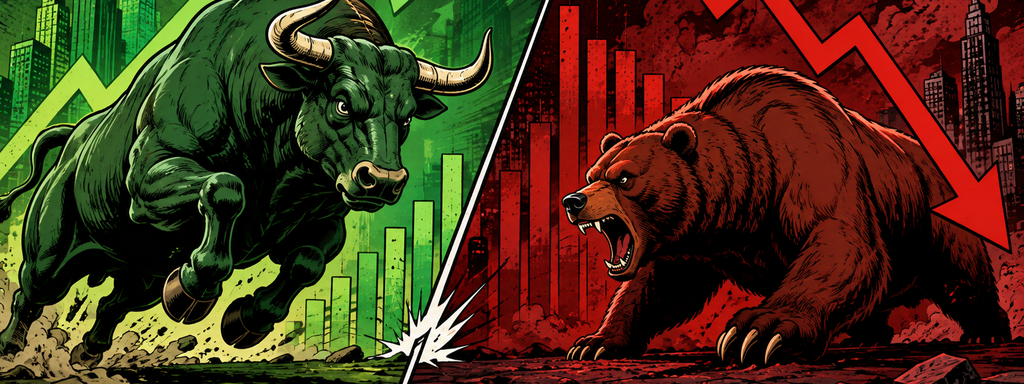

Crypto markets rarely move in one direction for long. Prices rise, optimism grows, momentum eventually fades, and periods of falling prices and uncertainty follow. These broad phases are commonly known as bull markets and bear markets.
Understanding the difference between them can help you interpret market sentiment, recognize changing conditions, and make more informed decisions. A bull market does not mean prices will rise forever, just as a bear market does not mean the market is doomed. Both are natural parts of financial market cycles, and both can create opportunities as well as risks.
What Is a Bull Market?
A bull market is an extended period in which asset prices generally trend upward. In crypto, bull markets are usually accompanied by increasing trading activity, growing public interest, positive sentiment, and greater willingness among investors to take risks.
There is no single rule that officially determines when a crypto bull market begins. Traditional financial markets sometimes use a rise of 20% or more from a recent low as a rough benchmark, but cryptocurrency markets are far more volatile. A 20% move can happen relatively quickly without representing a meaningful long-term change in the broader trend.
Instead, a crypto bull market is better understood as a sustained period in which rising prices, improving sentiment, increased demand, and market participation reinforce one another.
What Happens During a Bull Market?
Bull markets often begin quietly.
After a prolonged decline or period of sideways trading, prices may start recovering while much of the public remains skeptical. Early buyers begin returning, market confidence gradually improves, and previously negative sentiment becomes less dominant.
If the recovery continues, momentum can accelerate.
Rising prices attract attention. More investors enter the market, trading volumes increase, and crypto begins receiving more coverage from mainstream media and social platforms. Existing investors may become more willing to hold rather than sell, while new participants fear missing further gains.
This can create a feedback loop:
Prices rise → confidence increases → more buyers enter → demand grows → prices rise further.
Eventually, optimism can become excessive. Investors may begin assuming that prices will continue rising indefinitely, highly speculative assets can attract enormous attention, and valuations may become disconnected from realistic expectations.
This stage can be exciting, but it can also be one of the riskiest parts of a bull market.
Common Signs of a Bull Market
No individual indicator can reliably confirm a bull market, but several conditions often appear together:
- Major cryptocurrencies establish sustained upward trends
- Market capitalization increases over an extended period
- Trading volumes and liquidity grow
- Investor sentiment becomes increasingly optimistic
- New users enter exchanges, wallets, and crypto communities
- Social media activity increases
- Mainstream media coverage becomes more positive
- Venture capital and investment activity may increase
- Previously inactive projects begin attracting attention again
- Riskier assets start experiencing stronger speculation
One particularly noticeable characteristic is a shift in expectations. During strong bull markets, investors often stop asking whether prices will rise and start asking how high they can go.
That confidence can eventually become overconfidence.
What Is a Bear Market?
A bear market is an extended period characterized by declining prices, weak sentiment, reduced risk appetite, and widespread uncertainty.
As with bull markets, there is no perfect percentage that defines a crypto bear market. A sharp correction does not necessarily mean a long-term bear market has begun. Crypto assets regularly experience significant short-term declines even during broader upward trends.
A true bear market generally involves a sustained deterioration in market conditions rather than a brief drop.
Prices decline, investors become increasingly cautious, speculative interest disappears, and capital often moves away from higher-risk assets.
What Happens During a Bear Market?
Bear markets can develop gradually or arrive surprisingly quickly.
Prices may initially decline from a market peak and appear to be experiencing a normal correction. Some investors see lower prices as buying opportunities and expect the previous upward trend to resume.
If prices continue falling, however, sentiment can change dramatically.
Investors who previously expected new highs may begin questioning their positions. Leveraged traders can be liquidated, weaker projects struggle to maintain funding, and speculative assets may experience particularly severe losses.
The feedback loop that helped prices rise during a bull market can begin operating in reverse:
Prices fall → confidence decreases → investors sell → demand weakens → prices fall further.
Media coverage often becomes more negative, social activity declines, and people who entered during the previous period of excitement may leave the market entirely.
Eventually, pessimism itself can become excessive.
Just as bull markets can make investors believe prices will rise forever, bear markets can make it feel as though prices will never recover.
Common Signs of a Bear Market
Bear markets frequently include several recognizable characteristics:
- Major cryptocurrencies remain in prolonged downward trends
- Market capitalization declines
- Trading activity decreases
- Investor sentiment becomes fearful or pessimistic
- Speculative projects lose significant value
- Crypto-related search and social activity decline
- Companies and projects reduce spending or staff
- Funding becomes more difficult to obtain
- Investors become more interested in capital preservation
- Negative news receives greater attention
Some projects may disappear completely during prolonged downturns. Others continue building despite lower prices and reduced attention.
For this reason, bear markets can act as a kind of stress test for the industry.
Bull Market vs Bear Market
The biggest difference between bull and bear markets is not simply whether prices are moving up or down. The broader environment changes as well.
During bull markets, investors tend to focus on opportunity. During bear markets, they tend to focus on risk.
Bull markets are generally associated with optimism, expanding valuations, increased participation, and greater appetite for speculation. Bear markets are associated with pessimism, declining valuations, lower participation, and greater caution.
The same piece of news can even produce different reactions depending on the market environment.
During a strong bull market, investors may overlook negative developments because confidence remains high. During a bear market, relatively minor negative news can trigger significant selling because participants are already nervous.
Markets are driven not only by information, but also by how people interpret that information.
Why Do Bull and Bear Markets Happen?
There is rarely one single cause.
Crypto market cycles can be influenced by a combination of factors including:
Supply and demand: When demand consistently exceeds available supply, prices tend to rise. When selling pressure dominates, prices tend to fall.
Macroeconomic conditions: Interest rates, inflation, economic growth, liquidity, and monetary policy can influence how willing investors are to hold risky assets.
Regulation: Major regulatory developments can increase confidence or create uncertainty.
Technology and adoption: New applications, infrastructure improvements, institutional adoption, or technological breakthroughs can attract investment.
Leverage: Borrowed money can amplify both upward and downward movements. Rising prices can encourage more leverage, while falling prices can trigger liquidations that accelerate declines.
Investor psychology: Fear, greed, optimism, panic, and herd behavior play enormous roles in speculative markets.
Crypto cycles are therefore rarely caused by one event. They emerge from the interaction between market structure, economic conditions, technology, narratives, and human behavior.
Market Sentiment Can Become Extreme
One of the most important lessons from bull and bear markets is that sentiment tends to follow price.
When prices rise for months, bullish predictions begin to feel increasingly believable. Investors who were previously cautious may start believing they are missing an extraordinary opportunity.
When prices fall for months, the opposite happens. Even fundamentally strong projects can be treated as though they have no future.
This creates a psychological challenge.
People naturally want to buy when everyone feels confident and sell when everyone feels afraid. Unfortunately, those emotions can become strongest near market extremes.
Recognizing this tendency does not make market timing easy, but it can help investors question decisions driven primarily by emotion.
Corrections Are Not Always Bear Markets
Not every decline marks the beginning of a bear market.
Crypto markets are highly volatile, and substantial corrections can occur during otherwise strong upward trends. Prices may fall sharply before recovering and continuing higher.
Similarly, a sudden rally during a prolonged downturn does not necessarily mean a new bull market has begun.
Bear markets frequently contain powerful temporary rallies, sometimes called bear market rallies. These can convince investors that the downturn has ended before prices resume falling.
Looking at broader trends rather than isolated price movements can provide better context.
Different Cryptocurrencies Can Experience Different Cycles
The entire crypto market does not always move together.
Bitcoin may be rising while smaller cryptocurrencies remain weak. Certain sectors such as decentralized finance, gaming, artificial intelligence, NFTs, or tokenized real-world assets may experience periods of intense interest while other areas receive little attention.
Capital can also rotate between different parts of the market.
For example, investors may initially concentrate on larger, more established cryptocurrencies before becoming increasingly willing to speculate on smaller assets as confidence grows.
Because of this, calling the entire market "bullish" or "bearish" can sometimes oversimplify what is actually happening.
How Bull Markets Affect Crypto Communities
Market cycles dramatically influence online crypto communities.
During bull markets, Discord servers, Telegram groups, subreddits, forums, and social networks often experience rapid growth. New investors arrive looking for information, projects receive more attention, and discussions become increasingly active.
This growth can be positive, but it can also attract scammers, impersonators, fake investment schemes, and aggressive promotion.
Bear markets create a different environment.
Activity may decline as speculative participants leave. Communities can become smaller, but the remaining members are often more focused on development, technology, governance, education, and long-term goals.
For community owners, both environments create different challenges. Bull markets require managing rapid growth and protecting newcomers, while bear markets require maintaining engagement when public interest declines.
Platforms such as BlockMap can help users discover crypto communities across different parts of the ecosystem, regardless of where the broader market happens to be in its cycle.
Can You Predict When a Bull or Bear Market Will End?
Not reliably.
Analysts use technical indicators, blockchain data, macroeconomic statistics, sentiment measurements, liquidity conditions, historical patterns, and many other tools to estimate where the market may be heading.
These indicators can provide useful context, but none can consistently identify market tops and bottoms in advance.
Market cycles also look much clearer in hindsight.
Once prices have already risen significantly, the beginning of a bull market seems obvious on a historical chart. Once prices have collapsed, the previous market peak appears equally obvious.
Making those judgments in real time is considerably more difficult.
Managing Risk Through Different Market Conditions
Rather than attempting to perfectly predict every market transition, investors can focus on managing risk.
That might include diversifying investments, avoiding excessive leverage, maintaining realistic expectations, researching projects carefully, and deciding in advance how much risk they are willing to accept.
A strategy should also account for the possibility that the market will behave differently from expectations.
During bull markets, that means remembering that rapid gains can disappear quickly.
During bear markets, it means remembering that extreme pessimism does not necessarily last forever.
Neither optimism nor pessimism should replace research.
Bull and Bear Markets Are Part of the Same Cycle
Bull and bear markets may feel like completely different worlds, but they are connected parts of the same broader market cycle.
Periods of low valuations and pessimism can eventually create conditions for recovery. Recoveries can develop into optimism, speculation, and eventually excessive enthusiasm. When expectations become unsustainable, the cycle can reverse again.
The exact timing, duration, and magnitude of these phases are impossible to know in advance.
Understanding how they work, however, provides valuable context.
Instead of viewing every rally as the beginning of unlimited growth or every decline as the end of crypto, it is more useful to recognize that markets continuously move between optimism and pessimism, expansion and contraction, risk-taking and caution.
Bull markets reward optimism but can encourage excessive risk. Bear markets punish speculation but can expose weaknesses and reset expectations.
Both are part of how crypto markets evolve.



thanks for all these informations ♥