

Marketing has always played a major role in determining whether new technologies gain widespread adoption. In the cryptocurrency industry, however, marketing works differently than in many traditional sectors. While established companies often rely on advertising campaigns, public relations agencies, and centralized branding strategies, many blockchain projects have achieved remarkable success through passionate communities that voluntarily promote, educate, and support the ecosystem.
Community-led marketing has become one of the defining characteristics of the crypto space. Rather than simply selling a product, successful blockchain projects encourage users to become active participants, contributors, educators, and advocates. Understanding the differences between community-led and traditional marketing helps explain why some crypto projects continue to thrive while others disappear despite significant advertising budgets.
What Is Traditional Marketing?
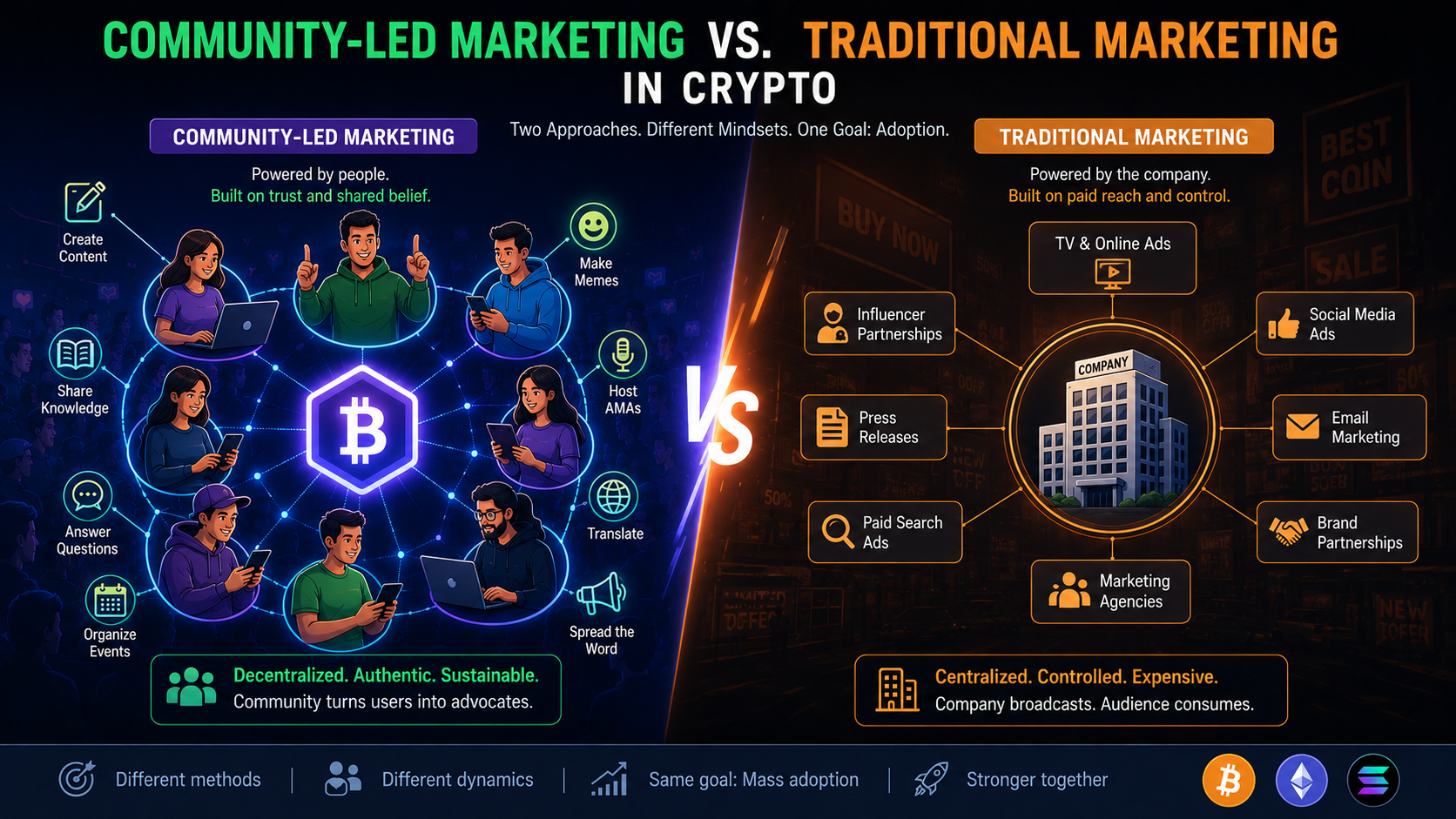
Traditional marketing is typically driven by the company itself. A centralized team develops a strategy, creates campaigns, purchases advertising, and measures success using established business metrics.
Common examples include:
- Television, radio, and online advertisements
- Sponsored influencer campaigns
- Press releases
- Paid search and social media ads
- Email marketing
- Brand partnerships
- Professional marketing agencies
This approach gives companies full control over messaging, branding, timing, and campaign execution. The goal is usually customer acquisition through carefully planned promotional efforts.
For many industries, this model works extremely well because the company owns the product, controls the messaging, and manages nearly every customer interaction.
What Is Community-Led Marketing?
Community-led marketing flips this model upside down.
Instead of relying primarily on paid advertising, crypto projects encourage members of the community to spread awareness naturally. Users create content, answer questions, organize events, develop educational resources, and introduce new people to the ecosystem.
The marketing becomes decentralized, much like blockchain itself.
Community members often:
- Write tutorials
- Produce YouTube videos
- Host livestreams
- Organize local meetups
- Moderate Discord and Telegram servers
- Translate documentation
- Answer questions on Reddit and forums
- Create memes
- Develop educational websites
- Share updates across social media
Many contributors receive no direct financial compensation. Their motivation often comes from enthusiasm for the project, ownership of tokens, or a genuine desire to help the ecosystem succeed.
Why Community Matters So Much in Crypto
Blockchain projects are different from traditional software companies.
Many networks have:
- No central headquarters
- Open-source development
- Decentralized governance
- Contributors from around the world
- Community voting
- Public roadmaps
Because users often become token holders, validators, developers, or governance participants, they are personally invested in the project's long-term success.
When users become owners, they naturally become marketers.
A person who believes in a blockchain network is far more likely to recommend it to friends than someone who simply purchased a product from a corporation.
Authenticity Builds Trust
Crypto users are generally skeptical of traditional advertising.
The industry has experienced numerous scams, failed projects, misleading promises, and aggressive promotional campaigns. As a result, many investors place greater trust in community discussions than in official advertisements.
People often prefer learning from:
- Long-term users
- Independent educators
- Developers
- Community moderators
- Technical analysts
- Open discussions
Authentic conversations often carry far more weight than polished marketing materials.
Education Is Marketing
One unique aspect of crypto is that education itself becomes a marketing tool.
Blockchain technology can be difficult to understand.
Topics such as:
- Wallet security
- Private keys
- Smart contracts
- Consensus mechanisms
- Tokenomics
- Staking
- Governance
require significant explanation before new users feel comfortable participating.
Community members who create beginner guides, tutorials, FAQs, and videos are not just educating people—they are helping grow the ecosystem.
Every useful tutorial reduces barriers for new users.
The Power of Word-of-Mouth
Word-of-mouth has always been one of the strongest forms of marketing.
Crypto amplifies this effect because communities are highly active online.
A positive experience shared in:
- Discord
- X
- Telegram
- YouTube
- Livestream chats
can quickly reach thousands of interested people.
Unlike paid advertisements, these recommendations often come from individuals who have already used the product extensively.
That experience creates credibility.
Memes as Marketing
Few industries embrace memes as effectively as cryptocurrency.
Memes can:
- simplify complex ideas
- create shared identity
- strengthen community culture
- spread rapidly across social media
- attract new audiences
Some blockchain projects have gained massive visibility through community-created memes rather than expensive advertising campaigns.
While memes alone cannot build sustainable products, they can dramatically increase awareness when combined with strong technology and active communities.
Community Events Create Engagement
Community-led marketing extends far beyond social media.
Successful crypto communities regularly organize:
- Ask Me Anything (AMA) sessions
- Twitter Spaces
- Livestreams
- Online workshops
- Gaming tournaments
- Hackathons
- Governance discussions
- Local meetups
- Educational webinars
These events strengthen relationships between developers and users while continuously attracting newcomers.
Participants often become long-term community members after attending just one welcoming event.
User-Generated Content Scales Naturally
Traditional marketing teams have limited resources.
A community, however, can consist of thousands of creative individuals producing content simultaneously.
Members create:
- blog articles
- podcasts
- graphics
- videos
- translations
- tutorials
- documentation
- software tools
- dashboards
- educational courses
This decentralized content creation allows projects to reach audiences in many different languages and regions without relying solely on an internal marketing department.
Challenges of Community-Led Marketing
Community marketing is powerful, but it is not without challenges.
Because content is created independently, messaging may become inconsistent.
Potential issues include:
- misinformation
- exaggerated claims
- outdated tutorials
- conflicting opinions
- unrealistic price expectations
- unofficial announcements
Successful projects address these challenges by providing accurate documentation, maintaining transparent communication, and encouraging respectful discussions rather than trying to control every conversation.
Traditional Marketing Still Has a Place
Community-led marketing does not completely replace traditional marketing.
Professional marketing remains valuable for:
- launching products
- reaching mainstream audiences
- building media relationships
- attending conferences
- creating professional branding
- running educational campaigns
- announcing partnerships
The strongest crypto projects often combine professional marketing with vibrant community engagement.
The company provides direction and resources, while the community provides authenticity and long-term momentum.
Measuring Success
Traditional marketing often measures success using metrics such as:
- impressions
- click-through rates
- advertising conversions
- customer acquisition cost
- return on investment
Community-led marketing looks beyond these numbers.
Important indicators include:
- active Discord members
- governance participation
- developer contributions
- forum discussions
- educational content creation
- community events
- long-term user retention
- volunteer activity
- organic social media engagement
These metrics reflect the health of the ecosystem rather than simply the reach of an advertising campaign.
The Future of Crypto Marketing
As blockchain ecosystems continue to mature, community participation is likely to become even more important.
Artificial intelligence, decentralized social networks, collaborative content creation, and global online communities are making it easier than ever for passionate users to contribute.
Projects that encourage openness, transparency, education, and meaningful participation are more likely to build resilient communities capable of growing organically over many years.
Rather than viewing users as customers, successful blockchain ecosystems increasingly treat them as collaborators, contributors, and co-builders.
Conclusion
Traditional marketing focuses on broadcasting a message from a company to potential customers. Community-led marketing focuses on empowering users to become ambassadors, educators, and advocates for the ecosystem. In the crypto industry, where trust, transparency, and decentralization are fundamental values, this approach often proves more effective than advertising alone.
The most successful blockchain projects recognize that lasting growth comes from combining professional marketing with genuine community engagement. When people feel heard, valued, and involved, they do more than promote a project. They help build its future.



Pick your reaction
Post your comment