

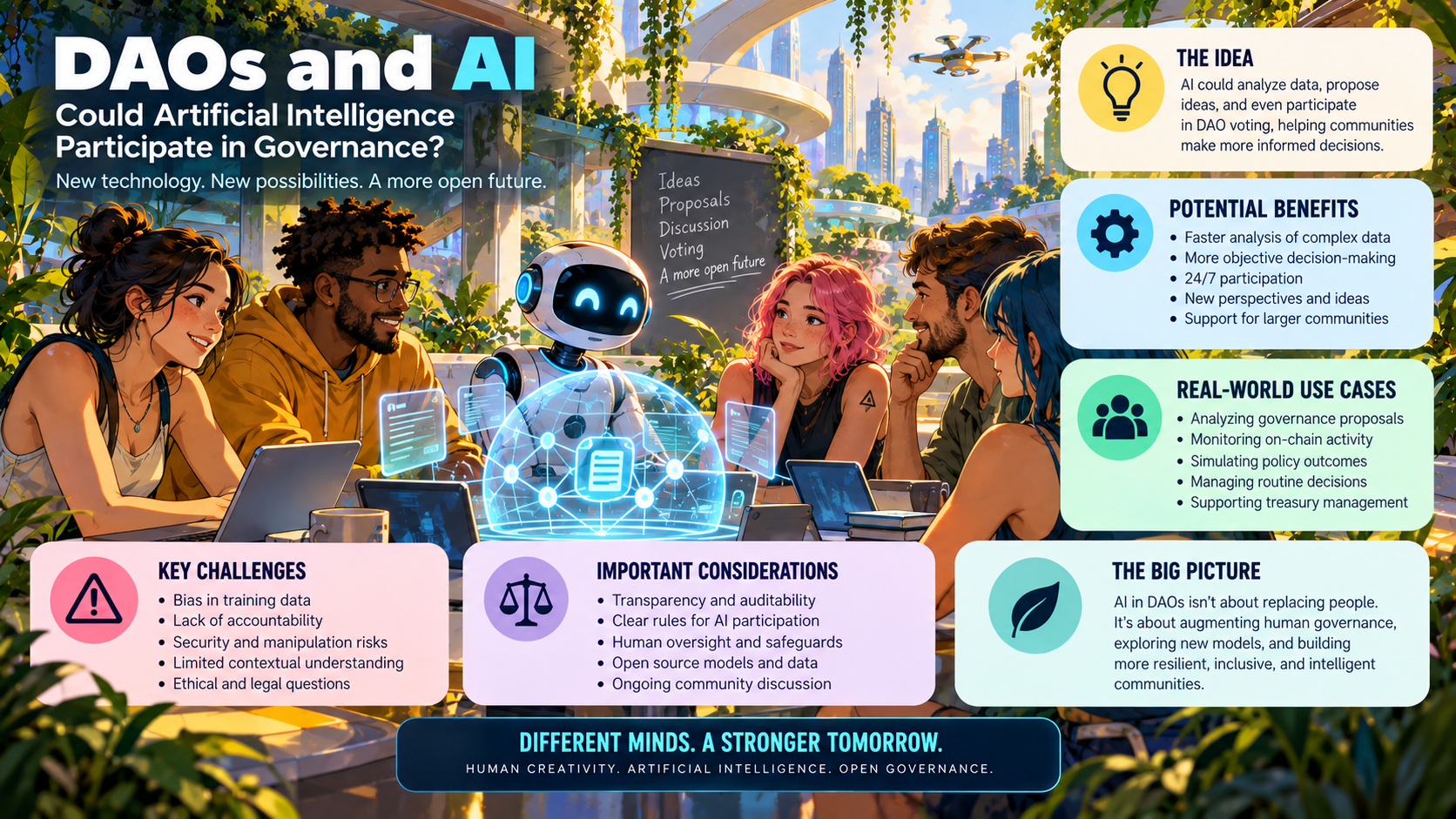
Decentralized autonomous organizations, or DAOs, were created to coordinate communities without relying on a traditional centralized management structure. Members can submit proposals, discuss ideas, vote, manage shared treasuries, and collectively decide how a project should develop. Artificial intelligence introduces another possibility: what if AI systems could participate in that governance process?
AI could potentially analyze proposals, summarize discussions, detect unusual voting activity, model the consequences of decisions, or even operate as an autonomous participant within predefined rules. This combination could make decentralized governance faster and more informed, but it also raises difficult questions about accountability, transparency, manipulation, and how much authority should ever be delegated to software.
What Is a DAO?
A decentralized autonomous organization is an internet-native organization whose rules and decision-making processes are often coordinated through blockchain technology.
Instead of a traditional company hierarchy where executives make most major decisions, DAOs can allow token holders, contributors, community members, or other participants to vote on proposals.
Depending on the DAO, governance decisions might include:
- How treasury funds should be spent
- Which developers or contributors should receive funding
- Changes to protocol parameters
- Partnerships with other projects
- Community grants
- Governance rules
- Product development priorities
- Changes to smart contracts
- Delegation of voting power
Some DAOs operate almost entirely through blockchain-based governance systems, while others combine on-chain voting with forums, Discord servers, working groups, multisignature wallets, and traditional organizational structures.
The word "autonomous" can therefore be somewhat misleading. Most DAOs still depend heavily on people.
Artificial intelligence could change that.
Where AI Could Enter DAO Governance
AI does not necessarily need voting power to participate in governance.
There are several levels at which artificial intelligence could become involved.
The simplest role would be assisting human participants. More advanced systems could perform governance tasks automatically, while highly autonomous systems might eventually become governance participants themselves.
These approaches involve very different levels of authority and risk.
AI Could Summarize Governance Proposals
Large DAOs can generate an enormous amount of information.
A single governance proposal might include:
- A detailed technical specification
- Hundreds of forum comments
- Financial projections
- Smart contract changes
- Community feedback
- Previous related proposals
- External research
Expecting every voter to read everything is unrealistic.
AI could summarize this information and provide participants with shorter explanations of what a proposal would change.
For example, an AI governance assistant could produce summaries such as:
Proposal: Increase validator rewards by 5%.
Potential benefits: May encourage additional validators to join the network.
Potential drawbacks: Increases token issuance and could affect inflation.
Previous related proposals: Similar adjustment rejected six months ago.
This could make governance more accessible, particularly for members who do not have the time or technical knowledge to analyze every proposal in detail.
However, summarization introduces its own risks.
The way information is summarized can influence how people understand a proposal. Important details could be omitted, misunderstood, or unintentionally framed in a particular way.
AI-generated summaries should therefore be treated as assistance rather than authoritative interpretations.
AI Could Analyze Governance Data
DAOs often generate large amounts of publicly available blockchain data.
Artificial intelligence could analyze this data and identify patterns that humans might overlook.
For example, an AI system could examine:
- Voting participation
- Token concentration
- Delegate behavior
- Treasury transactions
- Governance participation trends
- Proposal success rates
- Voting coalitions
- Changes in voter behavior
This could help communities understand how their governance systems actually function.
A DAO might discover that only a small number of wallets regularly participate in votes, for example, or that voting power is becoming increasingly concentrated.
AI could make these patterns easier to detect.
Detecting Suspicious Governance Activity
Governance systems can be targeted by attackers.
Potential attacks include:
- Vote buying
- Sybil attacks
- Flash-loan governance attacks
- Manipulation of delegates
- Coordinated voting campaigns
- Compromised wallets
- Malicious governance proposals
AI-based monitoring systems could attempt to detect unusual behavior.
For example, an AI system might flag a sudden movement of large amounts of governance tokens immediately before an important vote.
It could also identify voting behavior that differs significantly from historical patterns.
This would not automatically prove that an attack is happening, but it could alert community members to investigate.
AI Could Simulate the Effects of Proposals
Governance decisions can have complicated consequences.
Changing a lending protocol's collateral requirements, for example, could affect liquidity, borrowing behavior, liquidation risk, and revenue.
AI models could potentially simulate different scenarios before a proposal goes to a vote.
Instead of simply asking:
"Should we change this parameter?"
Participants could see several modeled outcomes.
For example:
Scenario A: Current parameters remain unchanged.
Scenario B: Collateral requirements decrease by 5%.
Scenario C: Collateral requirements decrease by 10%.
The model might then estimate how each scenario could affect protocol activity under different market conditions.
These simulations would not predict the future perfectly, but they could provide additional information for governance participants.
AI Governance Assistants
One of the most practical applications may be personal governance assistants.
A DAO member could configure an AI system to monitor governance activity and notify them when important proposals appear.
The assistant might:
- Track new proposals
- Summarize forum discussions
- Explain technical changes
- Compare proposals with previous decisions
- Identify deadlines
- Highlight controversial issues
- Track delegate activity
Someone participating in several DAOs could potentially use one interface to follow governance across many different communities.
This could significantly reduce the amount of time required to participate actively.
Could AI Become a DAO Delegate?
Many DAOs allow token holders to delegate their voting power to another participant.
Instead of voting on every proposal personally, users can choose someone they trust to vote on their behalf.
In theory, that delegate could eventually be an AI system.
A token holder might configure an AI delegate with instructions such as:
"Support proposals that reduce protocol risk unless they significantly increase token inflation."
The AI could then evaluate proposals according to those preferences.
Different AI delegates could follow different strategies.
Some might prioritize:
- Decentralization
- Security
- Growth
- Treasury preservation
- Privacy
- Environmental impact
- Developer funding
This concept effectively turns governance preferences into programmable policies.
Could AI Have Its Own Vote?
A more radical idea is allowing an AI system to participate as an independent governance actor.
An AI agent could potentially hold tokens, interact with smart contracts, submit proposals, participate in discussions, and vote.
Technically, parts of this are already possible.
Blockchain networks generally interact with cryptographic wallets rather than verifying whether the entity controlling the wallet is a human.
An automated software agent could therefore operate a blockchain wallet.
The more important question is not whether AI can participate.
It is whether DAOs should give autonomous AI systems meaningful governance power.
AI Agents Could Submit Governance Proposals
AI agents could also generate proposals automatically.
Imagine a decentralized lending protocol where an AI continuously monitors:
- Liquidity levels
- Market volatility
- Collateral ratios
- Borrowing demand
- Treasury reserves
If the system detects a potential problem, it might automatically submit a governance proposal suggesting a parameter adjustment.
Humans could then review and vote on the recommendation.
This would create something similar to an automated policy analyst working continuously for the DAO.
More advanced versions could potentially implement limited changes automatically when predefined conditions are met.
Machine-to-Machine Governance
AI participation becomes even more interesting when DAOs interact with other autonomous systems.
Future decentralized networks could include:
- AI agents
- Autonomous marketplaces
- Decentralized infrastructure networks
- Robotic systems
- Smart contracts
- Machine-operated wallets
Some governance decisions could eventually involve systems communicating and negotiating with each other.
For example, several decentralized infrastructure networks might automatically negotiate resource pricing or service agreements.
Governance could then become partially machine-to-machine.
Human participants would define the rules and boundaries while automated agents handled routine coordination.
The Problem of Accountability
The biggest challenge with AI governance may not be technical.
It may be accountability.
If an AI delegate makes a harmful decision, who is responsible?
Possible answers might include:
- The developer who created the model
- The person who deployed the AI agent
- The token holders who delegated votes to it
- The DAO that allowed AI delegates
- Nobody
Traditional organizations usually have identifiable decision-makers.
Autonomous systems make responsibility more complicated.
This becomes particularly important when governance decisions control large treasuries or critical infrastructure.
AI Models Can Make Mistakes
Artificial intelligence systems are not infallible.
They can:
- Misinterpret information
- Produce inaccurate conclusions
- Rely on incomplete data
- Generate incorrect explanations
- Reflect biases in training data
- Fail under unusual conditions
A governance system that treats AI recommendations as objective truth could therefore create serious risks.
AI should generally be treated as another source of analysis rather than an unquestionable authority.
Multiple models, independent audits, and human review could help reduce these risks.
Governance Manipulation Could Target AI
Humans would not be the only entities trying to influence governance.
Attackers could attempt to manipulate the AI systems themselves.
Potential techniques could include:
- Manipulating training data
- Feeding misleading information into governance discussions
- Prompt injection attacks
- Exploiting model vulnerabilities
- Creating fake community sentiment
- Coordinating automated accounts
If AI systems rely heavily on forum discussions or social media data, attackers could attempt to manipulate those information sources.
Governance security may therefore need to protect not only voting systems but also the information environments used by AI agents.
Transparency Becomes Essential
Traditional blockchain governance often emphasizes transparency.
Votes, transactions, and proposals may be publicly visible.
AI systems introduce another layer that may be much harder to inspect.
If an AI delegate votes against a proposal, community members may want to understand why.
Ideally, AI governance systems would provide:
- Clear decision criteria
- Explainable reasoning
- Data sources
- Model versions
- Governance rules
- Audit logs
Without transparency, an AI delegate could become a black box controlling significant voting power.
That would conflict with many of the principles decentralized governance attempts to promote.
Open Source AI Could Play an Important Role
Open source models may be especially relevant for DAO governance.
If a governance agent's software and configuration are publicly available, community members can inspect how it works.
They might be able to verify:
- What information the agent uses
- How decisions are evaluated
- Which rules influence votes
- Whether updates changed its behavior
This could make AI governance systems easier to audit.
However, open source code alone does not guarantee transparency. Large machine-learning models can still be extremely difficult to interpret.
AI Could Reduce Governance Fatigue
One persistent problem in DAOs is governance fatigue.
Participants may initially be enthusiastic about voting but gradually stop participating.
If dozens of proposals appear every month, reviewing each one can become exhausting.
AI could reduce that burden.
Instead of reading every proposal, participants might receive personalized summaries highlighting only the decisions most relevant to them.
An AI assistant could say:
"Three proposals were submitted this week. Two are routine treasury renewals. One proposes a significant change to governance voting thresholds."
The user could then focus their attention on the most important issue.
AI could therefore help increase meaningful participation without requiring people to spend hours following governance discussions.
AI Could Also Increase Centralization
There is also a contradictory possibility.
AI might make governance more efficient while simultaneously making it more centralized.
If most participants rely on the same AI provider to analyze proposals, that provider could gain enormous indirect influence.
Even without controlling any tokens, the system generating governance recommendations could shape how thousands of people vote.
A DAO could technically remain decentralized while depending heavily on a centralized AI service.
Communities may therefore want diversity among governance tools rather than allowing a single model to become the default source of information.
Human and AI Governance May Work Together
The most realistic future may not involve DAOs replacing human governance with artificial intelligence.
Instead, AI may become another layer of the governance process.
Humans could remain responsible for defining goals and values while AI systems handle data analysis, monitoring, simulation, and repetitive tasks.
A future governance process might look something like this:
- A community member submits a proposal.
- Several AI systems analyze the proposal.
- AI tools summarize technical and financial implications.
- Community members discuss the results.
- Simulation models test several potential outcomes.
- Delegates and token holders vote.
- Automated systems execute the approved decision.
In this model, AI supports governance without completely replacing human judgment.
AI Could Create New Types of DAOs
Artificial intelligence may eventually enable entirely new organizational structures.
Imagine a DAO where AI agents manage routine operations while humans focus on major strategic decisions.
An AI system could manage:
- Treasury accounting
- Grant applications
- Contributor payments
- Governance summaries
- Community analytics
- Risk monitoring
- Operational reporting
The DAO might effectively operate with a very small administrative team.
Another possibility is a DAO created specifically to govern an AI system.
Token holders or community members could vote on:
- Model updates
- Data sources
- Safety rules
- Usage policies
- Revenue distribution
- Infrastructure funding
AI and DAO governance could therefore work in both directions: AI could help govern DAOs, while DAOs could help govern AI systems.
The Question Is Not Simply Human vs AI
Discussions about artificial intelligence often frame the issue as humans being replaced by machines.
DAO governance may develop differently.
AI systems could become tools, advisors, delegates, monitors, analysts, or autonomous agents depending on how communities choose to design their governance.
The important questions will be about boundaries.
How much authority should an AI system receive?
Who defines its objectives?
Who can modify those objectives?
How transparent must its decisions be?
Can participants challenge or override them?
And who is responsible when something goes wrong?
A New Experiment in Digital Governance
DAOs are already experiments in how groups of people can coordinate online using blockchain technology.
Artificial intelligence introduces another layer to that experiment.
AI could help communities understand complex proposals, monitor governance activity, analyze large datasets, simulate decisions, and reduce the workload required to participate.
Eventually, autonomous agents might even hold voting power or submit proposals themselves.
That possibility could make decentralized organizations more efficient, but it could also introduce new forms of centralization, manipulation, and risk.
The most important development may therefore not be creating AI that governs independently.
It may be creating governance systems where humans and artificial intelligence can work together while keeping decision-making transparent, accountable, and under clearly defined rules.
As both DAO technology and AI agents continue to develop, decentralized governance may become one of the most interesting places to observe how humans and intelligent software learn to make collective decisions together.



Pick your reaction
Post your comment