

Crypto markets can offer significant opportunities, but they also come with considerable risk. Prices can move quickly, projects can fail, technologies can become outdated, and entire market sectors can fall out of favor. Diversification is one way investors try to manage these uncertainties.
Instead of depending on a single cryptocurrency, network, or type of investment, diversification spreads exposure across different assets and areas of the crypto ecosystem. It cannot eliminate risk or guarantee profits, but it can reduce the impact that one poorly performing investment has on an overall portfolio.
What Does Diversification Mean?
Diversification means spreading investments across multiple assets rather than concentrating everything in one place.
In traditional investing, someone might diversify across stocks, bonds, real estate, commodities, and other asset classes. Within crypto, the same principle can be applied by spreading exposure across different cryptocurrencies, blockchain networks, sectors, and investment strategies.
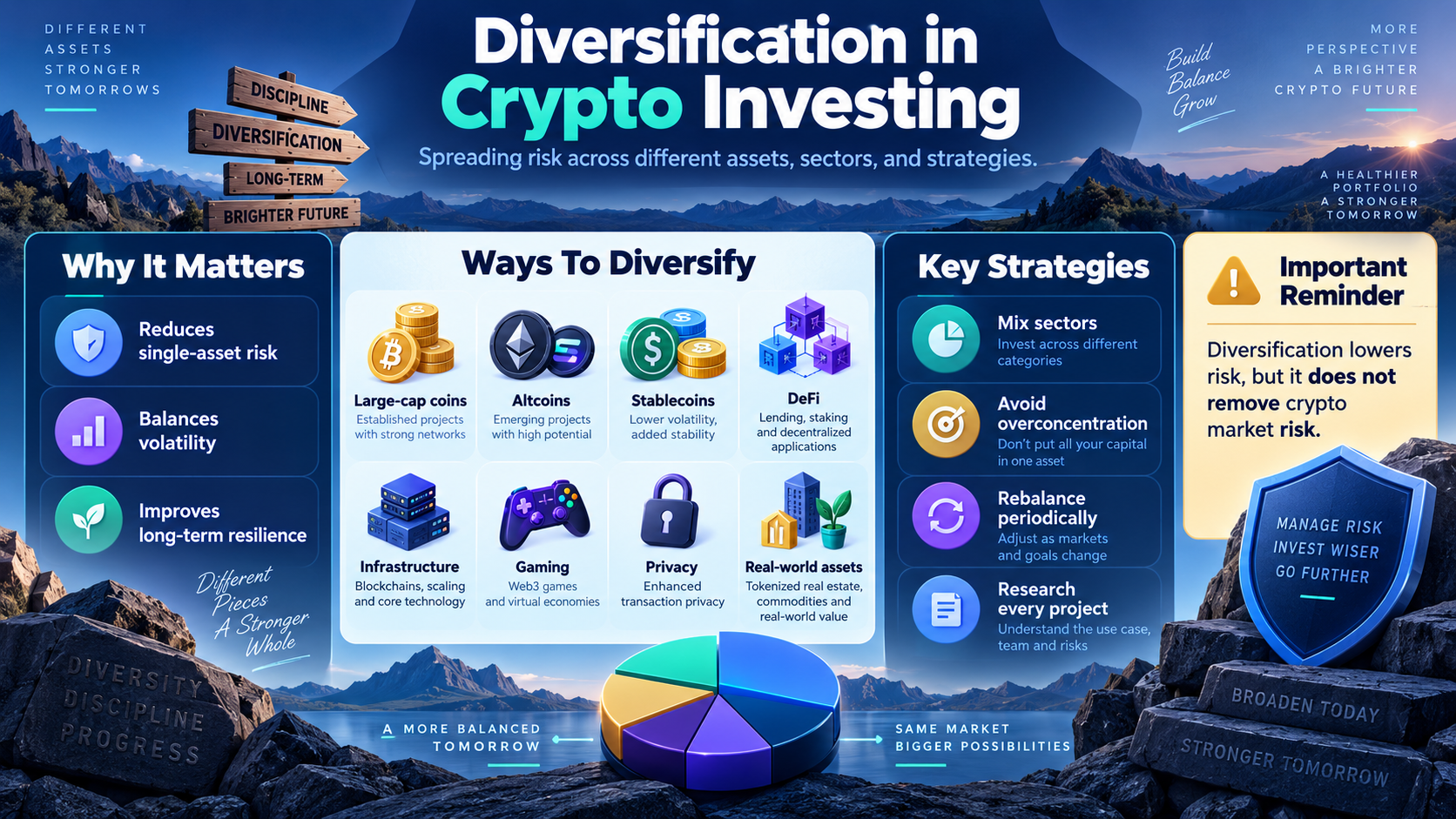
For example, a crypto portfolio could contain assets associated with:
- Payment networks
- Smart contract platforms
- Decentralized finance
- Infrastructure
- Decentralized physical infrastructure
- Privacy technologies
- Gaming
- Tokenized real-world assets
- Artificial intelligence and blockchain projects
- Stablecoins
The goal is not simply to own as many cryptocurrencies as possible. Effective diversification involves selecting assets that represent genuinely different sources of opportunity and risk.
Why Diversification Matters in Crypto
Cryptocurrency markets can be highly volatile. Even established projects can experience dramatic price declines, while smaller projects can lose most or all of their value.
A concentrated portfolio magnifies these risks.
Imagine someone invests their entire crypto allocation into one token. If that project suffers a major exploit, regulatory problem, development failure, or loss of community support, the investor's entire portfolio may be affected.
If the same investment were spread across several unrelated assets, a problem with one project would normally affect only part of the portfolio.
Diversification therefore aims to reduce dependence on any single outcome.
Diversification Does Not Mean Buying Random Coins
One common misconception is that owning many cryptocurrencies automatically creates a diversified portfolio.
It does not.
An investor could own 20 different tokens that are all connected to the same ecosystem or market narrative. If that sector experiences a downturn, all 20 assets could decline together.
Many cryptocurrencies are also highly correlated. During major market movements, large numbers of tokens can rise or fall simultaneously.
This means investors should think about what actually drives each investment rather than simply counting the number of tokens they own.
Diversifying Across Blockchain Networks
One way to diversify is by gaining exposure to different blockchain ecosystems.
Different networks make different technical and economic decisions regarding scalability, decentralization, fees, governance, privacy, smart contracts, and transaction processing.
An investor might therefore research projects operating across several independent blockchain networks rather than concentrating entirely on one ecosystem.
This can reduce exposure to problems that affect a particular network, such as:
- Technical failures
- Security vulnerabilities
- Network congestion
- Ecosystem decline
- Regulatory developments
- Developer migration
However, holding assets from several networks does not automatically remove broader crypto market risk.
Diversifying Across Crypto Sectors
The crypto industry contains many different sectors.
For example, decentralized finance focuses on financial services such as lending, trading, and liquidity. Gaming projects may focus on digital ownership and in-game economies. Infrastructure projects may provide data, storage, computing power, interoperability, or network services.
Other projects concentrate on payments, privacy, identity, artificial intelligence, social platforms, decentralized physical infrastructure, or tokenized real-world assets.
Spreading investments across different sectors can reduce dependence on a single market trend.
If interest in one sector declines, another may behave differently.
Large-Cap and Smaller Crypto Assets
Another form of diversification involves considering projects of different sizes and maturity levels.
Larger cryptocurrencies generally have more established markets, greater liquidity, and longer operating histories. Smaller projects may offer different growth opportunities but often come with substantially higher risk.
Smaller cryptocurrencies can suffer from:
- Limited liquidity
- Smaller development teams
- Lower adoption
- Greater price volatility
- Dependence on a small number of contributors
- Higher risk of abandonment
- Greater susceptibility to market manipulation
Some investors therefore combine more established assets with smaller speculative positions rather than treating every investment equally.
The appropriate balance depends on individual risk tolerance, research, financial circumstances, and investment objectives.
Stablecoins and Portfolio Management
Stablecoins can also play a role in crypto portfolio management.
Unlike most cryptocurrencies, stablecoins are designed to maintain a relatively stable value, usually relative to a currency such as the US dollar.
Investors sometimes hold stablecoins to maintain liquidity without immediately leaving the crypto ecosystem. They may also use them while waiting for new investment opportunities.
Stablecoins, however, have their own risks.
These can include:
- Issuer risk
- Reserve risk
- Smart contract vulnerabilities
- Depegging
- Regulatory changes
- Counterparty exposure
A stable price target should therefore not be confused with an absence of risk.
Diversification Outside Crypto
One of the most important aspects of diversification is sometimes overlooked: diversification does not have to stop at the edge of the crypto market.
Someone who owns 30 different cryptocurrencies may appear highly diversified within crypto while still having nearly all of their investment capital exposed to the same broader asset class.
Cryptocurrency markets can move together during major economic or financial events.
For this reason, broader diversification may include assets outside crypto, depending on someone's circumstances and investment strategy.
These could include traditional investments, savings, cash reserves, property, commodities, or other assets.
Crypto diversification and overall financial diversification are not necessarily the same thing.
Avoiding Excessive Concentration
Portfolio concentration happens when one investment represents a large percentage of the total portfolio.
This can happen intentionally, but it can also happen gradually.
For example, if one cryptocurrency rises significantly faster than everything else, it may eventually represent a much larger portion of the portfolio than originally intended.
An investor who started with a relatively balanced portfolio could therefore become heavily exposed to a single asset without purchasing any additional tokens.
Regularly reviewing portfolio allocations can help identify this kind of concentration.
Rebalancing a Crypto Portfolio
Rebalancing means adjusting a portfolio to restore a chosen allocation.
Suppose an investor initially decides that four assets should each represent 25% of a crypto portfolio.
After several months, one asset performs exceptionally well and grows to 50% of the portfolio.
The investor could choose to rebalance by reducing that position or increasing exposure to other assets.
Rebalancing can encourage investors to follow a predefined strategy rather than allowing short-term market movements to determine the structure of their portfolio.
It can also have tax and transaction-cost implications, so these factors should be considered before making changes.
Diversification by Investment Strategy
Investors can also diversify how they participate in the market.
Instead of relying entirely on one approach, some people combine different strategies.
Examples include:
- Long-term holding
- Periodic purchases
- Active trading
- Staking
- Providing liquidity
- Holding stablecoins
- Investing in different blockchain ecosystems
Each strategy introduces different risks.
Staking may involve validator, protocol, lock-up, or slashing risks. Providing liquidity can introduce smart contract risk and impermanent loss. Active trading creates additional exposure to timing mistakes, fees, and emotional decision-making.
Understanding these differences is essential before treating different strategies as diversification.
Diversification and Correlation
Correlation describes how closely two assets tend to move in relation to each other.
If two cryptocurrencies regularly rise and fall together, owning both may provide less diversification than expected.
Crypto assets often become highly correlated during major market events. When fear spreads across the market, investors may sell many different cryptocurrencies simultaneously regardless of the fundamentals of individual projects.
For this reason, diversification can reduce project-specific risk but cannot necessarily protect a portfolio from a broad crypto market downturn.
The Risk of Over-Diversification
Diversification can also be taken too far.
Owning a very large number of cryptocurrencies can make a portfolio difficult to manage.
Every project requires ongoing research. Investors may need to follow development activity, token economics, security incidents, governance proposals, regulatory developments, ecosystem changes, and major announcements.
Holding dozens or hundreds of tokens can make meaningful monitoring difficult.
Over-diversification may also result in many extremely small positions that have little effect on overall portfolio performance.
A diversified portfolio should still be understandable and manageable.
Research Still Matters
Diversification should never replace research.
Adding a low-quality project to a portfolio does not necessarily make the portfolio safer simply because it introduces another asset.
Before investing, it can be useful to investigate areas such as:
- The project's purpose
- Development activity
- Token distribution
- Token supply
- Security history
- Governance structure
- Network usage
- Liquidity
- Community activity
- Funding
- Competition
- Regulatory exposure
Understanding what makes each investment different is an important part of building meaningful diversification.
Communities Can Help With Research
Crypto communities can be valuable sources of information when researching different projects and ecosystems.
Developer communities, forums, Discord servers, Telegram groups, Reddit communities, YouTube channels, and other platforms can provide insight into current development, governance discussions, ecosystem activity, and community sentiment.
They can also expose investors to viewpoints that may challenge their existing assumptions.
However, community discussions should be treated as one source of information rather than unquestioned investment advice.
Some communities may strongly favor their own projects, and discussions can sometimes become dominated by hype or speculation.
Platforms such as BlockMap can help users discover crypto communities across different projects and sectors, making it easier to explore the wider ecosystem and conduct independent research.
Diversification Cannot Remove Crypto Risk
Diversification is a risk-management technique, not a guarantee.
A diversified crypto portfolio can still experience substantial losses during a major market decline.
It cannot protect investors from every possible event, including:
- Market-wide crashes
- Regulatory changes
- Exchange failures
- Stablecoin failures
- Smart contract exploits
- Economic downturns
- Liquidity crises
- Security breaches
Diversification primarily reduces the consequences of depending too heavily on one investment, project, network, or strategy.
Build a Portfolio You Understand
The purpose of diversification is not to collect as many tokens as possible.
It is to avoid unnecessary dependence on a small number of outcomes.
A thoughtful approach may involve considering different blockchain networks, sectors, project sizes, strategies, and potentially assets outside crypto. At the same time, every additional investment should have a clear reason for being included.
Crypto portfolios are easier to manage when investors understand what they own, why they own it, and which risks each investment introduces.
Diversification cannot make crypto investing risk-free, but it can help create a portfolio that is less dependent on any single project's success or failure.
Disclaimer: This article is for informational and educational purposes only and does not constitute financial or investment advice. Cryptocurrency investments involve significant risk, including the possibility of losing the entire amount invested. Always conduct your own research and consider your financial circumstances before making investment decisions.



Pick your reaction
Post your comment