

Blockchain networks are often described as permanent and unchangeable, but that does not mean the software running them stays the same forever. Like any complex technology, blockchains need to evolve. Developers discover bugs, new security techniques emerge, users demand better performance, and communities propose new features.
Upgrading a decentralized network, however, is very different from updating an ordinary website or application. There is usually no single administrator who can simply install a new version for everyone. Instead, developers, node operators, validators, miners, users, applications, and sometimes token holders must coordinate around changes to a shared protocol.
Understanding how blockchain upgrades work helps explain concepts such as hard forks, soft forks, protocol proposals, testnets, activation thresholds, and network governance.
Why Do Blockchain Networks Need Upgrades?
A blockchain protocol defines the rules that participants follow when communicating with the network. These rules determine how transactions are validated, how blocks are created, how consensus works, how fees are calculated, and what information can be stored on-chain.
Over time, those rules may need to change.
Networks may introduce upgrades to:
- Fix bugs or security vulnerabilities
- Improve transaction capacity
- Reduce fees or processing requirements
- Introduce new transaction types
- Improve privacy
- Change consensus mechanisms
- Add smart contract functionality
- Improve interoperability
- Make running nodes more efficient
- Prepare the protocol for future features
Some upgrades are small technical improvements. Others fundamentally change how a blockchain operates.
Because thousands of independent computers may be participating in the same network, changing these rules requires coordination.
Protocol Rules and Node Software
A blockchain network consists of many nodes running software that implements the network's protocol.
The protocol is the set of rules. The node software is the program that follows those rules.
When developers release a new version of node software, operators can decide whether to install it. Depending on the nature of the update, old and new versions may continue communicating normally, or the change may eventually create incompatible versions of the network.
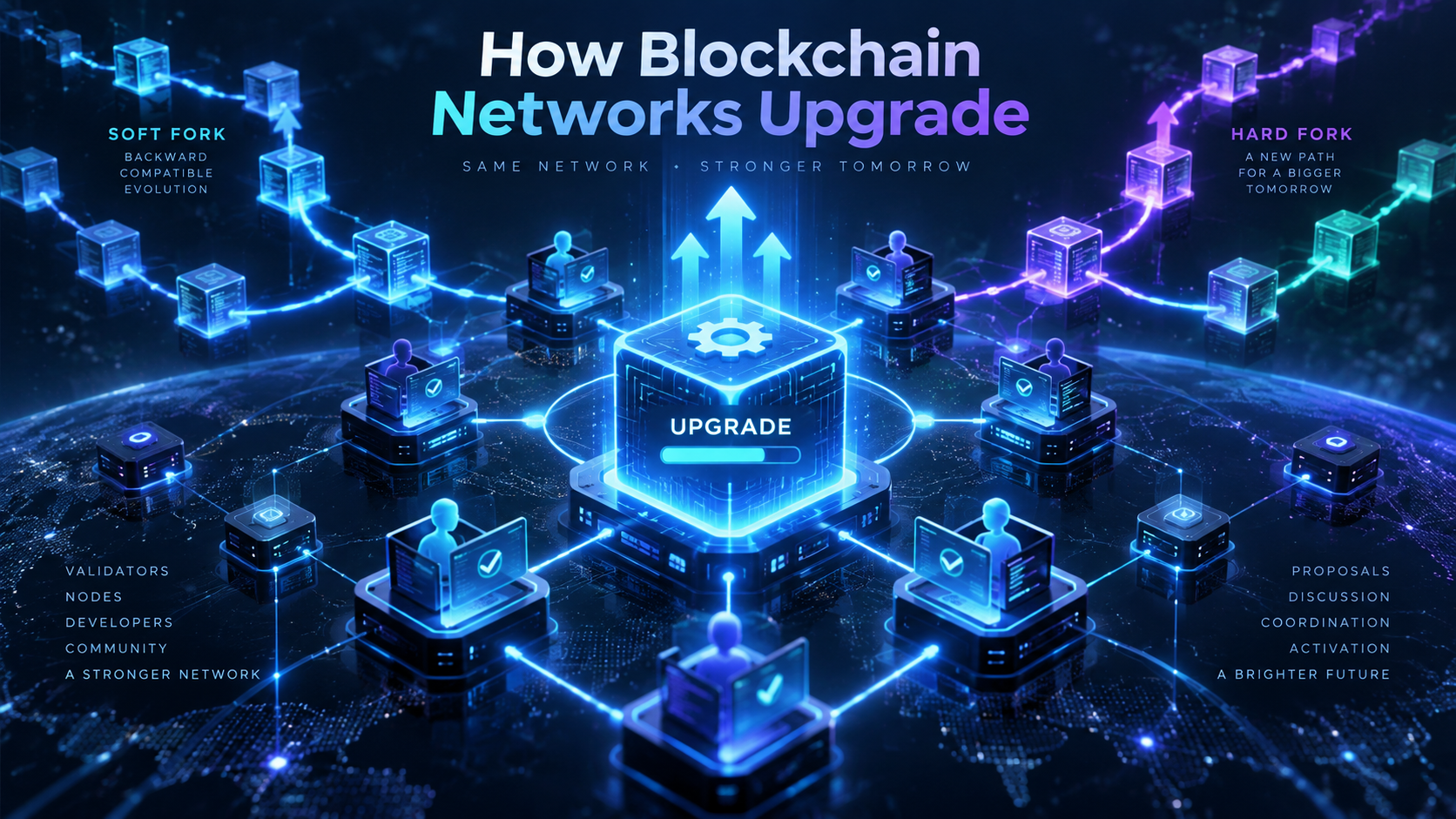
This distinction is one of the reasons blockchain upgrades are commonly described as either soft forks or hard forks.
What Is a Soft Fork?
A soft fork changes the protocol while remaining compatible with older versions under certain conditions.
New rules usually make validation requirements more restrictive. Nodes running older software may still recognize blocks created under the new rules because those blocks also satisfy the older rules.
Imagine that the original protocol allows blocks containing several different transaction formats. An upgrade might restrict which formats are permitted. Older nodes may still consider the new blocks valid because they fit within the broader original rules.
Soft forks can therefore allow networks to introduce changes without requiring every participant to upgrade simultaneously.
However, coordination is still important. Validators, miners, developers, exchanges, wallets, and other infrastructure providers may need to update their systems to fully understand or use the new functionality.
What Is a Hard Fork?
A hard fork introduces protocol rules that are not compatible with older versions.
Nodes using the old rules may reject blocks created under the new rules, while upgraded nodes may accept them.
If nearly everyone upgrades, the blockchain can continue as a single network using the new rules.
If a significant group decides not to upgrade, two separate networks can emerge.
Both networks may initially share the same blockchain history up to the point of divergence. After that point, they produce different blocks according to different rules.
This is why some blockchain networks that exist today share common historical origins.
A hard fork does not automatically mean that a permanent chain split will occur. Many hard forks are carefully planned protocol upgrades where most of the ecosystem agrees to move to the new version.
Who Decides That an Upgrade Should Happen?
There is no universal upgrade process across blockchain networks.
Different projects use different governance structures.
An upgrade may involve:
- Core protocol developers
- Independent development teams
- Validators or miners
- Node operators
- Token holders
- Foundations
- Ecosystem companies
- Application developers
- Community members
Some networks use formal on-chain governance systems where token holders or representatives vote directly on protocol changes.
Others rely primarily on off-chain coordination through developer discussions, technical proposals, community forums, meetings, and software adoption.
In many networks, developers can propose and implement software changes, but they cannot force independent node operators to install them.
Ultimately, protocol rules only become effective if enough of the relevant network participants adopt them.
Blockchain Improvement Proposals
Many blockchain ecosystems use formal proposal systems to document potential protocol changes.
A proposal typically explains:
- What should change
- Why the change is necessary
- How the change would work
- Technical implementation details
- Compatibility considerations
- Security implications
The proposal may then be reviewed publicly by developers and community members.
Bitcoin, Ethereum, and many other blockchain ecosystems use structured improvement proposal processes, although the terminology and procedures differ between networks.
A proposal does not necessarily mean that a feature will be implemented. Some proposals remain under discussion for years, while others are rejected or replaced by alternative approaches.
From an Idea to an Upgrade
A major blockchain upgrade usually passes through several stages.
1. Identifying a Problem or Opportunity
Someone identifies something that could be improved.
For example, developers may discover that transaction processing could become more efficient or that the network needs additional functionality.
2. Research and Discussion
Developers and researchers investigate possible solutions.
Technical discussions may happen through repositories, forums, community calls, conferences, mailing lists, or dedicated research channels.
Different solutions may compete before the community begins to converge on a preferred approach.
3. Writing a Formal Proposal
The proposed change may be documented through the network's improvement proposal process.
This gives other developers a precise technical specification to review.
4. Implementation
Developers implement the proposed changes in node software.
This stage may involve extensive code review and testing because mistakes in consensus software can have serious consequences.
5. Testnet Deployment
Before changing the main blockchain, upgrades are often deployed on test networks.
Testnets allow developers, validators, application teams, and infrastructure providers to experiment with the new rules without risking real assets on the main network.
Problems discovered during testing can be fixed before deployment.
6. Ecosystem Preparation
Wallet providers, exchanges, explorers, infrastructure services, smart contract developers, validators, and other participants may need to update their systems.
Major upgrades are usually announced well in advance so ecosystem participants have time to prepare.
7. Activation
The upgrade eventually becomes active.
Activation may happen at a predetermined:
- Block height
- Epoch
- Timestamp
- Validator threshold
- Miner signaling threshold
- Governance decision
Once the activation condition is reached, participating nodes begin enforcing the new rules.
Why Activation Mechanisms Matter
A blockchain cannot always introduce new consensus rules immediately after software is released.
Different node operators may install updates at different times.
Activation mechanisms provide a coordinated transition point.
For example, an upgrade might specify that new rules become active at block 10,000,000.
Nodes that already installed the software continue following the existing protocol until that block is reached. Once the activation block arrives, they begin enforcing the new rules simultaneously.
Other networks may require a percentage of validators or miners to signal support before activation occurs.
The exact mechanism depends on the blockchain's consensus and governance design.
What Happens If Nodes Do Not Upgrade?
The answer depends on the type of upgrade.
For ordinary software improvements that do not change consensus rules, an older node might continue functioning, although it may lack newer features or security improvements.
For consensus changes, the consequences can be more significant.
An outdated node may:
- Reject blocks that the upgraded network considers valid
- Accept blocks that upgraded nodes reject
- Stop following the main chain
- Lose access to certain network functionality
- Become vulnerable to previously fixed bugs
Node operators therefore need to pay attention to upgrade announcements, particularly when an update changes consensus rules.
Validators and Miners Play an Important Role
Consensus participants are especially important during upgrades.
In proof-of-work systems, miners produce blocks.
In proof-of-stake systems, validators typically propose and attest to blocks.
If consensus participants run incompatible software, network disruption may occur.
For this reason, major upgrades often involve coordination with mining pools, validator operators, staking providers, infrastructure companies, and exchanges.
A network may technically have thousands of nodes, but consensus participants can have a particularly important role when determining which chain continues producing valid blocks.
Developers Cannot Always Control the Network
One of the unusual characteristics of decentralized blockchain development is that writing software does not automatically give developers control over the network.
Developers can publish a new client version containing different rules.
But independent participants still decide whether to run it.
If node operators, validators, miners, exchanges, and users reject the change, the proposed rules may fail to gain adoption.
This creates an important distinction between developing protocol software and governing an active decentralized network.
The influence of developers can still be substantial, particularly when technical expertise is concentrated among a relatively small number of contributors. However, implementation, adoption, economic incentives, and community support all contribute to the outcome of major protocol changes.
What Role Do Exchanges and Wallets Play?
Exchanges and wallet providers do not usually determine protocol rules directly, but they can become important during major upgrades.
Exchanges may temporarily pause deposits and withdrawals around an upgrade to reduce operational risks.
Wallet providers may need to update transaction formats, fee calculations, address handling, or other network interactions.
If a chain splits, exchanges may also need to decide how they will identify, list, or support the resulting assets.
Application developers face similar challenges. Smart contracts, bridges, explorers, decentralized applications, and infrastructure services may all require testing before an upgrade becomes active.
Upgrading Smart Contract Platforms
Upgrades can be particularly complex on smart contract networks.
Thousands of applications may rely on specific network behavior.
Changing transaction costs, execution rules, cryptographic functions, or virtual machine behavior can potentially affect existing applications.
Developers therefore need to consider backward compatibility carefully.
Network upgrades may introduce new functionality while attempting to preserve the behavior expected by existing smart contracts.
This is one reason major protocol changes often undergo long testing and review periods.
Can Blockchain Upgrades Change Monetary Policy?
In some networks, yes.
Protocol upgrades can potentially change rules related to:
- Block rewards
- Validator rewards
- Token issuance
- Fee distribution
- Token burning
- Supply schedules
Such changes can be particularly controversial because they directly affect economic incentives.
Different stakeholders may have very different interests.
Validators might focus on network rewards, users might care about transaction costs, token holders may focus on supply dynamics, and developers may prioritize long-term protocol sustainability.
Economic changes therefore often receive extensive discussion before implementation.
Emergency Upgrades
Not every upgrade can be planned months in advance.
Occasionally, developers discover critical vulnerabilities that require rapid action.
In these situations, development teams may release emergency software updates and encourage node operators to upgrade quickly.
Details about severe vulnerabilities may sometimes be temporarily withheld until enough network participants have installed the fix. Publishing exploit details too early could give attackers an opportunity to target nodes that have not yet upgraded.
Emergency coordination demonstrates an important reality of blockchain systems: decentralization does not eliminate the need for communication and cooperation.
Upgrades Can Be Technically Successful but Socially Controversial
Blockchain governance includes both technical and social elements.
Developers may agree that a proposed feature works correctly while community members disagree about whether the network should adopt it.
Debates can involve questions such as:
- Should old behavior remain compatible?
- Who benefits from the change?
- Does the upgrade alter the network's original goals?
- Does it increase hardware requirements?
- Does it introduce new trust assumptions?
- Does it affect decentralization?
- Should economic rules be changed?
There is rarely a purely technical answer to every governance question.
A protocol can specify how nodes reach consensus, but it cannot completely automate how communities decide which rules they want the protocol to contain.
Network Splits Are Part of Decentralized Governance
Chain splits are sometimes described purely as technical failures, but they can also represent disagreement within a decentralized ecosystem.
If two groups strongly prefer different rules, both may choose to maintain their own version of the blockchain.
From a technical perspective, each chain can continue operating independently if it has enough users, developers, infrastructure, and consensus participants.
Market participants then decide whether either or both networks remain economically relevant.
This possibility gives decentralized participants an unusual option: rather than forcing everyone to accept a single decision, incompatible groups can sometimes continue under different protocol rules.
Testnets Make Safer Upgrades Possible
Test networks are one of the most important tools for blockchain development.
A testnet behaves similarly to the main network but uses tokens without significant economic value.
Developers can use testnets to simulate:
- Protocol upgrades
- Validator behavior
- Smart contract interactions
- Network congestion
- New transaction formats
- Consensus changes
Large upgrades may also go through multiple temporary test networks before reaching the main blockchain.
Even extensive testing cannot guarantee that every problem will be discovered, but it significantly reduces the risk of introducing unexpected behavior directly into a live network.
Client Diversity Can Make Upgrades More Complicated
Some blockchain networks have multiple independent software clients implementing the same protocol.
Client diversity can improve resilience because the entire network does not rely on a single codebase.
However, it also creates additional coordination challenges.
Every client must interpret the protocol rules consistently.
If one client implements an upgrade differently from another, nodes could disagree about which blocks are valid.
This is why protocol specifications, testing frameworks, interoperability tests, and coordinated releases can be extremely important.
Upgrades Show That Blockchains Are Not Static
The data recorded in a blockchain may be designed to resist alteration, but the protocol itself can evolve.
This distinction is important.
Immutability generally refers to the difficulty of rewriting previously confirmed blockchain history. It does not mean that the community can never change the rules governing future blocks.
A blockchain that could never upgrade would struggle to respond to security discoveries, technological improvements, or changing user requirements.
Successful networks therefore need to balance two goals:
stability and evolution.
Users need confidence that protocol rules will not change unpredictably, while developers need enough flexibility to improve the system when necessary.
Why Blockchain Upgrades Matter
Blockchain upgrades reveal one of the most interesting aspects of decentralized technology.
A network is not simply software running on computers. It is also a coordination system involving developers, node operators, validators, miners, businesses, applications, and users.
Changing the protocol means convincing enough independent participants to follow new rules without disrupting the shared network.
Soft forks, hard forks, governance proposals, testnets, activation mechanisms, and client updates are all tools that help make this possible.
Understanding these processes makes it easier to follow major blockchain developments. When a project announces a protocol upgrade, the important questions are not only what new feature is being introduced, but also how the change will be tested, activated, adopted, and coordinated across the wider ecosystem.
Blockchain networks may be designed to preserve their history, but their future is continuously being built.



Pick your reaction
Post your comment