

Finding a new crypto project is easier than ever. Every day, hundreds of new tokens, blockchain platforms, NFT collections, AI projects, and DeFi protocols compete for attention across social media, Discord, Telegram, Reddit, and other online communities. While many are built by passionate teams with genuine long-term goals, others exist only to capitalize on hype or deceive newcomers.
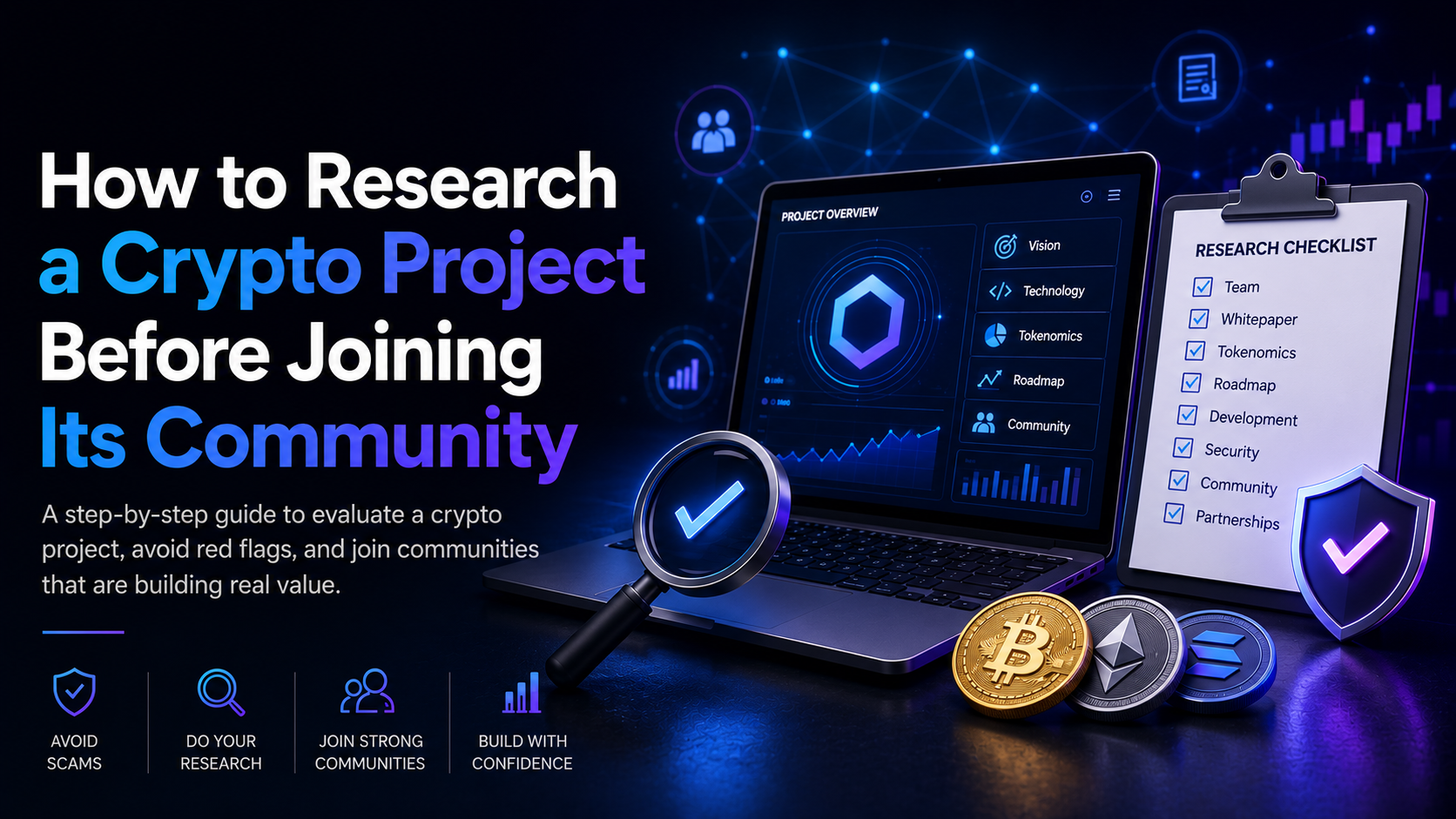
Before joining a community or investing your time and money, it's worth spending a little time researching the project itself. Good research helps you identify legitimate projects, avoid unnecessary risks, and find communities that match your interests. Here are the most important areas to examine before becoming part of any crypto ecosystem.
Start with the Official Website
The project's official website is usually your first stop. A professional website alone does not guarantee legitimacy, but it provides valuable insight into how seriously the project presents itself.
Look for clear explanations of:
- What problem the project solves
- How the technology works
- Why blockchain is necessary
- Who the intended users are
- What makes the project different from competitors
Be cautious if the website focuses almost entirely on price predictions, unrealistic profit claims, or exaggerated marketing language without explaining the underlying product.
Good projects usually invest considerable effort into documentation, educational content, and transparency.
Read the Whitepaper
Many blockchain projects publish a whitepaper that explains their vision, technical design, token economics, and roadmap.
You don't need to understand every technical detail. Instead, ask questions such as:
- Is the document well written?
- Does it explain the project's purpose clearly?
- Are goals realistic?
- Does it discuss challenges and limitations?
- Is there a practical use case?
If the whitepaper contains mostly buzzwords without meaningful explanations, that should raise questions.
Research the Development Team
Knowing who is building the project can provide important context.
Look for information about:
- Founders
- Developers
- Advisors
- Company background
- Previous blockchain experience
Anonymous teams are not automatically suspicious. Several successful crypto projects began with anonymous founders. However, anonymous teams require a higher level of trust because accountability is more limited.
If team members are public, verify that they have genuine professional histories instead of recently created social media profiles with little activity.
Check Development Activity
Most open-source crypto projects publish their code on platforms like GitHub.
Even if you are not a developer, you can still observe useful indicators:
- Recent code updates
- Active contributors
- Frequent commits
- Open discussions
- Bug fixes
- Feature development
An abandoned repository or one with little genuine activity may indicate that development has slowed significantly.
Keep in mind that some commercial projects keep portions of their code private, so this should only be one factor among many.
Understand the Tokenomics
If the project has its own cryptocurrency, examine how the token works.
Important questions include:
- What is the token used for?
- What is the maximum supply?
- How are new tokens created?
- How much is allocated to the team?
- Are there investor lockup periods?
- Is there a clear distribution plan?
Poor tokenomics can create long-term selling pressure or concentrate too much power among a small number of holders.
A sustainable token model usually aligns incentives between developers, investors, and community members.
Review the Roadmap
Every project makes promises. A roadmap helps determine whether those promises are realistic.
Look for:
- Clear milestones
- Achieved objectives
- Development progress
- Upcoming releases
- Transparent delays
Be cautious if the roadmap promises revolutionary technology every few months without showing completed work.
Reliable teams usually communicate delays openly rather than pretending everything is always on schedule.
Explore the Community
A project's community often reflects its overall health.
Visit its:
- Discord server
- Telegram group
- Reddit community
- X account
- Forum
- Livestreams
Observe conversations before participating.
Healthy communities usually include:
- Helpful discussions
- Technical support
- Constructive criticism
- Regular announcements
- Active moderators
- Genuine user questions
Communities filled entirely with "When moon?", constant price speculation, referral links, or spam may indicate weak long-term engagement.
Watch How the Team Communicates
Transparency is one of the strongest indicators of a trustworthy project.
Pay attention to whether the team:
- Publishes regular updates
- Explains technical decisions
- Admits mistakes
- Answers difficult questions
- Communicates during market downturns
Projects that disappear during difficult periods or avoid legitimate criticism should be approached carefully.
Strong communication builds trust even when progress is slower than expected.
Look for Independent Reviews
Don't rely only on information published by the project itself.
Read opinions from:
- Independent researchers
- Blockchain analysts
- Security companies
- Developers
- Community members
Remember that every source has potential biases.
Influencers may receive sponsorships.
Community members may already own the token.
Critics may misunderstand the technology.
Comparing multiple viewpoints provides a more balanced picture.
Check for Security Audits
Projects handling user funds should take security seriously.
Look for:
- Smart contract audits
- Public audit reports
- Bug bounty programs
- Security documentation
- Responsible disclosure policies
An audit does not guarantee that software is free from vulnerabilities, but it demonstrates that the team has invested effort into reviewing its code.
Projects that ignore security entirely deserve additional caution.
Examine Partnerships Carefully
Many projects advertise partnerships to appear more credible.
Verify whether those partnerships are genuine.
Questions to ask include:
- Has the partner publicly confirmed the relationship?
- Is it a technical integration or simply marketing?
- Does the partnership provide real value?
Some projects exaggerate minor collaborations to make themselves appear larger than they really are.
Watch Out for Red Flags
No single warning sign proves a project is fraudulent, but multiple red flags deserve attention.
Examples include:
- Guaranteed investment returns
- Pressure to buy immediately
- Secret investment opportunities
- Unrealistic roadmaps
- Fake partnerships
- Copied whitepapers
- Hidden team information
- Poor communication
- Disabled community discussions
- Excessive focus on token price instead of product development
Whenever something feels rushed or overly promotional, take additional time to research.
Understand That Every Project Carries Risk
Even well-managed blockchain projects can fail.
Markets change.
Regulations evolve.
Competitors emerge.
Technology develops rapidly.
Research reduces uncertainty, but it cannot eliminate risk entirely.
Joining a community should be based on curiosity, shared interests, and confidence in the project's long-term vision rather than fear of missing out.
Continue Learning After Joining
Research should not stop once you become a community member.
Continue following:
- Development updates
- Governance proposals
- Security announcements
- Community discussions
- Financial reports
- Ecosystem growth
The crypto industry evolves quickly, and informed community members make better long-term decisions.
Conclusion
Joining a crypto community can be an excellent way to learn, collaborate, and discover innovative technologies. However, taking the time to research a project beforehand can make a significant difference. By reviewing the team, technology, tokenomics, roadmap, development activity, security practices, and community culture, you gain a clearer understanding of whether a project deserves your attention.
No checklist can guarantee success, but careful research greatly improves your ability to identify legitimate projects and avoid common pitfalls. In crypto, informed decisions are almost always better than impulsive ones, and the strongest communities are built by members who value knowledge as much as enthusiasm.



Pick your reaction
Post your comment