

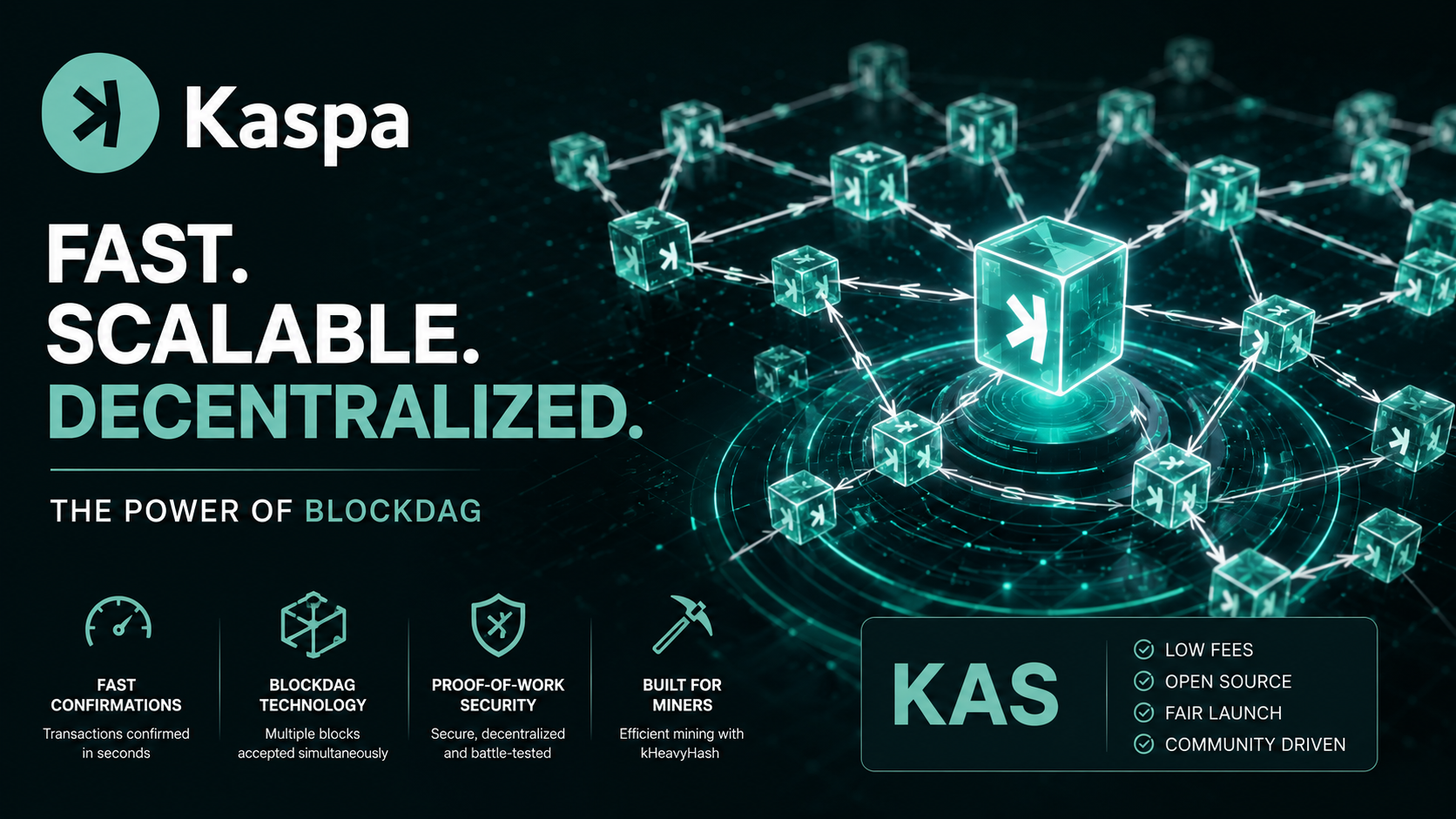
Kaspa is a Layer 1 blockchain designed to achieve fast transaction confirmations without sacrificing decentralization or security. Unlike traditional blockchains that produce one block at a time, Kaspa uses a unique BlockDAG (Directed Acyclic Graph) architecture that allows multiple blocks to be created and confirmed simultaneously.
This innovative approach enables high throughput, low confirmation times, and a smooth user experience while maintaining Proof-of-Work consensus.
What Is Kaspa?
Kaspa is an open-source cryptocurrency network that launched in 2021 with the goal of solving one of blockchain's biggest challenges: improving scalability without compromising decentralization or security.
Most blockchains organize transactions into a single chain of blocks. When two miners produce blocks at nearly the same time, one of those blocks is often discarded as an orphan. Kaspa takes a different approach by organizing blocks into a Directed Acyclic Graph (DAG), allowing multiple blocks to coexist and become part of the network history.
This technology is known as BlockDAG. Rather than rejecting simultaneously mined blocks, Kaspa processes them together, increasing network efficiency while preserving the security benefits of Proof-of-Work mining.
The native cryptocurrency of the network is KAS, which is used for transaction fees, payments, and rewarding miners.
How Does Kaspa Work?
Kaspa relies on an advanced consensus protocol called GHOSTDAG, an evolution of the earlier PHANTOM protocol developed from academic research.
Instead of selecting only one valid block every few seconds or minutes, GHOSTDAG orders multiple parallel blocks into a consistent history. This significantly increases the number of transactions the network can process while maintaining security.
The process works like this:
- Users broadcast transactions.
- Miners include those transactions in newly mined blocks.
- Multiple blocks can be mined simultaneously.
- GHOSTDAG orders those blocks instead of discarding competing ones.
- Transactions receive confirmations within seconds.
Because fewer blocks are wasted, Kaspa can achieve much faster confirmations than many traditional Proof-of-Work blockchains.
What Makes Kaspa Different?
Kaspa introduces several innovations that distinguish it from many existing blockchain networks.
BlockDAG Instead of a Single Chain
Traditional blockchains process blocks sequentially.
Kaspa allows many blocks to exist simultaneously, dramatically increasing throughput while reducing network congestion.
Fast Confirmations
Transactions are typically visible almost immediately and receive confirmations within seconds rather than minutes.
This makes Kaspa attractive for everyday payments and applications that require quick settlement.
Proof-of-Work Security
Unlike many modern networks that use Proof-of-Stake, Kaspa continues to rely on Proof-of-Work mining.
Its consensus mechanism has been optimized to support high-speed block production while maintaining the strong security model associated with PoW systems.
Fair Launch
Kaspa had no premine, no initial coin offering (ICO), and no allocation of tokens to venture capital firms before launch.
Coins entered circulation through public mining from day one, making the distribution more decentralized than many newer cryptocurrency projects.
Open-Source Development
The project is maintained by an active community of developers, researchers, miners, and contributors.
Its code is publicly available, allowing anyone to inspect, improve, or build upon the protocol.
The KAS Cryptocurrency
KAS is the native digital asset of the Kaspa network.
It serves several important purposes:
- Paying transaction fees
- Rewarding miners
- Transferring value globally
- Supporting future ecosystem applications
Kaspa uses a unique emission schedule known as the chromatic phase, where block rewards decrease gradually every month instead of dropping sharply every few years like Bitcoin's halving model.
This creates a smoother and more predictable reduction in new coin issuance.
Mining Kaspa
Kaspa uses the kHeavyHash mining algorithm, which was designed to be energy efficient while still benefiting from specialized mining hardware.
Initially, many users mined Kaspa using GPUs. As the network grew, ASIC miners optimized for kHeavyHash became available, increasing network security and hash rate.
Mining remains permissionless, allowing anyone with compatible hardware to participate.
Speed and Scalability
One of Kaspa's biggest strengths is transaction speed.
The network currently produces blocks at a very high frequency, resulting in near-instant transaction propagation and rapid confirmations.
Because BlockDAG accepts parallel blocks, increasing throughput does not require sacrificing decentralization in the same way that simply increasing block sizes often does.
Developers continue researching improvements that could further increase performance in future protocol upgrades.
Security
Kaspa inherits many security properties from traditional Proof-of-Work systems while reducing inefficiencies caused by orphaned blocks.
Its GHOSTDAG consensus algorithm has been extensively studied and is based on years of academic research into scalable PoW consensus.
The decentralized mining model also helps reduce reliance on trusted validators or staking systems.
Kaspa Ecosystem
Although younger than many established blockchain platforms, Kaspa's ecosystem continues to grow.
Community projects include:
- Wallet applications
- Mining software
- Block explorers
- Exchanges
- Developer tools
- Community websites
- Educational resources
- Payment integrations
As adoption increases, additional services and decentralized applications continue to emerge.
Advantages of Kaspa
Kaspa offers several notable benefits:
- Extremely fast confirmations
- Innovative BlockDAG architecture
- Strong Proof-of-Work security
- Fair launch with no premine
- Low transaction fees
- Active open-source community
- Efficient block processing
- Scalable network design
These characteristics make Kaspa appealing to users who value speed, decentralization, and transparent token distribution.
Things to Consider
Like every cryptocurrency project, Kaspa also has challenges.
Its ecosystem is still developing compared to older networks such as Bitcoin or Ethereum.
The long-term adoption of BlockDAG technology remains an area to watch, and continued developer activity will be important for expanding applications, infrastructure, and integrations.
Competition among scalable Layer 1 networks is also intense, with many projects pursuing different technical approaches.
Where Is Kaspa Used?
Kaspa is used around the world for:
- Peer-to-peer payments
- Cryptocurrency trading
- Mining
- Long-term investing
- Community projects
- Merchant payments
- Blockchain research
- Developer experimentation
As more wallets, exchanges, and payment providers support KAS, the network's practical use cases continue to expand.
The Kaspa Community
Kaspa has built a highly active global community across social media platforms, forums, Discord servers, Telegram groups, GitHub, and educational websites.
Community members contribute software, create learning resources, organize discussions, and help newcomers understand the technology. This open and collaborative environment has played a significant role in the project's growth and adoption.
Final Thoughts
Kaspa introduces a fresh approach to blockchain scalability through its BlockDAG architecture and GHOSTDAG consensus protocol. By allowing multiple blocks to be processed simultaneously, it delivers fast confirmations while preserving the decentralization and security associated with Proof-of-Work.
With its fair launch, active community, innovative technology, and growing ecosystem, Kaspa has established itself as one of the more distinctive Layer 1 blockchain projects. As development continues and adoption grows, it will be interesting to see how BlockDAG technology shapes the future of decentralized networks.



Pick your reaction
Post your comment