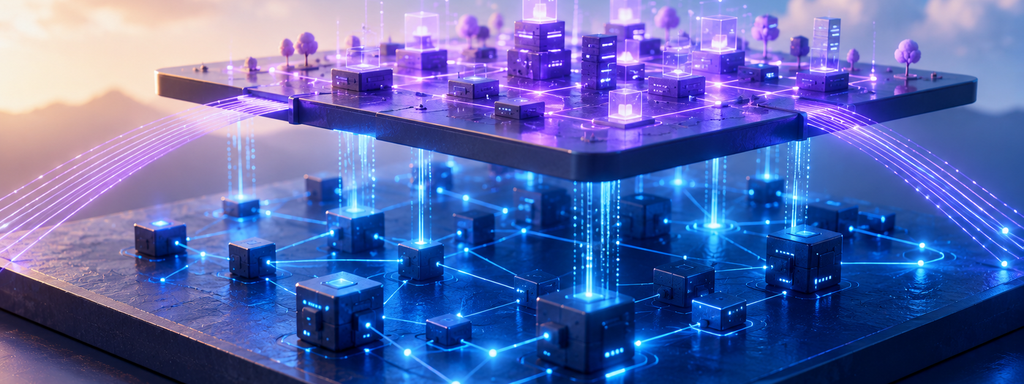

Blockchain networks are designed to let people transfer value, run applications, and interact with digital assets without relying on a central authority. But as more people use a blockchain, the network can face an important challenge: how can it process more activity without becoming slow, expensive, or overly centralized?
Two terms frequently appear in discussions about blockchain scalability: Layer 1 and Layer 2. Layer 1 refers to the underlying blockchain itself, while Layer 2 refers to additional systems built on top of a blockchain to increase capacity or improve efficiency.
Understanding the difference helps explain how blockchain ecosystems scale, why transaction fees can vary dramatically, and why users increasingly interact with networks that extend beyond the base blockchain.
What Is a Layer 1 Blockchain?
A Layer 1 blockchain, often called an L1, is the base blockchain network. It provides the fundamental infrastructure responsible for recording transactions, reaching consensus, maintaining security, and defining the rules of the network.
Examples of Layer 1 blockchains include:
- Bitcoin
- Ethereum
- Nano
- Solana
- Cardano
- Avalanche
- BNB Smart Chain
- Algorand
- NEAR Protocol
Each Layer 1 operates according to its own protocol and has its own approach to consensus, transaction processing, security, and decentralization.
When someone sends Bitcoin directly on the Bitcoin network, for example, the transaction is processed and recorded by Bitcoin's Layer 1 blockchain.
The same principle applies when someone performs a transaction directly on Ethereum. Validators process the transaction according to Ethereum's protocol, and the resulting data becomes part of Ethereum's blockchain history.
What Does Layer 1 Handle?
Layer 1 is responsible for the core functions that allow a blockchain to operate.
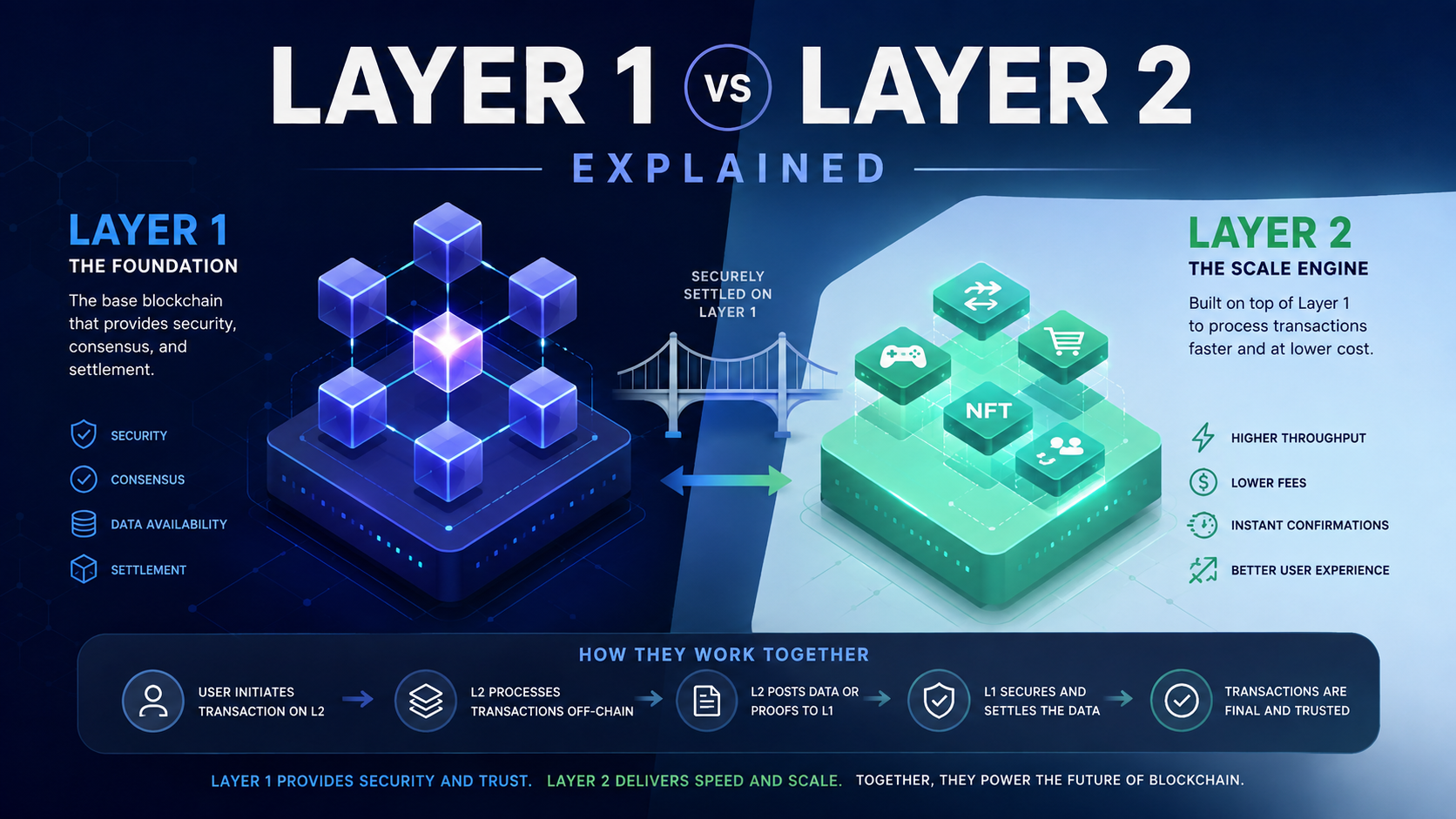
These typically include consensus, which determines how participants agree on the state of the network; security, which protects the blockchain against attacks and invalid transactions; data availability, which ensures that necessary blockchain data can be accessed and verified; and transaction settlement, which establishes the authoritative state of transactions.
Depending on the blockchain, Layer 1 may also support smart contracts, tokens, decentralized applications, NFTs, governance systems, and other functionality.
Because these responsibilities are fundamental to the network, changing a Layer 1 protocol can be complicated. Major changes often require coordination among developers, validators, node operators, users, and other ecosystem participants.
The Scalability Problem
One of the biggest challenges facing Layer 1 networks is scalability.
A blockchain has limited resources. Blocks have limited capacity, transactions require computation, and thousands of independent participants may need to verify the network's state.
When demand exceeds available capacity, users may compete to have their transactions processed. On networks with fee markets, this can cause transaction fees to rise significantly.
Simply increasing capacity is not always straightforward.
For example, increasing block sizes or hardware requirements might allow a blockchain to process more transactions. However, if operating a node becomes significantly more expensive, fewer people may be able to participate independently.
This tension is closely related to what is commonly known as the blockchain scalability trilemma: the challenge of balancing scalability, security, and decentralization.
Different Layer 1 networks make different trade-offs between these goals.
How Layer 1 Networks Can Scale
Layer 1 blockchains can improve scalability by modifying the underlying protocol.
One approach is increasing the amount of data or computation that can be processed within a given period. Another is improving the efficiency of consensus mechanisms or transaction execution.
Some networks also explore techniques such as sharding, where certain responsibilities are divided across multiple parts of the network rather than requiring every participant to process everything in exactly the same way.
Layer 1 improvements can provide substantial benefits because they affect the base network itself. However, upgrading a decentralized blockchain can be technically difficult and may require broad ecosystem coordination.
This is one reason Layer 2 solutions have become increasingly important.
What Is Layer 2?
A Layer 2, or L2, is a system built on top of a Layer 1 blockchain that processes activity outside the base layer while maintaining some form of connection to it.
Instead of requiring every individual transaction to be handled entirely by Layer 1, a Layer 2 can process many transactions separately and then submit relevant information or results back to the underlying blockchain.
The basic idea is simple:
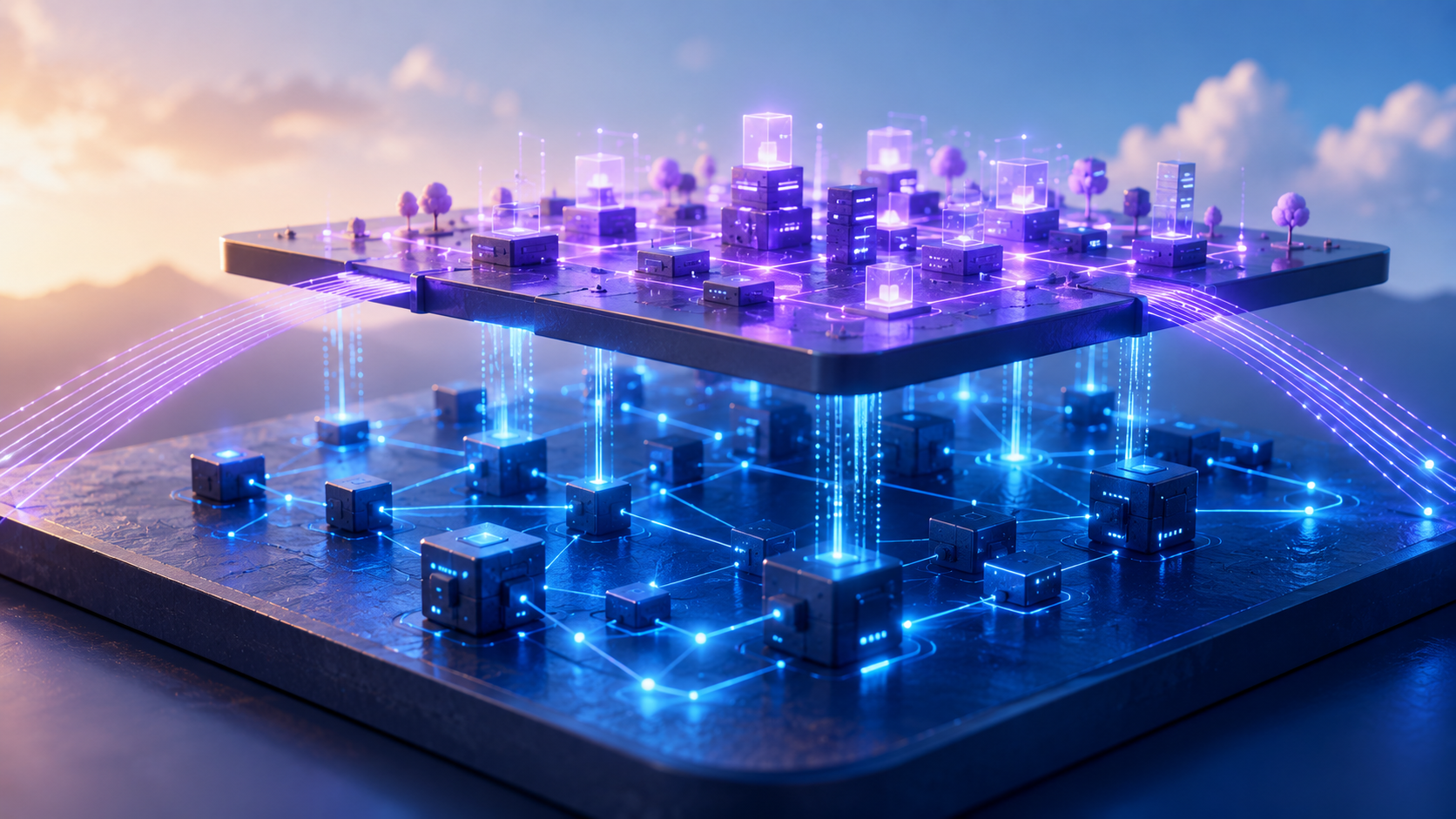
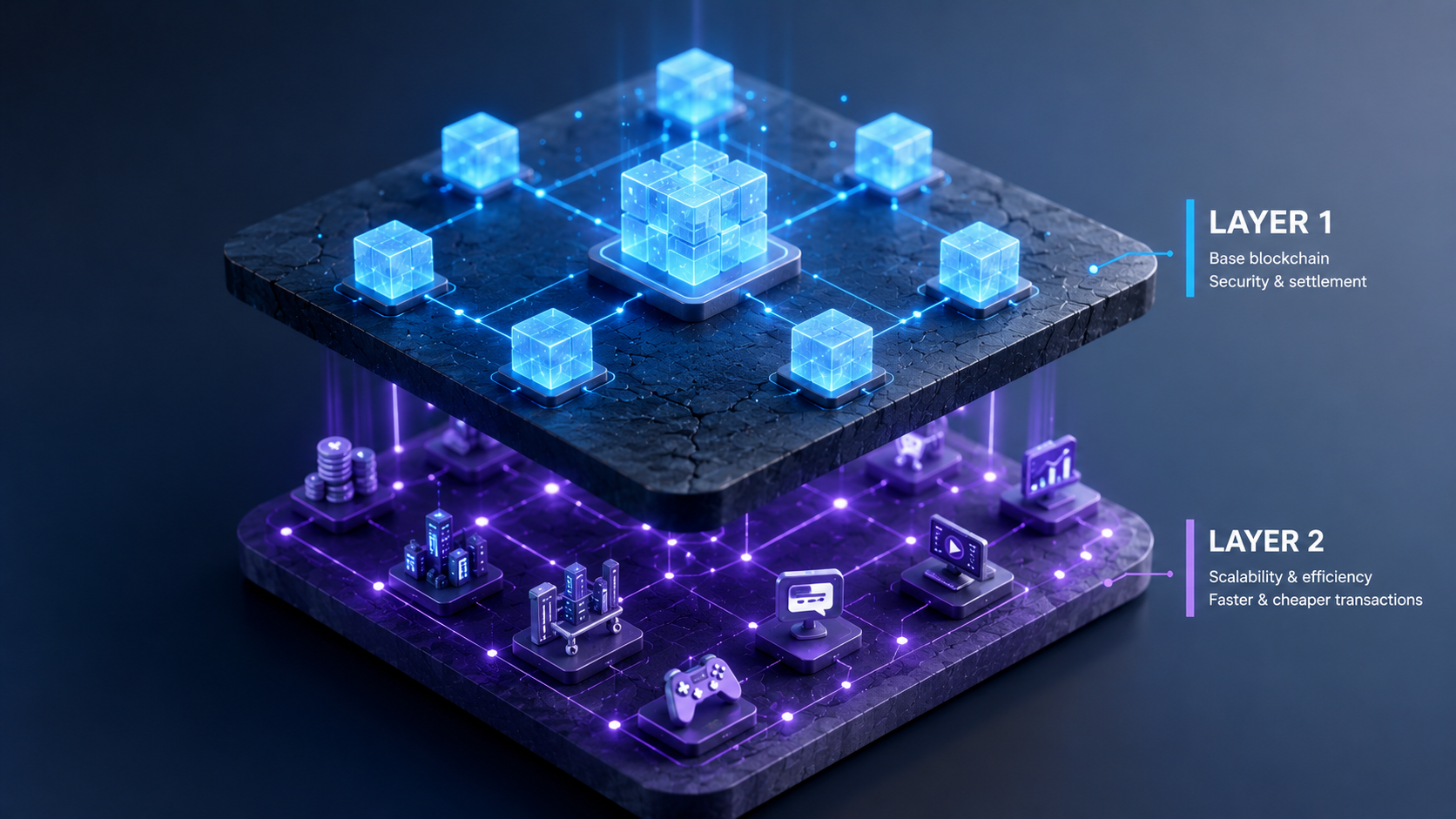
Layer 1 provides the foundation and settlement layer, while Layer 2 provides additional transaction capacity.
Ethereum has become one of the most prominent examples of this approach, with numerous Layer 2 networks designed to process transactions more efficiently while ultimately relying on Ethereum for important aspects of settlement and security.
Why Layer 2 Networks Exist
Imagine a popular blockchain capable of processing a limited number of transactions during a particular period.
If millions of users attempt to use the network simultaneously, demand may exceed available block space. Transactions can become more expensive or take longer to confirm.
Instead of forcing every transaction through the base blockchain individually, a Layer 2 can process large amounts of activity separately.
The Layer 2 then communicates with Layer 1, often by publishing transaction data, proofs, commitments, or settlement information.
By reducing the amount of work that must be performed directly on Layer 1 for each individual user transaction, Layer 2 systems can significantly increase effective network capacity.
Rollups
One of the most important Layer 2 technologies is the rollup.
Rollups execute many transactions outside the Layer 1 execution environment and combine information about those transactions before interacting with the base blockchain.
There are two major categories.
Optimistic Rollups
Optimistic rollups generally assume submitted transaction results are valid unless they are challenged.
A period is provided during which potentially invalid results can be disputed using a fraud-proof or fault-proof mechanism.
Examples associated with optimistic rollup technology include Arbitrum and Optimism.
Zero-Knowledge Rollups
Zero-knowledge rollups, often called ZK rollups, use cryptographic proofs to demonstrate that transactions were processed correctly.
Instead of requiring the Layer 1 network to independently execute every transaction, the Layer 2 can provide a compact mathematical proof demonstrating the validity of a larger collection of activity.
ZK technology is a major area of blockchain research and development, with multiple projects exploring different implementations and architectures.
Are All Networks Built on Another Blockchain Layer 2?
No.
This distinction is important because the term "Layer 2" is sometimes used loosely.
A blockchain that connects to another blockchain is not automatically a Layer 2. Sidechains, independent networks, state channels, rollups, validiums, and other scaling systems can have very different security models.
A true Layer 2 generally derives important security or settlement properties from the Layer 1 network beneath it.
A sidechain, by comparison, may operate its own validator set and consensus mechanism. Although it can communicate with another blockchain through bridges, its security may depend primarily on its own network rather than the Layer 1 blockchain.
Understanding the underlying security model is therefore more useful than relying on the Layer 2 label alone.
Layer 1 vs Layer 2 Transaction Fees
Transaction costs are one of the most visible differences users may notice.
On a Layer 1 blockchain with limited capacity and high demand, transaction fees can become expensive. Users are competing for scarce block space.
Layer 2 networks can reduce costs by processing many transactions more efficiently and spreading certain Layer 1 costs across larger amounts of activity.
For example, instead of hundreds of users individually paying for separate Layer 1 transactions, a rollup can aggregate information from many transactions and settle them more efficiently.
This does not necessarily mean Layer 2 transactions will always be cheap. Costs depend on network demand, architecture, data requirements, and the underlying Layer 1.
Layer 1 vs Layer 2 Security
Security is another important distinction.
A Layer 1 blockchain maintains its security through its own consensus mechanism and network participants.
Layer 2 security is more complicated.
Some Layer 2 systems rely heavily on the underlying Layer 1 for settlement and data availability, while others introduce additional assumptions involving sequencers, operators, committees, bridges, or separate data availability systems.
As a result, two networks both described as Layer 2 solutions may have significantly different security properties.
Users should consider questions such as:
- Where is transaction data stored?
- How are invalid transactions prevented or challenged?
- Can users withdraw funds without permission from a centralized operator?
- What happens if the Layer 2 stops operating?
- Does the system rely on additional trusted parties?
- How mature are its smart contracts and proof systems?
These details can matter more than the Layer 2 label itself.
What Are Sequencers?
Many Layer 2 networks use a component known as a sequencer.
The sequencer receives transactions from users, determines their ordering, and helps produce batches that are eventually submitted to Layer 1.
This can provide fast transaction confirmation and a smoother user experience.
However, some Layer 2 networks currently rely on centralized or relatively centralized sequencing infrastructure. A centralized sequencer may be able to temporarily censor transactions or become unavailable, even if it cannot directly steal users' assets under the protocol's normal assumptions.
Decentralizing sequencing is therefore an important area of ongoing Layer 2 development.
Moving Assets Between Layer 1 and Layer 2
Users often need to move cryptocurrency or tokens between Layer 1 and Layer 2 networks.
This is commonly accomplished through a bridge.
For example, assets may be deposited into a smart contract on Layer 1, after which a corresponding representation becomes available on Layer 2.
Moving assets back to Layer 1 reverses the process.
The exact mechanism depends on the network architecture. Withdrawal times can also vary. Some optimistic rollup designs may involve waiting periods for certain native withdrawals because transactions need sufficient time to be challenged.
Third-party bridges can sometimes provide faster transfers, but they may introduce additional security assumptions.
Layer 2 Is Not Only About Lower Fees
Lower transaction costs are one of the main reasons Layer 2 networks attract users, but scalability can enable much more than cheaper transfers.
Applications that require frequent transactions may be difficult or expensive to operate directly on a congested Layer 1.
Additional capacity can make blockchain technology more practical for areas such as:
- Decentralized exchanges
- Blockchain games
- NFT marketplaces
- Social applications
- Micropayments
- On-chain communities
- Prediction markets
- High-frequency DeFi applications
As transaction costs decrease and throughput increases, developers can experiment with applications that would be impractical when every interaction consumes expensive Layer 1 block space.
The User Experience Challenge
Layer 2 technology can improve scalability while introducing additional complexity.
Users may need to understand which network their assets are on, which wallet network to select, which bridge to use, and whether an application supports a particular Layer 2.
Someone might own the same token across several networks while those balances remain technically separate.
Sending an asset using the wrong network can also cause confusion and, depending on the circumstances, make recovery difficult.
Wallets, exchanges, and decentralized applications are increasingly trying to hide this complexity. Ideally, users may eventually interact with blockchain applications without needing to understand exactly which scaling layer handles every transaction.
Can Layer 2 Replace Layer 1?
Layer 2 is generally not designed to eliminate the need for Layer 1.
Instead, the two layers can perform complementary roles.
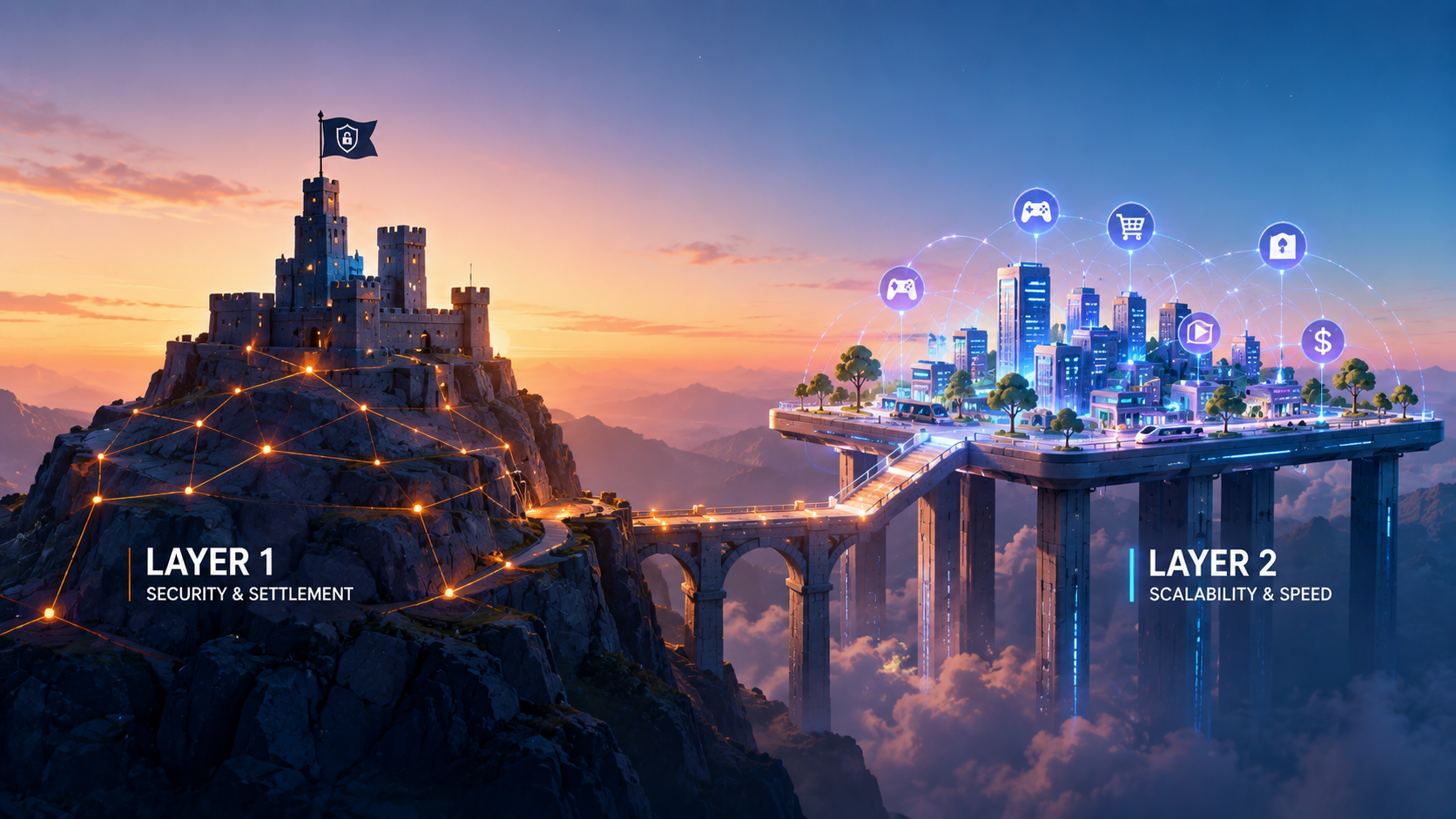
Layer 1 can provide strong settlement, consensus, and security, while Layer 2 networks provide additional execution capacity and specialized environments.
This creates a layered architecture similar to other complex technological systems, where different components handle different responsibilities.
The relationship can be summarized as:
Layer 1 provides the foundation. Layer 2 helps the ecosystem scale.
Different Blockchains Take Different Approaches
Not every blockchain ecosystem follows the same scaling strategy.
Ethereum increasingly relies on a rollup-centered scaling model, where Layer 2 networks handle significant amounts of user activity while Ethereum acts as an underlying settlement and data layer.
Other Layer 1 blockchains focus heavily on increasing the performance of the base blockchain itself.
Some ecosystems combine both approaches, improving Layer 1 performance while simultaneously developing additional scaling layers.
There is therefore no universal architecture for blockchain scalability.
Layer 1 and Layer 2 Are Part of a Larger Stack
Blockchain infrastructure is becoming increasingly modular.
Beyond Layer 1 and Layer 2, developers may use specialized systems for data availability, interoperability, transaction sequencing, execution, and application-specific functionality.
Terms such as Layer 3, appchain, validium, and modular blockchain are becoming more common as developers experiment with different ways of dividing blockchain responsibilities.
These categories are not always perfectly defined, and terminology can vary between projects.
The important concept is that blockchain networks no longer need to perform every task within a single monolithic system.
The Future of Layered Blockchain Networks
Layer 2 technology represents an attempt to solve one of blockchain's fundamental problems: supporting large numbers of users without sacrificing the properties that make decentralized networks valuable.
Layer 1 blockchains continue to improve through protocol upgrades, better cryptography, more efficient consensus mechanisms, and new approaches to data availability.
At the same time, Layer 2 networks are becoming faster, cheaper, and increasingly sophisticated.
The long-term result may be blockchain ecosystems where most everyday activity occurs on scalable execution layers while highly secure Layer 1 networks operate quietly underneath them.
For users, the distinction between these layers may eventually become much less visible.
Conclusion
The difference between Layer 1 and Layer 2 comes down to where blockchain activity is processed and how the system derives its security.
Layer 1 is the base blockchain. It provides the fundamental consensus, security, data, and settlement infrastructure of the network.
Layer 2 is additional infrastructure built on top of Layer 1. It moves some transaction processing away from the base layer to increase capacity, reduce costs, or provide specialized functionality while maintaining a connection to the underlying blockchain.
Neither approach solves every blockchain challenge on its own. Layer 1 improvements and Layer 2 scaling technologies increasingly work together.
Understanding this relationship makes it easier to see why modern blockchain ecosystems contain multiple interconnected networks and why scalability is evolving from a single-chain problem into a layered infrastructure challenge.
Pick your reaction
Post your comment