

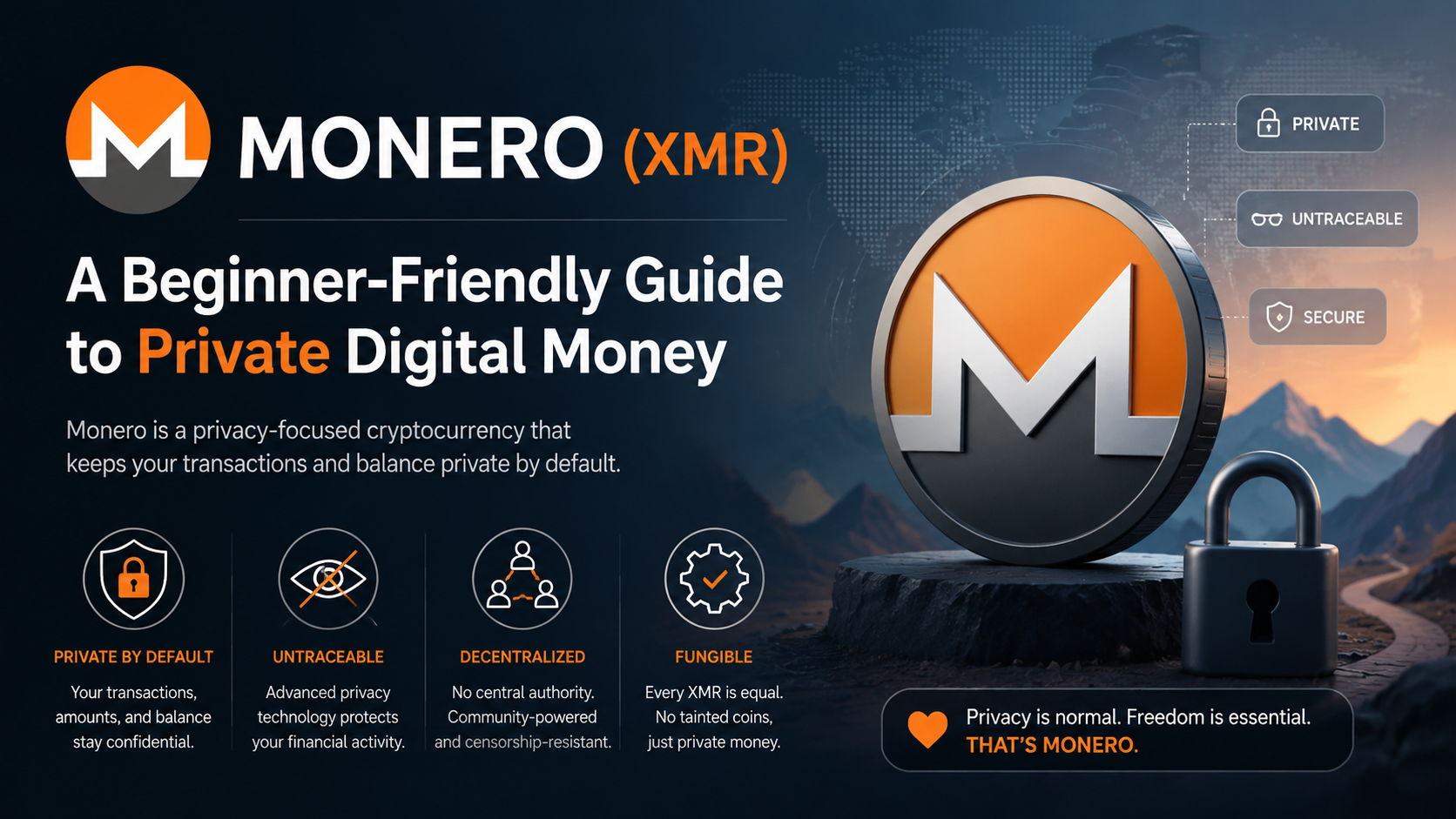
Monero is a decentralized cryptocurrency designed to make digital payments private, secure, and difficult to trace. While many blockchains publish transaction details for anyone to inspect, Monero automatically conceals information about senders, recipients, and transferred amounts.
Its native cryptocurrency, XMR, can be sent worldwide without relying on banks, payment processors, or another central authority.
What Is Monero?
Monero is an open-source, peer-to-peer cryptocurrency launched in 2014. Its name comes from the Esperanto word for “coin,” and its ticker symbol is XMR.
The project focuses on providing private digital money. Anyone can use the Monero network, create a wallet, receive XMR, or broadcast transactions without requesting permission from a company or government.
Like Bitcoin, Monero operates through a decentralized blockchain maintained by a global network of nodes and miners. However, the information recorded on its blockchain is protected by privacy technologies that make transactions confidential by default.
This distinction is important. On many public blockchains, anyone can view:
- The addresses involved in a transaction
- The amount transferred
- The balance held by an address
- The address’s complete transaction history
Monero is designed to prevent this type of public financial surveillance.
How Monero Protects Transaction Privacy
Monero combines several cryptographic technologies to hide different parts of a transaction. Privacy is built into the protocol and applies automatically rather than being an optional feature.
Ring Signatures
Ring signatures help obscure the origin of a transaction.
When someone spends XMR, their transaction input is placed into a group with other possible inputs from the blockchain. An outside observer can confirm that one member of the group authorized the transaction, but cannot easily determine which one was the actual spender.
This provides plausible deniability for the sender and makes it significantly more difficult to follow XMR as it moves between wallets.
Stealth Addresses
Stealth addresses protect the recipient.
A sender does not place the recipient’s published wallet address directly on the blockchain. Instead, the wallet creates a unique, one-time destination for each transaction.
Only the recipient can detect and spend the funds sent to that destination. This prevents observers from searching the blockchain for a public address and viewing all payments associated with it.
Users can also generate subaddresses for different purposes. For example, someone could use separate subaddresses for online shopping, donations, freelance work, and personal payments while managing everything from the same wallet.
Ring Confidential Transactions
Ring Confidential Transactions, commonly called RingCT, hide the transferred amount.
The network can mathematically confirm that a transaction does not create or destroy unauthorized XMR without publicly revealing how much was sent. This allows Monero’s supply rules to be verified while individual payment amounts remain confidential.
Together, ring signatures, stealth addresses, and RingCT conceal the sender, recipient, and amount of a Monero transaction. Monero’s official documentation provides a more technical introduction to these technologies.
Privacy by Default
Some cryptocurrencies offer privacy through optional tools or special transaction types. Monero takes a different approach: every standard transaction uses the network’s privacy protections.
Users cannot accidentally make a transparent Monero transaction. This also strengthens the privacy of the broader network because private transactions do not stand out from ordinary activity.
However, privacy should not be confused with guaranteed anonymity. Information can still be exposed through poor operational security, compromised devices, malicious software, centralized exchanges, network monitoring, or voluntarily shared transaction details.
Monero improves privacy at the blockchain level, but users must still protect their wallets, identities, internet connections, and personal information.
What Is Fungibility?
Fungibility means that individual units of a currency are interchangeable.
One euro is generally accepted as having the same value as another euro. The previous owners of a particular coin or banknote usually do not affect whether someone will accept it.
Transparent blockchains can complicate this property. Because transaction histories are publicly visible, certain coins may become associated with thefts, scams, hacks, or sanctioned services. Exchanges and payment processors may then reject or freeze them, even when the current owner had nothing to do with their past.
Monero’s private transaction history makes it difficult to distinguish one unit of XMR from another. This gives Monero strong fungibility, which its community considers an essential characteristic of useful digital money.
How Monero Transactions Work
A typical Monero payment follows a familiar process:
- The sender enters the recipient’s address.
- The sender chooses an amount and transaction fee.
- The wallet constructs and signs the transaction.
- The transaction is broadcast to the Monero network.
- Miners include it in a block.
- The recipient’s wallet detects the incoming payment.
The important difference is what outsiders can see. They can verify that a valid transaction occurred, but the transaction does not publicly reveal the sender’s true input, the recipient’s published address, or the amount transferred.
Monero blocks are produced approximately every two minutes. The protocol also uses a dynamic block-size system rather than a permanently fixed maximum size. Monero’s technical overview explains these network characteristics in more detail.
Monero Wallets
A Monero wallet manages the keys required to receive, detect, and spend XMR. The coins themselves remain represented on the blockchain.
Monero wallets normally use two important types of private keys:
- A private spend key authorizes outgoing transactions.
- A private view key allows the wallet to detect incoming transactions.
This separation makes it possible to provide limited visibility without giving someone permission to spend the funds. For example, a user may share certain viewing information with an accountant or auditor when appropriate.
Wallet options include:
- The official Monero GUI wallet
- The official command-line wallet
- Mobile wallets
- Hardware wallets with Monero support
- Lightweight wallets connected to remote nodes
Users should download wallet software from official or trusted sources and verify files whenever possible.
Wallet Synchronization and Nodes
Because incoming transactions are hidden behind one-time addresses, a Monero wallet must scan blockchain data to identify funds belonging to it. This can make the initial synchronization process slower than users expect.
A wallet can connect in several ways:
Local Node
Running a local node downloads and independently verifies the Monero blockchain. It offers greater control, strengthens the network, and avoids depending on an outside node operator.
The disadvantages are the required storage space, bandwidth, processing time, and initial synchronization period.
Remote Node
A remote node allows a wallet to access the network without storing the complete blockchain locally. This is more convenient, particularly on mobile devices or computers with limited storage.
However, the operator of a remote node may observe information such as connection times and IP addresses. A remote node cannot directly spend the user’s funds, but it introduces privacy and reliability considerations.
How Monero Mining Works
Monero uses Proof of Work to secure its blockchain. Miners process transactions, compete to produce valid blocks, and receive XMR as compensation.
The network uses RandomX, a mining algorithm designed to work efficiently with general-purpose processors. Its goal is to reduce the advantage of specialized mining hardware and make participation with consumer CPUs more practical.
This does not guarantee perfectly equal mining conditions, and profitability still depends on hardware, electricity prices, network difficulty, and the market value of XMR. Nevertheless, RandomX reflects Monero’s effort to keep mining relatively accessible.
Users interested in mining can participate independently or join a mining pool. P2Pool provides a decentralized pool-mining option that allows miners to combine their work without relying on a traditional custodial pool operator.
Monero’s Tail Emission
Monero does not have a fixed maximum supply.
Its initial emission gradually released most of the early supply. In June 2022, the network entered a permanent tail-emission phase that provides 0.6 XMR per block, assuming the standard block schedule.
This means the XMR supply will continue increasing slowly. However, the percentage inflation rate declines over time as the total supply grows.
The tail emission is intended to ensure that miners always receive a base block reward. This provides a permanent incentive to secure the network instead of relying entirely on transaction fees. Monero’s official FAQ discusses the supply model and its purpose.
Who Controls Monero?
Monero is not operated by a company, bank, or foundation with unilateral control over the network. It is an open-source project developed by contributors from around the world.
Developers can propose code changes, researchers can analyze privacy technologies, and community members can review, debate, fund, and test improvements. Network participants ultimately decide which software they run.
Monero also has a Community Crowdfunding System through which community members can propose and fund development, research, documentation, localization, and other work.
This decentralized structure supports independence, but it can also make decision-making slower and less predictable than development within a conventional company.
Common Uses for Monero
Monero can be used anywhere two parties agree to exchange XMR. Possible uses include:
- Private peer-to-peer payments
- Online purchases
- Donations
- Freelance payments
- International transfers
- Savings outside traditional banking systems
- Payments where publishing balances or business relationships would create risks
Financial privacy has legitimate everyday applications. A customer may not want a merchant to inspect their wallet balance. A company may need to keep supplier payments confidential. A journalist, activist, or donor may face personal risks if their financial relationships become public.
Monero’s technology is neutral. As with cash, encryption, and other privacy tools, it can be used for both legitimate and unlawful purposes.
Benefits of Monero
Strong Default Privacy
Monero automatically protects transaction details without requiring users to activate a separate privacy mode.
Fungibility
Because individual transaction histories are concealed, XMR units are less likely to be treated differently based on their past use.
Decentralized and Permissionless
Users can transact directly without requesting approval from a bank or payment processor.
Open-Source Development
Monero’s software can be inspected, tested, criticized, and improved publicly.
Accessible Mining
RandomX is designed to support mining with general-purpose processors and reduce dependence on specialized hardware.
Active Community
The Monero ecosystem includes developers, researchers, miners, node operators, merchants, translators, educators, and privacy advocates.
Limitations and Challenges
Regulatory Pressure
Privacy-focused cryptocurrencies receive considerable attention from regulators. Some exchanges have restricted or removed XMR trading in certain jurisdictions, which can make it more difficult to buy, sell, or exchange.
Users should check the laws, tax requirements, and platform rules that apply in their location.
Limited Availability
Monero is not supported by every exchange, wallet, payment provider, or merchant. Its accessibility varies significantly between countries and services.
Larger Transactions
Monero’s privacy technologies require more blockchain data than simple transparent transfers. Continued research and protocol improvements aim to make transactions more efficient without sacrificing privacy.
Wallet Synchronization
Scanning the blockchain for incoming transactions can require additional time and processing, especially when restoring an old wallet.
Learning Curve
Concepts such as view keys, spend keys, nodes, subaddresses, restore heights, and transaction proofs may initially be confusing.
Privacy Has Boundaries
Monero protects information recorded on its blockchain, but it cannot secure a compromised computer or prevent someone from revealing their own identity. Exchanges, websites, malware, network observers, and careless reuse of personal information can still reduce privacy.
Is Monero Illegal?
Monero itself is not universally illegal, but laws and service restrictions differ between jurisdictions.
Some countries and regulated platforms impose special rules on privacy-focused cryptocurrencies. Exchanges may delist XMR because of compliance requirements or their own risk policies, even in places where individuals are still permitted to own and use it.
Before buying, mining, accepting, or spending XMR, users should research the current rules that apply to them.
How to Get Started with Monero
Someone exploring Monero for the first time can follow a few basic steps:
- Learn how Monero’s privacy model differs from transparent blockchains.
- Choose a trusted wallet suitable for the intended device.
- Download it from an official source.
- Write down the recovery seed and store it offline.
- Never share the seed or private spend key.
- Decide whether to use a local or remote node.
- Test the wallet with a small amount of XMR.
- Wait for the appropriate number of confirmations before treating a payment as final.
- Keep the wallet and operating system updated.
- Learn about local legal and tax obligations.
Always verify addresses before sending funds. Cryptocurrency transactions usually cannot be reversed after they have been confirmed.
The Monero Community
Monero’s community plays a central role in the project. Participants contribute software, security reviews, research, translations, documentation, merchant tools, educational resources, and technical support.
Because Monero has no traditional marketing department or corporate leadership, community spaces are particularly important. Forums, chat groups, social platforms, meetups, and educational websites help users understand the technology and participate in its development.
As with any cryptocurrency community, official announcements should be distinguished from impersonators, unofficial promotions, and scams. Administrators and support volunteers will never need a user’s recovery seed or private spend key.
Final Thoughts
Monero approaches cryptocurrency from a clear principle: financial privacy should be a normal feature of digital money, not an optional extra.
By combining ring signatures, stealth addresses, confidential amounts, decentralized mining, and open-source development, Monero enables transactions without publishing a detailed financial history to the world. This gives XMR distinctive strengths in privacy and fungibility.
Those strengths also create challenges. Regulatory pressure, limited exchange support, additional technical complexity, and the need for responsible operational security can make Monero less convenient than more widely supported cryptocurrencies.
For users who value confidential peer-to-peer payments, however, Monero remains one of the most established examples of privacy-focused digital money.
This article is for educational purposes only and does not constitute financial, legal, or investment advice. Always conduct your own research before using or purchasing cryptocurrency.

Pick your reaction
Post your comment