

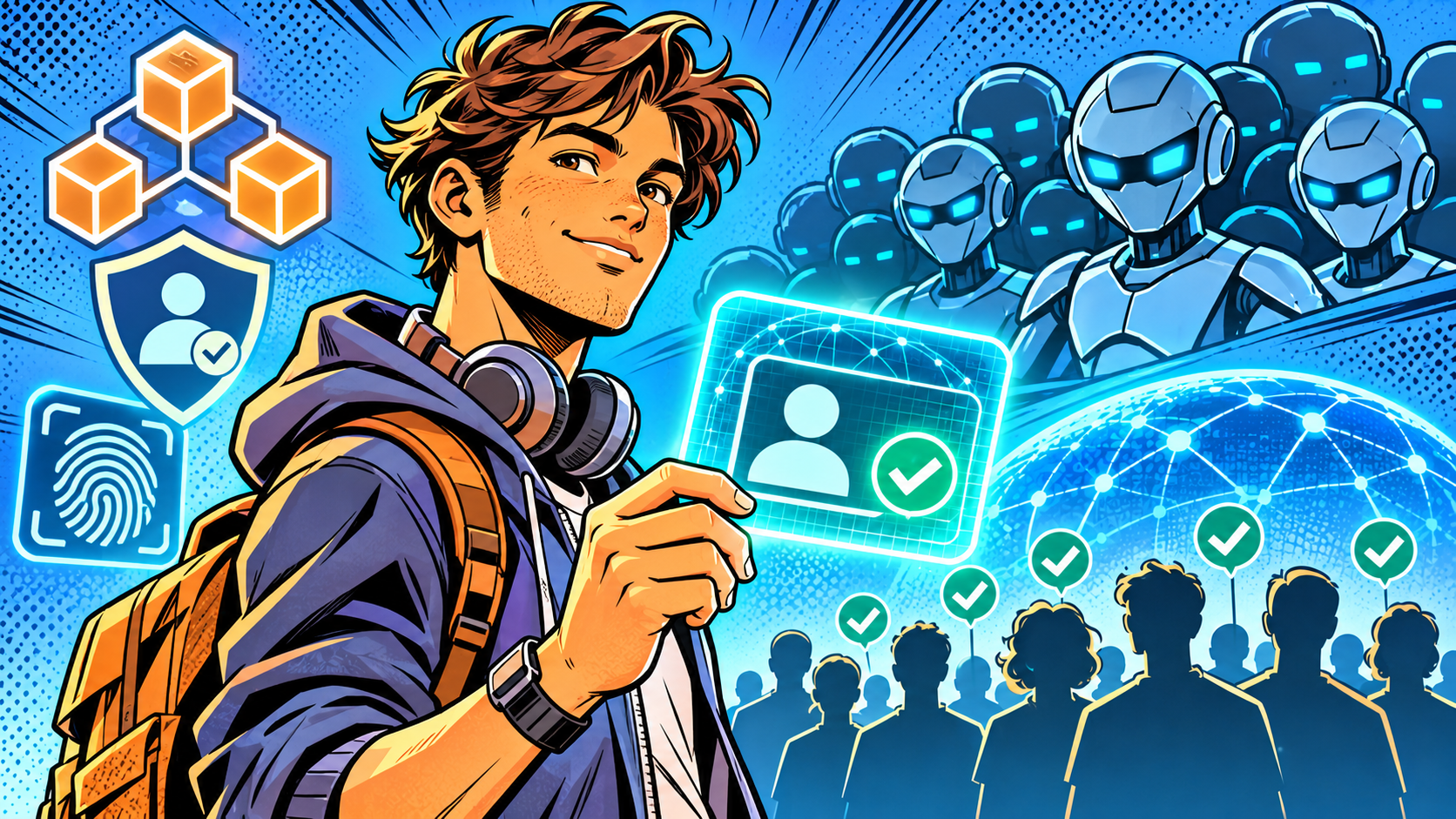
Artificial intelligence is changing how people interact online. AI-generated profiles, automated conversations, and increasingly convincing digital identities make it harder to distinguish real humans from sophisticated bots. This creates new challenges for social networks, online communities, and decentralized platforms.
Proof of Personhood offers a potential solution by allowing individuals to demonstrate that they are real, unique humans without necessarily revealing their personal identities. But how does it work, why is it becoming important, and what challenges must be overcome before it can be widely adopted?
What Is Proof of Personhood?
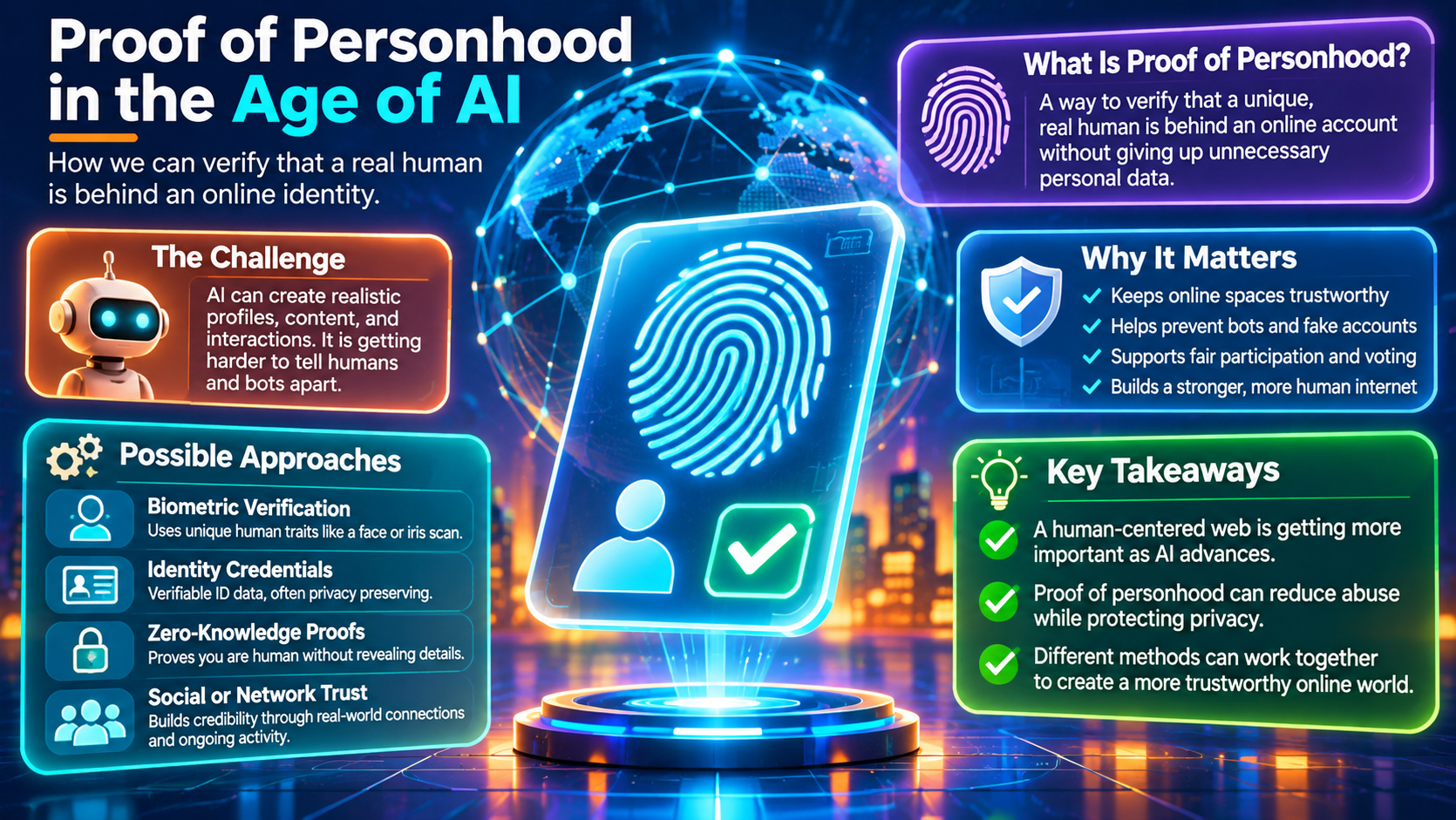
Proof of Personhood (PoP) is a method of verifying that an online participant represents a real, unique human being rather than an automated system or a collection of fake identities.
Unlike traditional identity verification, which often requires names, addresses, government-issued documents, or other personal information, Proof of Personhood focuses on establishing two important properties:
- Humanity: The participant is a real human rather than an automated program.
- Uniqueness: The participant represents one distinct person rather than multiple identities controlled by the same individual.
The distinction between these properties is important. A CAPTCHA might demonstrate that someone can complete a task associated with human behavior, but it cannot reliably establish that the same person has not created hundreds of accounts.
Similarly, verifying a government-issued identity document may establish someone's legal identity, but it does not automatically prevent that person from operating multiple online profiles.
Proof of Personhood attempts to address these limitations by creating mechanisms that make it difficult to claim more than one verified human identity within a particular system.
The ultimate goal is not necessarily to reveal who someone is, but to establish that a unique person exists behind a digital identity.
Why AI Is Making Proof of Personhood More Important
The internet has struggled with fake accounts, spam, and automated activity for decades. However, advances in artificial intelligence are changing the scale and sophistication of these problems.
Traditional bots frequently relied on repetitive messages, predictable behavior, and easily recognizable patterns. Modern AI systems can generate realistic conversations, adapt their responses, and imitate human communication styles.
AI-generated images, voices, and videos also make it possible to create convincing fictional personalities with relatively little effort.
This development creates several challenges.
The Growing Problem of AI-Generated Identities
A single individual or organization can operate large numbers of AI-powered accounts that appear to represent independent people.
These accounts might participate in discussions, post opinions, share content, or interact with legitimate users.
When coordinated, they can create the impression of widespread public support or opposition, even when the apparent activity originates from only a handful of operators.
This practice can distort online conversations and make it increasingly difficult to assess the authenticity of digital communities.
Manipulation of Online Communities
Community platforms depend heavily on genuine participation.
Votes, reactions, reviews, and discussions are often treated as indicators of what members think or value.
If automated accounts can influence these mechanisms, the results become less meaningful.
For example, a community might use member voting to select a project for funding. Without effective protections, one participant could create hundreds of accounts and disproportionately influence the outcome.
AI makes such attacks more scalable because automated identities can generate realistic activity rather than simply repeating identical messages.
Fraud, Scams, and Impersonation
AI-powered accounts can also support fraudulent activities.
Scammers may use convincing profile images, automated conversations, or AI-generated voices to establish trust with potential victims.
In cryptocurrency communities, these techniques can be particularly dangerous when attackers impersonate project representatives, community moderators, or technical support personnel.
Proof of Personhood cannot determine whether someone is trustworthy, but it could make certain forms of mass impersonation and account creation more difficult.
The Sybil Attack Problem
One of the central challenges addressed by Proof of Personhood is the Sybil attack.
A Sybil attack occurs when a single participant creates or controls multiple identities to gain disproportionate influence over a system.
The concept is especially relevant in decentralized networks, where participation does not necessarily require permission from a central authority.
Consider a decentralized community that allows every registered member to cast one vote.
If one individual creates 100 accounts, that person might obtain 100 votes while legitimate participants receive only one vote each.
The system appears democratic, but its voting results no longer reflect the preferences of 100 independent people.
Similar problems can affect:
- Decentralized governance and community elections.
- Cryptocurrency airdrops and reward distributions.
- Reputation and review systems.
- Community funding and grant programs.
- Online competitions and promotional campaigns.
- Social platforms that measure popularity through engagement.
Proof of Personhood attempts to make these systems more resistant to manipulation by linking eligibility to unique human participants rather than unrestricted account creation.
However, even a perfectly implemented personhood system would not eliminate every attack. Verified individuals could still coordinate, sell access to their credentials, or participate in fraudulent activities.
How Does Proof of Personhood Work?
There is no universally accepted method for establishing Proof of Personhood.
Different projects use different verification approaches, each balancing security, privacy, accessibility, and decentralization.
1. Biometric Verification
Biometric systems use physical characteristics to help establish that a person is human and distinguish them from other participants.
These characteristics may include facial features or iris patterns.
A well-known example is World ID, which uses specialized hardware called the Orb for biometric verification.
According to World, its system processes images of a participant's eyes and face to establish uniqueness. Its architecture is designed to allow users to prove their verified status without sharing their names or other identifying information with applications.
Biometric verification can provide strong uniqueness signals, but it introduces important questions.
Biometric information is highly sensitive. Unlike a password, a person's iris pattern or facial characteristics cannot simply be changed after a security incident.
Such systems must also consider verification errors, accessibility, hardware availability, data protection, and the organizations responsible for operating the infrastructure.
2. Social Verification and Human Trust Networks
Another approach relies on existing relationships between people.
Instead of scanning biometric characteristics, participants may establish their humanity through endorsements, community verification, or challenges reviewed by other members.
A project using this approach is Proof of Humanity.
Its verification model combines social attestations and submitted evidence to build a registry designed to resist duplicate registrations.
Social verification can reduce dependence on specialized hardware and centralized identity providers.
However, it also introduces difficulties. Coordinated participants might endorse fraudulent identities, while newcomers without established connections could struggle to obtain verification.
The effectiveness of such systems depends on carefully designed incentives, dispute resolution, and safeguards against collusion.
3. Reputation and Activity-Based Verification
Some systems analyze multiple indicators of genuine participation to estimate whether an account belongs to a real, unique person.
These indicators might include account history, participation in established communities, existing credentials, or blockchain activity.
One example is Human Passport, previously known as Gitcoin Passport.
The platform combines verification methods and behavioral signals to help applications evaluate whether participants are likely to represent unique humans. Applications can choose thresholds suited to their security requirements.
This approach allows platforms to combine different sources of evidence rather than relying on a single verification process.
However, reputation-based systems are not definitive proof of humanity.
Established accounts can be purchased or compromised, automated systems can imitate human behavior, and legitimate newcomers may lack the history needed to receive a strong score.
4. Cryptographic Credentials and Zero-Knowledge Proofs
Cryptography offers another important component of Proof of Personhood.
A verified participant might receive a digital credential confirming that a trusted verification process has been completed.
The participant could then use that credential to demonstrate eligibility without repeatedly exposing personal information.
Zero-knowledge proofs (ZKPs) are particularly relevant because they allow someone to demonstrate that a statement is true without revealing the underlying information used to establish it.
For example, a person might prove that:
- They possess a valid personhood credential.
- Their credential has not already been used in a particular vote.
- They meet a platform's eligibility requirements.
A properly designed system could verify these statements without learning the participant's legal name or revealing the same identifying information across different services.
Cryptographic techniques do not independently determine whether someone is human. They help protect and verify claims established through other processes.
In May 2025, the World Wide Web Consortium (W3C) published its Verifiable Credentials 2.0 standards, providing a standardized foundation for exchanging cryptographically verifiable claims. These standards support approaches such as selective disclosure, although their use alone does not establish unique personhood.
The Role of Blockchain in Proof of Personhood
Blockchain technology can support Proof of Personhood by providing shared infrastructure for verifying credentials, recording eligibility, and coordinating decentralized applications.
A blockchain-based personhood system might use smart contracts to check whether a participant holds a valid credential before allowing certain actions.
For example, a decentralized organization could require an eligible personhood proof before accepting a governance vote.
The system could potentially enforce one eligible vote per verified participant without publicly revealing the voter's real-world identity.
Blockchain can also allow multiple applications to rely on shared verification infrastructure instead of independently collecting sensitive identity documents.
However, blockchain is not a requirement for Proof of Personhood.
Traditional databases, digital signatures, and privacy-preserving credential systems can also implement elements of personhood verification.
Furthermore, storing sensitive identity information directly on a public blockchain would create significant privacy concerns.
A more privacy-conscious architecture might use blockchain infrastructure only for public verification data or cryptographic commitments while keeping personal information off-chain.
Privacy: Can Someone Prove They Are Human Without Revealing Who They Are?
One of the most important questions surrounding Proof of Personhood is whether people should have to sacrifice anonymity to demonstrate that they are human.
Anonymity and pseudonymity are important features of the internet.
They allow individuals to participate in sensitive discussions, explore controversial subjects, and communicate without automatically linking every activity to their legal identities.
In cryptocurrency communities, pseudonymous participation is also deeply connected to the principles of decentralization and individual control.
Requiring everyone to submit identification documents or biometric information to access online services could undermine these freedoms.
This is why privacy-preserving verification is particularly important.
A well-designed Proof of Personhood system should ideally allow participants to demonstrate uniqueness without exposing their identities or making their activity traceable across unrelated platforms.
For example, someone might participate in several online communities under different usernames while still proving that they are eligible to vote only once within each community.
Technologies such as zero-knowledge proofs, selective disclosure, and application-specific identifiers can support this goal.
Nevertheless, privacy claims must be evaluated carefully. Even when credentials do not directly reveal names, poorly designed identifiers, metadata, or verification processes can allow activity to be linked across services.
The W3C's Verifiable Credentials specification explicitly discusses these correlation risks and techniques for reducing them.
The Challenges and Risks of Proof of Personhood
Although Proof of Personhood promises significant benefits, implementing it on a global scale is extremely difficult.
No current approach eliminates every technical, social, and ethical challenge.
Centralization and Control
If a single company or organization controls the verification infrastructure, it could gain considerable influence over who is recognized as a verified human.
This raises concerns about censorship, exclusion, governance, and dependence on centralized services.
A system claiming to protect decentralized communities should therefore be evaluated not only for its technical design but also for who controls enrollment, verification decisions, and credential revocation.
Accessibility and Global Inclusion
Not everyone has access to modern smartphones, identity documents, reliable internet connections, or specialized verification hardware.
Systems that depend on these resources may unintentionally exclude legitimate participants.
Accessibility requirements also vary across countries, physical abilities, and economic circumstances.
For Proof of Personhood to support widespread participation, verification methods must account for these differences.
Errors and False Rejections
No verification system is perfect.
Biometric matching can produce errors, reputation models can incorrectly classify legitimate accounts, and social verification processes can reach unfair decisions.
These mistakes become particularly serious when personhood credentials are required for access to essential digital services.
Systems therefore need transparent appeals, recovery mechanisms, and ways to correct mistakes.
Credential Theft and Human-Assisted Attacks
Even when verification successfully establishes a unique human identity, attackers may attempt to obtain or misuse the resulting credential.
People might voluntarily sell access, be pressured into participating, or unknowingly authorize automated activity.
This means Proof of Personhood must address more than the initial verification process.
Secure credential management, abuse detection, and appropriate limits on credential use remain important.
The Risk of Making Verification Mandatory
Perhaps the most significant concern is the possibility that voluntary verification could gradually become a requirement for participating online.
A world where every website demands proof of humanity might reduce some forms of automated abuse, but it could also introduce new barriers to expression and participation.
Not every interaction requires strong identity assurance.
Reading an article, participating in an informal discussion, or exploring a public community may not justify collecting additional information about a visitor.
Proof of Personhood should therefore be proportionate to the risks of the activity it protects.
Why Proof of Personhood Matters for Crypto Communities
Cryptocurrency communities provide particularly interesting use cases because they often combine pseudonymous identities, economic incentives, and decentralized decision-making.
These characteristics create opportunities for open participation but also make certain forms of manipulation attractive.
Proof of Personhood could help address several community-specific problems.
Fairer Community Voting
Communities frequently use polls to make decisions about development priorities, events, partnerships, or governance proposals.
Verifying unique participants could help reduce attempts to manipulate these decisions through duplicate accounts.
However, one-person-one-vote governance is not appropriate for every decentralized system. Some communities intentionally use token-weighted voting or other participation models.
Personhood verification offers an additional governance option rather than a universal replacement.
More Equitable Rewards and Airdrops
Cryptocurrency projects sometimes distribute tokens or other rewards to community participants.
These campaigns can attract automated accounts and individuals attempting to claim rewards repeatedly.
Proof of Personhood could help projects limit certain distributions to unique eligible individuals, improving fairness and reducing opportunities for reward farming.
More Meaningful Reviews and Reputation
Community directories, discussion platforms, and review systems depend on authentic engagement.
A project might appear popular because hundreds of accounts have submitted positive ratings, even when many accounts are controlled by the same operator.
Personhood verification could provide an additional signal when evaluating reviews or preventing repeated participation.
However, being a verified human does not automatically make a review accurate, independent, or trustworthy.
Platforms would still need moderation, fraud detection, and transparent reputation systems.
Protecting Community Discussions
AI-generated accounts can overwhelm discussions with automated responses or coordinated promotional campaigns.
Verification tools could help communities distinguish between unverified accounts and participants who have demonstrated unique humanity.
This does not mean AI agents should be banned from online communities.
Automated tools can provide valuable services, including moderation, translation, accessibility assistance, and information retrieval.
The more useful distinction may be whether an account represents a verified person, an openly identified automated agent, or an unknown participant.
Should AI Agents Have Their Own Digital Identities?
As artificial intelligence becomes more autonomous, the relationship between human identity and digital participation becomes more complicated.
AI agents can already perform tasks such as retrieving information, interacting with software, and executing predefined workflows.
More advanced systems may increasingly participate in online communities, manage digital assets, and interact with decentralized applications.
Rather than treating every non-human participant as malicious, online platforms may benefit from distinguishing between different kinds of digital identities.
A human user could hold a personhood credential, while an AI agent could have a separate machine identity that identifies it as an automated participant.
An agent might also carry a verifiable authorization proving that a particular person or organization has permitted it to perform specific actions.
This would allow platforms to distinguish between an authorized AI assistant and an unknown bot without pretending that the AI itself is human.
For example, a community could permit AI agents to answer technical questions while reserving certain governance votes for verified human participants.
Such an approach could support productive human-AI collaboration while reducing the potential for deceptive automated activity.
The Future of Digital Identity in an AI-Driven Internet
Proof of Personhood is still an evolving field, and there is no universally accepted solution.
Biometric systems, social verification networks, reputation models, and cryptographic credentials each address different parts of the problem.
Future systems may combine several methods rather than relying on a single universal identity provider.
Interoperable credentials could allow people to reuse verification results across multiple platforms, while privacy-preserving cryptography could reduce the information disclosed during each interaction.
At the same time, verification technologies will need to adapt as AI capabilities improve.
Methods that distinguish humans from machines today may become less reliable as automated systems learn to imitate the required behavior.
This creates an ongoing challenge: developing verification mechanisms that remain effective without requiring increasingly intrusive monitoring.
The long-term success of Proof of Personhood will likely depend on whether it can balance four competing priorities: reliable uniqueness, individual privacy, broad accessibility, and protection against centralized control.
Conclusion
Artificial intelligence is making online identity more complicated. As automated accounts become increasingly convincing, communities and decentralized platforms need better ways to distinguish genuine human participation from artificial activity.
Proof of Personhood offers a promising approach by focusing on the existence of a unique human rather than automatically requiring the disclosure of a legal identity.
It could support fairer voting, reduce certain forms of fraud, protect reward distributions, and improve confidence in online participation.
However, its benefits must be weighed against concerns about privacy, exclusion, surveillance, and centralized control.
The future of the internet should not require people to surrender their anonymity simply to demonstrate that they exist.
The real challenge is not just proving that someone is human, but doing so in a way that preserves the freedom, privacy, and openness that make online communities valuable.


Pick your reaction
Post your comment