

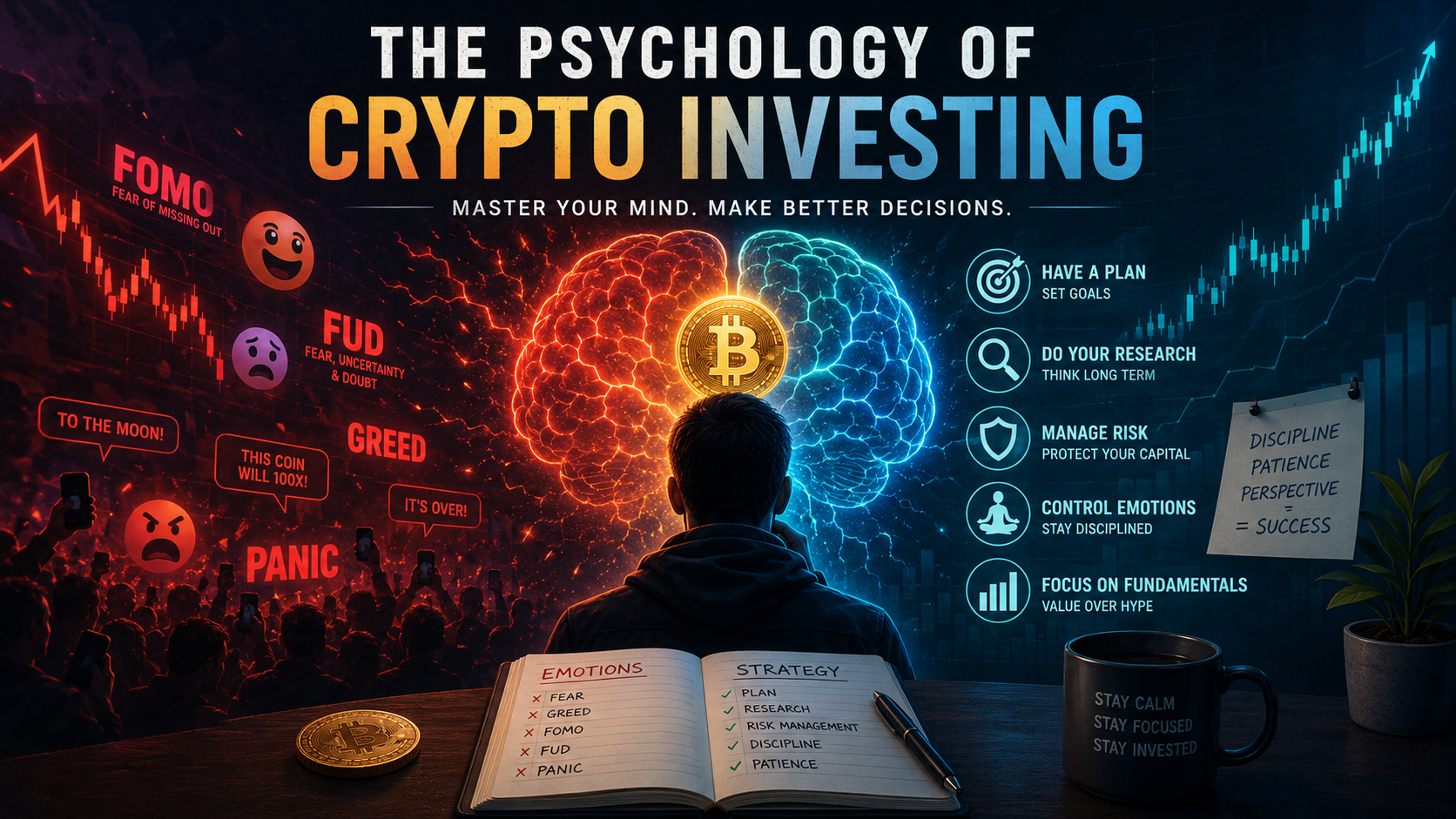
Cryptocurrency investing is often described as a technological or financial activity, but psychology plays an equally important role in shaping investor behavior. While blockchain technology, tokenomics, and market fundamentals matter, emotions frequently drive short-term market movements and individual investment decisions. Fear, greed, excitement, uncertainty, and social influence can all affect how people buy, sell, and hold digital assets.
The cryptocurrency market is particularly susceptible to psychological factors because it operates 24/7, experiences high volatility, and is heavily influenced by online communities and social media. Understanding the psychological forces behind investment decisions can help investors make more rational choices, avoid common mistakes, and develop healthier long-term strategies.
How Emotions Influence Investment Decisions
Human beings are not perfectly rational decision-makers. Even experienced investors can be influenced by emotions, especially during periods of rapid market movement.
When prices rise quickly, excitement and optimism often take over. Investors may become convinced that prices will continue increasing indefinitely, leading them to buy assets at elevated valuations. Conversely, when markets decline sharply, fear can cause panic selling, often locking in losses that might have been avoided through patience.
The crypto market amplifies these emotional reactions because price swings can be dramatic. A token may gain or lose significant value within hours, creating constant emotional pressure. Investors who allow emotions to guide their decisions often find themselves buying near market peaks and selling near market bottoms.
Fear of Missing Out (FOMO)
One of the most common psychological phenomena in crypto investing is Fear of Missing Out, commonly known as FOMO.
FOMO occurs when investors see others making profits and worry that they will miss a major opportunity. This often leads to impulsive buying decisions without proper research. Social media platforms can intensify FOMO by showcasing success stories, massive gains, and predictions of future wealth.
During bull markets, FOMO can drive large numbers of investors into trending cryptocurrencies, creating a self-reinforcing cycle of rising prices and increasing excitement. While some investors may profit, many enter the market late and face losses when momentum eventually slows.
Managing FOMO requires discipline. Investors should develop clear investment criteria and avoid making decisions solely because an asset is gaining popularity.
Fear, Uncertainty, and Doubt (FUD)
The opposite of FOMO is Fear, Uncertainty, and Doubt, commonly referred to as FUD.
Negative news, regulatory concerns, security incidents, or market crashes can trigger widespread anxiety among investors. In some cases, FUD is based on legitimate concerns. In others, it may be exaggerated or spread intentionally to influence market sentiment.
When fear dominates the market, investors often focus excessively on worst-case scenarios. This can lead to emotional selling, even when the underlying investment thesis remains unchanged.
Successful investors learn to distinguish between meaningful information and emotional reactions. Evaluating news objectively and considering long-term implications can help reduce the impact of FUD-driven decisions.
Herd Mentality and Social Influence
Humans are social creatures, and investment behavior is often influenced by the actions of others.
In crypto markets, communities play a significant role in shaping opinions. Investors frequently participate in Discord servers, Telegram groups, Reddit discussions, X posts, livestreams, and online forums. While these communities can provide valuable information, they can also create herd behavior.
When large groups of people collectively believe that a project will succeed, confidence can spread rapidly. Similarly, negative sentiment can trigger widespread pessimism. Investors may begin following the crowd rather than conducting their own analysis.
Herd mentality can sometimes create market bubbles, where prices rise primarily because investors expect others to continue buying. Understanding this tendency can help investors recognize situations where market sentiment has become disconnected from underlying fundamentals.
Confirmation Bias
Confirmation bias is the tendency to seek information that supports existing beliefs while ignoring contradictory evidence.
For example, an investor who strongly believes in a particular cryptocurrency may focus on positive news while dismissing legitimate concerns about competition, technology, or adoption challenges. This can lead to overly optimistic expectations and poor risk management.
Crypto communities can unintentionally reinforce confirmation bias because members often share similar viewpoints. Investors should actively seek diverse perspectives and consider arguments both for and against their investments.
A balanced approach helps reduce emotional attachment and promotes more objective decision-making.
Loss Aversion and Risk Perception
Research has shown that people generally experience the pain of losses more intensely than the pleasure of equivalent gains. This phenomenon is known as loss aversion.
In crypto investing, loss aversion can lead to several behaviors:
- Refusing to sell losing investments in hopes of recovering losses.
- Taking profits too early out of fear that gains will disappear.
- Avoiding new opportunities after experiencing significant losses.
- Making increasingly risky decisions to recover previous losses.
Understanding loss aversion can help investors evaluate positions more objectively and avoid decisions driven primarily by emotional discomfort.
Overconfidence in Bull Markets
During extended periods of market growth, investors often become overconfident.
After several successful trades, individuals may begin attributing profits entirely to skill rather than favorable market conditions. This confidence can lead to excessive risk-taking, leverage usage, poor diversification, and reduced attention to potential risks.
Many investors discover during market downturns that their success was influenced by broader market trends rather than exceptional forecasting abilities.
Maintaining humility and recognizing uncertainty are important traits for long-term investing success.
The Impact of Social Media
Social media has become one of the most powerful influences on crypto market psychology.
News spreads instantly across platforms, and influential personalities can shape market sentiment with a single post. Viral narratives can attract thousands of new investors to specific projects within hours.
While social media provides access to valuable information and community discussions, it also increases exposure to speculation, hype, misinformation, and emotional decision-making.
Investors who constantly monitor social feeds may experience increased stress and become more likely to react impulsively to short-term market fluctuations.
Limiting emotional exposure to market noise and focusing on reliable sources can help improve decision quality.
Developing a Healthy Investor Mindset
Understanding psychology is only useful if it leads to better habits. Successful crypto investors often develop systems that reduce emotional decision-making.
Some useful practices include:
- Creating a long-term investment plan.
- Defining risk tolerance before investing.
- Conducting independent research.
- Diversifying investments.
- Avoiding excessive leverage.
- Setting clear profit-taking and risk-management strategies.
- Keeping emotions separate from investment decisions.
- Maintaining realistic expectations.
No investor can completely eliminate emotional influences, but awareness significantly improves decision-making.
Conclusion
The psychology of crypto investing is just as important as understanding blockchain technology or market fundamentals. Emotions such as fear, greed, excitement, and anxiety influence countless investment decisions every day. Factors like FOMO, FUD, herd mentality, confirmation bias, and overconfidence can shape market behavior and individual outcomes.
By recognizing these psychological patterns, investors can better understand both their own behavior and the broader market environment. While no strategy guarantees success, developing emotional discipline and a rational investment framework can help investors navigate the highly volatile world of cryptocurrency with greater confidence and resilience.



Pick your reaction
Post your comment