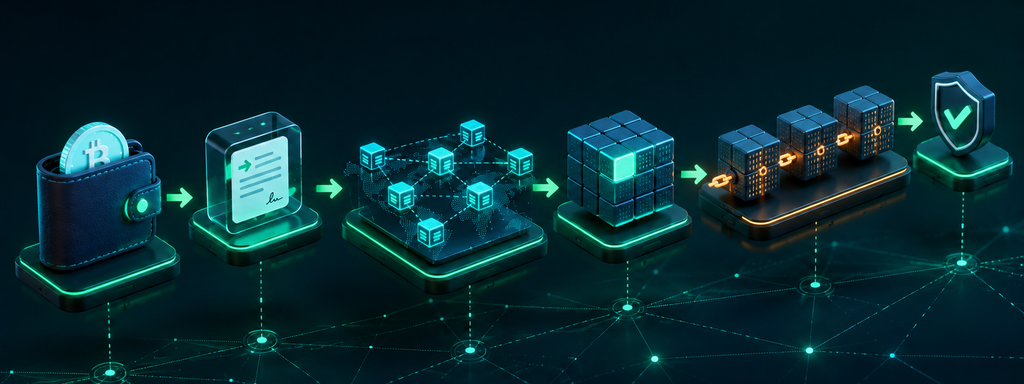

If you've ever sent cryptocurrency from one wallet to another, you've probably wondered what actually happens after you click "Send." While the process may seem instant from the user's perspective, a blockchain transaction goes through several important steps before it becomes a permanent part of the blockchain.
Understanding how transactions work helps explain why confirmations take time, why network fees exist, and how decentralized networks prevent fraud without relying on banks or other central authorities.
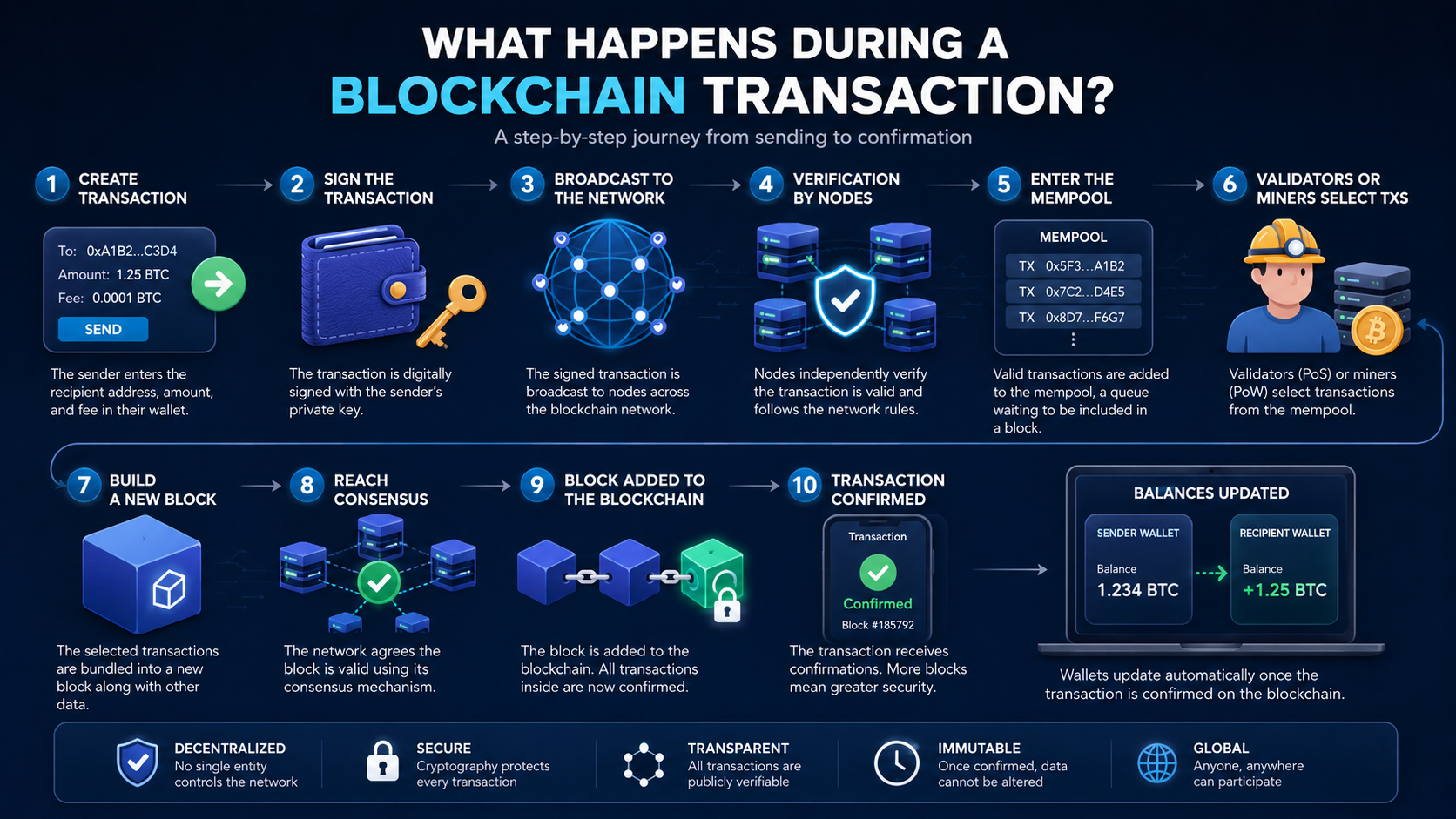
Creating the Transaction
Every blockchain transaction begins in a wallet application. A wallet doesn't actually store cryptocurrency. Instead, it stores the private keys that allow you to access and control your digital assets on the blockchain.
When you decide to send cryptocurrency, your wallet asks you to enter several pieces of information:
- The recipient's wallet address
- The amount to send
- An optional message or memo (on supported blockchains)
- A network fee
After reviewing the details, your wallet creates a transaction containing all of this information.
At this stage, nothing has been sent yet. The transaction simply exists as digital data waiting to be authorized.
Signing the Transaction
Before the transaction can leave your wallet, it must be digitally signed using your private key.
This signature proves two important things:
- You own the funds you're trying to spend.
- The transaction has not been altered after you approved it.
The private key never leaves your device. Instead, it creates a cryptographic signature that anyone on the network can verify using your public key.
This process is what makes blockchain transactions both secure and trustless.
Broadcasting to the Network
Once signed, the wallet broadcasts the transaction to nearby nodes.
Nodes are computers participating in the blockchain network. Thousands of nodes around the world receive and share new transactions with one another.
Within seconds, the transaction spreads across the global network.
At this point, the transaction is considered unconfirmed because it has not yet been added to the blockchain.
Verification by Nodes
Each node independently checks whether the transaction is valid.
Typical verification includes:
- Is the digital signature correct?
- Does the sender actually own the funds?
- Have those funds already been spent?
- Does the transaction follow the blockchain's rules?
- Is the transaction format valid?
If any of these checks fail, the transaction is rejected.
Because every node performs these checks independently, there is no central authority deciding whether a transaction is legitimate.
Entering the Mempool
Valid transactions are placed into a waiting area called the mempool (short for memory pool).
The mempool acts like a queue of transactions waiting to be included in the next block.
During busy periods, thousands or even millions of transactions may be waiting simultaneously.
Many blockchains prioritize transactions offering higher network fees, since validators or miners typically earn these fees as part of their reward.
This is why paying a higher fee can sometimes result in faster confirmations.
Validators or Miners Select Transactions
The next step depends on the blockchain's consensus mechanism.
Proof of Work
On Proof of Work blockchains such as Bitcoin, miners compete to solve complex mathematical puzzles.
The winning miner earns the right to create the next block and usually fills it with transactions from the mempool.
Proof of Stake
On Proof of Stake blockchains like Ethereum, Cardano, Solana, Avalanche, and many others, validators are selected according to the network's consensus rules.
Validators verify transactions, assemble new blocks, and receive rewards for helping secure the network.
Although the mechanisms differ, the goal is the same: deciding which valid transactions become part of the blockchain.
Building a New Block
A new block contains much more than a list of transactions.
It typically includes:
- A reference to the previous block
- A timestamp
- Hundreds or thousands of transactions
- Various cryptographic values used by the network
Each block is connected to the previous one, creating the blockchain itself.
Changing any transaction would alter the block's cryptographic fingerprint, immediately revealing tampering.
Reaching Consensus
Before a block becomes part of the blockchain, the network must agree that it is valid.
Consensus mechanisms ensure that honest participants reach the same version of the blockchain, even though there is no central coordinator.
Once consensus is achieved, the block is officially added to the chain.
Every transaction inside that block is now confirmed.
Transaction Confirmations
A confirmation means that your transaction has been included in a block.
Each additional block built on top of it increases the transaction's security.
For example:
- 1 confirmation means the transaction is included in the blockchain.
- 3 confirmations make reversing it significantly more difficult.
- 6 confirmations are often considered highly secure on Bitcoin for larger payments.
Different blockchains and applications require different numbers of confirmations depending on their security models.
Some modern blockchains provide near-instant transaction finality, while others rely on multiple confirmations over time.
Updating Wallet Balances
After confirmation, every node updates its copy of the blockchain.
Wallet software notices the confirmed transaction and updates the displayed balances.
The recipient can now spend the newly received cryptocurrency according to the network's confirmation requirements.
Although the wallet interface appears simple, thousands of computers have independently verified and agreed upon the transaction behind the scenes.
Why Network Fees Matter
Network fees are often misunderstood.
Contrary to popular belief, they are not paid to a company or bank.
Instead, fees typically serve several purposes:
- Reward validators or miners
- Prevent spam transactions
- Help prioritize transactions during congestion
- Support overall network security
Fee structures vary significantly between blockchains.
Some networks consistently have very low fees, while others can become more expensive during periods of heavy demand. A few cryptocurrencies, such as Nano, operate without transaction fees using different network designs.
What Happens If Something Goes Wrong?
Not every transaction succeeds.
A transaction might fail if:
- The network fee is too low.
- The sender doesn't have enough funds.
- The digital signature is invalid.
- The transaction conflicts with another one.
- A smart contract execution fails.
On some blockchains, even failed smart contract transactions may still consume network fees because validators performed computational work while processing them.
Why Blockchain Transactions Are Secure
Several technologies work together to secure every transaction:
- Public-key cryptography protects ownership.
- Digital signatures prove authorization.
- Decentralized nodes independently verify transactions.
- Consensus mechanisms prevent fraudulent blocks.
- Cryptographic hashing protects the integrity of the blockchain.
- Thousands of distributed copies make altering history extremely difficult.
Instead of trusting a single institution, users trust mathematics, cryptography, and decentralized consensus.
Common Misconceptions
"My crypto is inside my wallet."
Wallets store private keys, not the cryptocurrency itself. Your assets remain recorded on the blockchain.
"Transactions are always instant."
Some networks confirm transactions within seconds, while others may take several minutes or longer depending on congestion and the blockchain's design.
"The fee goes to the wallet provider."
In most cases, network fees are paid to miners or validators, not to the wallet application.
"Once I click Send, it cannot fail."
Transactions can still be rejected, delayed, replaced (on supported networks), or fail if network rules are not satisfied.
Final Thoughts
A blockchain transaction is much more than moving digital coins from one wallet to another. Behind every payment is a carefully designed process involving cryptography, decentralized verification, consensus, and permanent record keeping.
From the moment you sign a transaction until it receives confirmations on the blockchain, thousands of independent computers work together to verify its validity without requiring a central authority. This coordinated process is one of the key innovations that makes blockchain technology secure, transparent, and reliable.
Understanding what happens during a blockchain transaction not only helps explain confirmation times and network fees, but also provides a deeper appreciation for the technology powering cryptocurrencies and many decentralized applications.



Pick your reaction
Post your comment