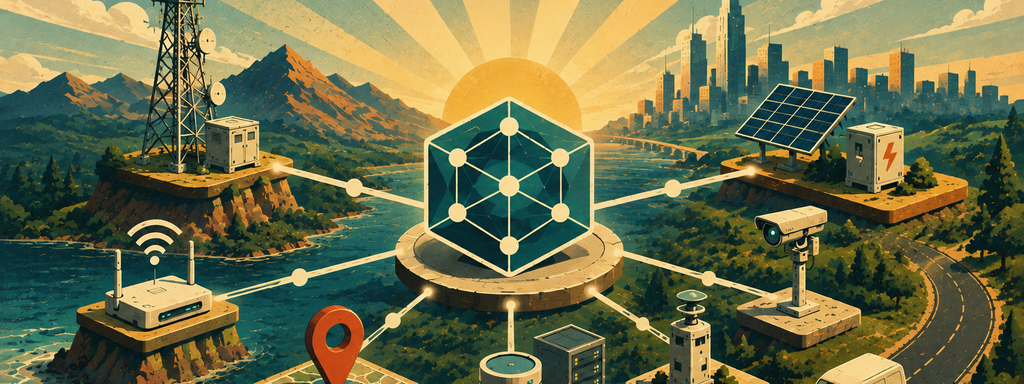

Blockchain technology is usually associated with digital assets, decentralized finance, NFTs, and online applications. DePIN takes the idea of decentralization beyond the digital world by connecting blockchain networks with physical infrastructure.
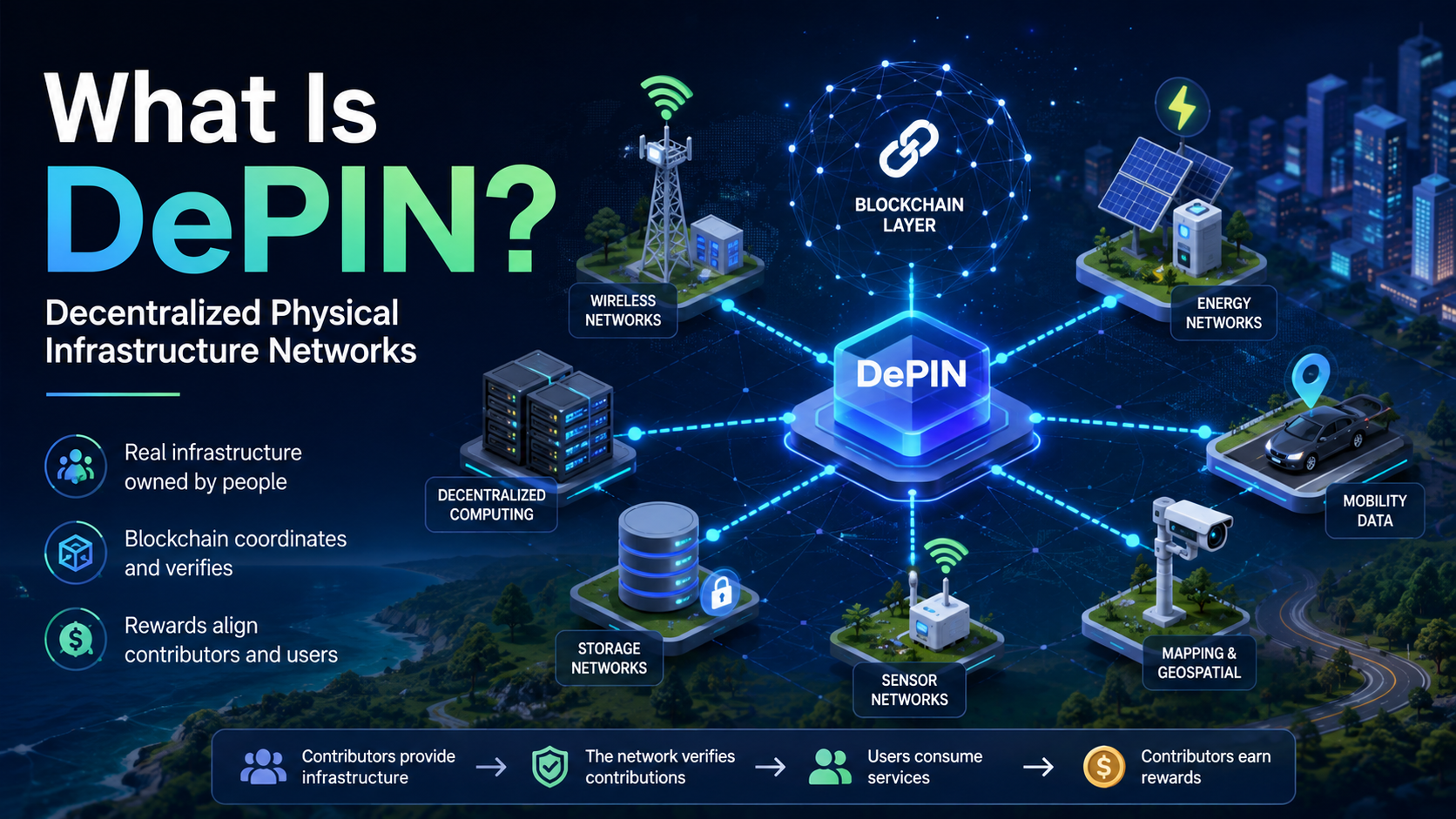
DePIN stands for Decentralized Physical Infrastructure Networks. These networks use blockchain technology, digital incentives, and distributed communities to build or operate real-world infrastructure such as wireless networks, computing resources, data storage, energy systems, sensors, and mapping services.
Instead of relying entirely on a single company to purchase equipment and deploy infrastructure, DePIN projects can encourage thousands of independent participants to contribute hardware, resources, or services. In return, contributors may receive cryptocurrency or other digital rewards.
The result is an emerging model in which physical infrastructure can be built from the bottom up, with blockchain providing coordination, payments, ownership records, and economic incentives.
What Does DePIN Mean?
The term DePIN, short for Decentralized Physical Infrastructure Networks, describes blockchain-based networks that coordinate physical resources contributed by many independent participants.
Traditional infrastructure is usually developed through centralized organizations. A telecommunications company installs cell towers. A cloud provider builds data centers. An energy company operates power infrastructure.
A DePIN network approaches the problem differently.
Rather than having one organization provide all of the necessary infrastructure, the network allows individuals and businesses to contribute their own resources. Depending on the project, participants might provide:
- Wireless hotspots
- Internet bandwidth
- Computer processing power
- Graphics processing units
- Data storage
- Sensors
- Cameras
- Mapping data
- Energy generation
- Battery capacity
- Vehicle data
Blockchain technology provides a shared system for recording contributions and distributing rewards according to the rules of the network.
The physical equipment remains in the real world, but the coordination layer can operate through decentralized software and blockchain protocols.
How Does DePIN Work?
Although individual DePIN projects can be very different, many follow a similar basic structure.
A project first creates a network that requires some type of physical resource. This could be wireless coverage, computing capacity, storage space, geographic information, or environmental data.
Participants then contribute resources to that network.
For example, someone might install a compatible wireless hotspot in their home. Another participant might provide unused GPU capacity from a computer. A driver could contribute mapping information collected by a vehicle-mounted device.
The network verifies these contributions using software, hardware, cryptographic proofs, or other validation mechanisms.
Participants who provide useful resources can then receive rewards, often in the form of the project's native cryptocurrency token.
Meanwhile, customers or applications can pay to use the infrastructure.
This creates a basic economic loop:
Contributors provide infrastructure → the network verifies contributions → users consume services → contributors receive rewards.
The exact mechanics vary significantly between projects, but this relationship between physical resources, network demand, and digital incentives is at the center of the DePIN concept.
Why Use Blockchain for Physical Infrastructure?
It might seem unusual to involve blockchain technology in something as physical as wireless coverage or computing hardware.
However, distributed infrastructure creates a coordination problem.
If thousands of unrelated people are providing resources, the network needs mechanisms to determine who contributed what, whether those contributions were legitimate, and how participants should be compensated.
Blockchain networks can provide a transparent and programmable coordination layer.
Smart contracts can automate payments and incentives. Tokens can reward contributors. Cryptographic systems can help verify certain activities. Public ledgers can make economic activity easier to audit.
Blockchain can therefore act as the connective tissue between participants who may not know or trust one another.
Importantly, blockchain does not replace the physical infrastructure itself. A blockchain cannot create wireless coverage, generate electricity, or provide GPU processing without real hardware.
Instead, it helps coordinate the people and machines providing those resources.
The Main Categories of DePIN
DePIN is an umbrella term covering several different types of infrastructure.
Wireless Networks
Decentralized wireless networks allow participants to deploy hotspots, antennas, or other networking equipment.
Rather than a telecommunications provider building every piece of infrastructure itself, individuals can help expand network coverage.
Participants may receive rewards based on factors such as coverage, location, network activity, or actual usage.
This model has been explored for technologies including Wi-Fi, LoRaWAN, 5G, and other wireless communication systems.
Computing Networks
Artificial intelligence, scientific computing, 3D rendering, gaming, and other applications can require enormous amounts of computing power.
DePIN projects can create marketplaces where participants contribute unused CPU or GPU resources.
Users who need computing capacity can access resources from distributed providers rather than relying exclusively on centralized cloud platforms.
The rapid growth of AI has made decentralized GPU networks an especially visible part of the DePIN sector.
Decentralized Storage
Storage networks distribute files or data across computers operated by independent participants.
Providers contribute available disk space and receive rewards for storing or serving data.
Instead of storing everything inside data centers controlled by one company, information can be distributed across a broader network.
Mapping and Geospatial Networks
Creating detailed maps requires enormous amounts of real-world information.
Some decentralized networks reward participants for collecting geographic data using cameras, smartphones, vehicles, sensors, or specialized devices.
This information can potentially be used for navigation, logistics, urban planning, autonomous systems, and other location-based applications.
Sensor Networks
Physical sensors can collect information about the surrounding environment.
This might include weather conditions, air quality, noise levels, traffic, radiation, or other measurements.
A decentralized sensor network can combine information from independently operated devices and create datasets that applications or organizations can access.
Energy Networks
Energy is another area where decentralized infrastructure models are being explored.
Households and businesses increasingly operate solar panels, batteries, electric vehicles, and other distributed energy resources.
Blockchain-based systems can potentially help coordinate energy production, storage, consumption, and transactions between participants.
This area remains complex because energy markets are heavily influenced by local infrastructure and regulation.
What Are DePIN Tokens Used For?
Tokens often play an important role in DePIN networks because they provide economic incentives for participants.
A project may distribute tokens to people who install hardware, provide computing resources, store data, collect information, or otherwise contribute useful infrastructure.
Tokens can also have additional purposes.
Depending on the network, they might be used to pay for services, participate in governance, provide collateral, access network resources, or reward operators.
The goal is often to create an incentive system that encourages infrastructure growth before the network has enough traditional revenue to compensate every contributor directly.
This can help solve one of the biggest challenges faced by new infrastructure networks: getting enough participants to make the service useful.
The DePIN Flywheel
One idea frequently associated with DePIN is the flywheel effect.
Imagine a decentralized wireless network.
Initially, the network has very little coverage. Because coverage is limited, few customers want to use it.
The project introduces token rewards to encourage people to install hotspots.
More participants join and coverage expands.
Better coverage makes the network more useful, potentially attracting more customers. Increased usage generates more demand for the infrastructure, which can make operating equipment more attractive.
Ideally, this creates a cycle:
Rewards attract contributors → contributors expand infrastructure → better infrastructure attracts users → user demand creates revenue → revenue strengthens incentives for contributors.
If this cycle works, the network can gradually become less dependent on speculative token incentives and more dependent on actual demand for its services.
That final transition is particularly important.
DePIN vs Traditional Infrastructure
Traditional infrastructure networks usually require substantial upfront investment.
A company may need to purchase land, construct facilities, install equipment, hire employees, and maintain the entire system.
DePIN attempts to distribute some of those costs.
Instead of purchasing every device itself, a network can encourage participants to buy or contribute hardware. Instead of maintaining one enormous centralized resource pool, capacity can come from thousands of independent operators.
This approach can potentially allow networks to expand quickly and reach locations that might not be economically attractive for traditional providers.
However, decentralization also introduces new challenges.
A centralized company has direct control over its equipment. A decentralized network must coordinate hardware owned by many different people, potentially using different configurations and operating under different conditions.
This can make reliability, quality control, maintenance, and verification considerably more complicated.
What Is Proof of Physical Work?
Some DePIN projects use mechanisms sometimes described as Proof of Physical Work.
The general idea is to reward participants for demonstrating that they have performed useful activity in the physical world.
For example, a network might attempt to verify that a wireless hotspot is providing legitimate coverage, that a mapping device has collected new geographic information, or that a storage provider is actually storing requested data.
The terminology and verification mechanisms differ between projects.
The difficult part is connecting blockchain records with reality.
A blockchain can verify digital signatures very effectively. Determining whether a physical device actually performed useful work at a particular location is much harder.
For this reason, DePIN networks may combine cryptography with hardware authentication, location verification, peer validation, challenges, reputation systems, or other techniques.
The Challenge of Verifying the Physical World
One of the most important challenges facing DePIN is ensuring that rewards correspond to genuinely useful contributions.
If a network rewards people simply for reporting activity, participants may attempt to manipulate the system.
Someone could create fake devices, falsify locations, simulate network traffic, duplicate sensor information, or otherwise try to earn rewards without providing meaningful infrastructure.
Projects therefore need mechanisms for distinguishing legitimate contributions from fraudulent ones.
This problem becomes particularly difficult because blockchains cannot directly observe the physical world.
A smart contract knows what data it receives. It does not automatically know whether that data accurately represents reality.
Strong verification systems are therefore essential for sustainable DePIN networks.
Token Incentives Can Be Both Powerful and Dangerous
Tokens can help decentralized networks grow extremely quickly.
Instead of waiting years for infrastructure demand to develop naturally, projects can immediately reward early participants for deploying hardware.
But incentives can also create distorted behavior.
If token rewards are worth significantly more than the actual services being provided, participants may join primarily to earn tokens rather than because customers need the infrastructure.
This can lead to large networks that appear impressive on paper but generate relatively little real-world usage.
Falling token prices can then make operating equipment less attractive, potentially causing participants to leave.
For this reason, one of the most useful questions when evaluating a DePIN project is not simply:
How many devices are connected?
It is also:
How much genuine demand exists for the service those devices provide?
DePIN and Artificial Intelligence
Artificial intelligence has created new opportunities for DePIN, particularly around computing infrastructure.
Training and running advanced AI models requires significant computational resources, especially GPUs.
Demand for high-performance computing has increased rapidly, while access to suitable hardware can be expensive or constrained.
Decentralized computing networks attempt to connect people and organizations that own available computing resources with customers who need them.
In theory, this could create global marketplaces for computing power where capacity from many independent providers can be combined.
AI applications may also benefit from decentralized sensor, mapping, and data networks.
Physical infrastructure generates enormous quantities of real-world data. DePIN systems could provide mechanisms for collecting and distributing some of that information to AI developers and applications.
Is DePIN Really Decentralized?
The word "decentralized" can mean very different things depending on the project.
A DePIN network might have thousands of independent hardware operators while development remains controlled by a single company.
Another network might decentralize infrastructure ownership but rely heavily on centralized servers.
Token distribution, governance, software development, hardware manufacturing, and network access can each have different levels of decentralization.
As a result, simply describing a project as DePIN does not automatically mean every part of the system is decentralized.
Users should examine how the network actually operates.
Risks and Challenges of DePIN
DePIN combines blockchain technology with physical infrastructure, which means it inherits challenges from both worlds.
Hardware can fail. Equipment can become obsolete. Installation may be expensive. Local regulations can restrict certain services.
At the same time, token prices can fluctuate dramatically, smart contracts can contain vulnerabilities, and incentive systems can be exploited.
Other challenges include:
- Maintaining consistent service quality
- Preventing fraudulent contributions
- Creating sustainable demand
- Managing hardware supply chains
- Competing with established infrastructure companies
- Meeting regulatory requirements
- Protecting user privacy
- Scaling verification systems
- Avoiding excessive dependence on token rewards
A project that successfully distributes thousands of devices has not necessarily built a sustainable business.
Long-term success depends on whether the infrastructure provides something people or organizations are willing to use and pay for.
How to Evaluate a DePIN Project
DePIN projects can be difficult to compare because they operate in very different industries.
Still, several questions can help when researching a network.
What physical resource does the network provide?
Who actually needs that resource?
How are contributions verified?
Who owns and operates the hardware?
What does it cost to participate?
Where do rewards come from?
Are customers paying for the service, or are most incentives funded through token issuance?
How decentralized is the infrastructure in practice?
What happens if token rewards decline significantly?
Does the network provide an advantage over existing centralized alternatives?
These questions can help separate infrastructure with meaningful utility from systems primarily designed around token incentives.
Why DePIN Matters
DePIN represents an interesting expansion of blockchain technology beyond purely digital applications.
Instead of using blockchains only to transfer assets or execute smart contracts, these networks attempt to coordinate real machines, resources, and services.
The broader idea is significant.
Millions of people already own computers, storage devices, internet connections, vehicles, solar panels, batteries, smartphones, and sensors. Much of this infrastructure is underused.
DePIN asks whether decentralized networks can organize those resources into useful shared systems.
If successful, this model could create infrastructure networks that are more open to participation and less dependent on a small number of centralized operators.
But the technology alone does not guarantee success.
The strongest DePIN networks will likely be those that combine effective decentralization with reliable physical infrastructure, strong verification mechanisms, sensible incentives, and genuine customer demand.
The Future of DePIN
DePIN remains a developing sector, and many experiments will likely fail or change significantly over time.
However, the underlying concept extends far beyond cryptocurrency speculation.
Wireless connectivity, cloud computing, AI infrastructure, energy systems, mapping, storage, transportation data, and environmental monitoring are enormous industries. Even a small shift toward community-operated infrastructure could create new economic models.
The key question is whether decentralized networks can provide these services competitively while maintaining reliability and preventing abuse.
If they can, blockchain networks may become more than financial infrastructure. They could become coordination systems for infrastructure in the physical world.
Conclusion
DePIN, or Decentralized Physical Infrastructure Networks, combines blockchain technology with real-world hardware and resources.
Instead of requiring a single company to own and operate an entire infrastructure network, DePIN projects allow individuals and organizations to contribute equipment, computing capacity, storage, connectivity, data, energy, and other resources.
Tokens and blockchain protocols help coordinate these participants and reward useful contributions.
The concept has enormous potential, but sustainable DePIN networks need more than token incentives. They need reliable infrastructure, effective verification, competitive services, and genuine demand.
DePIN is therefore best understood not simply as another category of crypto projects, but as an experiment in building physical infrastructure through decentralized economic coordination.
Pick your reaction
Post your comment