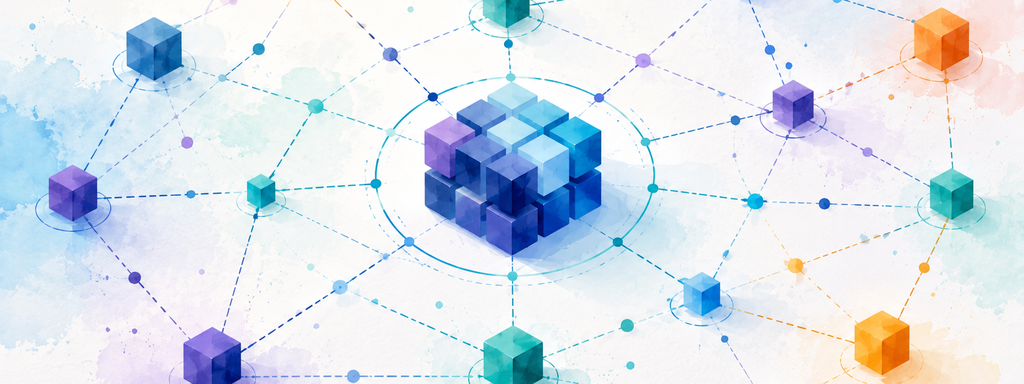

Blockchain is often described as a decentralized technology, but not every blockchain is decentralized to the same degree. Some networks are highly distributed across thousands of participants worldwide, while others rely on a relatively small number of organizations to validate transactions and make decisions.
Understanding decentralization is important because it influences security, censorship resistance, reliability, governance, and the overall trustworthiness of a blockchain network. In this article, we'll explore what decentralization really means, the factors that determine it, its advantages and disadvantages, and why it remains one of the defining characteristics of blockchain technology.
What Does Decentralization Mean?
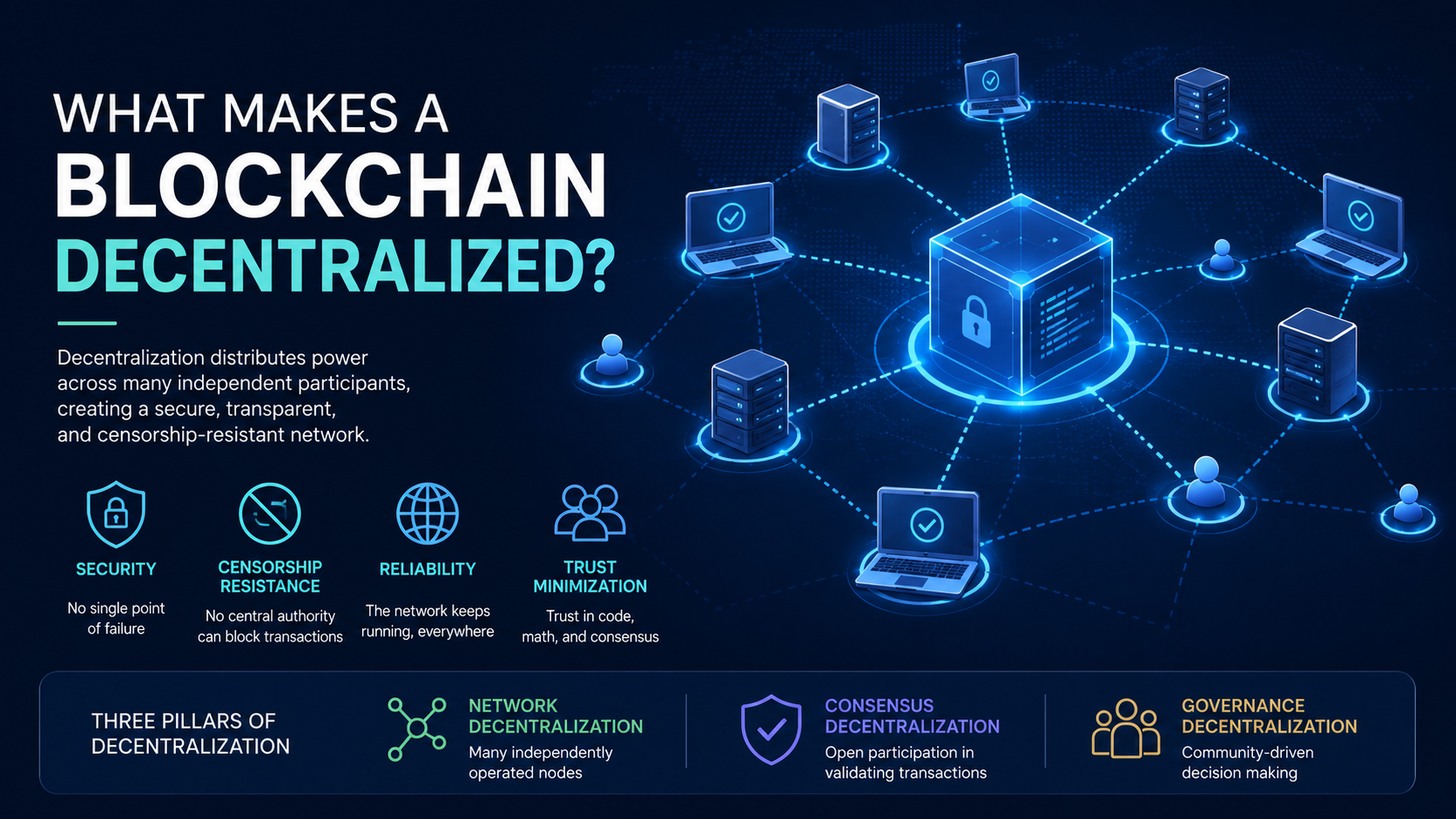
Decentralization means that control over a blockchain network is spread among many independent participants rather than being held by a single company, government, or organization.
Traditional systems usually have a central authority responsible for maintaining records, approving transactions, and enforcing rules. Banks, social media platforms, and online marketplaces all operate this way.
A decentralized blockchain works differently. Instead of trusting one central operator, thousands of independent computers—called nodes—work together to verify transactions, store copies of the blockchain, and enforce the network's rules.
The more independent these participants are, the more decentralized the network becomes.
The Three Types of Blockchain Decentralization
Decentralization is not a single characteristic. It exists across several different dimensions.
1. Network Decentralization
This refers to how many computers participate in maintaining the blockchain.
A highly decentralized network has:
- Thousands of independently operated nodes
- Geographic distribution across many countries
- Multiple internet providers
- No single point of failure
If a few nodes go offline, the network continues operating normally.
2. Consensus Decentralization
Consensus determines who can validate transactions and create new blocks.
Different blockchains use different consensus mechanisms:
- Proof of Work (Bitcoin, Kaspa, Litecoin)
- Proof of Stake (Ethereum, Cardano, Solana)
- Delegated Proof of Stake (EOS, WAX, TRON)
- Other specialized mechanisms
Some systems allow anyone meeting the technical requirements to participate, while others limit validation to a relatively small number of validators.
Generally, the more participants involved in consensus, the more decentralized the network.
3. Governance Decentralization
Governance refers to how decisions about the blockchain are made.
Examples include:
- Software upgrades
- Protocol changes
- Security improvements
- Monetary policy
- Transaction fee adjustments
In decentralized governance, no single organization can unilaterally change the rules. Instead, changes require broad agreement among developers, validators, miners, node operators, and the wider community.
Why Decentralization Matters
Security
A decentralized network is much harder to attack.
An attacker would need to compromise a large percentage of validators or miners instead of targeting a single server.
This significantly increases the cost and complexity of attacks.
Censorship Resistance
Because there is no central authority controlling transactions, it becomes extremely difficult for governments, companies, or individuals to block legitimate transactions.
Even if some validators refuse to process certain transactions, others can continue to include them.
Reliability
Centralized systems can suffer outages if their servers fail.
Decentralized blockchains continue functioning even if hundreds or thousands of nodes disconnect.
The remaining participants keep the network running.
Trust Minimization
Users do not need to trust one company.
Instead, they trust:
- Open-source software
- Mathematical cryptography
- Consensus rules
- Independent verification
This is often summarized by the phrase:
"Don't trust. Verify."
What Makes a Blockchain Truly Decentralized?
Many factors contribute to decentralization.
Large Number of Nodes
The more independently operated nodes a blockchain has, the more difficult it becomes for anyone to control the network.
A blockchain with tens of thousands of nodes is generally more resilient than one with only a few dozen.
Independent Validators
Validators should ideally be operated by different individuals, companies, and organizations.
If one company controls a majority of validators, decentralization is weakened.
Open Participation
Anyone should be able to:
- Run a node
- Verify transactions
- Join the network
- Participate in consensus (where applicable)
High hardware requirements or expensive staking requirements can reduce participation.
Geographic Distribution
Nodes should be spread across multiple countries and continents.
This protects the network against:
- Local power outages
- Natural disasters
- Internet disruptions
- Government restrictions
Open Source Software
Most decentralized blockchains publish their source code publicly.
Anyone can inspect it, verify how it works, and contribute improvements.
Open-source development also makes hidden backdoors far less likely.
Diverse Development Teams
If only one company develops the blockchain software, it gains significant influence over the network.
Healthy ecosystems often have:
- Multiple development teams
- Independent client software
- Community contributions
- Open discussions
This reduces dependence on any single organization.
Common Misconceptions
"Blockchain Automatically Means Decentralized"
Not necessarily.
Some private blockchains are controlled by one company.
Others may have only a handful of validators.
While they use blockchain technology, they may not provide the same decentralization as public blockchain networks.
"More Validators Always Means Better"
Quantity matters, but quality matters too.
If thousands of validators are all controlled by the same organization, decentralization remains limited.
Ownership diversity is just as important as validator count.
"Fast Networks Cannot Be Decentralized"
This is an ongoing area of research.
Many newer blockchains are exploring ways to improve scalability while maintaining strong decentralization.
Different projects make different trade-offs between speed, cost, and decentralization.
The Blockchain Trilemma
One of the most well-known ideas in blockchain is the Blockchain Trilemma.
It suggests that blockchains must balance three competing goals:
- Decentralization
- Security
- Scalability
Improving one area often affects the others.
For example:
- Larger blocks can increase transaction throughput but make running a node more expensive.
- Very fast block times may increase hardware requirements.
- Fewer validators can improve speed but reduce decentralization.
Different blockchain projects prioritize these trade-offs differently depending on their goals.
Examples of Different Approaches
Different blockchain networks pursue decentralization in different ways.
Bitcoin prioritizes decentralization and security through Proof of Work and a large global network of independently operated nodes.
Ethereum combines Proof of Stake with a large validator set while continuing to expand scalability through Layer 2 solutions.
Some enterprise blockchains intentionally limit participation because they are designed for private business environments rather than public use.
None of these approaches is universally "best"—they simply serve different purposes.
Challenges of Decentralization
While decentralization offers many benefits, it also comes with trade-offs.
Slower Decision Making
Without central leadership, major protocol upgrades often require extensive discussion and community agreement.
This can slow innovation.
Lower Transaction Throughput
Maintaining consensus across thousands of participants may reduce transaction speed compared to centralized systems.
Many blockchains address this through Layer 2 networks, sidechains, or other scaling technologies.
Resource Requirements
Operating nodes, validators, or mining equipment requires:
- Hardware
- Internet connectivity
- Electricity
- Technical knowledge
Encouraging broad participation remains an ongoing challenge.
Can a Blockchain Become More or Less Decentralized?
Yes.
Decentralization is not fixed.
A blockchain may become more decentralized over time as:
- More nodes join
- More validators participate
- Development becomes more diverse
- Governance becomes more community-driven
Conversely, decentralization can decrease if:
- Validator power becomes concentrated
- Mining pools dominate block production
- Development becomes controlled by one organization
- Participation barriers increase
Many blockchain communities actively monitor these factors to preserve the health of their networks.
Why Decentralization Remains Important
Decentralization is one of the core innovations that distinguishes blockchain from traditional databases.
Rather than relying on a central authority, decentralized networks distribute trust among thousands of independent participants. This makes blockchains more resistant to censorship, outages, manipulation, and single points of failure.
Although no blockchain is perfectly decentralized, many public networks continuously work toward improving their distribution of nodes, validators, governance, and development. Understanding these factors helps users evaluate different blockchain projects beyond marketing claims and better appreciate the trade-offs each network makes in pursuit of security, scalability, and openness.

Pick your reaction
Post your comment