

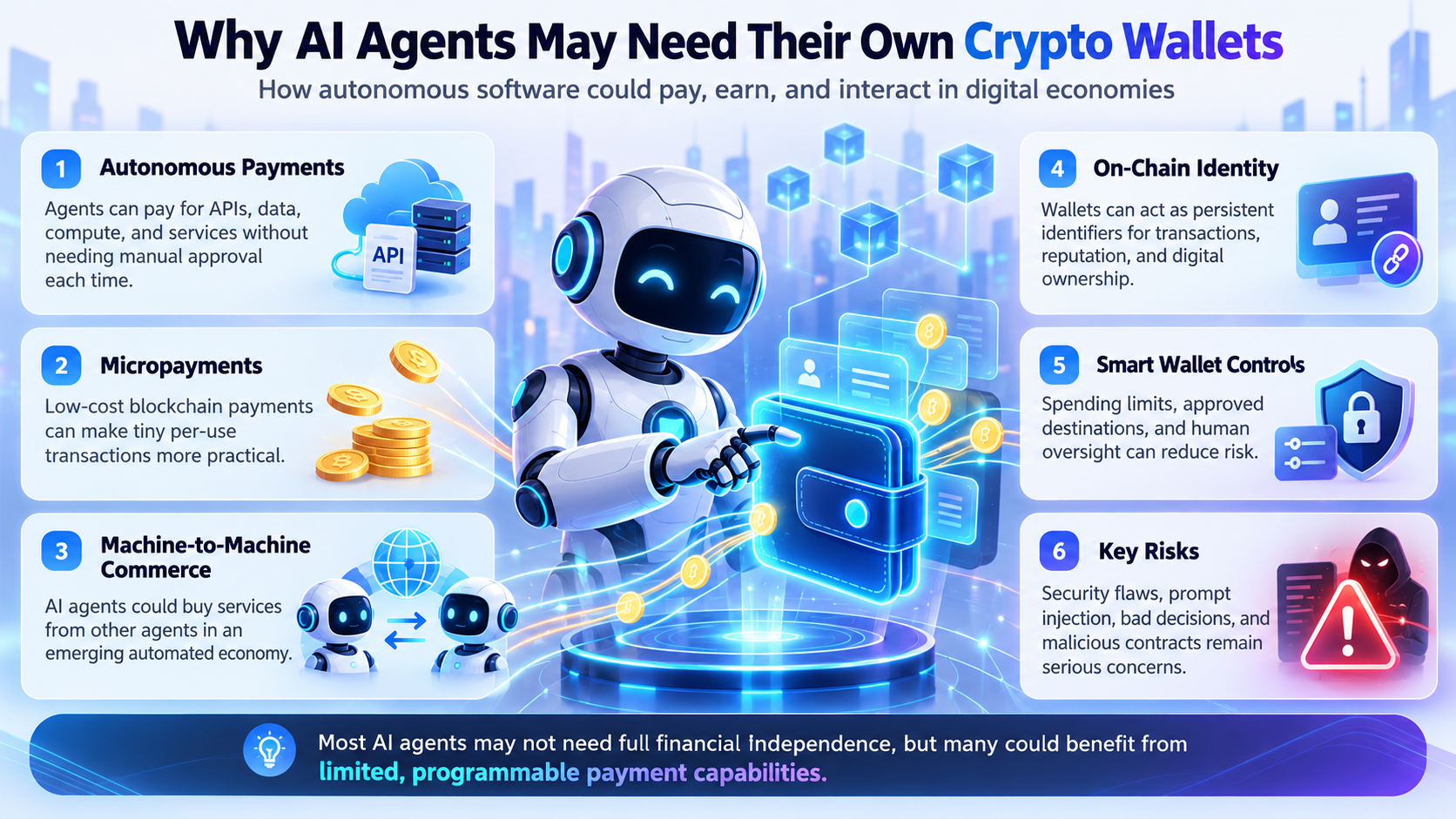
Artificial intelligence is evolving from systems that simply answer questions into autonomous agents capable of performing tasks, making decisions, and interacting with digital services. As these AI agents become more independent, they may need something traditionally associated with humans: their own wallets.
Cryptocurrency wallets could allow AI agents to pay for services, receive rewards, manage digital assets, and interact with blockchain applications without requiring human approval for every transaction. This combination of artificial intelligence and decentralized finance could create new opportunities for automated economies where software agents exchange value directly.
But why would an AI agent need a crypto wallet, how would it work, and what challenges would come with giving software the ability to manage money?
What Are AI Agents?
AI agents are software systems designed to perform tasks with varying degrees of autonomy. Unlike traditional chatbots that primarily respond to user requests, AI agents can plan activities, use external tools, evaluate information, and take actions to achieve specific objectives.
For example, an AI agent might:
- Research products and compare prices across different websites.
- Manage online advertising campaigns and adjust budgets.
- Monitor financial markets and execute predefined strategies.
- Purchase access to APIs, datasets, or computing resources.
- Coordinate tasks with other AI agents.
- Manage digital services, subscriptions, or infrastructure.
While conventional automation follows predefined instructions, more advanced AI agents can adapt their actions based on changing conditions.
However, an important limitation remains: most digital payment systems were designed around human users, businesses, and conventional account structures.
An agent might independently determine that it needs additional computing power, but purchasing that computing power could still require a human to enter payment information or approve a transaction.
Cryptocurrency wallets offer one potential way to reduce this dependency.
Why Traditional Payment Systems Can Be Difficult for AI Agents
Traditional financial systems rely heavily on bank accounts, payment cards, identity verification, and centralized service providers.
These mechanisms serve important purposes, including fraud prevention, regulatory compliance, and consumer protection. However, they can introduce complications when software needs to make frequent, automated payments.
For example, imagine an AI research agent that needs information from several specialized data providers.
Each provider might require a separate account, subscription, or payment method. The agent would need access to those accounts before retrieving the information.
This creates several challenges.
Account requirements: Many payment services require a legally recognized individual or organization to register and maintain an account.
Human intervention: Certain transactions require additional authentication, approval, or verification.
Transaction costs: Fixed processing fees can make extremely small payments economically impractical.
Cross-border restrictions: International payments may involve additional costs, settlement delays, or geographic limitations.
Integration complexity: Different providers may require separate billing systems and credentials.
These limitations do not make traditional payment systems unsuitable for all AI agents. In fact, many agents can operate effectively using conventional payment APIs.
However, blockchain-based payments introduce an alternative that may be particularly useful when autonomous software needs to exchange small amounts of value frequently.
How a Crypto Wallet Could Work for an AI Agent
A cryptocurrency wallet allows its controller to authorize blockchain transactions, receive digital assets, and interact with compatible decentralized applications.
Technically, a wallet does not store cryptocurrency in the same way a physical wallet stores cash. Digital assets are recorded on a blockchain, while cryptographic keys or other authorization mechanisms control access to them.
For an AI agent, a wallet could function as a financial interface connected to its decision-making system.
Consider a simplified example:
- A developer creates an AI agent responsible for researching cryptocurrency markets.
- The developer assigns the agent a wallet with a limited balance.
- The agent identifies a paid data service that provides relevant market information.
- The agent checks whether the requested information fits its assigned budget and permissions.
- An authorized wallet service executes the payment.
- The agent receives the data and continues its analysis.
The entire process could happen without a person manually approving each small transaction.
However, the agent would not necessarily have unrestricted control over the wallet.
Developers could establish spending limits, approved destinations, and additional authorization requirements to prevent unwanted transactions.
This distinction is important. Giving an AI agent access to a wallet does not have to mean giving it complete control over the assets inside it.
Why Cryptocurrency Could Be Useful for Autonomous Payments
Cryptocurrency offers several characteristics that could make it attractive for machine-to-machine payments.
1. Programmable Payments
Blockchain transactions can be integrated into software workflows, allowing payments to occur when specific conditions are satisfied.
For example, an AI agent could be authorized to pay for data only when the requested information meets certain predefined requirements.
Smart contracts can also coordinate transactions between multiple participants.
An agent might deposit funds into a smart contract that releases payment after a service has been delivered and verified.
However, verifying whether an off-chain service was completed correctly remains challenging. Smart contracts cannot automatically determine the quality or accuracy of external information without reliable verification mechanisms.
2. Micropayments
Many automated services involve small individual transactions.
An AI agent might need to purchase:
- A single API request.
- A few seconds of computing time.
- Access to one research document.
- A specific dataset.
- An individual image or media asset.
Traditional payment processing fees can be disproportionately expensive for these small purchases.
Blockchain networks with sufficiently low transaction costs could make such micropayments more practical.
For example, rather than purchasing a monthly subscription to a data provider, an AI agent could potentially pay only for the individual requests it needs.
The feasibility depends on network fees, settlement mechanisms, service-provider support, and the payment infrastructure involved.
3. Global Accessibility
Blockchain networks generally operate across national borders without requiring every transaction to pass through a traditional international banking network.
This could help AI agents interact with service providers in different countries.
A software agent operating on a server in Germany, for example, could potentially pay a compatible service provider in Japan using the same blockchain payment infrastructure.
However, global technical accessibility does not remove financial regulations, sanctions requirements, taxation, or other legal obligations.
The individuals and organizations operating these agents remain responsible for applicable rules.
4. Automated Settlement
Many blockchain transactions can settle without the batch-processing schedules commonly associated with traditional banking systems.
Depending on the network, transactions may reach practical finality relatively quickly.
This could be useful when an AI agent needs immediate access to a service after payment.
Different blockchain networks offer different settlement times, costs, and security properties, so selecting an appropriate network would be an important design decision.
5. Verifiable Transaction Records
Public blockchains provide records of transactions that can be independently inspected.
For businesses deploying AI agents, this could improve visibility into how funds are being transferred.
A company could review the payments made by an agent, identify unusual spending patterns, and reconcile blockchain activity with its internal accounting systems.
However, a blockchain transaction alone does not prove that a payment was authorized, necessary, or associated with a legitimate service.
Additional records and monitoring would still be required.
AI Agents Paying Other AI Agents
One of the more interesting possibilities is an economy where AI agents purchase services directly from other agents.
Imagine three specialized software agents working together:
Research Agent: Collects and evaluates information from external sources.
Analysis Agent: Processes the information and produces forecasts or recommendations.
Presentation Agent: Converts the results into reports, charts, or other content.
Instead of relying on a single application to perform every task, these agents could operate as independent services.
A research agent might charge a small fee for retrieving specialized information. The analysis agent could pay for that information, process it, and sell its results to another agent.
Cryptocurrency wallets could provide a common payment mechanism between these systems.
This type of arrangement is sometimes described as an agent economy, where autonomous software services exchange resources and value.
The concept is promising, but significant challenges remain.
Agents would need reliable ways to discover trustworthy services, negotiate prices, verify completed work, and handle disputes.
A payment mechanism solves only one part of that problem.
Stablecoins Could Become Important for AI Agent Payments
Although cryptocurrency wallets can hold many types of digital assets, not every cryptocurrency is equally suitable for automated payments.
Price volatility can complicate budgeting.
For example, an AI agent authorized to spend the equivalent of $20 on computing resources might encounter problems if the value of its cryptocurrency balance changes significantly during operation.
Stablecoins offer one potential solution.
A stablecoin is a digital asset designed to maintain a relatively stable value, commonly by referencing a fiat currency such as the US dollar.
For AI agents, stablecoins could provide several advantages:
- More predictable spending budgets.
- Easier comparison of service prices.
- Simpler accounting in familiar currency units.
- Reduced exposure to the volatility of many other cryptocurrencies.
- Compatibility with programmable blockchain payments.
However, stablecoins introduce their own risks, including issuer dependency, reserve management, depegging, smart contract vulnerabilities, and potential regulatory restrictions.
They should not automatically be treated as equivalent to insured bank deposits or risk-free cash.
Other cryptocurrencies may also be useful, particularly on networks designed for inexpensive, efficient transfers.
Ultimately, the most appropriate payment asset would depend on the agent's tasks and the infrastructure supported by its service providers.
Account Abstraction and Smart Wallets for AI Agents
Giving an autonomous system unrestricted access to a conventional private key creates obvious security concerns.
If an attacker compromises the agent or its operating environment, the attacker could potentially gain control over the wallet.
This is where account abstraction becomes particularly relevant.
Account abstraction allows blockchain accounts to incorporate more flexible transaction authorization rules.
On Ethereum, standards such as ERC-4337 support smart contract wallets that can implement customized security and transaction validation mechanisms.
For AI agents, these capabilities could be especially valuable.
Spending Limits
A wallet could restrict how much an agent is allowed to spend within a certain period.
For example, an agent might be permitted to spend no more than $10 per day on external API services.
Approved Services
Transactions could be restricted to specific addresses or approved smart contracts.
This would prevent the agent from sending funds to arbitrary recipients.
However, approved destinations must still be assessed for security and legitimacy.
Temporary Permissions
An agent could receive limited authorization to perform specific activities during a defined period.
Once that period expires, the permissions would no longer be valid.
Human Approval for Large Transactions
Small purchases could be processed automatically, while larger transactions would require confirmation from a human operator.
This would allow an agent to handle routine activities without granting it unlimited financial authority.
Emergency Controls
Developers could implement mechanisms to suspend an agent's permissions or revoke its authorization.
The availability and effectiveness of these controls depend on the wallet architecture.
Smart wallets could therefore make AI agent payments more controllable, rather than simply making them more autonomous.
Existing Projects Are Already Exploring AI Wallets
The idea of connecting AI agents to cryptocurrency wallets is not purely theoretical.
Several projects and technologies already provide components for building autonomous financial workflows.
Coinbase AgentKit
Coinbase AgentKit is a development toolkit designed to connect AI agents with cryptocurrency wallets and blockchain functionality.
It supports integration with AI frameworks and various wallet providers, allowing developers to build agents that can perform supported on-chain operations.
AgentKit demonstrates how wallet functionality can become part of an AI agent's existing software tools rather than requiring an entirely separate application.
The x402 Payment Protocol
Another relevant development is x402, a protocol designed to enable payments through standard web interactions.
Its approach uses the HTTP 402 Payment Required response to communicate payment requirements.
An AI agent accessing a paid service can receive payment instructions, authorize a supported payment, and retry the request to obtain access.
This provides a potential foundation for pay-per-request services that do not require conventional subscriptions.
In June 2026, Coinbase announced work with AWS CloudFront and AWS WAF to help publishers and API providers accept agent payments through x402.
These developments show that the technical infrastructure is progressing, although broad adoption, interoperability, reliability, and security still require further development.
Potential Use Cases for AI Agents With Crypto Wallets
The combination of AI agents and blockchain payments could support several applications.
Automated Research and Data Collection
Research agents could purchase specialized information from multiple independent providers.
Instead of subscribing to every available service, they could select and pay for individual resources based on relevance, price, and quality.
Cloud Computing and AI Infrastructure
An agent responsible for completing a complex task might determine that it needs additional processing capacity.
With an authorized wallet, it could purchase computing resources from compatible providers.
This could support more flexible allocation of computational resources, particularly in decentralized infrastructure networks.
Digital Content and Creator Payments
AI agents that retrieve or incorporate paid digital content could compensate publishers through usage-based payment systems.
For example, an agent preparing a research report could purchase access to licensed articles or datasets.
Such systems would still need to respect copyright, licensing requirements, and restrictions on how purchased content may be used.
Automated Software Maintenance
A software maintenance agent could identify a technical problem and obtain a necessary service to resolve it.
It might purchase access to a specialized diagnostic API or an external security analysis service.
Payments could be restricted to approved vendors and predefined budgets.
Decentralized Finance
AI agents could potentially manage certain decentralized finance activities, such as monitoring collateral positions, rebalancing predefined allocations, or executing transactions when specific conditions are met.
This is among the higher-risk applications.
Incorrect decisions, manipulated data, malicious smart contracts, or unexpected market conditions could cause significant financial losses.
Financial agents would require especially strong oversight and restrictions.
Community Management and Online Services
AI agents could also become useful participants in online communities.
For example, a community management agent might have a small budget for purchasing approved services, rewarding contributions, or coordinating community activities.
In blockchain communities, such systems could interact with tokens, decentralized applications, and on-chain reward mechanisms.
However, the agent should operate under transparent rules established by the community or its administrators.
The Security Risks of Giving AI Agents Financial Access
Although AI-controlled wallets introduce interesting possibilities, they also create serious security concerns.
An AI agent capable of making payments becomes a potential target for attackers.
The risks extend beyond those associated with ordinary cryptocurrency wallets because the agent may interpret untrusted information and use it to decide what to do next.
Prompt Injection Attacks
Prompt injection occurs when malicious instructions are embedded in information processed by an AI system.
Imagine an agent researching online services.
An attacker could place instructions on a webpage designed to trick the agent into transferring cryptocurrency to an unauthorized address.
If the agent has direct access to a wallet without effective restrictions, such an attack could result in financial losses.
Wallet security must therefore operate independently of the agent's language-processing decisions.
Private Key Compromise
If an agent stores private keys in an insecure environment, attackers may be able to steal them.
Keys should not be exposed through prompts, logs, publicly accessible files, or unprotected software components.
Secure signing services, hardware-backed key management, and other protective mechanisms can help reduce this risk.
Incorrect Decisions
AI models can misunderstand instructions, misinterpret information, and produce incorrect conclusions.
An agent could mistakenly purchase unnecessary services, authorize an excessive payment, or interact with an unintended smart contract.
Even without a malicious attacker, unreliable decision-making can create financial losses.
Malicious Smart Contracts
Agents that interact with decentralized applications may encounter malicious or vulnerable contracts.
A transaction that appears harmless could authorize additional token transfers or expose assets to unexpected risks.
Restricting contract interactions and independently validating proposed transactions can reduce exposure.
Runaway Spending
An agent could repeatedly purchase resources because of an error, poorly designed objective, or unexpected feedback loop.
Without limits, a seemingly minor software problem could rapidly consume its available funds.
For this reason, developers should treat financial permissions as a separate security layer rather than relying solely on the AI model to behave correctly.
Who Is Responsible When an AI Agent Makes a Mistake?
Financial autonomy also raises questions about responsibility.
If an AI agent makes an unauthorized purchase, transfers funds incorrectly, or causes financial damage, who is accountable?
Possibilities include the developer, the organization deploying the agent, the wallet provider, or another involved service.
The answer depends on the circumstances, contracts, applicable law, and the technical architecture.
An AI agent having its own wallet does not automatically mean that it has legal ownership of assets or independent legal personality.
In most practical deployments, the wallet would remain controlled by, or operated on behalf of, a person or organization.
The agent would simply exercise delegated permissions.
This distinction matters because technical autonomy and legal independence are not the same thing.
As autonomous software becomes more capable, clearer frameworks for authorization, liability, dispute resolution, and financial accountability may become increasingly important.
Do AI Agents Really Need Their Own Wallets?
Despite the potential benefits, not every AI agent needs a dedicated cryptocurrency wallet.
Many applications can operate effectively with traditional payment integrations, centralized billing systems, or services paid for directly by their operators.
An agent that summarizes emails, schedules appointments, or processes internal business documents may have no reason to access cryptocurrency.
Even agents that occasionally purchase external services might use existing corporate payment infrastructure.
A separate wallet becomes more interesting when an agent needs to make frequent payments, interact with decentralized applications, receive cryptocurrency, or operate across multiple independent service providers.
The word "own" is also worth examining.
An AI agent does not necessarily need exclusive control over a private key.
It could instead receive access to a dedicated wallet managed by a secure signing service, or obtain narrowly defined spending permissions within a larger organizational wallet system.
This approach could provide the operational benefits of financial autonomy without granting unrestricted access to valuable assets.
In many cases, limited financial authority may be more useful than complete financial independence.
Could Crypto Wallets Become Part of an AI Agent's Digital Identity?
Cryptocurrency wallets provide more than payment functionality.
A blockchain address can serve as a persistent identifier for an agent's on-chain activities.
Over time, an agent could build a transaction history associated with that address.
Other systems might use this information to assess payment activity, verify ownership of particular assets, or identify previous interactions.
For example, a service provider could recognize that a particular wallet has previously completed successful payments.
Combined with decentralized identity systems and verifiable credentials, wallets could eventually become part of a broader identity infrastructure for autonomous agents.
However, a wallet address alone does not prove that the software interacting with it is trustworthy or that the same AI system remains in control.
Private keys can be transferred or compromised, multiple agents can share one wallet, and one agent can control multiple wallets.
On-chain reputation systems can also be manipulated through fabricated activity or coordinated interactions.
Reliable agent identity would therefore require stronger verification than simply possessing a wallet address.
Privacy would also be an important consideration, since public transaction histories could expose sensitive information about an agent's operations.
The Future of AI Agents and Cryptocurrency
As AI agents become more integrated into digital services, the ability to exchange value automatically could become increasingly useful.
Cryptocurrency offers a potential financial layer for these interactions, particularly where services benefit from programmable payments, low-cost transactions, or compatibility across different providers.
Several developments could accelerate adoption.
Improved smart wallets could make it easier to give agents narrowly defined financial permissions.
Payment protocols could simplify the process of purchasing API access and digital resources.
Lower-cost blockchain networks and alternative payment architectures could make smaller transactions more practical.
Meanwhile, decentralized identity and reputation technologies could help agents identify legitimate counterparties.
However, several obstacles remain.
AI agents must become more reliable when interpreting instructions and making decisions. Wallet infrastructure must resist attacks and limit the consequences of compromised agents.
Payment systems must offer predictable costs, dependable settlement, and practical ways to resolve failures or disputes.
Regulatory requirements must also be addressed, particularly when agents operate financial services or perform transactions on behalf of businesses and individuals.
The development of autonomous agent economies will depend on more than adding cryptocurrency wallets to AI applications.
It will require an entire ecosystem of secure authorization systems, trusted services, interoperable protocols, and accountable operators.
Conclusion
AI agents are gradually moving beyond answering questions toward performing activities across digital environments.
As their responsibilities expand, some agents may need the ability to pay for services, receive digital assets, and interact with blockchain applications.
Cryptocurrency wallets could provide an important foundation for these capabilities, enabling programmable payments, micropayments, and direct transactions between autonomous software systems.
Technologies such as smart contract wallets, account abstraction, and emerging machine-payment protocols are already making parts of this vision technically possible.
However, financial autonomy comes with significant responsibilities.
Security, spending restrictions, human oversight, and clear accountability will remain essential, especially when agents operate with real financial resources.
Ultimately, the future may not involve AI agents independently controlling unlimited amounts of cryptocurrency.
Instead, it could involve AI agents operating with carefully defined financial permissions, using crypto wallets as tools to interact with an increasingly automated digital economy.
The most important question may not be whether every AI agent needs a crypto wallet, but how much financial autonomy an agent should be allowed to have.



Pick your reaction
Post your comment