
Blockchain technology promises decentralized systems that can operate without relying on a central authority. But as blockchain networks attract more users, applications, and transactions, they face a fundamental challenge: how can they handle significantly more activity without becoming slow, expensive, or increasingly centralized?
This challenge is known as blockchain scalability. It affects everything from transaction fees and confirmation times to the hardware required to operate a network. Developers have proposed many solutions, including larger blocks, Layer 2 networks, sharding, alternative consensus mechanisms, and new blockchain architectures. Yet there is no universal solution, because increasing capacity often involves trade-offs elsewhere.
Understanding scalability helps explain why blockchain networks are designed so differently and why scaling remains one of the industry's most important technical challenges.
What Does Blockchain Scalability Mean?
Scalability describes a blockchain network's ability to handle increasing amounts of activity while maintaining acceptable performance.
A scalable network should ideally be able to accommodate more users and transactions without experiencing dramatic increases in fees, confirmation times, or infrastructure requirements.
Several measurements are commonly associated with scalability, including:
- Transaction throughput: How many transactions the network can process within a given period.
- Confirmation time: How long users typically wait before a transaction is considered sufficiently confirmed.
- Transaction cost: How expensive it becomes to use the network when demand increases.
- Network capacity: How much data the blockchain can process and store.
- Node requirements: How much computing power, bandwidth, and storage are required to participate in the network.
However, scalability cannot be reduced to a single number such as transactions per second. A network processing thousands of transactions per second is not necessarily "better" if doing so requires expensive infrastructure or sacrifices decentralization.
Why Blockchains Are Difficult to Scale
Traditional centralized systems can often increase capacity by upgrading servers, adding databases, or distributing workloads across data centers.
Public blockchains operate differently.
Instead of trusting one organization to maintain the authoritative database, blockchain networks distribute responsibility among many independent participants. Depending on the network, numerous nodes may receive transactions, verify them, maintain blockchain data, and participate directly or indirectly in consensus.
This redundancy is valuable because it reduces dependence on a central operator. But it also creates overhead.
If thousands of independent computers need to verify the same information, the system cannot simply optimize for maximum processing speed. It must also consider whether ordinary participants can continue verifying the network independently.
That makes blockchain scalability partly a question of how much work the network can ask its participants to perform without excluding too many of them.
The Blockchain Trilemma
Scalability discussions frequently refer to the blockchain trilemma, a concept commonly associated with Ethereum co-founder Vitalik Buterin.
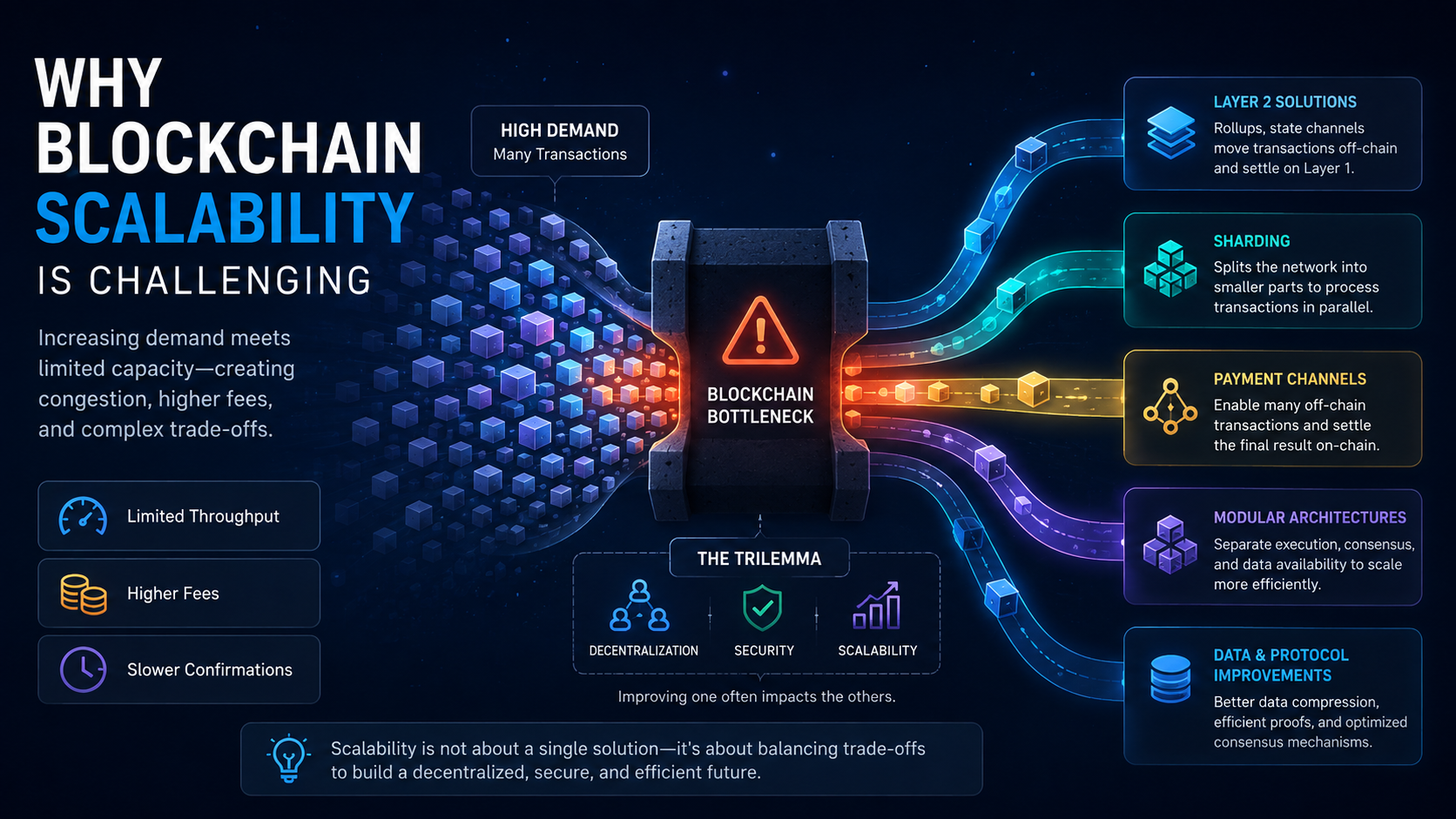
It describes the difficulty of simultaneously maximizing three desirable properties:
- Decentralization: Control and verification are distributed among many independent participants.
- Security: The network remains resistant to attacks, manipulation, censorship, and invalid transactions.
- Scalability: The network can process large amounts of activity efficiently.
The trilemma is not a strict mathematical law saying a blockchain can only have two of these properties. Instead, it is a useful way of describing the trade-offs developers encounter when designing decentralized networks.
For example, increasing the amount of data processed in every block may improve transaction capacity. But if this dramatically increases hardware and bandwidth requirements, fewer people may be able to operate nodes.
The network becomes faster, but potentially less decentralized.
Why Increasing Block Size Is Not a Complete Solution
One seemingly straightforward way to increase blockchain capacity is to allow larger blocks.
Imagine a block as a container holding transactions. If each container can hold more transactions, the blockchain can theoretically process more activity during the same period.
But larger blocks also contain more data.
Nodes must download, verify, transmit, and potentially store this additional information. As blocks become larger, network requirements increase.
Operators may need:
- Faster internet connections
- More storage
- More processing power
- Greater memory capacity
- More expensive hardware
If operating a node becomes too demanding, fewer individuals may choose or be able to do it.
This illustrates a recurring scalability problem: increasing raw capacity can shift the cost of scaling onto network participants.
Why Faster Blocks Also Create Trade-Offs
Another potential approach is reducing the time between blocks.
If blocks are produced more frequently, transactions can potentially be processed more quickly.
However, blocks need time to propagate across the network. When a new block is created, information about it must reach participants in different geographic locations using different internet connections.
Producing blocks extremely quickly can make network synchronization more difficult and can increase the likelihood that participants temporarily disagree about the latest state of the blockchain.
Different blockchain architectures address this problem in different ways, but simply making block production faster does not eliminate the underlying networking constraints.
Network Congestion and Transaction Fees
Scalability problems become particularly visible during periods of heavy demand.
A blockchain has a limited amount of transaction capacity available at any particular moment. When more people want to submit transactions than the network can immediately process, they effectively compete for limited block space.
On networks with fee markets, users may offer higher fees to encourage validators or miners to prioritize their transactions.
This can cause transaction fees to increase dramatically during periods of congestion.
Congestion can be triggered by many activities, including:
- Rapid cryptocurrency market movements
- Popular token launches
- NFT activity
- DeFi applications
- Blockchain games
- Airdrops
- Meme coin speculation
- Sudden increases in general network usage
High fees are therefore often not simply an arbitrary characteristic of a blockchain. They can be a symptom of demand exceeding available capacity.
Why Transactions Per Second Can Be Misleading
Blockchain networks are frequently compared using transactions per second, usually abbreviated as TPS.
While useful, TPS should be interpreted carefully.
Not all transactions require the same amount of computational work or data. A simple cryptocurrency transfer may require significantly fewer resources than a complex smart contract interaction.
Different projects may also calculate or advertise TPS differently.
More importantly, a blockchain could achieve extremely high throughput by requiring powerful servers and limiting the number of machines capable of validating the network.
That system might be fast, but its decentralization characteristics would differ considerably from a network designed to allow verification using relatively modest hardware.
For this reason, throughput should be considered alongside decentralization, hardware requirements, security, finality, and other network properties.
The Growing Blockchain Data Problem
Scalability is not only about processing transactions quickly. It also involves managing the growing amount of blockchain data.
As transactions accumulate, blockchain history can become extremely large.
Depending on the network and node configuration, participants may need substantial storage capacity to maintain blockchain data. Rapidly increasing transaction throughput can accelerate this growth.
This raises an important long-term question:
If blockchain activity increases by orders of magnitude, who will be able to store and independently verify the resulting data?
Technologies such as pruning, snapshots, statelessness research, specialized node configurations, and more efficient data structures attempt to reduce this burden.
However, data availability and verification remain important parts of the scalability challenge.
Layer 1 Scaling
Scaling improvements made directly to the underlying blockchain are generally described as Layer 1 scaling.
Possible Layer 1 approaches include:
- Increasing block capacity
- Improving transaction processing
- Optimizing data structures
- Using more efficient consensus mechanisms
- Parallelizing transaction execution
- Introducing sharding
- Improving networking and block propagation
- Reducing unnecessary computational overhead
Different blockchain projects make different choices depending on their priorities.
Some networks deliberately accept higher hardware requirements in exchange for greater throughput. Others prioritize the ability for a wider range of users to independently verify the blockchain.
There is no single correct design because different networks optimize for different goals.
Sharding
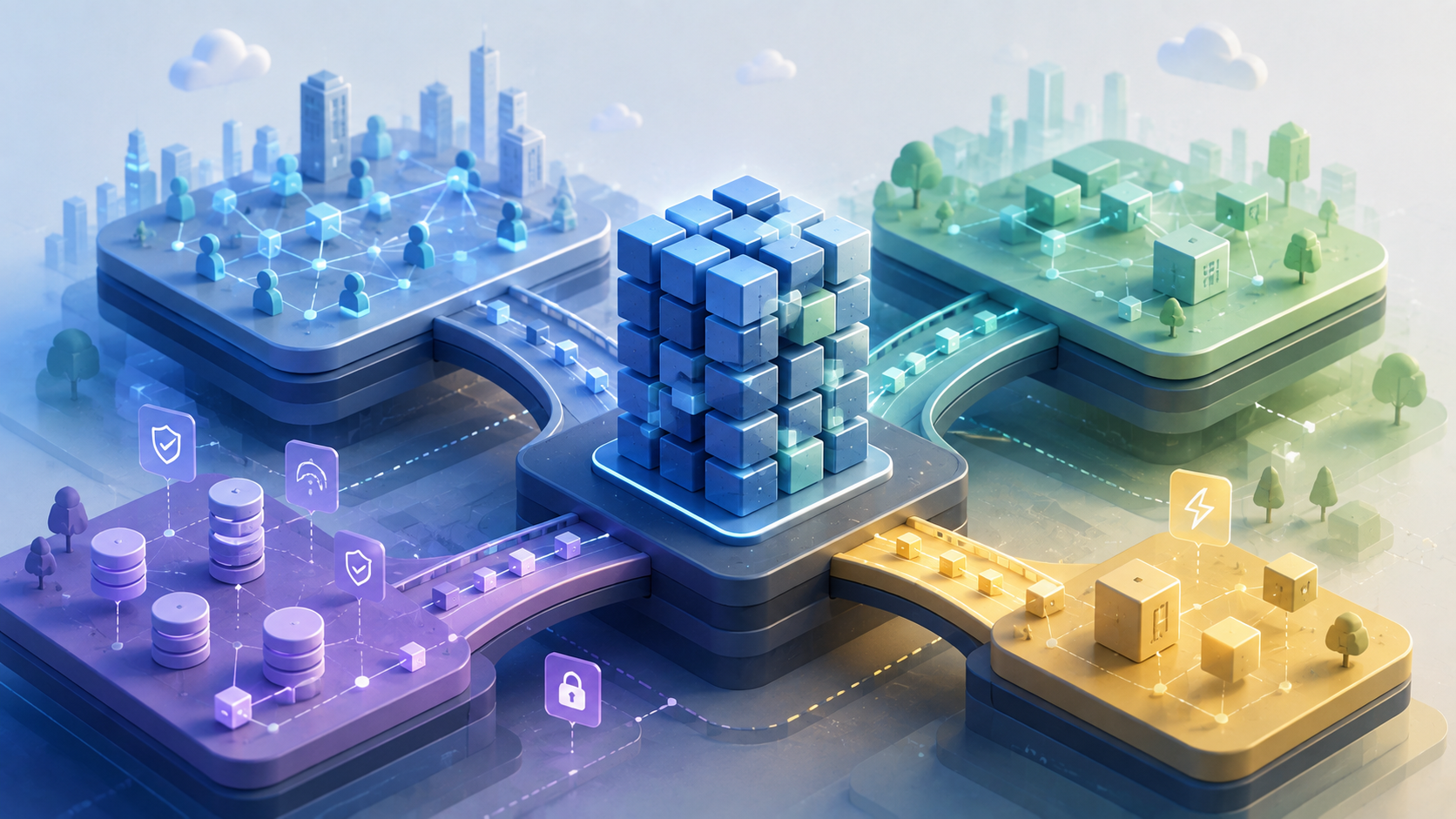
Sharding is one approach designed to prevent every participant from having to process every piece of network activity.
Instead of treating the blockchain as one workload processed uniformly across the entire network, sharding divides certain responsibilities among different groups or sections.
In theory, this allows multiple operations to occur in parallel.
The concept is similar to dividing a large workload among several teams instead of requiring every team member to independently complete the entire workload.
However, blockchain sharding introduces difficult questions.
How do shards communicate securely? What happens when a transaction involves multiple shards? How is data availability guaranteed? How does the system prevent attackers from concentrating resources against a particular shard?
Sharding can improve scalability, but it also introduces significant architectural complexity.
Layer 2 Networks
Rather than forcing the base blockchain to process every individual transaction directly, another strategy is moving some activity to Layer 2 systems.
Layer 2 solutions perform transactions or computation outside the base layer while using the underlying blockchain for settlement, security, data availability, dispute resolution, or some combination of these functions.
One prominent example is the use of rollups.
Rollups process many transactions outside the base execution layer and then submit compressed data, proofs, or transaction results back to the underlying blockchain.
Two major categories are:
- Optimistic rollups, which generally assume submitted results are valid unless challenged.
- Zero-knowledge rollups, which use cryptographic proofs to demonstrate that computations were performed correctly.
By combining many transactions into a smaller amount of base-layer activity, rollups can significantly increase effective capacity.
Scaling Through Payment Channels
Payment channels provide another way to move repeated transactions away from the main blockchain.
Two participants can establish a channel, conduct many transactions between themselves, and later settle the final result on the blockchain.
Bitcoin's Lightning Network is a well-known example of this approach.
Instead of recording every small payment directly on Bitcoin's base layer, participants can make payments through a network of channels.
This can enable rapid, low-cost transactions while reducing demand for base-layer block space.
However, payment-channel networks introduce their own considerations, including liquidity management, routing, channel availability, and user experience.
Alternative Blockchain Architectures
Not every blockchain follows the traditional model of transactions being grouped into a single linear chain of blocks.
Some projects experiment with alternative architectures designed to process activity more efficiently or in parallel.
These include various forms of:
- Directed Acyclic Graphs (DAGs)
- BlockDAGs
- Parallel execution systems
- Modular blockchain architectures
- Multiple-chain ecosystems
Such architectures may allow transactions or blocks to be processed concurrently rather than forcing all activity through a single sequential path.
However, alternative architectures still need to solve fundamental problems involving consensus, security, data availability, networking, and decentralization.
Changing the architecture can change the trade-offs, but it does not make those trade-offs disappear.
Modular Blockchains
Traditional blockchains often perform several major functions within the same system:
Execution: Processing transactions and smart contracts.
Consensus: Determining agreement about the network state.
Settlement: Establishing the authoritative result of transactions.
Data availability: Ensuring that the information required to verify the blockchain is accessible.
Modular blockchain designs attempt to separate some of these responsibilities.
Instead of requiring one blockchain to perform every function, specialized layers can handle different tasks.
For example, one layer might focus on transaction execution while another provides data availability and another acts as the settlement layer.
The goal is to allow different components to scale independently.
The trade-off is increased complexity. Users and developers must interact with multiple layers, bridges, protocols, and security assumptions.
Hardware Requirements Matter
One of the most important but sometimes overlooked aspects of blockchain scalability is the hardware required to participate.
Suppose a blockchain could process hundreds of thousands of transactions per second, but independently verifying the network required extremely expensive servers and enormous amounts of bandwidth.
The network might have excellent throughput.
But only professional infrastructure providers might be able to operate full validating nodes.
This could concentrate network infrastructure among a relatively small number of organizations.
Conversely, keeping hardware requirements extremely low can make independent verification more accessible, but may limit how much activity the network can process directly.
Scalability is therefore not just about making blockchains faster. It is about increasing capacity while preserving the properties that make decentralized systems valuable in the first place.
Scalability and Decentralization
Decentralization itself is difficult to measure.
A blockchain might have thousands of nodes while block production is dominated by a handful of entities. Another network might have many validators but rely heavily on a small number of infrastructure providers, software implementations, staking pools, or data centers.
When evaluating scalability solutions, it is useful to ask where additional requirements are being introduced.
Does scaling require more expensive hardware?
Does it make operating a validator more complicated?
Does it encourage participants to rely on specialized infrastructure providers?
Does it create new trusted intermediaries?
Does it increase dependence on bridges or sequencers?
These questions help reveal the less obvious costs of scaling.
Scalability Is Also a User Experience Problem
Users generally do not care how many transactions per second a blockchain can theoretically process.
They care whether their transaction works.
A blockchain application that requires users to understand congestion, manually adjust fees, bridge assets between networks, manage multiple tokens for gas, or wait unpredictably for confirmation can be difficult to use even if the underlying technology is sophisticated.
Layered scaling architectures can also fragment liquidity and applications across multiple networks.
As a result, improving scalability increasingly involves improving the infrastructure connecting different layers and networks.
Wallets, bridges, interoperability protocols, account abstraction, and better application interfaces can make complicated scaling infrastructure largely invisible to ordinary users.
Why There Is No Universal Scaling Solution
Blockchain projects make different design choices because they serve different purposes.
A network designed primarily for high-frequency gaming transactions may prioritize different properties than one intended to provide highly secure settlement for valuable financial assets.
Similarly, a payment-focused cryptocurrency may approach scalability differently from a general-purpose smart contract platform.
Developers therefore have many variables to balance:
- Throughput
- Latency
- Security
- Decentralization
- Hardware requirements
- Storage requirements
- Data availability
- Transaction costs
- Finality
- Interoperability
- Developer experience
- User experience
Improving one property can influence several others.
This is why blockchain scalability is better understood as a multidimensional engineering challenge rather than a race toward the highest possible TPS number.
The Future of Blockchain Scalability
The future of blockchain scaling will likely involve several technologies working together rather than one breakthrough solving everything.
Base-layer protocols can become more efficient. Layer 2 networks can move large amounts of activity away from congested base layers. Improved cryptographic proofs can reduce verification requirements. Data availability technologies can make large-scale transaction processing more practical. Parallel execution can make better use of modern hardware.
At the same time, wallets and applications can hide much of this complexity from users.
The ultimate goal may not be a single blockchain capable of processing every transaction in the world directly.
Instead, blockchain ecosystems could develop into interconnected layers and specialized networks that distribute workloads while using decentralized infrastructure for verification, settlement, and security.
Scalability Is a Balancing Act
Blockchain scalability is challenging because decentralized networks are intentionally designed differently from conventional centralized systems.
Simply increasing transaction capacity is relatively easy if decentralization, accessibility, and hardware requirements do not matter. The difficult part is increasing capacity while maintaining the characteristics that make blockchain technology useful.
Larger blocks, faster block times, sharding, Layer 2 networks, payment channels, modular architectures, and new consensus designs all approach the problem from different directions. Each provides benefits while introducing its own limitations and trade-offs.
That is why there is unlikely to be one definitive solution to blockchain scalability.
Instead, scalability will continue to evolve as developers find better ways to distribute computation, reduce data requirements, improve cryptographic verification, and coordinate increasingly complex blockchain ecosystems.
For users, understanding these trade-offs provides a much better way to evaluate blockchain networks than simply asking which one is the fastest.

Pick your reaction
Post your comment