

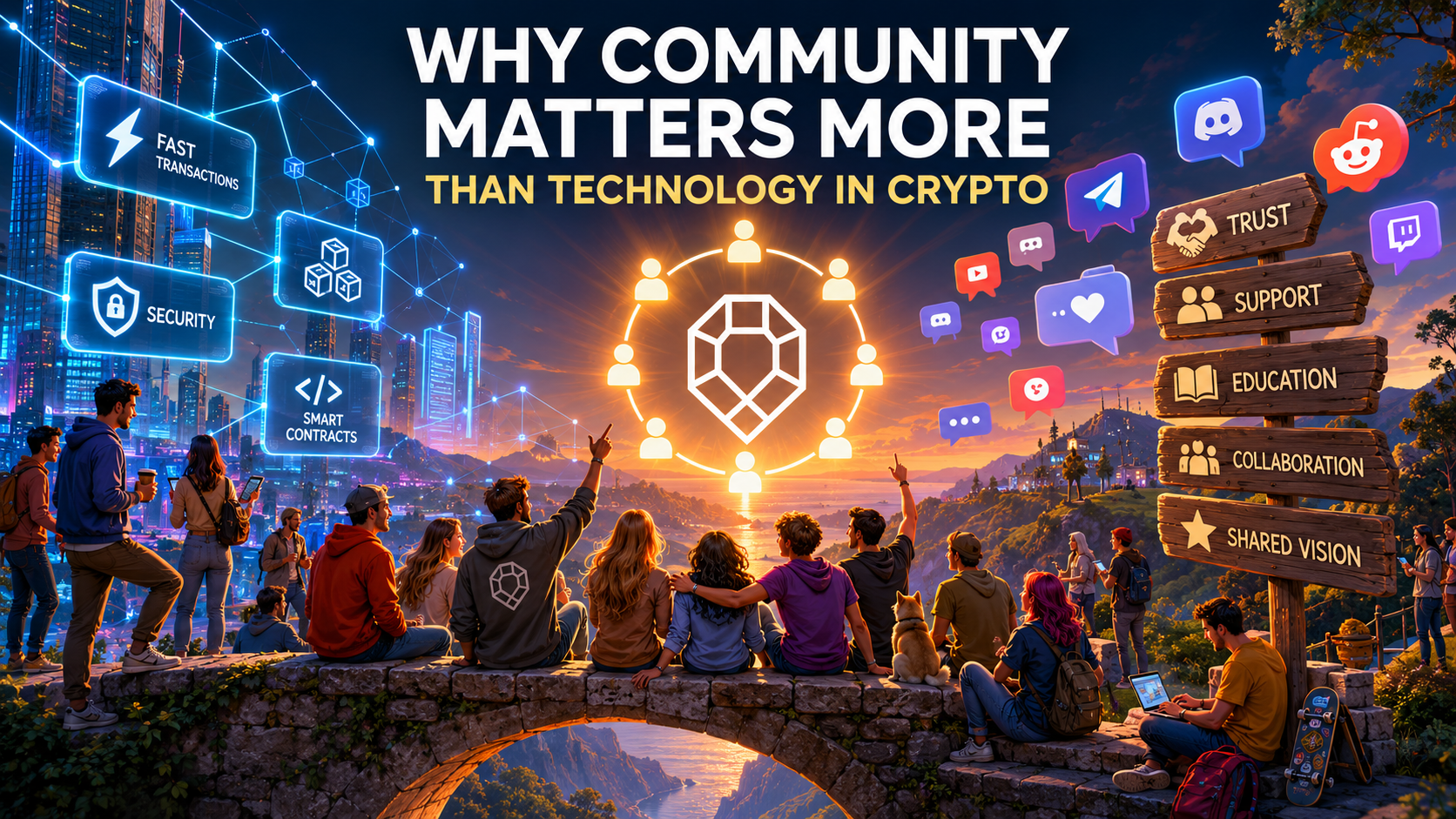
When people first discover cryptocurrency, they often focus on technology. They compare transaction speeds, consensus mechanisms, smart contract capabilities, and scalability solutions. While these technical aspects are important, history has shown that technology alone is rarely enough to guarantee success. In many cases, the strength of a project's community plays a larger role in its long-term growth and survival than its technical advantages.
A passionate, engaged, and supportive community can help a project overcome challenges, attract new users, and continue evolving even during difficult market conditions. In the world of crypto, technology builds the foundation, but community builds the ecosystem.
Technology Can Be Copied
One of the realities of blockchain development is that most technical innovations eventually spread throughout the industry. Open-source code allows developers to study, improve, and sometimes replicate successful features. A project may launch with groundbreaking technology, but competitors can often implement similar solutions over time.
What cannot be easily copied is a dedicated community. Trust, culture, shared values, and relationships take years to develop. Communities form around common goals, experiences, and beliefs. They create an identity that extends beyond the underlying code. This is why many projects with technically similar features can experience vastly different levels of adoption and success.
Communities Drive Adoption
A blockchain network has little value if nobody uses it. Communities play a crucial role in introducing new users to projects and helping them get started. Community members create tutorials, answer questions, host events, produce educational content, and share their experiences with others.
Many newcomers learn about crypto not from official documentation but from community channels such as Discord servers, Telegram groups, Reddit communities, YouTube channels, livestreams, and forums. These spaces provide guidance that makes complex technologies more accessible.
A welcoming community can turn curious visitors into long-term users. Conversely, an unfriendly or inactive community can discourage adoption even when the technology itself is excellent.
Community Creates Trust
Trust is one of the most valuable assets in the cryptocurrency industry. Because blockchain projects often operate globally and without traditional institutions, users rely heavily on community feedback and reputation.
Active communities help build confidence by:
- Answering questions transparently
- Discussing updates openly
- Identifying potential risks
- Sharing real-world experiences
- Holding project teams accountable
When users see thousands of people actively participating, contributing, and supporting a project, it creates social proof. While popularity should never replace research, strong communities often signal that a project has successfully earned trust over time.
Surviving Bear Markets
Bull markets attract attention, but bear markets reveal a project's true strength.
When prices fall, speculative investors often leave. Communities that exist solely around financial gains tend to shrink rapidly. However, projects with strong communities frequently continue building regardless of market conditions.
Developers keep developing. Moderators continue supporting members. Content creators keep educating audiences. Community leaders organize events and discussions. This ongoing engagement helps projects maintain momentum during periods when external interest declines.
Many of today's largest blockchain ecosystems survived multiple market cycles because their communities remained active long after the initial excitement faded.
Community Contributions Extend Beyond Development
Not every valuable contribution comes from writing code.
Strong crypto communities benefit from a wide range of participants, including:
- Educators
- Moderators
- Translators
- Designers
- Content creators
- Event organizers
- Testers
- Researchers
- Ambassadors
These contributors help projects grow by creating resources, welcoming newcomers, improving documentation, and expanding awareness. Their efforts often determine how accessible and attractive a project becomes to the wider public.
A successful ecosystem is rarely built by developers alone.
Decentralization Requires Participation
Many blockchain projects promote decentralization as a core principle. However, decentralization is not achieved simply by distributing nodes or tokens. True decentralization requires active participation from community members.
Governance systems, decentralized autonomous organizations (DAOs), validator networks, and community voting mechanisms all depend on engaged users. Without participation, decentralization becomes more theoretical than practical.
Communities provide the human layer that allows decentralized systems to function effectively.
The Best Projects Understand This
Some of the most successful cryptocurrency projects have demonstrated the importance of community from the beginning. While their technologies differ significantly, they share a common characteristic: strong user engagement.
Their communities contribute ideas, identify problems, promote adoption, create educational content, and help shape the project's future. In many cases, community members become the project's most effective advocates.
These ecosystems grow because users feel connected to something larger than a piece of software. They feel like stakeholders in a shared mission.
Looking Beyond Price
One of the biggest mistakes newcomers make is evaluating projects solely based on token prices or market capitalization. While financial metrics can provide useful information, they do not tell the whole story.
A healthy community often reveals important indicators such as:
- Long-term commitment
- User satisfaction
- Developer engagement
- Governance participation
- Educational resources
- Ecosystem growth
When researching a project, spending time in its community channels can provide insights that charts and statistics cannot.
Conclusion
Technology remains the foundation of every blockchain project, but community is what transforms technology into a living ecosystem. Features can be copied, code can be improved, and competitors can emerge, but a strong community creates resilience that is difficult to replicate.
The most successful crypto projects are rarely defined by technology alone. They succeed because people believe in them, contribute to them, and work together to help them grow. As the cryptocurrency industry continues to evolve, communities will remain one of the most important factors determining which projects thrive and which eventually fade away.
In crypto, technology may start the journey, but community is what sustains it.



Pick your reaction
Post your comment