

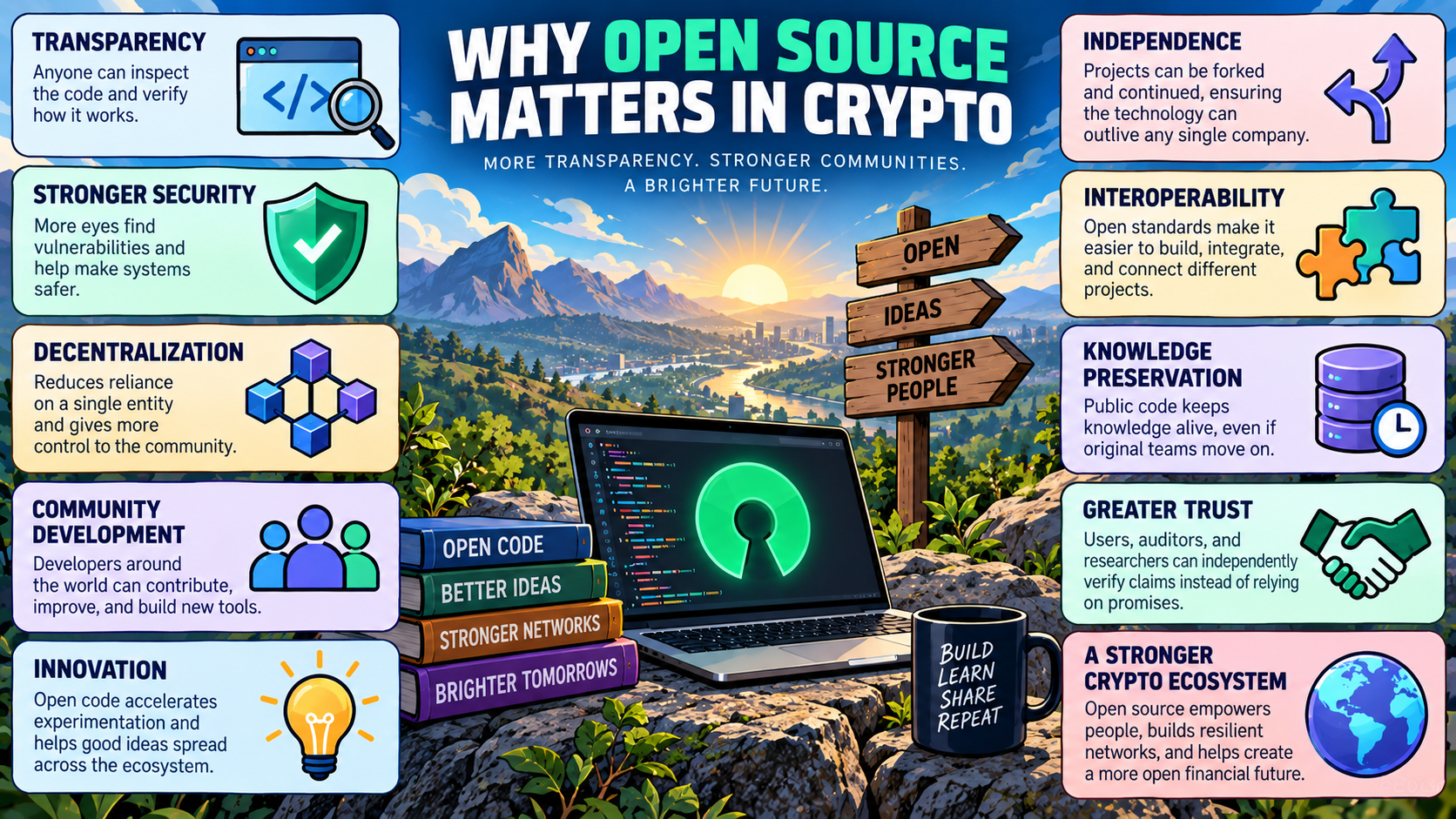
Cryptocurrency was built on the idea that people should not have to blindly trust a central authority. Instead, networks can use transparent rules, cryptography, and distributed consensus to let participants independently verify what is happening. Open-source software is a natural extension of that philosophy.
When the code behind a blockchain, wallet, protocol, or application is publicly available, developers can inspect it, test it, improve it, and identify potential problems. Users do not have to rely entirely on promises about how a system works.
But open source is not automatically synonymous with security, decentralization, or trustworthiness. Understanding what open source actually provides, and what it does not, is an important part of evaluating crypto projects.
What Does Open Source Mean?
Software is considered open source when its source code is made available under a license that permits people to inspect it and, depending on the license, modify, redistribute, and build upon it.
Source code is the human-readable set of instructions developers write to create software. Most users normally interact only with the finished application. With open-source software, the underlying code can also be examined.
In crypto, open-source development is common across many different types of technology, including:
- Blockchain node software
- Cryptocurrency wallets
- Smart contracts
- Decentralized applications
- Decentralized exchanges
- Developer libraries
- Blockchain explorers
- Mining and validator software
- Layer 2 protocols
- Cryptographic tools
Public code makes it possible for independent developers and researchers to investigate how these systems actually operate.
Crypto Is Built Around Verification
One of the most important ideas in cryptocurrency is often summarized as "don't trust, verify."
Traditional financial systems frequently require users to trust institutions to maintain accurate records, enforce rules, secure funds, and process transactions correctly.
Public blockchains approach the problem differently. Participants can independently verify transactions and network rules rather than relying entirely on one organization.
Open-source software supports the same principle at the software level.
If a project claims that its wallet does not collect private keys, for example, publicly available source code can potentially allow developers to investigate that claim. If a protocol claims that funds can only move under certain conditions, researchers can examine the relevant smart contracts.
This does not mean every user needs to understand programming. Instead, openness allows a wider ecosystem of developers, auditors, security researchers, and technically skilled community members to perform independent verification.
Transparency Creates Accountability
Crypto projects often manage systems containing significant financial value. That makes transparency particularly important.
When important software is closed source, users must largely trust the organization operating it. They may have limited ability to independently determine exactly what the application is doing.
Open-source code creates another layer of accountability.
Developers can examine updates and identify unexpected changes. Security researchers can investigate potential vulnerabilities. Competing teams can challenge technical claims. Community members can discuss controversial changes before or after they are introduced.
Public repositories can also provide insight into how actively a project is being developed.
Users may be able to see:
- Recent code changes
- Development discussions
- Bug reports
- Proposed improvements
- Release histories
- Contributors
- Documentation
- Unresolved technical issues
This can provide considerably more information than marketing materials alone.
Open Source Helps Security Researchers Find Problems
Crypto software can be an attractive target for attackers because vulnerabilities may provide direct access to valuable digital assets.
Making code public might initially sound dangerous. If everyone can see the code, attackers can inspect it too.
That is true, but defenders can inspect it as well.
Open-source projects can benefit from large numbers of developers, auditors, and independent security researchers examining the same code. Vulnerabilities can be discovered, reported, discussed, and patched.
Some projects also operate bug bounty programs that reward researchers for responsibly reporting security weaknesses.
This creates the potential for a broad security community around important infrastructure rather than limiting security review to the employees of a single company.
However, public scrutiny only helps when scrutiny actually happens. A little-known repository with few developers and no independent audits should not be assumed secure simply because its source code is available.
Open Source Does Not Mean Bug-Free
A common misconception is that open-source software must be safe because anyone can inspect it.
Anyone can inspect it. That does not mean anyone has.
Large codebases can contain hundreds of thousands or even millions of lines of code. Vulnerabilities may involve subtle interactions between different components and can remain unnoticed for years.
Even heavily reviewed software can contain serious bugs.
Open source should therefore be viewed as an opportunity for verification rather than proof of security.
When evaluating a crypto project, additional questions are useful:
- How many developers actively work on the project?
- Has the code received independent security audits?
- How quickly are vulnerabilities addressed?
- Are releases reproducible?
- Is development happening publicly?
- Are major changes openly discussed?
- Does the project have a responsible disclosure process?
- Are important components actually open source?
The answers can reveal much more than the presence of a public repository alone.
Community Development Can Make Projects More Resilient
Open-source projects can allow contributors from around the world to participate in development.
A developer does not necessarily need permission from a company to study the code, propose improvements, create tools, or experiment with alternative implementations.
This can create communities around protocols rather than around individual companies.
Over time, contributors may develop:
- Alternative wallets
- New interfaces
- Developer tools
- Integrations
- Educational resources
- Security improvements
- Alternative node implementations
- Experimental features
The original development team therefore does not always need to be responsible for every innovation surrounding the network.
A healthy ecosystem of independent contributors can also reduce dependence on a single organization.
Forking Is an Important Form of Independence
One particularly powerful feature of open-source software is the ability to fork a project when its license permits it.
A software fork creates a separate version of an existing codebase that can then be developed independently.
In crypto, this has important implications.
If developers disagree about the direction of a project, they may be able to take the existing code and pursue another approach. If a company abandons useful software, community developers may be able to continue maintaining it. If users dislike certain changes, alternative implementations can sometimes emerge.
Forking does not guarantee that the alternative project will succeed. Maintaining complex blockchain software requires developers, infrastructure, users, funding, and coordination.
Nevertheless, the ability to fork reduces the absolute control that one development organization can exercise over publicly licensed code.
Open Source Encourages Interoperability and Innovation
Crypto ecosystems rarely exist as isolated applications.
Wallets connect to blockchains. Exchanges interact with smart contracts. Explorers analyze network data. Developers build applications using libraries and APIs. Hardware devices communicate with wallet software.
Open-source components can make these integrations easier to understand and develop.
Instead of starting entirely from scratch, developers may be able to build on existing libraries, protocols, and implementations.
This has played an important role in the rapid experimentation seen throughout the cryptocurrency industry.
One project may introduce a new idea, another may adapt it, and a third may improve upon it. Successful concepts can spread across ecosystems while unsuccessful experiments provide lessons for future developers.
This ability to build on previous work is one of the major strengths of open-source development.
Open Source and Decentralization Are Not the Same Thing
Although the two concepts are closely associated, an open-source project is not necessarily decentralized.
A company could publish all of its code while still controlling:
- The project's servers
- Administrative keys
- Software releases
- Governance decisions
- Protocol upgrades
- User accounts
- Infrastructure
- Funding
Likewise, a blockchain's code could be public while a small number of entities dominate network validation or governance.
Open source describes how software code is made available and licensed. Decentralization describes how control, authority, infrastructure, and decision-making are distributed.
The distinction matters when evaluating crypto projects.
A public repository is useful evidence of transparency, but it should not automatically be treated as evidence that a project is decentralized.
Not Everything in an Open-Source Project Is Necessarily Open
Another important consideration is the scope of the published code.
A crypto application may advertise itself as open source while only publishing certain components.
For example, its wallet interface might be public while important backend infrastructure remains proprietary. A decentralized application might publish its smart contracts but rely heavily on centralized servers. A hardware wallet might provide open-source companion software while keeping parts of its firmware closed.
None of these arrangements automatically make a project good or bad.
What matters is understanding which components are open and which still require trust.
Users evaluating a project should therefore look beyond the phrase "open source" and determine exactly what has been published.
Reproducible Builds Strengthen Verification
There is another subtle problem with open-source applications.
Even if the source code is public, how does a user know that the application they downloaded was actually created from that code?
This is where reproducible builds can help.
A reproducible build allows independent developers to compile the same source code and produce an identical software output. This can provide stronger evidence that a distributed application corresponds to its published source.
Without this capability, users may be able to inspect the public repository but still have to trust whoever distributes the compiled application.
Reproducible builds are therefore an important transparency mechanism, particularly for security-sensitive software such as cryptocurrency wallets.
Open Development Preserves Knowledge
Open-source development can also help preserve technical knowledge.
If a proprietary crypto company disappears, its private code may disappear with it. Users and developers might be unable to maintain the software or recover important infrastructure.
Public code is much harder to eliminate.
Copies can exist across developer machines, repositories, archives, and forks. Even if the original organization stops operating, other developers may be able to study or continue the project.
This can make open-source infrastructure more resilient to the failure of individual organizations.
It does not guarantee continued development, but it gives communities the possibility of continuing without the original creators.
Open Source Still Requires Trust
Crypto sometimes presents openness as a way to eliminate trust entirely. In practice, trust usually changes rather than disappears.
Most users will never personally review wallet source code or inspect cryptographic implementations.
Instead, they may rely on a broader network of specialists:
- Developers
- Independent auditors
- Security researchers
- Package maintainers
- Hardware manufacturers
- Community contributors
The advantage of open source is that these parties do not necessarily have to belong to the organization that created the software.
Independent people can check each other's work.
This creates the possibility of distributed verification rather than forcing everyone to trust a single authority.
How to Evaluate an Open-Source Crypto Project
You do not need to be a programmer to learn something from a project's open-source activity.
Start by finding its official code repository and checking whether development appears active. Look at when meaningful updates were made and whether multiple developers are contributing.
Read discussions surrounding major changes. Look at open and closed issues. Check whether developers respond to bug reports and whether security problems appear to be handled responsibly.
For applications that hold or control funds, investigate whether reputable independent audits have been conducted. An audit is not a guarantee of safety, but it provides additional evidence that specialists have reviewed the system.
Also determine whether the code you are viewing actually covers the important parts of the product.
A polished public repository means relatively little if the components responsible for custody, transaction signing, governance, or other critical operations remain hidden.
Why Open Source Fits the Philosophy of Crypto
Cryptocurrency introduced the possibility of financial networks whose rules could be independently verified instead of being defined entirely behind institutional walls.
Open-source software applies a similar principle to development.
Rather than saying:
"Trust us, the software works this way."
A project can provide the code and allow others to investigate.
That does not remove every risk. It does not guarantee good developers, secure code, fair governance, decentralization, or a successful project.
What it provides is the opportunity for independent verification.
And in an industry built around the idea that users should be able to verify rather than simply trust, that opportunity matters enormously.
The Bottom Line
Open source is one of the foundations that helped cryptocurrency grow from small technical experiments into global networks maintained by developers, researchers, companies, and communities around the world.
Public code allows software to be inspected, challenged, improved, reused, audited, and sometimes continued independently of its original creators.
But "open source" should never be treated as a security certificate.
The important questions are not only whether the code is public, but whether people are actively reviewing it, whether development is transparent, whether critical components are included, and whether users can verify the software they actually run.
Crypto is ultimately about reducing unnecessary trust.
Open source does not eliminate trust, but it gives communities something far more valuable than a promise: the ability to check.



Pick your reaction
Post your comment