
Cryptocurrency has created exciting opportunities for financial freedom, online communities, decentralized applications, gaming, NFTs, and global payments. But as the crypto industry continues to grow, so does the number of scams targeting newcomers and experienced users alike.
Unlike traditional banking systems, blockchain transactions are usually irreversible. If funds are stolen or sent to the wrong address, there is often no customer support team that can recover them. This makes personal security extremely important for anyone participating in the crypto space.
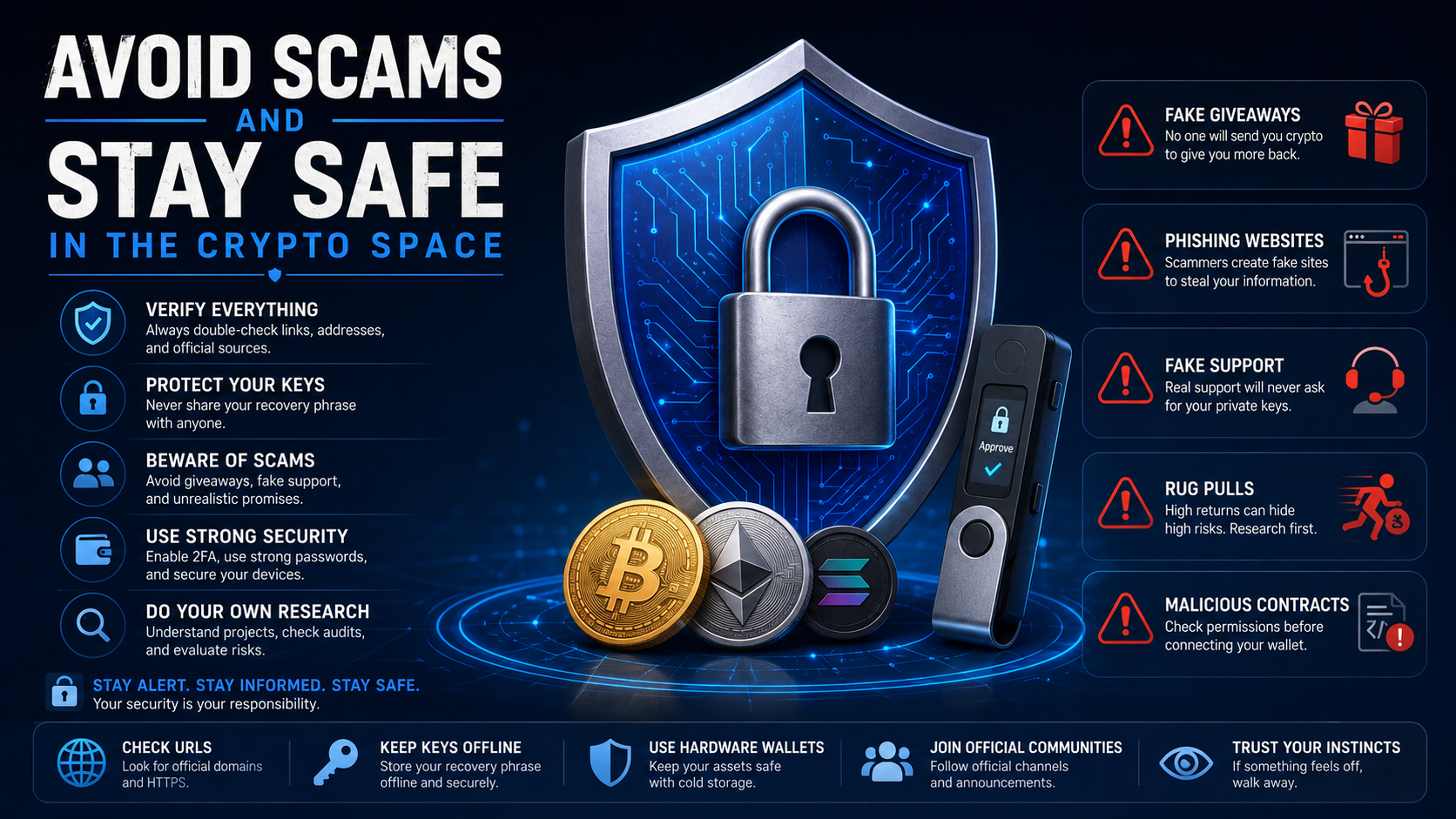
Understanding common scams and following basic safety practices can dramatically reduce the risk of losing funds, accounts, or sensitive information.
Why Crypto Scams Are So Common
The cryptocurrency industry moves quickly, attracts large amounts of money, and allows users to transact globally with minimal restrictions. These characteristics make crypto appealing not only to investors and developers, but also to scammers.
Many scams rely on:
- Hype and fear of missing out (FOMO)
- Fake urgency
- Impersonation of trusted projects or influencers
- Lack of technical knowledge among beginners
- Social engineering and emotional manipulation
Scammers often target users through Discord, Telegram, X, Reddit, YouTube comments, email, fake websites, and direct messages.
Learning how these scams work is the first step toward staying safe.
Common Crypto Scams
Fake Giveaways
One of the oldest and most common crypto scams involves fake giveaways. Scammers impersonate well-known people, exchanges, or crypto projects and claim users can double their crypto by sending funds to a wallet address.
Typical examples include:
- “Send 0.1 BTC and receive 0.2 BTC back”
- Fake livestreams pretending to feature famous crypto founders
- Fraudulent posts on social media using copied branding
Legitimate projects will never ask users to send crypto in order to receive more crypto in return.
If something sounds too good to be true, it almost always is.
Phishing Websites
Phishing attacks are designed to steal passwords, wallet recovery phrases, or login credentials.
Scammers create websites that look nearly identical to real exchanges, wallets, NFT marketplaces, or DeFi platforms. The domain name may differ by only a single letter.
Users may accidentally:
- Enter wallet seed phrases
- Connect wallets to malicious smart contracts
- Download infected software
- Reveal exchange credentials
Always:
- Double-check website URLs
- Bookmark official sites
- Avoid clicking suspicious links from messages or comments
- Verify announcements through official community channels
Fake Support Staff
Scammers frequently pretend to be moderators, admins, or support agents on Discord and Telegram.
A common tactic is contacting users privately after they ask for help publicly.
Fake support staff may:
- Ask for wallet recovery phrases
- Request remote access to devices
- Send malicious links
- Offer fake “verification” steps
Real moderators and support teams will never ask for your private keys or recovery phrase.
If someone contacts you first claiming to be support, treat it as suspicious.
Rug Pulls and Fake Projects
Some crypto projects are created solely to steal money from investors.
Developers may:
- Launch a token
- Build hype through influencers or fake communities
- Encourage users to buy
- Suddenly disappear with the funds
This type of scam is commonly known as a rug pull.
Warning signs include:
- Anonymous teams with no history
- Unrealistic promises
- No clear use case
- Artificial hype
- Locked communication channels where criticism is deleted
- Extremely aggressive marketing
Before investing in any project:
- Research the team
- Read documentation carefully
- Check whether the code is audited
- Look for genuine community discussion
- Be cautious with newly launched projects
Malicious Smart Contracts
Connecting a wallet to a decentralized application can sometimes grant permissions that allow tokens to be moved from the wallet.
Malicious smart contracts may:
- Drain wallet funds
- Gain unlimited spending permissions
- Trick users into signing dangerous transactions
Before approving transactions:
- Read wallet prompts carefully
- Verify token permissions
- Use revoke tools occasionally to remove old approvals
- Avoid connecting your main wallet to unknown applications
Using a separate wallet for testing new platforms is often a smart idea.
Fake Tokens and Copycat Projects
Scammers frequently create fake versions of popular cryptocurrencies or meme coins.
These tokens may use:
- Similar names
- Similar logos
- Fake websites
- Fake social accounts
Always verify:
- Official contract addresses
- Official community links
- Listings on trusted exchanges or aggregators
Never buy a token simply because it appears in search results or trending lists.
Account Security Best Practices
Strong account security is essential in crypto.
Use Two-Factor Authentication (2FA)
Enable 2FA on:
- Exchanges
- Email accounts
- Wallet-related services
Authenticator apps are generally safer than SMS verification.
Protect Your Recovery Phrase
Your recovery phrase or seed phrase is the master key to your wallet.
Anyone who gains access to it can control your funds completely.
Never:
- Share it with anyone
- Store it in screenshots
- Send it through Discord or Telegram
- Enter it on random websites
Safer options include:
- Writing it down offline
- Using metal backup plates
- Storing backups securely in multiple locations
Use Hardware Wallets for Larger Holdings
Hardware wallets store private keys offline, making them far safer than keeping large amounts of crypto on exchanges or browser wallets.
They significantly reduce the risk of malware or phishing attacks stealing funds.
For long-term holdings, hardware wallets are one of the best security investments available.
Stay Careful on Social Media
Crypto scammers are extremely active on social platforms.
Be cautious of:
- Fake influencers
- Impersonation accounts
- Pump-and-dump groups
- Guaranteed profit claims
- “Insider information”
- AI-generated scam videos and voice clones
Always verify information through official project channels.
Follower counts and verification badges alone are not proof of legitimacy.
Emotional Decisions Are Dangerous
Scammers often rely on emotion rather than technology.
Fear, greed, excitement, and urgency can lead people to ignore obvious warning signs.
Be cautious when you feel pressured to:
- Invest immediately
- Reveal private information
- Rush through transactions
- Chase unrealistic profits
Taking a few extra minutes to verify something can prevent major losses.
Learn Before You Invest
The safest crypto users are usually the most informed ones.
Before investing in any cryptocurrency, NFT project, or DeFi platform, take time to understand:
- How the technology works
- What the project actually does
- How wallets and transactions function
- What risks are involved
Following educational communities and trustworthy sources can help users avoid many common mistakes.
Final Thoughts
The crypto space offers incredible opportunities, but it also requires personal responsibility. Scammers continuously adapt their tactics, and even experienced users can become targets.
Good security habits, patience, skepticism, and proper research are some of the best tools available for staying safe.
Remember:
- Never share your recovery phrase
- Double-check links and wallet addresses
- Be suspicious of unrealistic promises
- Verify information through official channels
- Take your time before making financial decisions
In crypto, protecting your assets starts with protecting yourself.
Metal backup plates? I had to look it up, and this is what I found (at coincodex.com):
What is a metal crypto wallet?
A metal crypto wallet, often referred to as a "metal backup," is a physical storage solution for cryptocurrency seed phrases or private keys. It involves engraving or etching these sensitive cryptographic keys onto a piece of metal, usually stainless steel or titanium. This provides durable protection against various potential hazards like fire, water damage, and physical wear and tear. Metal crypto wallets are a secure way to back up your crypto assets and ensure their long-term safety.
Somehow I think the average person might not have the skills or tools to engrave or etch stainless steel or titanium plates at home. And paying someone else to do it would mean giving them access to the keys or seedphrases. But it's a nice idea :)
A great compendium of knowledge about security in the crypto world.
I'd like to emphasize one more thing: never brag about how much you've earned or show your wallet balances. You don't know who's watching and what their intentions are.