

Yesterday, we looked at the Brave Browser and how it combines privacy protection, ad blocking, crypto rewards, and Web3 functionality in a single browser. One of the most distinctive parts of that ecosystem deserves a closer look: Basic Attention Token (BAT).
BAT is more than simply a cryptocurrency associated with Brave. It was created around a much bigger idea: online attention has economic value, so the people providing that attention should participate in the value it creates. Instead of an advertising system built around extensive tracking and centralized user profiles, BAT is designed to connect users, advertisers, and creators through a privacy-focused attention economy.
Since its launch in 2017, BAT has evolved beyond its original role in Brave Rewards. Today, it is an ERC-20 token with a fixed total supply of 1.5 billion BAT, support across multiple blockchain environments, self-custody payout options, creator integrations, and growing utility outside the browser. Brave's 2026 roadmap aims to expand that role even further into payments, commerce, creator monetization, and what the company calls the "transactional attention economy."
What Is Basic Attention Token?
Basic Attention Token, usually referred to by its ticker BAT, is a utility token originally designed for the digital advertising industry.
BAT was launched in 2017 alongside Brave's broader attempt to rethink how advertising works on the web. The basic problem it addresses is relatively easy to understand.
Online advertising traditionally involves three major groups:
Users provide their attention.
Advertisers pay to reach those users.
Publishers and creators produce the content that attracts the audience.
Yet much of the infrastructure connecting those groups is controlled by advertising platforms, tracking companies, data brokers, and other intermediaries.
BAT introduces a token that can function as a unit of value between users, advertisers, and creators.
The concept is based on a simple premise: attention itself has value.
Why Tokenize Attention?
Attention is one of the most valuable resources on the Internet.
Social networks compete for it. Streaming platforms compete for it. News websites compete for it. Advertisers ultimately pay enormous amounts of money for it.
Yet users traditionally receive little direct economic benefit from providing that attention.
In many advertising systems, users instead make another kind of payment: data.
Websites and advertising networks can collect information about browsing activity, interests, devices, locations, purchases, and other behavior. That information helps advertisers determine which people are most likely to respond to particular advertisements.
Brave and BAT attempt to change the incentives.
Rather than sending detailed browsing histories to centralized advertising platforms, Brave can perform certain ad matching locally on the user's device. Brave says browsing activity used for this matching does not leave the device.
Users who choose to participate in Brave Rewards can then earn BAT from eligible Brave Ads.
This changes the basic relationship from something resembling:
User attention → tracking → profiling → advertising revenue
to:
User attention → privacy-preserving advertising → BAT rewards
It is an ambitious attempt to assign measurable economic value to something people already provide every day.
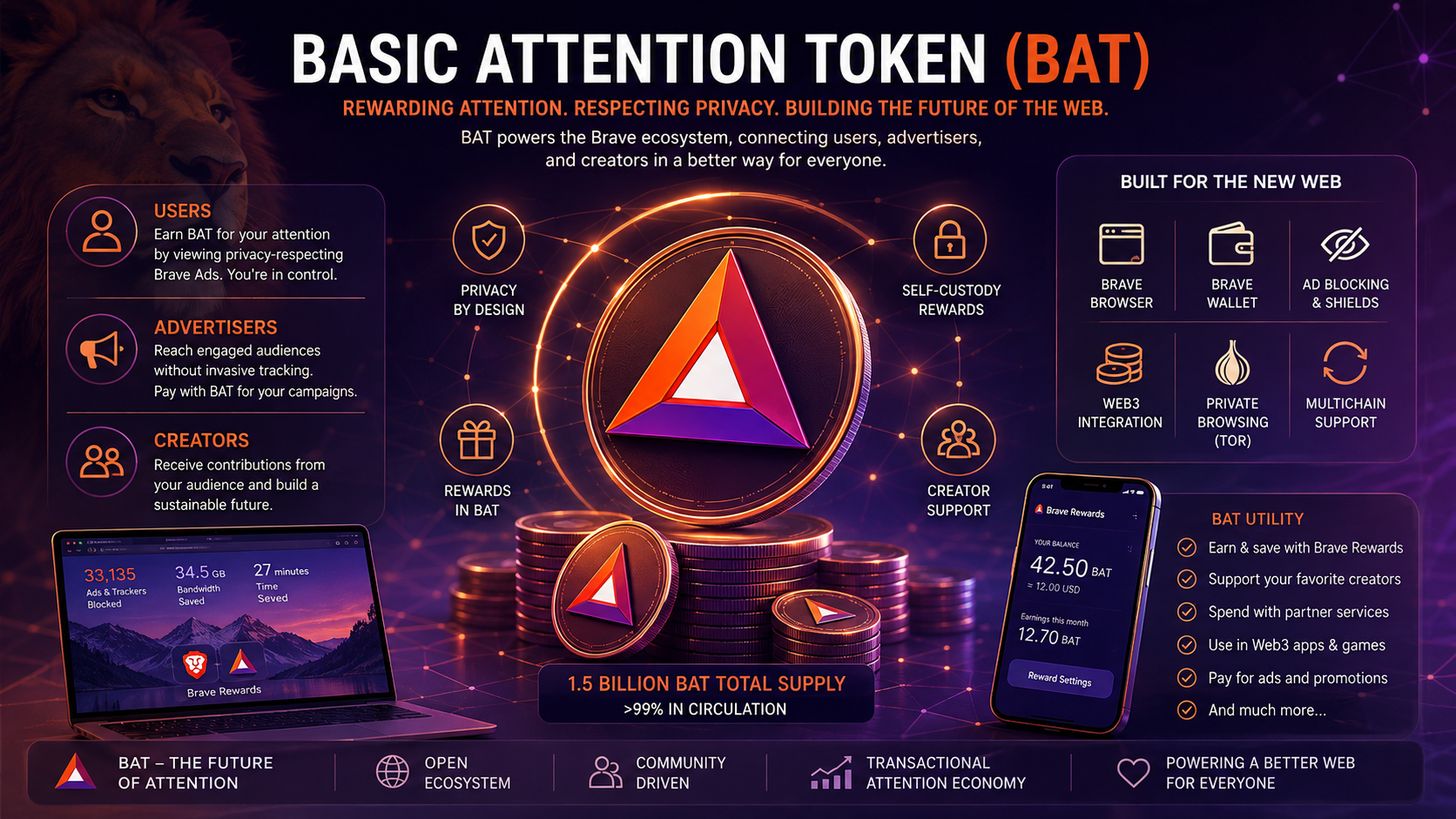
The Three Participants in the BAT Economy
The BAT ecosystem makes the most sense when viewed as a relationship between three groups.
Users
Users provide attention.
Brave users can choose to enable Brave Rewards and receive eligible privacy-respecting advertisements. In return, participating users can earn BAT.
The important word here is choose.
Brave's regular privacy protections and ad blocking do not require participation in Brave Rewards. Users can use the browser without enabling the rewards system.
Advertisers
Advertisers want access to audiences.
Instead of relying entirely on conventional cross-site tracking, Brave offers advertisers access to people through its privacy-focused advertising system.
Brave Ads can appear in formats such as sponsored new-tab images and notifications. They do not simply replace the third-party banner advertisements that Brave Shields blocks on websites.
Brave's self-serve advertising platform also accepts BAT as one of the methods advertisers can use to pay for campaigns.
Creators and Publishers
Creators provide the content that attracts attention in the first place.
Brave Creators allows eligible websites, YouTube channels, Twitch streamers, social media accounts, and other creators to receive contributions from Brave users.
BAT can therefore circulate through an ecosystem where advertisers pay for attention, users receive value for participating, and creators can receive direct support from their audiences.
How Brave Rewards Works
Brave Rewards is the system through which most people first encounter BAT.
When Rewards is enabled, users can choose to see eligible Brave Ads. Brave performs ad matching locally rather than uploading a browsing history to create a conventional advertising profile.
Brave uses privacy-preserving mechanisms to confirm advertising activity and calculate rewards.
Users who want to earn BAT need to connect an eligible payout account to their Brave Rewards profile. Depending on the user's region and available options, this may involve a supported custodial provider or a self-custody crypto address.
BAT earnings are then sent to that payout account.
This distinction is important because Brave Rewards and Brave Wallet are not the same thing.
Brave Rewards manages participation in the rewards ecosystem, while Brave Wallet is a general-purpose Web3 wallet for managing crypto assets, connecting to decentralized applications, swapping tokens, and other blockchain activities.
BAT earned through Rewards can ultimately be transferred to a Web3 address controlled by the user.
Self-Custody BAT Rewards
One of the most significant recent changes to Brave Rewards has been the expansion of self-custody payouts.
Brave previously relied heavily on custodial partners for distributing BAT rewards. That created an unusual situation for a browser and ecosystem strongly associated with Web3 and user control: earning tokens often still involved a centralized intermediary.
Brave has been working to change this.
Eligible Brave Rewards users can now connect a self-custody Solana wallet address and receive BAT directly on-chain. Brave opened this option broadly in supported regions after initially testing it with a limited group.
These payouts use BAT bridged to Solana.
The change is important because users can receive their rewards directly at an address they control rather than necessarily keeping them with a custodial service.
It also moves Brave Rewards closer to the broader principle behind self-custody crypto: your wallet, your assets, your responsibility.
BAT Is an Ethereum Token
BAT was originally created as an ERC-20 token on Ethereum.
That means BAT is not a separate blockchain and there is no independent BAT network that miners or validators need to secure.
Instead, BAT exists as a token using Ethereum's infrastructure.
Its original token contract established a maximum supply of 1.5 billion BAT.
The original distribution allocated:
- 1 billion BAT to the public token sale
- 300 million BAT to a user growth pool
- 200 million BAT to a development pool
The 2017 token sale became notable in crypto history for its speed. The sale of 1 billion BAT raised approximately $36 million and was completed in less than a minute.
Today, more than 99% of BAT's total 1.5 billion supply is in circulation.
A Fixed Supply
BAT's fixed supply is one of its important economic characteristics.
There is no ongoing mining process that continuously creates new BAT, and the original system capped the total amount at 1.5 billion tokens.
That does not mean the price must rise as adoption increases. Token prices depend on supply, demand, utility, speculation, liquidity, market conditions, and many other factors.
But it does mean BAT does not rely on continuous token issuance to operate its rewards economy.
Brave can acquire BAT on the market for use within the ecosystem, including rewards associated with advertising activity.
This creates a different economic model from cryptocurrencies where new tokens are continuously issued through mining, staking rewards, or inflation schedules.
What Gives BAT Utility?
A cryptocurrency token needs more than a ticker symbol and an exchange listing to have meaningful utility.
BAT's strongest advantage is that it is connected to an existing consumer product.
Brave has built BAT into several parts of its ecosystem.
BAT can be used to:
- Receive rewards through Brave Rewards
- Support websites and content creators
- Hold or transfer value between wallets
- Swap for other crypto assets where supported
- Interact with compatible Web3 applications
- Participate in partner offers and promotions
- Pay for certain goods or services through participating platforms
- Pay for Brave advertising campaigns
This is significantly different from a token whose utility exists primarily inside a theoretical future platform.
BAT has an active ecosystem, although the usefulness of individual features depends on region, platform, wallet support, and participating services.
BAT and Content Creators
Creator support has been part of BAT's vision since the early days of Brave.
Creators can register through Brave Creators and connect supported websites or channels.
The system supports different types of online creators, including websites and accounts on platforms such as YouTube, Twitch, X, and Reddit.
Users can then contribute BAT to participating creators.
This creates an alternative monetization path.
Instead of relying exclusively on advertising networks, subscriptions, sponsorships, or platform revenue sharing, creators can receive direct contributions from their audiences.
For smaller websites and independent creators, that idea is particularly interesting because the relationship can be much more direct:
Audience → creator
rather than:
Audience → advertising platform → publisher
BAT does not eliminate intermediaries entirely, but its expanding self-custody infrastructure is intended to reduce some of that dependence.
BAT Beyond Brave Rewards
One of the challenges facing BAT has always been obvious: if the token only has value inside Brave Rewards, its potential ecosystem is limited by the browser itself.
Brave has increasingly tried to expand BAT utility beyond that boundary.
The Brave Rewards Partner Program connects BAT with third-party Web3 projects and businesses. Participating services have experimented with BAT in gaming, shopping, digital identity, DeFi, livestreaming, promotions, and other applications.
For example, integrations announced through the program have included the ability to use BAT for purchases through participating commerce services and to tip livestream creators directly.
This direction is important.
The long-term success of BAT may depend less on whether people can simply earn the token and more on whether they have compelling reasons to use it.
BAT Across Multiple Blockchain Networks
Although BAT originated on Ethereum, its ecosystem is no longer limited to Ethereum alone.
Bridged versions of BAT have appeared across additional blockchain networks, and Brave has increasingly emphasized a multichain strategy.
Solana has become particularly important because of Brave Rewards self-custody payouts.
Eligible users can receive Wormhole-bridged BAT directly to Solana addresses. Lower transaction costs and faster settlement can make networks such as Solana more practical for smaller-value rewards than executing every transaction directly on Ethereum mainnet.
This illustrates a broader trend in crypto.
A token may originate on one blockchain while its practical utility expands across multiple networks through bridges and interoperability infrastructure.
However, bridged assets also introduce additional technical considerations. Users need to understand which network their BAT is on before transferring it and ensure the receiving wallet or service supports that particular version.
Privacy Is Central to the Model
BAT would be much less interesting if Brave simply recreated conventional targeted advertising and paid users a small amount of cryptocurrency for participating.
Privacy is what makes the model distinctive.
Brave says ad matching can happen locally on the user's device. Browsing history does not need to be uploaded to Brave to determine which advertisements might be relevant.
Brave Rewards does use identifiers necessary to operate the rewards system. For example, Brave assigns a Rewards Payment ID and uses country information for functions such as regional advertising and fraud prevention.
However, Brave states that it does not collect or retain users' browsing histories through this system and cannot use Rewards contributions to determine which websites a user visits.
This illustrates an important distinction.
Privacy does not necessarily mean collecting zero information.
Instead, privacy-focused systems attempt to minimize what information needs to be collected and prevent unrelated personal behavior from becoming part of centralized tracking profiles.
BAT Is Not a Privacy Coin
Because BAT is associated with Brave, it can be easy to assume the token itself provides special privacy characteristics.
It does not.
BAT is not a privacy coin in the sense of cryptocurrencies designed specifically to conceal transaction information.
Transactions made with BAT on public blockchains can generally be inspected using blockchain explorers.
Brave's privacy features relate primarily to how browser activity, advertising, and attention are handled. They do not make ordinary blockchain transactions invisible.
Users should therefore separate two concepts:
Brave provides browser and advertising privacy features.
BAT provides a tokenized unit of value within and beyond that ecosystem.
The two are closely connected, but they are not the same thing.
BAT as an Advertising Currency
BAT also has utility on the advertiser side of the ecosystem.
Brave's advertising platform allows businesses to run campaigns targeting the Brave audience without relying on the same surveillance-heavy model associated with much of traditional ad technology.
Advertisers can pay for self-serve campaigns using several payment methods, including BAT.
This matters because it creates potential demand for the token that is connected to an actual commercial service.
Instead of BAT existing only as something distributed to users, it can also function as a payment asset within the advertising system that helped inspire its creation.
That closes part of the economic loop between advertisers, Brave, users, and creators.
The Challenge of Token Velocity
BAT also faces an economic challenge common to utility tokens.
If users earn BAT and immediately sell it, and recipients do the same, the token may move rapidly through the ecosystem without people having much reason to hold or reuse it.
This is sometimes described as token velocity.
A useful token economy therefore benefits from multiple reasons to earn, hold, spend, contribute, and otherwise interact with the asset.
Brave's efforts to expand BAT into partner rewards, commerce, creator payments, Web3 applications, and other services can be understood partly through this lens.
The goal is not simply to distribute BAT.
The larger challenge is creating an economy where BAT repeatedly circulates because participants actually have reasons to use it.
The Brave Rewards Partner Program
The Brave Rewards Partner Program is one of the clearest examples of this expansion.
Launched in 2025 and expanded during 2026, the program encourages Web3 companies and other partners to integrate BAT into their products and services.
Users and BAT holders can gain access to promotions, discounts, experiences, games, shopping opportunities, and other benefits.
For Brave, this potentially expands the usefulness of Rewards.
For partners, it provides exposure to Brave's large browser audience.
For BAT, it creates additional destinations where the token can be used.
By June 2026, Brave said its browser audience had grown beyond 117 million monthly users, giving integrations access to a substantial potential user base.
Of course, browser users and active BAT users are not the same thing. The size of Brave's audience should not be interpreted as the number of people actively using BAT.
Still, the browser provides something many crypto projects struggle to obtain: an established distribution channel to mainstream users.
BAT Roadmap 4.0
The most interesting developments may still be ahead.
In July 2026, Brave announced BAT Roadmap 4.0, outlining a significantly broader vision for BAT, Brave Rewards, and Brave Creators.
The roadmap describes a transition toward what Brave calls a transactional attention economy.
The idea expands the original model beyond advertising.
Attention may begin a commercial relationship, but payments, purchases, subscriptions, creator support, AI agents, and other transactions can happen afterward.
Brave wants BAT and its surrounding infrastructure to participate in more of that economic activity.
Planned or developing concepts include:
- Agentic payments
- A more unified Brave Wallet experience
- BravePay
- A Brave Rewards Card
- A Creator Contribution Protocol
- Expanded creator monetization
- Broader BAT payment and commerce utility
These are roadmap items and should not be confused with fully deployed features. Some may change substantially during development.
Nevertheless, they show how much broader the BAT vision has become since 2017.
BAT and AI Agents
One particularly interesting direction in Roadmap 4.0 is agentic payments.
As AI assistants and autonomous agents become capable of performing more tasks on behalf of users, they may eventually need mechanisms to make payments, purchase services, compensate creators, or conduct small transactions automatically.
Crypto assets and stablecoins are frequently discussed as potential payment infrastructure for this emerging machine economy because blockchain transactions can be initiated programmatically.
Brave's roadmap places BAT within this developing area.
The concept represents a major expansion from BAT's original purpose. What began primarily as a token connecting advertisers, users, and publishers could potentially become part of a broader system where humans and software agents exchange value.
How significant that becomes will depend on what Brave actually delivers and whether users, developers, and businesses adopt the resulting infrastructure.
BravePay and Payments
Another major concept in the latest roadmap is BravePay.
Brave describes BravePay as part of its effort to build payment infrastructure around the broader attention economy, including stablecoin-related functionality.
This points toward a future where discovering something through Brave, interacting with it, and eventually paying for it could potentially happen within a more integrated ecosystem.
BAT would not necessarily replace stablecoins or conventional currencies in such a system.
Instead, BAT could coexist with other payment assets while retaining its role in rewards, incentives, and attention-related transactions.
This is an important evolution because stablecoins are generally better suited to transactions where users need predictable prices, while BAT can continue serving as a utility and incentive token.
The Creator Contribution Protocol
Creator monetization is another major part of Brave's future plans.
The proposed Creator Contribution Protocol aims to expand how creators can receive value through Brave's ecosystem.
The broader objective is to make creator support more open, direct, and compatible with on-chain payment infrastructure.
This builds on a concept BAT has pursued for years: people who produce valuable online content should have ways to receive compensation without being completely dependent on advertising networks or centralized platforms.
If successful, this could make BAT and Brave's infrastructure relevant not only to browser users but also to a wider creator economy.
Again, this is an evolving roadmap rather than a guarantee of future adoption.
Why BAT Is Different From Many Crypto Tokens
Thousands of crypto tokens have been launched with promises of future utility.
BAT stands out because it was connected to a functioning consumer product from an early stage.
The Brave Browser provides distribution.
Brave Ads provides a commercial advertising product.
Brave Rewards provides a mechanism for users to earn BAT.
Brave Creators provides a mechanism for creators to receive it.
Brave Wallet provides infrastructure for holding and using crypto.
Partner integrations provide additional opportunities to spend or interact with BAT.
That does not automatically make BAT successful as an investment, nor does it guarantee that its ecosystem will continue growing. But it gives BAT something relatively uncommon: a token economy connected to software used by millions of ordinary Internet users.
BAT Is Not the Same as Investing in Brave
Another important distinction is that owning BAT does not mean owning part of Brave Software.
BAT is a utility token, not company stock.
Holding BAT does not give someone equity in Brave, voting rights over the company, a claim on Brave's profits, or ownership of the Brave Browser.
This distinction matters whenever cryptocurrency tokens are connected closely with recognizable companies.
A company could grow while its associated utility token performs poorly. Conversely, speculation could increase the price of a token without corresponding improvements in the underlying business.
Anyone evaluating BAT as an asset should therefore distinguish between:
Brave the company
Brave the browser
Brave Rewards the product
and
BAT the crypto asset
They are interconnected, but they are not interchangeable.
Risks and Limitations
BAT also faces several challenges.
Its utility remains closely connected to the success of Brave and the growth of its surrounding ecosystem.
Rewards availability and payout methods can differ between countries and platforms. On iOS, for example, Brave Rewards functionality remains more limited than on desktop and Android.
Crypto markets also introduce price volatility. BAT earned today may be worth considerably more or less in the future.
Moving BAT across blockchain networks requires users to understand network compatibility, addresses, transaction fees, and bridged assets.
Brave also faces the difficult challenge of balancing privacy with fraud prevention. Any rewards system involving real economic value attracts bots, fake engagement, and other attempts to manipulate payouts.
And while Brave has a substantial browser audience, convincing users to actively participate in a token economy is a different challenge from convincing them to install a privacy-focused browser.
Does BAT Need Cryptocurrency?
A reasonable question is whether Brave actually needs a blockchain token at all.
Could the company simply reward users with conventional points or money?
Technically, many aspects of the system could probably be built without cryptocurrency.
BAT's advantage is portability.
A conventional rewards point generally remains inside the company that issued it. BAT can exist independently in a user's wallet, be transferred between people, exchanged, integrated into third-party applications, and used outside Brave where supported.
That makes BAT more open than a traditional loyalty-points system.
The trade-off is additional complexity.
Wallets, networks, bridges, token prices, custody, regulations, and transaction fees are considerably more complicated than a simple centralized rewards balance.
Whether that trade-off is worthwhile ultimately depends on how much meaningful utility develops outside Brave itself.
From Attention Token to Attention Economy
BAT began with a relatively focused idea: users should receive value for their attention, advertisers should be able to reach audiences without invasive surveillance, and creators should receive a fairer share of the resulting economy.
That remains the foundation of the project.
But the ecosystem is gradually becoming broader.
Self-custody rewards bring BAT further on-chain. Partner integrations give users additional ways to spend it. Creator tools expand direct monetization. Commerce integrations introduce new transactional use cases. Roadmap 4.0 pushes toward payments, stablecoin infrastructure, AI agents, and a wider transactional attention economy.
The interesting question is therefore no longer simply whether people can earn a few BAT for seeing advertisements.
It is whether Brave can turn millions of small interactions involving attention, content, advertising, rewards, commerce, and payments into a sustainable economy where BAT has a meaningful role.
That is a much more ambitious goal.
And unlike many cryptocurrency projects whose ecosystems must be built from scratch, BAT already has something important working in its favor: a browser that can put that experiment directly in front of millions of people.

Pick your reaction
Post your comment