

The web browser is one of the most important pieces of software we use. It sits between us and almost everything we do online, from reading news and watching videos to accessing exchanges, managing wallets, and interacting with Web3 applications. That makes privacy and security at the browser level especially important for cryptocurrency users.
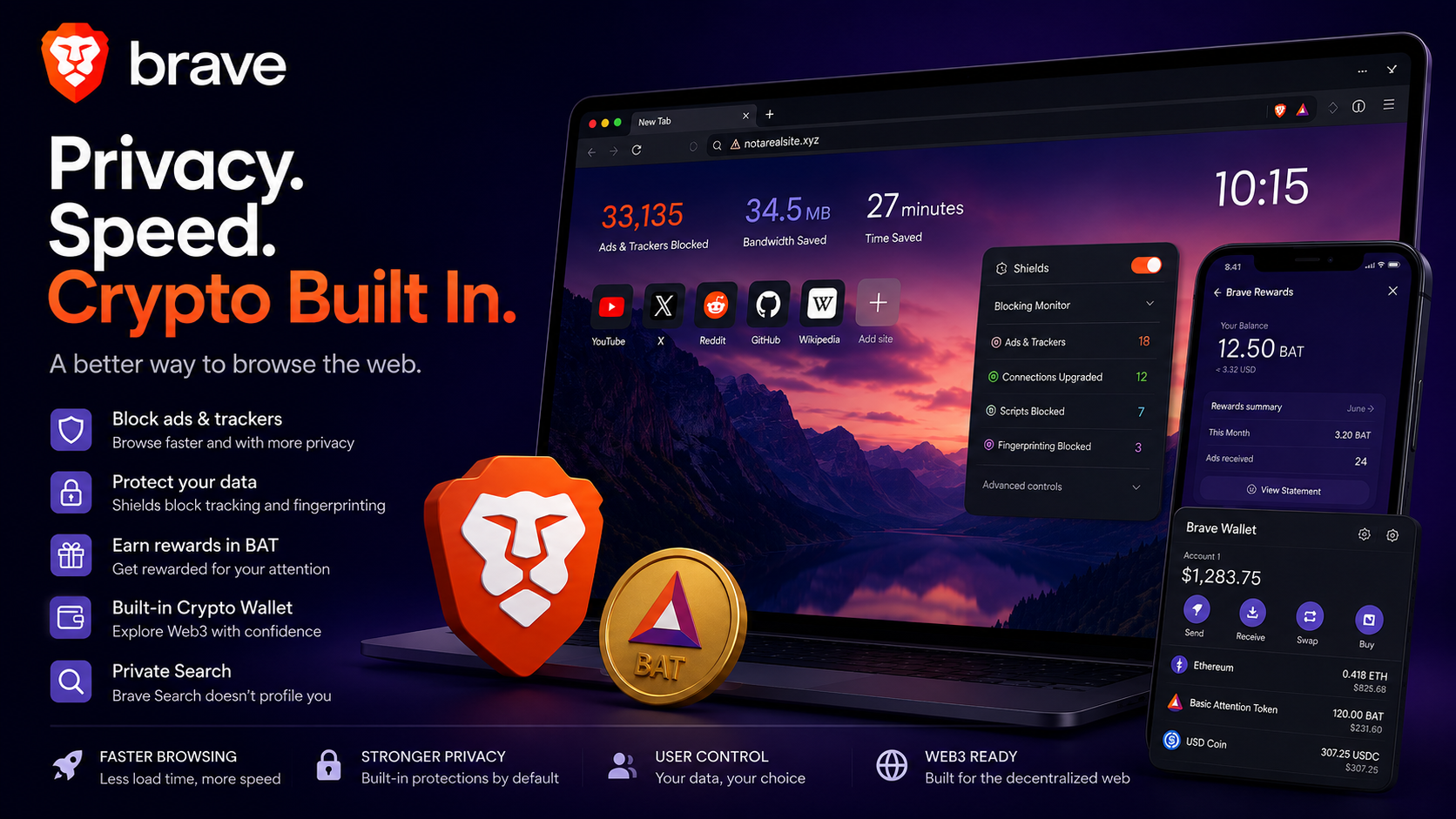
Brave takes a different approach from many mainstream browsers. Instead of relying primarily on extensions to improve privacy, Brave includes ad and tracker blocking, fingerprinting protection, secure connection upgrades, and other protections directly in the browser. It also has unusually strong ties to the cryptocurrency ecosystem through Brave Rewards, Basic Attention Token (BAT), and a built-in self-custody crypto wallet.
For crypto users, Brave represents an interesting combination: a familiar Chromium-based browser with privacy protections and Web3 functionality built in from the start.
What Is the Brave Browser?
Brave is a free, open-source web browser developed by Brave Software. On desktop and Android, it is based on Chromium, the open-source project that also forms the foundation of Google Chrome, Microsoft Edge, and several other browsers. On iOS, Brave uses Apple's WebKit engine.
Being Chromium-based has an important practical advantage. For most users, switching from Chrome or another Chromium browser does not require learning an entirely new browsing environment. Websites generally behave as expected, and desktop users can access extensions from the Chrome Web Store.
However, Brave modifies Chromium extensively. The company removes or changes components it considers harmful to privacy, including certain Google-related services and APIs. Brave also uses its own encrypted synchronization system rather than relying on Google's infrastructure for browser sync.
The result is a browser that feels familiar while operating with a substantially different philosophy toward advertising, tracking, and user data.
Privacy by Default
Privacy is at the center of Brave's design.
Most browsers provide some privacy controls, but users may need to change settings or install additional extensions to achieve stronger protection. Brave instead enables many protections automatically.
The main system responsible for this is called Brave Shields.
Shields can block or restrict:
- Third-party ads and trackers
- Cross-site cookies
- Browser fingerprinting
- Certain tracking scripts and resources
- Phishing and malicious websites
- Other techniques used to identify or follow users across the web
These protections are enabled by default and can also be adjusted globally or individually for specific websites.
This matters because online tracking extends far beyond visible advertisements. Websites can load scripts, cookies, analytics systems, and other resources from numerous third parties. Over time, these systems can help build detailed profiles of browsing behavior.
Brave attempts to prevent much of this tracking before it happens.
Blocking Ads and Trackers
One of the first things many people notice after switching to Brave is how different some websites look.
Pages that normally contain several advertisements, pop-ups, and tracking elements can appear considerably cleaner. Because Brave blocks many of these resources before they load, the browser may also reduce the amount of unnecessary data transferred while loading a page.
This can have performance benefits as well. Fewer advertising scripts, trackers, and other third-party resources mean there is potentially less content for the browser to download and process. Brave promotes faster page loading, lower bandwidth consumption, reduced CPU and memory usage, and potential battery savings as benefits of this approach.
Importantly, Brave's blocking system is integrated directly into the browser. Users do not have to install a separate ad-blocking extension to receive the default protections.
Protection Against Browser Fingerprinting
Cookies are not the only way users can be tracked.
Another technique is known as browser fingerprinting.
Websites can collect information about a device and browser, including characteristics related to hardware, browser configuration, screen properties, and supported features. When enough of these details are combined, they can sometimes create a relatively distinctive fingerprint.
That fingerprint may allow tracking even when traditional cookies are unavailable.
Brave combats this using techniques including fingerprint randomization. Instead of simply exposing the same identifying characteristics repeatedly, Brave can alter certain browser APIs used by fingerprinting systems, making it more difficult to consistently identify a browser across websites and sessions.
For privacy-conscious users, this adds an important layer beyond traditional cookie blocking.
Why Browser Privacy Matters for Crypto Users
Privacy is important for everyone, but cryptocurrency users have additional reasons to think carefully about their browsers.
A crypto user might regularly visit:
- Cryptocurrency exchanges
- Blockchain explorers
- Web3 applications
- NFT marketplaces
- Wallet websites
- DeFi platforms
- Crypto community websites
- Token analytics services
Browsing activity can reveal a surprising amount about someone's interests and potentially even their financial behavior.
Blocking trackers does not make cryptocurrency activity anonymous, nor does Brave hide transactions recorded on public blockchains. However, reducing unnecessary web tracking can limit some of the information collected about browsing habits.
That distinction is important.
Browser privacy is not the same thing as blockchain privacy.
Brave can help reduce tracking while browsing, but it cannot make a transparent blockchain private or prevent users from exposing information through their own actions.
Brave Rewards and Basic Attention Token
Brave's connection to cryptocurrency becomes most obvious with Brave Rewards.
The system uses Basic Attention Token, commonly known by its ticker BAT.
Users can optionally enable Brave Rewards and receive BAT for eligible Brave Ads they see. Brave says ad matching takes place locally on the user's device rather than building a centralized profile of their browsing activity. Rewards users can use BAT in several ways, including supporting participating creators or transferring and using the asset elsewhere where supported.
This creates a different advertising model.
Traditional online advertising generally works something like this:
User attention → tracking and profiling → advertising revenue
Brave attempts to create another model:
User attention → privacy-preserving advertising → user rewards
Participation is optional. Someone can use Brave's browser and its built-in blocking protections without enabling Brave Rewards.
What Is BAT?
Basic Attention Token is the cryptocurrency used within the Brave Rewards ecosystem.
Rather than treating attention as something advertisers and platforms can monetize without directly involving users, BAT was designed around the idea that attention itself has value.
Within the Brave ecosystem, BAT can connect three groups:
Users provide attention.
Advertisers pay to reach users.
Creators and publishers can receive contributions from their audiences.
Users participating in eligible Brave Rewards programs can earn BAT from Brave Ads and may choose to use some of those tokens to support websites and creators. BAT can also be stored or used outside Brave where supported.
This makes Brave one of the most visible examples of cryptocurrency being integrated into an everyday consumer application rather than existing only within exchanges or specialized crypto platforms.
Brave Wallet
Brave goes further into Web3 with Brave Wallet, a self-custody cryptocurrency wallet integrated directly into the browser.
Unlike traditional browser wallets that are installed as extensions, Brave Wallet is browser-native. Brave positions this as a way to access Web3 without requiring a separate wallet extension.
A built-in wallet can be used to interact with supported blockchain applications and manage crypto assets.
For Web3 users, the convenience is obvious. Instead of turning a conventional browser into a Web3 browser through several extensions, some of the necessary functionality is already available.
However, convenience does not remove responsibility.
Users still need to protect wallet credentials, verify websites carefully, inspect transaction requests, and avoid malicious smart contracts or phishing attempts. A secure browser cannot prevent someone from voluntarily approving a malicious transaction.
Brave Search
Brave has also expanded beyond the browser itself.
Brave Search is the company's privacy-focused search engine. Brave says the service does not profile users and operates using its own independent search index. It can be used inside Brave or accessed separately from other browsers.
This fits into Brave's broader strategy of reducing dependence on large advertising and tracking ecosystems.
A privacy-focused browser combined with a privacy-focused search engine can reduce some forms of cross-service profiling, although users should still understand that no single tool can provide complete online anonymity.
Private Windows With Tor
Desktop versions of Brave also offer private windows with Tor connectivity.
When this option is used, browsing traffic inside that private window is routed through the Tor network, helping obscure the user's IP address from the websites being visited.
However, Brave's Tor-enabled private windows should not automatically be treated as a replacement for the dedicated Tor Browser when strong anonymity is required. Users dealing with situations where anonymity is critical should use tools specifically designed and configured for that purpose.
For ordinary browsing, however, the feature provides another privacy option without requiring a separate browser for occasional use.
Extensions and Compatibility
Privacy browsers sometimes involve compromises in website or extension compatibility.
Brave minimizes this problem by building its desktop and Android versions on Chromium. Desktop users can install extensions from the Chrome Web Store, making it relatively easy to migrate an existing browser setup.
This is particularly useful for crypto users because many cryptocurrency tools have historically been distributed as browser extensions.
Still, extensions should be installed carefully.
Every additional extension potentially expands the browser's attack surface. Crypto users should be especially cautious with wallet extensions, unknown publishers, cloned extensions, and software requesting unnecessary permissions.
Using a privacy-focused browser does not make an unsafe extension safe.
Is Brave Completely Private?
No browser can provide absolute privacy.
Brave significantly reduces many common forms of tracking, but privacy depends on much more than browser settings.
For example, signing into an account immediately tells that service who you are regardless of whether third-party trackers are blocked. Similarly, posting personal information, connecting identifiable cryptocurrency wallets, reusing usernames, or interacting with public blockchain addresses can create connections between activities.
Some Brave features also require limited information to operate. Brave's current browser privacy policy, for example, explains how features such as Rewards may process specific identifiers while stating that the company does not collect or retain users' browsing histories.
The best way to think about Brave is therefore not as an anonymity tool, but as a browser designed to reduce unnecessary tracking and give users greater control over their browsing data.
Potential Drawbacks
Brave's aggressive privacy protections can occasionally create compatibility problems.
Some websites depend heavily on third-party scripts, cookies, advertising systems, or other resources that Shields may block. When that happens, parts of a website might not function correctly.
Brave allows Shields to be adjusted or disabled for individual websites. Its default configuration is intended to balance privacy with compatibility, while an Aggressive blocking mode provides stronger filtering with a greater chance of breaking sites.
There is also a philosophical question surrounding Brave's cryptocurrency and advertising features.
Some users want a browser that simply blocks advertising and has no connection to tokens or alternative advertising systems. Others see Brave Rewards as an interesting attempt to redesign the relationship between users, advertisers, and creators.
Fortunately, the Rewards system is optional, so users can largely choose how deeply they want to engage with Brave's crypto ecosystem.
Brave and the Future of Web Browsing
Brave is interesting because it combines several ideas that are usually treated separately.
It is simultaneously a conventional web browser, privacy tool, advertising platform, crypto rewards system, Web3 gateway, search ecosystem, and self-custody wallet.
That combination makes Brave particularly relevant to the cryptocurrency community.
It demonstrates one possible direction for integrating blockchain technology into everyday software: not by requiring users to understand complex protocols first, but by incorporating crypto features into something people already use every day.
Whether BAT and privacy-preserving advertising become major parts of the future web remains uncertain. But Brave has already shown that browsers do not necessarily have to follow the traditional model where extensive tracking is treated as an unavoidable cost of accessing online content.
A Different Relationship With the Web
Brave's biggest idea may not actually be its cryptocurrency integration.
It is the idea that the browser should work primarily for the person using it.
Blocking trackers by default, reducing fingerprinting, giving users control over advertising, offering an optional rewards system, and integrating Web3 tools all follow that basic principle.
For cryptocurrency users, Brave adds another interesting dimension. The browser is not simply a tool for accessing the crypto ecosystem. Through BAT, Brave Rewards, and Brave Wallet, cryptocurrency is part of the browser itself.
That does not eliminate the need for careful security practices, and it certainly does not make every interaction with Web3 safe. But it provides an example of what a more privacy-conscious and crypto-aware browsing experience can look like.
As the boundaries between traditional websites, digital assets, decentralized applications, and online identity continue to blur, browsers may play an increasingly important role in connecting these worlds. Brave is already experimenting with what that future might look like.



Pick your reaction
Post your comment