

Cryptocurrency can seem overwhelming when you first enter the space. Articles, videos, and community discussions are often filled with technical jargon that can make learning more difficult than it needs to be. Fortunately, you do not need to understand every advanced concept to get started. Learning the most common crypto terms will help you follow conversations, make better decisions, and avoid common misunderstandings.
This guide explains many of the essential cryptocurrency terms that every beginner should know before exploring blockchain projects, wallets, exchanges, and online communities.
Blockchain
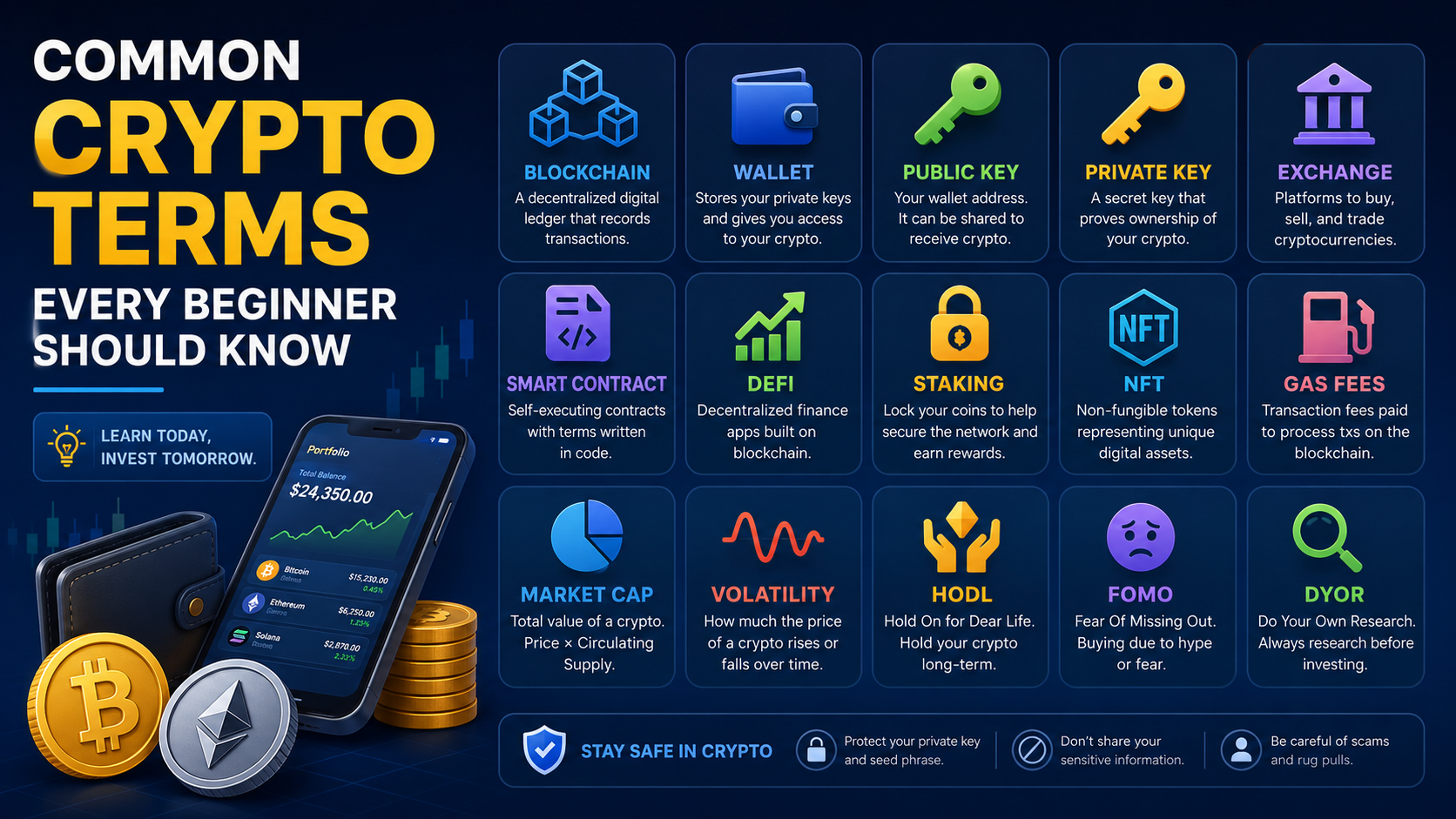
A blockchain is a decentralized digital ledger that records transactions across many computers. Instead of relying on a single company or server, copies of the blockchain are distributed across thousands of participants worldwide. Every new block contains verified transactions and is permanently linked to previous blocks, making the history difficult to alter.
Popular blockchains include Bitcoin, Ethereum, Solana, Avalanche, BNB Chain, Cardano, and many others.
Cryptocurrency
A cryptocurrency is a digital asset that exists on a blockchain. Unlike traditional currencies issued by governments, cryptocurrencies operate using decentralized networks. Some cryptocurrencies primarily serve as digital money, while others power decentralized applications, governance systems, or smart contracts.
Coin vs Token
Although many people use these words interchangeably, they are not the same.
A coin is the native currency of its own blockchain. Examples include Bitcoin on the Bitcoin blockchain and Ether on the Ethereum blockchain.
A token is created on an existing blockchain. Thousands of projects create tokens on networks such as Ethereum, Solana, or BNB Chain without building an entirely new blockchain.
Wallet
A crypto wallet stores the private keys that allow you to access and manage your cryptocurrency. The wallet does not actually hold your coins. Instead, it provides secure access to assets recorded on the blockchain.
Wallets come in several forms:
- Software wallets
- Mobile wallets
- Browser extension wallets
- Hardware wallets
- Paper wallets (rarely used today)
Public Key and Wallet Address
A public key generates your wallet address, which is similar to a bank account number. You can safely share your wallet address with others to receive cryptocurrency.
Anyone can view transactions associated with a public blockchain address.
Private Key
A private key is the secret code that proves ownership of your cryptocurrency. Whoever controls the private key controls the funds.
Never share your private key with anyone.
Seed Phrase (Recovery Phrase)
Most wallets generate a recovery phrase consisting of 12 or 24 random words. This seed phrase allows you to recover your wallet if your device is lost or damaged.
It is one of the most important pieces of information you will ever receive in crypto.
Best practices include:
- Write it down offline.
- Store it securely.
- Never save it in screenshots or cloud storage.
- Never enter it into unknown websites.
Exchange
A crypto exchange is a platform where users can buy, sell, and trade cryptocurrencies.
There are two main categories:
Centralized Exchange (CEX)
A centralized exchange is operated by a company that manages customer accounts and holds user funds while trading.
Advantages include:
- Beginner-friendly interfaces
- High liquidity
- Customer support
- Easy fiat deposits
Examples include Binance, Coinbase, Kraken, and Bitget.
Decentralized Exchange (DEX)
A decentralized exchange allows users to trade directly from their own wallets without handing custody of their assets to a central company.
Examples include Uniswap, PancakeSwap, Raydium, and Jupiter.
Fiat Currency
Fiat refers to government-issued money such as:
- US Dollar (USD)
- Euro (EUR)
- British Pound (GBP)
- Japanese Yen (JPY)
Crypto investors often discuss converting between fiat and cryptocurrency.
Gas Fees
Gas fees are transaction fees paid to blockchain validators or miners for processing transactions.
Gas fees vary depending on:
- Network demand
- Blockchain design
- Transaction complexity
Ethereum is well known for variable gas fees during busy periods.
Smart Contract
A Smart Contract is self-executing software stored on a blockchain. It automatically performs actions when predefined conditions are met.
Smart Contracts power:
- Decentralized finance (DeFi)
- NFT marketplaces
- Blockchain games
- Voting systems
- Token creation
Decentralization
Decentralization means that no single company or government controls the entire network.
Instead, thousands of independent participants validate transactions and maintain the blockchain together.
This reduces single points of failure and increases transparency.
Consensus
Consensus is the process by which blockchain participants agree on the correct version of transaction history.
Different blockchains use different consensus mechanisms.
Proof of Work (PoW)
Proof of Work uses miners who compete to solve mathematical puzzles.
Bitcoin is the most famous blockchain using Proof of Work.
Proof of Stake (PoS)
Proof of Stake replaces mining with validators who lock up cryptocurrency (stake) to help secure the network.
Many modern blockchains use Proof of Stake because it generally consumes less energy than Proof of Work.
Mining
Mining is the process of verifying transactions and creating new blocks on Proof of Work blockchains.
Miners receive newly created coins and transaction fees as rewards.
Staking
Staking involves locking cryptocurrency to help secure a Proof of Stake blockchain.
In return, participants often receive staking rewards.
Validator
Validators verify transactions, create new blocks, and maintain blockchain security on Proof of Stake networks.
Node
A node is a computer running blockchain software that helps maintain and distribute the network.
Some nodes validate transactions, while others simply store and share blockchain data.
Market Cap
Market capitalization estimates the total value of a cryptocurrency.
The formula is simple:
Market Cap = Current Price × Circulating Supply
Market cap often provides a better measure of a project's size than price alone.
Circulating Supply
Circulating supply is the number of coins or tokens currently available to the public.
It differs from:
- Maximum supply
- Total supply
These values help investors understand scarcity.
Bull Market
A bull market describes a period when prices generally rise and investor confidence is strong.
Bull markets often attract new investors and increased media attention.
Bear Market
A bear market is the opposite.
Prices decline over extended periods, and market sentiment becomes cautious or pessimistic.
Volatility
Volatility refers to how much prices move over time.
Cryptocurrency markets are known for being highly volatile, with significant price swings sometimes occurring within a single day.
HODL
HODL began as a misspelled version of "hold" and became one of crypto's most famous expressions.
Today, it means holding cryptocurrency through market ups and downs rather than selling during periods of volatility.
FOMO
FOMO stands for Fear Of Missing Out.
Investors experiencing FOMO may buy assets simply because prices are rising, often without conducting proper research.
FUD
FUD stands for:
- Fear
- Uncertainty
- Doubt
The term usually describes negative information, rumors, or speculation that influences investor sentiment.
DYOR
DYOR means Do Your Own Research.
It encourages investors to evaluate projects independently rather than relying solely on influencers, social media posts, or online hype.
Whale
A whale is an individual or organization that owns a very large amount of cryptocurrency.
Large trades by whales can sometimes influence market prices.
Altcoin
An altcoin is any cryptocurrency other than Bitcoin.
There are thousands of altcoins with different goals, technologies, and communities.
Stablecoin
A stablecoin is a cryptocurrency designed to maintain a relatively stable value.
Many stablecoins are pegged to the US Dollar.
Stablecoins are commonly used for:
- Trading
- Payments
- DeFi
- Preserving value during volatile markets
NFT
NFT stands for Non-Fungible Token.
Unlike cryptocurrencies, NFTs represent unique digital assets such as artwork, collectibles, gaming items, music, or digital memberships.
DeFi
DeFi stands for Decentralized Finance.
It refers to financial applications built on blockchains that allow users to borrow, lend, trade, or earn interest without relying on traditional financial institutions.
DAO
DAO stands for Decentralized Autonomous Organization.
DAOs allow communities to make decisions collectively through blockchain-based voting systems.
Rug Pull
A rug pull is a type of scam where project creators suddenly abandon a project after collecting investor funds.
Learning how to identify warning signs is an important part of staying safe in crypto.
Airdrop
An airdrop distributes free cryptocurrency tokens to users.
Projects may reward:
- Early supporters
- Active community members
- Wallet holders
- Testnet participants
Always verify that an airdrop is legitimate before connecting your wallet.
Liquidity
Liquidity describes how easily an asset can be bought or sold without causing significant price changes.
Higher liquidity generally results in smoother trading.
Slippage
Slippage is the difference between the expected price of a trade and the price at which it is actually executed.
It often occurs during periods of high volatility or low liquidity.
Conclusion
The cryptocurrency world has developed its own vocabulary, but learning these common terms makes navigating the ecosystem much easier. Understanding concepts such as wallets, private keys, Smart Contracts, staking, gas fees, and market capitalization provides a solid foundation for further learning.
Remember that knowledge is one of your most valuable assets in crypto. Continue learning, ask questions within reputable communities, and always practice DYOR before investing in any project. The more familiar you become with these terms, the more confident you will feel exploring the growing world of blockchain and digital assets.

Pick your reaction
Post your comment