
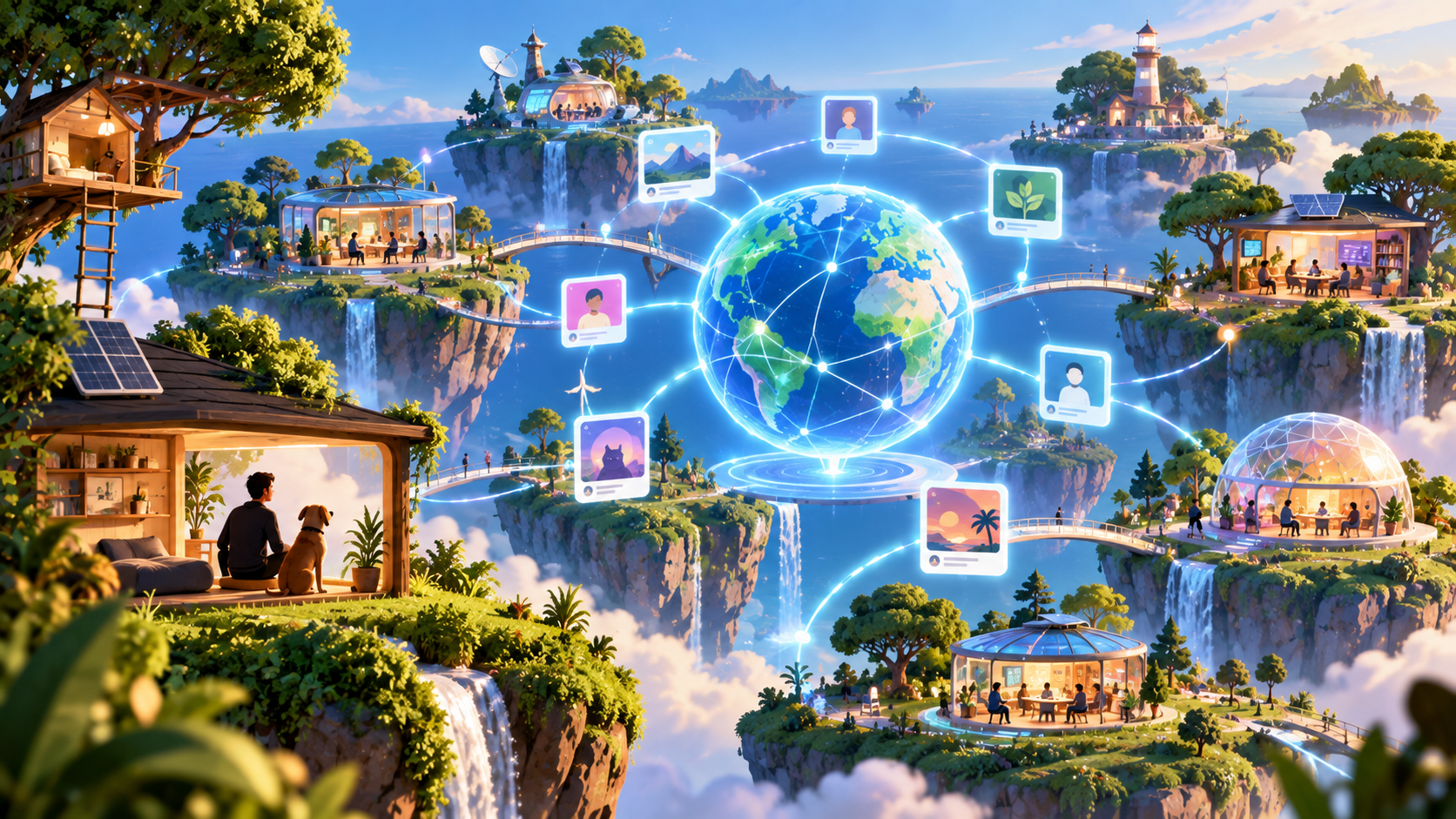
Social networks have become some of the most important places for communication, entertainment, news, and community building. Billions of people use them to share ideas, follow creators, discover projects, and connect with others around the world.
Most popular social platforms, however, are controlled by individual companies. These companies operate the infrastructure, define the rules, manage user accounts, control access to data, and ultimately decide what happens to the content and communities hosted on their services.
Decentralized social networks explore a different model.
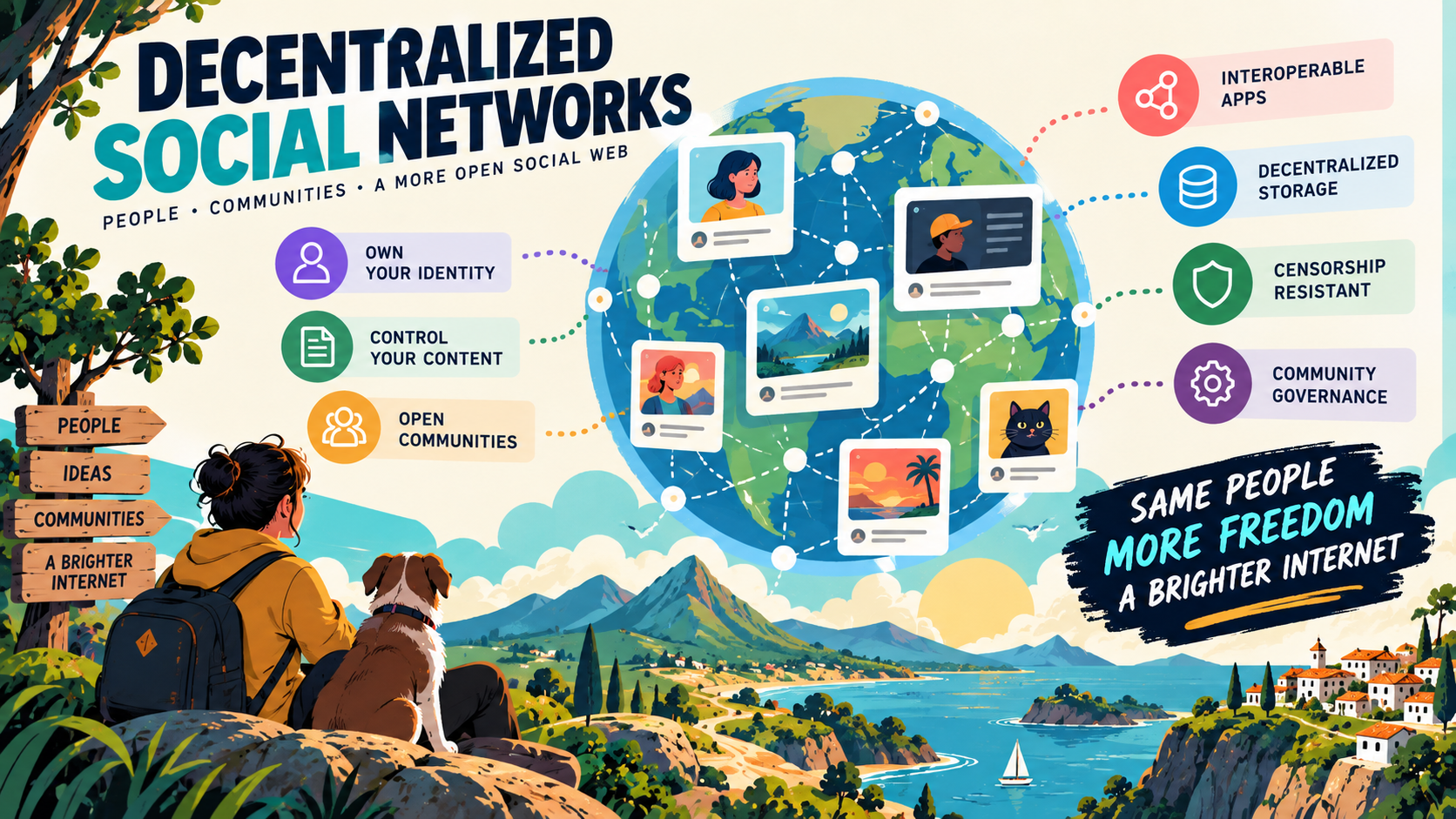
Instead of placing an entire social ecosystem under the control of one organization, they distribute parts of the network across independent servers, protocols, blockchains, or user-controlled infrastructure. Depending on the design, users may gain greater control over their identity, content, social connections, and the applications they use.
But decentralization does not automatically solve every problem associated with traditional social media. It introduces its own challenges involving moderation, usability, governance, scalability, privacy, and sustainability.
Understanding decentralized social networks therefore means looking beyond the idea of simply putting social media "on the blockchain."
What Is a Decentralized Social Network?
A decentralized social network is a social platform or protocol that does not depend entirely on a single central operator.
Traditional social networks generally work through centralized infrastructure. One company maintains the platform's databases and servers while controlling accounts, moderation systems, recommendation algorithms, APIs, and platform policies.
Decentralized networks distribute some of these responsibilities.
Depending on the architecture, this could mean that:
- Communities operate their own servers.
- User identities exist independently of individual applications.
- Social connections can move between compatible platforms.
- Content is stored across distributed systems.
- Governance decisions are shared among participants.
- Public data is recorded on a blockchain.
- Multiple applications interact with the same social protocol.
There is no single technical definition that applies to every decentralized social network. Decentralization exists on a spectrum, and different projects decentralize different parts of the social media stack.
Why Decentralize Social Media?
Centralized social platforms provide significant advantages. They are often easy to use, fast, highly integrated, and capable of serving enormous audiences.
Their centralized structure also creates important trade-offs.
A platform operator can change its rules, algorithms, pricing, APIs, or moderation policies at any time. Accounts may be suspended or removed. Developers can lose access to APIs. Communities can disappear when a service shuts down.
Users also typically build their social identities inside closed ecosystems.
A creator might spend years building thousands of followers on one platform, but those relationships are often difficult or impossible to transfer elsewhere. The audience effectively exists inside the platform's database.
Decentralized social technologies attempt to reduce this dependency by separating social identity and relationships from individual applications.
Protocols Instead of Platforms
One of the most important concepts behind decentralized social networking is the shift from platforms toward protocols.
A traditional platform combines many functions into one service:
identity, profiles, posts, followers, moderation, discovery, messaging, hosting, and the user interface.
A decentralized protocol can separate these components.
Developers may then build different applications that interact with the same underlying social network.
This resembles other open internet technologies. Email, for example, is not controlled by one email application. Different providers and clients can communicate using shared standards.
Decentralized social protocols attempt to bring similar interoperability to social networking.
Instead of choosing one permanent platform, users could potentially choose between different interfaces while maintaining access to the same identity or social graph.
Portable Digital Identity
Identity portability is one of the most significant potential advantages of decentralized social networks.
On centralized platforms, an account usually belongs to a particular service. Your username, profile, followers, and content are tied to that company's infrastructure.
Some decentralized systems attempt to make identity independent from the application.
A user might control an identity through cryptographic keys, a domain, a decentralized identifier, or an account hosted by a provider that can be changed later.
Applications then become interfaces for interacting with that identity rather than owners of it.
This can make switching services easier.
If users dislike one application's interface, policies, or features, they may be able to move to another compatible application without completely rebuilding their online presence.
The Social Graph
Your social graph represents the network of relationships surrounding your account.
It includes information such as:
- Who you follow
- Who follows you
- Communities you participate in
- Accounts you interact with
- Connections between users
On conventional social platforms, the social graph is typically controlled by the platform itself.
Decentralized social protocols can make some or all of this graph portable.
This changes the competitive dynamics of social applications.
A new application built on an open social protocol may not need to create an entirely new network from zero. Users could potentially sign in and immediately access existing relationships from the underlying protocol.
Developers can compete on interfaces, moderation tools, discovery systems, algorithms, and features rather than exclusively competing over ownership of the network.
Federation: Decentralization Without a Blockchain
Decentralized social networking does not necessarily require cryptocurrency or blockchain technology.
Federated networks are one important alternative.
In a federated system, many independently operated servers communicate using a shared protocol. Each server can have its own administrators, communities, moderation policies, and rules while remaining capable of interacting with other compatible servers.
Users select a server but can often communicate with people hosted elsewhere.
This prevents one organization from operating the entire network.
Federation can provide considerable decentralization while avoiding the cost and complexity of recording social activity on a blockchain.
However, server operators still have substantial control over users hosted on their individual servers.
Blockchain-Based Social Networks
Other decentralized social networks use blockchains as part of their architecture.
Blockchain technology can provide a shared database that does not depend on a single platform operator.
Depending on the protocol, blockchain infrastructure might be used for:
- Account ownership
- Usernames
- Social relationships
- Governance
- Creator payments
- Digital assets
- Reputation
- Application permissions
A blockchain can make certain information publicly verifiable and accessible to multiple applications.
But storing social activity directly on-chain also introduces limitations.
Blockchains have finite capacity, transactions can cost money, and public data may be extremely difficult to remove. For those reasons, many blockchain-based social systems use hybrid architectures where only certain information exists on-chain while larger content is stored elsewhere.
Decentralized Storage
Social networks generate enormous amounts of data.
Images, videos, posts, profile information, messages, and other media all need somewhere to live.
Putting everything directly on a blockchain would usually be impractical.
Decentralized social applications may instead combine blockchain or protocol-level identity with distributed storage networks, peer-to-peer systems, independent servers, or conventional cloud infrastructure.
This demonstrates an important distinction.
A social network can be decentralized in one layer while remaining centralized in another.
A project might provide decentralized account ownership while relying on centralized servers for its website. Another might use federated hosting but centralized search. Another might distribute content while maintaining centrally controlled moderation.
The important question is therefore not simply:
"Is this social network decentralized?"
A better question is:
"Which parts of this social network are decentralized?"
Content Ownership and Control
Decentralized social networks often emphasize greater user control over content.
This does not necessarily mean users legally own everything they publish in a fundamentally different way. Instead, technical architectures can make content less dependent on a particular application's database.
If posts are stored using open protocols or distributed infrastructure, multiple applications may be able to access and display them.
That can reduce platform lock-in.
However, permanent or widely replicated content creates another problem: deletion.
Users sometimes need to remove information because it is outdated, embarrassing, sensitive, illegal, or simply something they no longer want online.
Systems designed around immutable data must therefore carefully balance permanence with privacy and the ability to remove content.
Moderation Becomes More Complicated
Decentralization does not eliminate the need for moderation.
Spam, scams, harassment, illegal content, impersonation, manipulation, and abusive behavior can exist on decentralized networks just as they do elsewhere.
The difference is that there may be no single authority responsible for the entire network.
Different communities, servers, applications, or users may instead apply their own moderation policies.
One application could hide certain content while another displays it. Communities could maintain blocklists. Users could subscribe to third-party moderation services or choose different filtering systems.
This can provide greater choice, but it can also make moderation more complicated.
Decentralized networks must determine how to provide user autonomy without making harmful behavior impossible to manage.
Algorithms and User Choice
Recommendation algorithms determine much of what people see on modern social platforms.
Centralized platforms generally control these algorithms internally. Users may have limited understanding of why certain posts appear in their feeds.
Open social protocols could support a different model.
Multiple developers could potentially create competing recommendation algorithms. Users might choose chronological feeds, community-curated feeds, topic-based algorithms, personalized recommendations, or third-party discovery services.
Instead of one company deciding how information is ranked for everyone, algorithms could become another interchangeable layer of the social network.
This could give users considerably more control over how they experience online communities.
Monetization and Digital Economies
Some decentralized social networks also experiment with new economic models.
Cryptocurrency can enable payments directly between users without requiring the social platform to operate the entire payment infrastructure.
Possible applications include:
- Creator tips
- Paid communities
- Memberships
- Digital collectibles
- Micropayments
- Community rewards
- Crowdfunding
- Token-based governance
These systems can create new opportunities for creators and communities.
They can also introduce speculation.
If financial incentives dominate the social experience, interactions may become focused on earning tokens rather than creating meaningful conversations or relationships.
A successful decentralized social network therefore does not necessarily need a token. Social decentralization and financialization are separate concepts.
Governance
Who decides how a decentralized social network evolves?
There is no universal answer.
Governance models can include developers, foundations, server operators, community representatives, token holders, users, or combinations of these groups.
Some protocols use formal on-chain voting. Others rely on open-source development and community discussion. Federated systems may allow individual server administrators to establish their own rules.
Governance decentralization is also different from technical decentralization.
A network could run on decentralized infrastructure while development remains controlled by a small team.
Understanding who can change the protocol is therefore just as important as understanding where its data is stored.
Censorship Resistance and Its Trade-Offs
Decentralized infrastructure can make it more difficult for a single organization to remove users or information from an entire network.
This can be valuable in situations where centralized communication services are restricted, unavailable, or controlled by powerful intermediaries.
But censorship resistance also creates difficult questions.
The same infrastructure that protects legitimate expression can potentially make harmful or illegal material harder to remove.
This tension cannot be solved through decentralization alone.
Technical architecture, moderation, governance, community standards, and legal requirements all interact.
The User Experience Challenge
Perhaps the biggest obstacle facing decentralized social networks is not decentralization itself.
It is usability.
Mainstream social platforms have spent years simplifying account creation, discovery, notifications, recommendations, media uploads, password recovery, and countless other small interactions.
Decentralized alternatives may require users to understand unfamiliar concepts such as:
private keys, seed phrases, servers, instances, wallets, protocols, relays, decentralized identifiers, or network fees.
Most users do not want to understand the infrastructure behind a social network. They simply want it to work.
For decentralized social networks to reach broader audiences, much of this technical complexity needs to disappear into the background.
Scalability and Performance
Social networks operate at enormous scale.
Popular posts can generate millions of views and interactions within hours. Video and image content requires substantial bandwidth and storage. Search indexes must constantly process new information.
Distributed systems need to handle this activity without making the experience noticeably slower or more expensive.
This often leads to hybrid architectures.
Rather than decentralizing every component, developers may decentralize the elements where independence matters most while using conventional infrastructure where it provides practical advantages.
The result may be less ideologically pure, but considerably more usable.
Decentralization Is a Spectrum
One of the most useful ways to understand decentralized social networks is to avoid treating decentralization as a binary label.
A network might decentralize:
identity but not hosting,
hosting but not discovery,
content but not moderation,
payments but not accounts,
or infrastructure but not governance.
Different approaches make different trade-offs.
Evaluating a decentralized social project therefore requires looking at its actual architecture rather than simply accepting the word "decentralized" in its marketing.
Ask who controls accounts, who operates infrastructure, where data is stored, who can change the rules, whether users can migrate, and what happens if the primary application disappears.
Those questions reveal far more than the label itself.
Why Decentralized Social Networks Matter for Crypto Communities
Crypto communities have always depended heavily on social platforms.
Projects use social networks to publish announcements, organize communities, educate users, discuss governance, coordinate development, and build relationships.
This creates an interesting contradiction.
Communities centered around decentralization often depend on highly centralized communication platforms.
Decentralized social protocols could reduce some of this dependency by allowing identities, communities, and social relationships to exist independently from any one application.
For crypto communities in particular, this could eventually connect communication with wallets, governance, reputation, decentralized identity, and community-owned infrastructure.
But technology alone does not create a strong community.
Open protocols still need active participants, useful conversations, effective moderation, trustworthy information, and people willing to contribute.
The Future May Be Multi-Platform
Decentralized social networks do not necessarily need to replace traditional social media.
A more likely development is an increasingly diverse social ecosystem.
Centralized platforms may continue serving enormous audiences while federated networks, open protocols, blockchain-based systems, and specialized communities provide alternatives.
Users may eventually interact with several networks without thinking much about the infrastructure underneath them.
The most important shift could be from choosing a platform to choosing an interface.
If identity, content, and relationships become portable, social applications can compete to provide the best experience without requiring users to abandon their communities whenever they switch services.
Conclusion
Decentralized social networks represent an attempt to rethink one of the fundamental assumptions of modern social media: that a single company must control the platform, the identity system, the social graph, the data, and the user experience.
Federation, open protocols, blockchains, decentralized identity, and distributed storage offer different ways to separate these components.
The result could be a social web where users and communities have greater control over where they participate, which applications they use, and how their online identities move between services.
Significant challenges remain. Moderation, privacy, scalability, governance, sustainability, and usability are difficult problems regardless of whether a network is centralized or decentralized.
The goal of decentralized social networking is therefore not simply to remove platforms.
It is to create social infrastructure where platforms are no longer the only ones in control.

Pick your reaction
Post your comment