

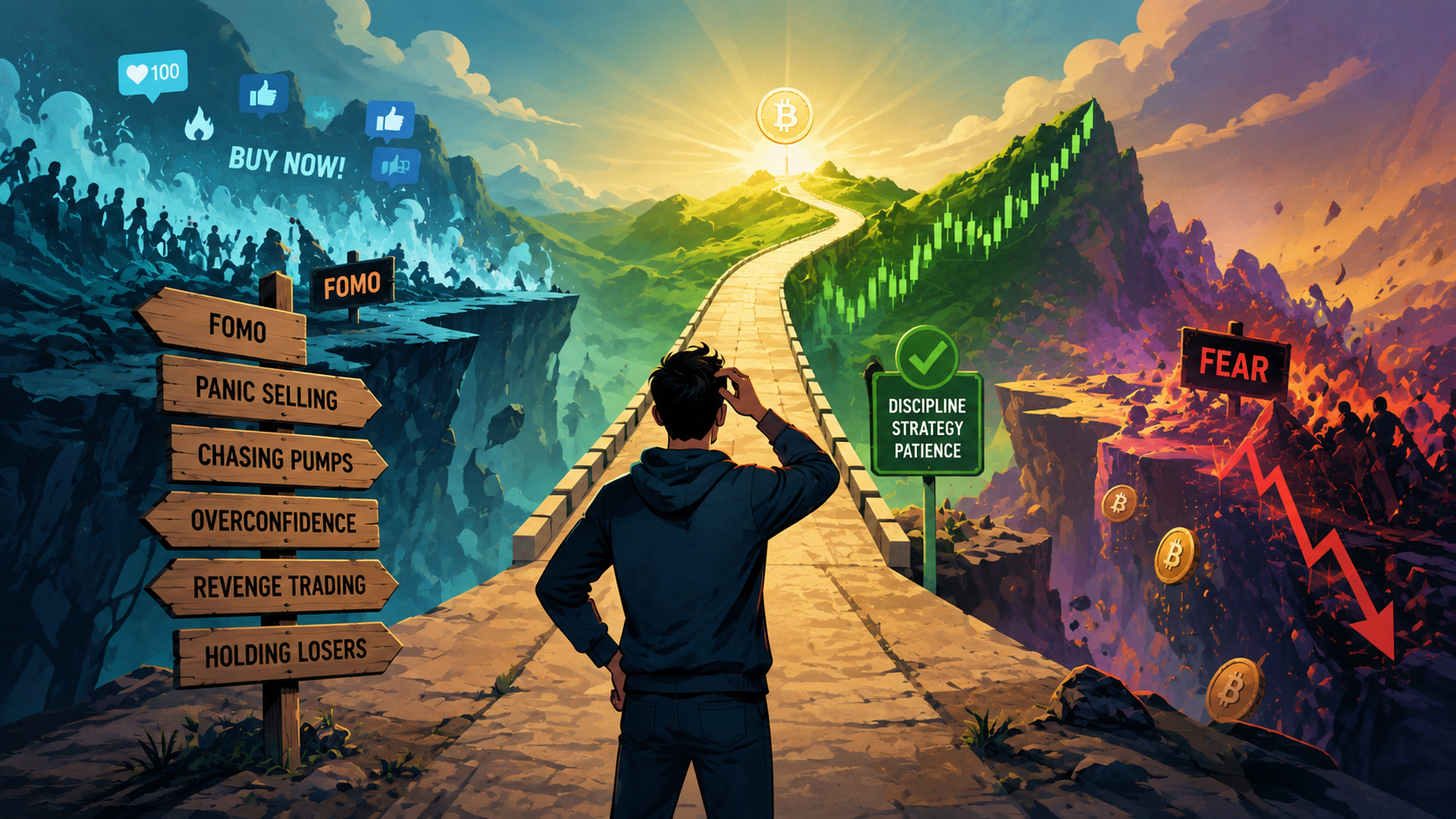
Crypto markets move fast, but prices are only part of the challenge. For many investors, the hardest thing to manage is their own emotional response to uncertainty, volatility, profits, and losses. Fear can push people to sell at the worst possible moment, while excitement can encourage them to take risks they would normally avoid.
Understanding these emotional mistakes does not guarantee better returns, but it can help investors make more deliberate decisions. By recognizing common psychological traps before they happen, it becomes easier to follow a strategy instead of reacting impulsively to every market movement.
Why Emotions Have Such a Strong Influence in Crypto
Investing has always involved psychology, but cryptocurrency markets can amplify emotional reactions. Prices can move significantly within hours, markets trade around the clock, and social media constantly exposes investors to predictions, success stories, warnings, rumors, and opinions.
Unlike traditional markets with defined trading hours, crypto never really closes. Someone checking their portfolio before going to sleep may wake up to a completely different market situation.
This environment can create a powerful feedback loop. Rising prices generate excitement, which attracts more attention and buying. Falling prices create fear, which can lead to panic selling and even more downward pressure.
The result is a market where investor psychology can sometimes become almost as important as fundamentals.
FOMO: Buying Because Everyone Else Is
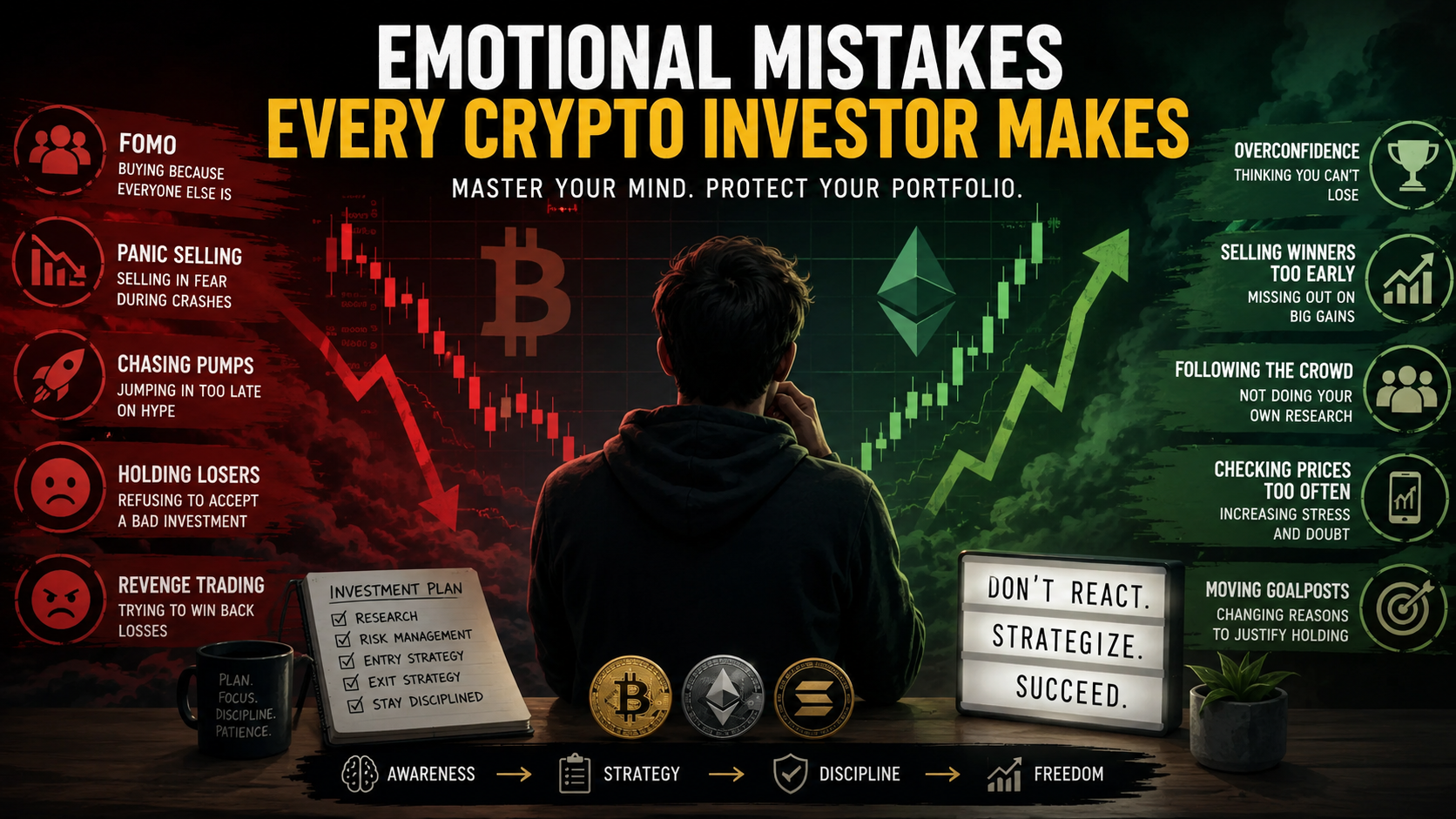
Fear of missing out, commonly known as FOMO, is one of the most recognizable emotional mistakes in crypto.
Imagine watching a cryptocurrency rise 20%, then 40%, then 80%. Social media fills with posts about enormous profits. Influencers begin discussing ambitious price targets, and people who bought earlier proudly share their gains.
Suddenly, not owning the asset feels like a mistake.
This can lead investors to buy primarily because the price is rising rather than because they have researched the project or believe the current valuation makes sense.
The danger is that FOMO often becomes strongest after a large price increase has already occurred. Investors who enter late may therefore be taking considerably more risk than those who bought before the excitement began.
A useful question before buying is simple: Would I still want this asset if its price had not increased recently?
If the answer is no, emotion may be influencing the decision more than research.
Panic Selling During Market Crashes
FOMO dominates rising markets, while fear tends to take control when prices fall.
Crypto corrections can be severe. Seeing a portfolio lose a significant percentage of its value within days can create a strong urge to escape before things become worse.
Selling is not automatically a mistake. Sometimes an investment thesis changes, a project encounters serious problems, or reducing exposure is the sensible decision.
The emotional mistake is selling simply because falling prices feel uncomfortable.
Investors may sell near local lows, only to watch the market recover later. Some then buy back at higher prices, effectively turning temporary volatility into a permanent loss.
Having predefined reasons for selling can help separate strategic decisions from emotional reactions.
Chasing Pumps
A cryptocurrency suddenly starts rising rapidly. Perhaps there is major news, a new exchange listing, a viral social media campaign, or simply speculation.
The temptation is obvious: buy quickly before the price goes even higher.
But rapid price increases can reverse just as quickly.
Chasing a pump means entering primarily because of recent momentum without properly considering valuation, liquidity, market conditions, or the reason behind the movement.
In extreme cases, investors may unknowingly enter coordinated pump-and-dump schemes where earlier participants are waiting for new buyers to provide liquidity for their exit.
A rapidly rising chart should generally be a reason for additional caution, not less research.
Refusing to Accept a Bad Investment
Another common psychological trap is becoming emotionally attached to an investment.
After spending time researching a cryptocurrency, joining its community, following its development, and perhaps holding it for years, selling can feel like admitting that the original decision was wrong.
This can create what economists call the sunk cost fallacy.
Money, time, or effort already invested cannot change what happens next. The relevant question is not:
"How much have I already lost?"
It is:
"Knowing what I know today, would I still choose to invest in this asset?"
If the answer has changed, continuing to hold simply because of the original investment can make the situation worse.
Selling Winners Too Early
Emotions can also interfere when investments are profitable.
After experiencing losses or volatility, investors may become eager to lock in any available profit. A 10% or 20% gain can suddenly feel too valuable to risk losing.
Taking profits can absolutely be part of a sensible strategy. The problem occurs when fear causes investors to abandon their original plan.
An investor might carefully research an asset with a long-term thesis, then sell after a relatively small increase simply because watching the unrealized profit fluctuate becomes uncomfortable.
This behavior can produce an unfortunate pattern: losing positions are held indefinitely in hope of recovery, while successful positions are sold quickly out of fear.
A predetermined exit strategy can help prevent both extremes.
Revenge Trading After a Loss
Losses can feel personal, even though markets have no awareness of individual investors.
After losing money on a trade, some people immediately try to win it back. They may increase their position size, use additional leverage, or enter another trade without proper analysis.
This is often called revenge trading.
The objective quietly changes from making a rational investment to recovering a previous loss.
That shift is dangerous because the amount already lost has no relationship to the probability that the next trade will succeed.
If an investment loses $1,000, the market does not owe the investor $1,000.
Treating each decision independently can help prevent one mistake from becoming several.
Overconfidence After Making Money
Losses create their own emotional problems, but profits can be equally dangerous.
After several successful investments, people may begin believing their results are primarily the product of skill. Confidence increases, position sizes grow, and risk management starts to feel unnecessary.
In reality, strong market conditions can make many strategies appear successful.
During a broad bull market, even poorly researched assets may rise dramatically. Investors can mistake favorable conditions for exceptional investing ability.
Overconfidence may then encourage concentrated positions, excessive trading, leverage, or investments in increasingly speculative assets.
Success should therefore be evaluated just as critically as failure.
Ask not only whether an investment made money, but why it made money.
Constantly Checking Prices
Crypto makes it extremely easy to monitor prices.
Exchanges, portfolio trackers, mobile notifications, social media feeds, and price widgets can provide updates every few seconds.
But having access to constant information does not mean investors benefit from consuming it.
Someone investing with a multi-year horizon may still find themselves checking five-minute charts dozens of times per day. Every small movement begins to feel important.
Frequent monitoring can magnify emotional reactions to normal volatility and create pressure to take unnecessary action.
The appropriate frequency for checking an investment should generally reflect the strategy behind it. A long-term strategy rarely requires minute-by-minute monitoring.
Following the Crowd Without Doing Research
Humans naturally look to others when making uncertain decisions.
In crypto, this can mean following influencers, online communities, friends, prominent traders, or general market sentiment.
Social proof becomes particularly powerful when large numbers of people appear to agree.
But popularity is not the same as accuracy.
Thousands of people can be wrong simultaneously, especially in speculative markets. Communities can also become echo chambers where criticism disappears and optimistic assumptions are constantly reinforced.
Other people's opinions can provide useful information, but they should not replace independent research.
Becoming Emotionally Attached to a Community
Crypto communities are an important part of the industry. They help people learn, collaborate, discover projects, discuss technology, and share information.
However, belonging to a community can also influence investment decisions.
An investor may gradually stop seeing a cryptocurrency as an asset and begin seeing it as part of their identity. Criticism of the project then feels like criticism of the community or even of the investor personally.
This makes objective evaluation difficult.
Healthy communities should allow questions, disagreement, and critical discussion. Investors should be especially cautious when communities discourage skepticism or label every negative opinion as an attack.
Community participation can be valuable, but investment decisions should remain independent.
Moving the Goalposts
Suppose someone buys a cryptocurrency expecting a particular development to happen within a year.
The development never arrives.
Instead of reconsidering the investment, the investor creates a new reason to continue holding. When that reason fails, another explanation appears.
This is known as moving the goalposts.
Investment theses should evolve when new information becomes available, but constantly changing the justification for holding an asset can prevent investors from acknowledging that their original assumptions were incorrect.
Writing down the original reasons for an investment can help.
Months later, those reasons can be reviewed objectively:
- Has the project delivered what was expected?
- Have the fundamentals improved or deteriorated?
- Has the competitive environment changed?
- Is the original investment thesis still valid?
This creates accountability that memory alone often cannot provide.
Trying to Predict Every Market Movement
Crypto investors are surrounded by forecasts.
Bitcoin will reach a particular price. Altcoin season will begin next month. The market bottom is already in. A correction is coming next week.
Some predictions will inevitably turn out to be correct.
The problem is believing that markets can consistently be predicted with precision.
Attempting to perfectly time every top and bottom can encourage excessive trading and emotional decision-making. Investors may sell because they fear an upcoming correction, buy back because prices continue rising, then sell again when the market finally falls.
Instead of requiring perfect predictions, many strategies focus on managing uncertainty.
Position sizing, diversification, dollar-cost averaging, predetermined exit rules, and maintaining appropriate cash reserves are examples of approaches that do not depend on knowing exactly what the market will do next.
Comparing Your Returns With Other Investors
Social media makes investment performance highly visible, but what people share is rarely a complete record.
Someone may post about turning $1,000 into $20,000 while saying nothing about previous losses. Another person may show an extremely profitable trade without mentioning the enormous risk involved.
Comparing your portfolio with these selective examples can create unnecessary pressure.
It may encourage investors to abandon reasonable strategies simply because someone else appears to be making more money.
Investment performance should instead be considered relative to personal objectives, time horizon, and risk tolerance.
The person making the highest return is often also taking the greatest risk.
Increasing Risk Because the Market Feels Safe
During prolonged bull markets, volatility can begin to feel normal rather than dangerous.
Prices keep recovering. Dips become buying opportunities. Speculative assets generate enormous returns.
Gradually, investors may increase their exposure because the environment appears safer than it actually is.
This is when leverage, oversized positions, and highly speculative investments can become particularly tempting.
Risk, however, does not disappear because recent investments have performed well.
In fact, periods of extreme optimism can sometimes be when investors should examine their risk exposure most carefully.
Making Decisions Based on Unrealized Profits
Suppose an investor buys an asset for $2,000 and watches it rise to $10,000.
Psychologically, that $10,000 can quickly begin to feel like money they already own.
If the value then falls to $7,000, the investor may feel as though they have "lost" $3,000, even though the investment remains significantly profitable.
This reference-point effect can distort decisions.
The investor might sell because they are desperate to protect what remains, or refuse to sell because they are waiting for the portfolio to return to its previous peak.
Markets do not know or care about an individual's previous portfolio value.
Decisions should be based on current information and future expectations rather than attachment to a previous high.
How to Reduce Emotional Investing
It is impossible to remove emotion completely. Investors are human, and uncertainty naturally produces psychological reactions.
The goal is therefore not to become emotionless. It is to build systems that make emotional impulses less influential.
Several habits can help:
- Define why you are buying before making an investment.
- Decide how much you are willing to risk.
- Establish conditions that would cause you to sell.
- Avoid investing money you may need in the near future.
- Be cautious after unusually large profits or losses.
- Reduce unnecessary exposure to short-term price movements.
- Keep records of investment decisions and the reasoning behind them.
- Reevaluate investments when fundamentals change.
- Separate community participation from financial decisions.
- Accept that missing opportunities is unavoidable.
That final point is particularly important.
There will always be another cryptocurrency that rises dramatically without you owning it. Missing a profitable trade does not mean you made a bad decision. Taking unnecessary risk simply because someone else made money can be far more damaging.
A Strategy Is Most Valuable When Emotions Are Strong
Investment strategies are easy to follow when markets are calm.
Their real value appears when conditions become uncomfortable.
During euphoric markets, a strategy can prevent excessive risk-taking. During crashes, it can prevent fear from completely replacing rational analysis.
This is why risk management should ideally happen before emotions become intense.
Deciding how much to invest after a cryptocurrency has already doubled is much harder than deciding beforehand. Determining when to sell during a sudden crash is more difficult than establishing exit conditions while the market is calm.
Preparation creates distance between emotion and action.
Final Thoughts
Some of the biggest mistakes in crypto have nothing to do with choosing the wrong blockchain, misunderstanding technology, or failing to predict the market.
They happen because investors are human.
Fear encourages people to sell. Greed encourages them to chase prices. Losses create frustration. Profits create overconfidence. Communities create attachment, while social media creates constant pressure to compare results.
These emotions cannot be eliminated, but they can be recognized and managed.
Successful investing is not necessarily about making the perfect decision every time. It is about creating a process that remains reasonably consistent when markets become exciting, frightening, or unpredictable.
In a market where prices can change within minutes, controlling your own decisions may ultimately be more important than trying to control what the market does next.


Pick your reaction
Post your comment