
Ethereum is the largest smart contract platform in the blockchain industry and serves as the foundation for thousands of decentralized applications, DeFi protocols, NFT marketplaces, and blockchain games. As Ethereum's popularity has grown, so have its challenges, particularly high transaction fees and network congestion during periods of heavy usage. To solve these issues without compromising security, developers have created Layer 2 chains.
These networks work alongside Ethereum, providing faster transactions and significantly lower fees while remaining connected to the Ethereum ecosystem.
Today, Layer 2 networks process a large share of Ethereum's transaction activity and are considered a core part of Ethereum's long-term scaling strategy.
What Are Ethereum Layer 2 Chains?
Layer 2 chains are blockchain networks built on top of Ethereum. Instead of processing every transaction directly on Ethereum's main network, Layer 2 solutions handle most activity separately and periodically submit transaction data or cryptographic proofs back to Ethereum. This reduces the workload on the main chain and allows many more transactions to be processed at a fraction of the cost.
The term "Layer 2" refers to the fact that these networks operate as an additional layer above Ethereum's base layer, often called Layer 1. Ethereum remains the foundation for security and settlement, while Layer 2 networks focus on scalability and efficiency.
Why Ethereum Needs Layer 2 Solutions
Ethereum was designed to prioritize decentralization and security. While these qualities make the network highly resilient, they also limit the number of transactions that can be processed directly on the main chain.
During periods of heavy demand, users compete for limited block space, causing gas fees to rise significantly. Historically, interacting with popular DeFi applications or NFT marketplaces could cost tens or even hundreds of dollars in transaction fees.
Layer 2 networks solve this problem by processing transactions off the Ethereum mainnet while still relying on Ethereum for final settlement and security.
The Dencun Upgrade and Blob Transactions
A major breakthrough for Ethereum scaling arrived in March 2024 with the Dencun upgrade. One of its most important features was EIP-4844, commonly known as Proto-Danksharding.
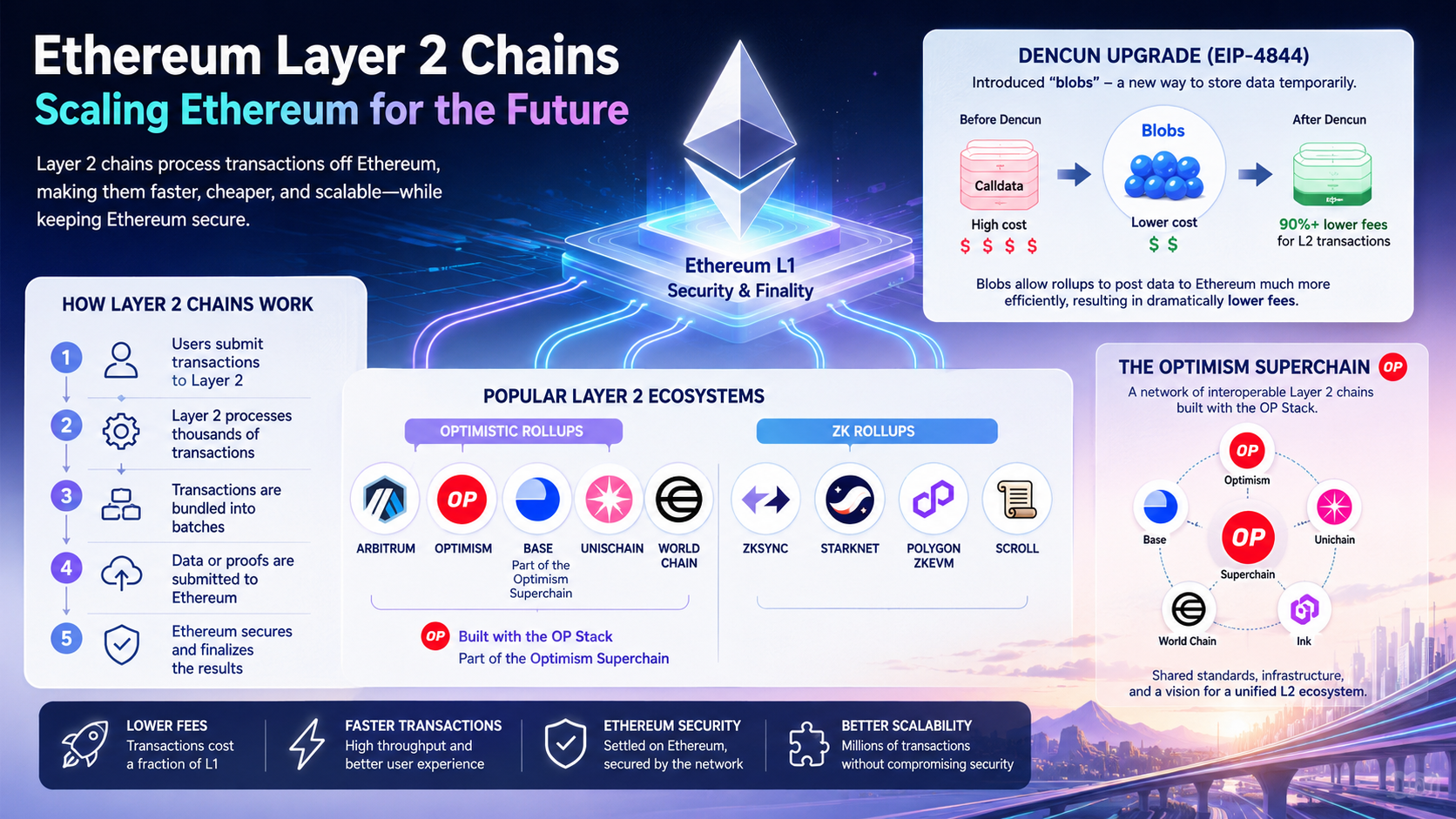
Before Dencun, Layer 2 rollups had to publish transaction data to Ethereum using calldata. While secure, this method was relatively expensive because the data had to be stored permanently on the blockchain.
EIP-4844 introduced a new type of temporary data storage called blobs. Blob data remains available long enough for rollups to verify and secure transactions but does not need to be stored forever by Ethereum nodes.
This dramatically reduced the cost of posting Layer 2 transaction data to Ethereum. As a result, transaction fees on many Layer 2 networks fell substantially, often reaching just a few cents or less.
The introduction of blobs strengthened Ethereum's rollup-centric roadmap and reinforced the idea that most user activity will eventually take place on Layer 2 networks, while Ethereum itself serves as a highly secure settlement and data availability layer.
How Layer 2 Chains Work
Although different Layer 2 networks use different technologies, the general process is similar:
- Users submit transactions to the Layer 2 network.
- The Layer 2 chain processes thousands of transactions quickly and cheaply.
- Transactions are bundled into batches.
- Data or proofs are submitted to Ethereum.
- Ethereum secures and finalizes the results.
Because many transactions are grouped together, the cost of using Ethereum is shared across thousands of users, resulting in dramatically lower fees.
Types of Ethereum Layer 2 Chains
Optimistic Rollups
Optimistic Rollups assume transactions are valid by default and only verify them in detail if they are challenged during a dispute period.
This approach enables high scalability while maintaining strong security guarantees inherited from Ethereum.
Popular Optimistic Rollup ecosystems include:
- Arbitrum
- Optimism
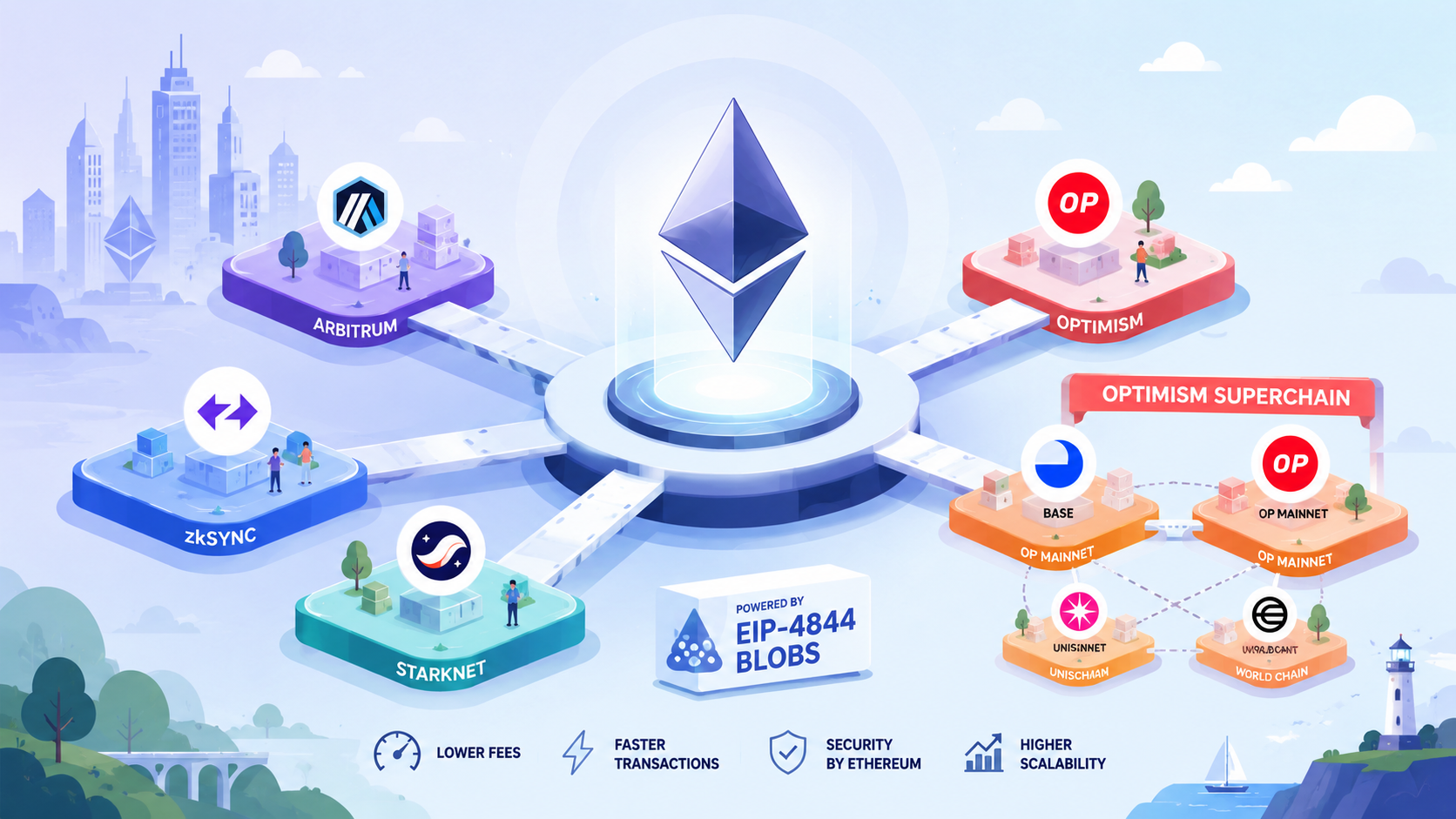
- Base
- Unichain
- World Chain
Zero-Knowledge Rollups (ZK Rollups)
ZK Rollups use advanced cryptographic proofs to mathematically verify transaction validity before results are submitted to Ethereum.
Benefits include:
- Faster finality
- Strong security guarantees
- High scalability
- Efficient use of Ethereum block space
Leading ZK Rollup projects include:
- zkSync
- Starknet
- Polygon zkEVM
- Scroll
Many developers believe ZK Rollups represent the long-term future of Ethereum scaling due to their efficiency and security properties.
The Optimism Superchain
One of the most important developments in the Layer 2 ecosystem is the emergence of the Optimism Superchain.
The Superchain is a network of interconnected Layer 2 chains built using the OP Stack, an open-source framework developed by the Optimism project. Rather than operating as isolated networks, Superchain members share technology standards, infrastructure, and a common vision for interoperability.
Notable Superchain members include:
- Optimism
- Base
- Unichain
- World Chain
- Ink
Base, developed by Coinbase, is therefore more than simply another Layer 2 network. It is part of the broader Superchain ecosystem and contributes to a future where multiple Layer 2 chains can work together more seamlessly while benefiting from shared infrastructure and security assumptions.
The Superchain vision aims to create an internet-scale network of interoperable Layer 2 chains that feels increasingly unified to users and developers.
Popular Ethereum Layer 2 Ecosystems
Arbitrum
Arbitrum is one of the largest Layer 2 networks by total value locked and application activity. It focuses heavily on DeFi and maintains strong compatibility with existing Ethereum applications.
Optimism
Optimism pioneered many concepts behind the OP Stack and the Superchain. It remains one of the most influential projects in Ethereum's scaling ecosystem.
Base
Created by Coinbase, Base has become one of the fastest-growing Ethereum Layer 2 networks. As a member of the Optimism Superchain, it combines low transaction fees, strong developer support, and access to Coinbase's large user base.
zkSync
zkSync leverages Zero-Knowledge Rollup technology to provide fast, low-cost transactions while maintaining Ethereum-level security.
Starknet
Starknet uses STARK proofs, a highly advanced form of cryptographic verification, to achieve scalability while preserving decentralization and security.
The Future of Ethereum Layer 2
Ethereum's future is increasingly rollup-centric. Rather than scaling primarily through larger blocks or more powerful hardware requirements, Ethereum is evolving into a secure settlement layer that supports an expanding ecosystem of Layer 2 networks.
The Dencun upgrade and blob transactions significantly reduced Layer 2 costs and laid the foundation for future upgrades that will further increase data availability and scalability.
As interoperability improves through initiatives such as the Optimism Superchain and advances in ZK technology, users may eventually interact with multiple Layer 2 networks without even noticing which chain they are using.
Conclusion
Ethereum Layer 2 chains have become the primary solution to Ethereum's scalability challenges. By processing transactions off-chain while leveraging Ethereum's security, they provide faster transactions, lower fees, and a better user experience.
Recent innovations such as the Dencun upgrade, blob transactions, and the growth of ecosystems like the Optimism Superchain have accelerated adoption and made Layer 2 networks more practical than ever. As Ethereum continues to evolve, Layer 2 chains are expected to handle the majority of user activity, helping bring blockchain technology to a global audience.


Pick your reaction
Post your comment