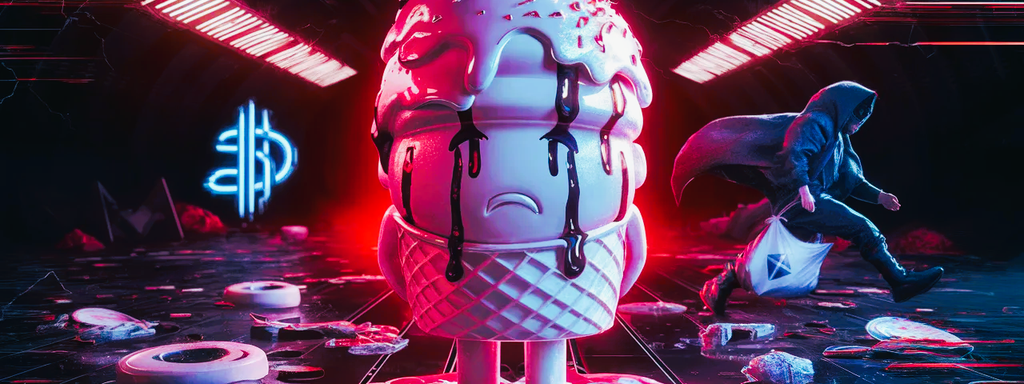

🐾 Three NFT Stories That Started Like a Dream... and Ended Like a Warning In the world of NFTs, everything moves faster than in real life. One day you see a project that looks like the "next big thing." The next day, it's gone. The third... someone makes a YouTube documentary about it and everyone says, "How could we have missed this?" This isn't a list for drama. These are three stories that have become Web3 legends—but from a less pleasant perspective. Today, we'll tackle the first of them.
🧁 Frosties—a Sweet Beginning and a Very Bitter Ending
Imagine a collection that looks like a sugary dream.
Colorful NFTs, an active community, promises of the future, a roadmap full of "exciting plans."
Discord is alive. People are writing, speculating, planning.
The hype is growing. Mint is ending. And then... silence falls.
But let's start from the beginning.
Frosties launched on January 7, 2022, as a collection of 8,888 ice cream-themed NFTs, billing itself as a "cool, delicious, and unique" project. It featured a collection of colorful, animated ice cream-inspired characters with a light, cheerful vibe. The collection launched on January 9, 2022, when ETH was over $3,000 and new users were still flocking to the NFT space, hoping to make money.
The project's creators, Nguyen and Llacuna, lured investors with promises of perks for purchasing NFTs, including giveaways, early access to the metaverse game they were supposedly creating, and exclusive passes to future seasons of Frosties. The project generated tremendous interest—among the announced features were a metaverse game and a staking mechanism. Tens of thousands of people followed the project's Twitter account and joined its Discord server.
On January 9th, an ice cream-themed NFT project called "Frosties" raked in $1.1 million in rug pull just an hour after the NFT launched. Less than an hour after the January 9th launch, Nguyen and Llacuna abandoned Frosties, shutting down their website and 25,000-member Discord server, and transferring all funds to their own cryptocurrency wallets.
Using pseudonyms such as "Frostie," "Jakefiftyeight," "Jobo," and "Joboethan," they shut down the project's Discord server and Twitter account and transferred $1.1 million to a series of external wallets—but not before tweeting "I'm sorry" to their NFT holders, some of whom had spent tens of thousands of dollars on the now-worthless tokens.
The criminal complaint against Nguyen and Llacuna included a screenshot of an apology message Nguyen sent to a moderator of the Frosties Discord server. In this message, Ethan Vinh Nguyen allegedly admitted that he never intended to follow through with the project's announced roadmap. He wrote, in part: *"I know this comes as a shock, but this project is coming to an end. I never intended to continue it and have no future plan."*
Just before the anonymous duo was set to launch another rug pull project called "Embers," which could have earned the scammers $1.5 million, authorities tracked them down. Friends Ethan Nguyen and Andre Llacuna from Los Angeles were arrested and charged by the Department of Justice (DOJ) with conspiracy to commit telecommunications fraud and conspiracy to commit money laundering.
Both were 20 years old at the time, and each charge carried a maximum penalty of 20 years in prison. This case became one of the first instances in which US law enforcement took decisive action against NFT scammers.
What is the legal situation of the creators of Frosties NFT, Ethan Nguyen and Andre Llacuna, today (April 15, 2026)?
Both men have been indicted, but criminal trials in the US can be lengthy, and there is no public record of their final conviction and a specific prison sentence.
In March 2022, they were charged with conspiracy to commit wire fraud and conspiracy to launder money.
Each of these offenses carries a maximum sentence of 20 years in prison.
Why is it taking so long, you ask?
The Frosties case was the first criminal trial in US history for a "rug pull" NFT. Therefore, it is precedent-setting. In the US legal system, years often pass between indictment and sentencing, especially if the defendants opt for plea bargaining or the case is complex in terms of analyzing blockchain flows.
The indictment of these young men definitively ended their criminal activities, but the final sentence has not yet been made public.


Pick your reaction
Post your comment