

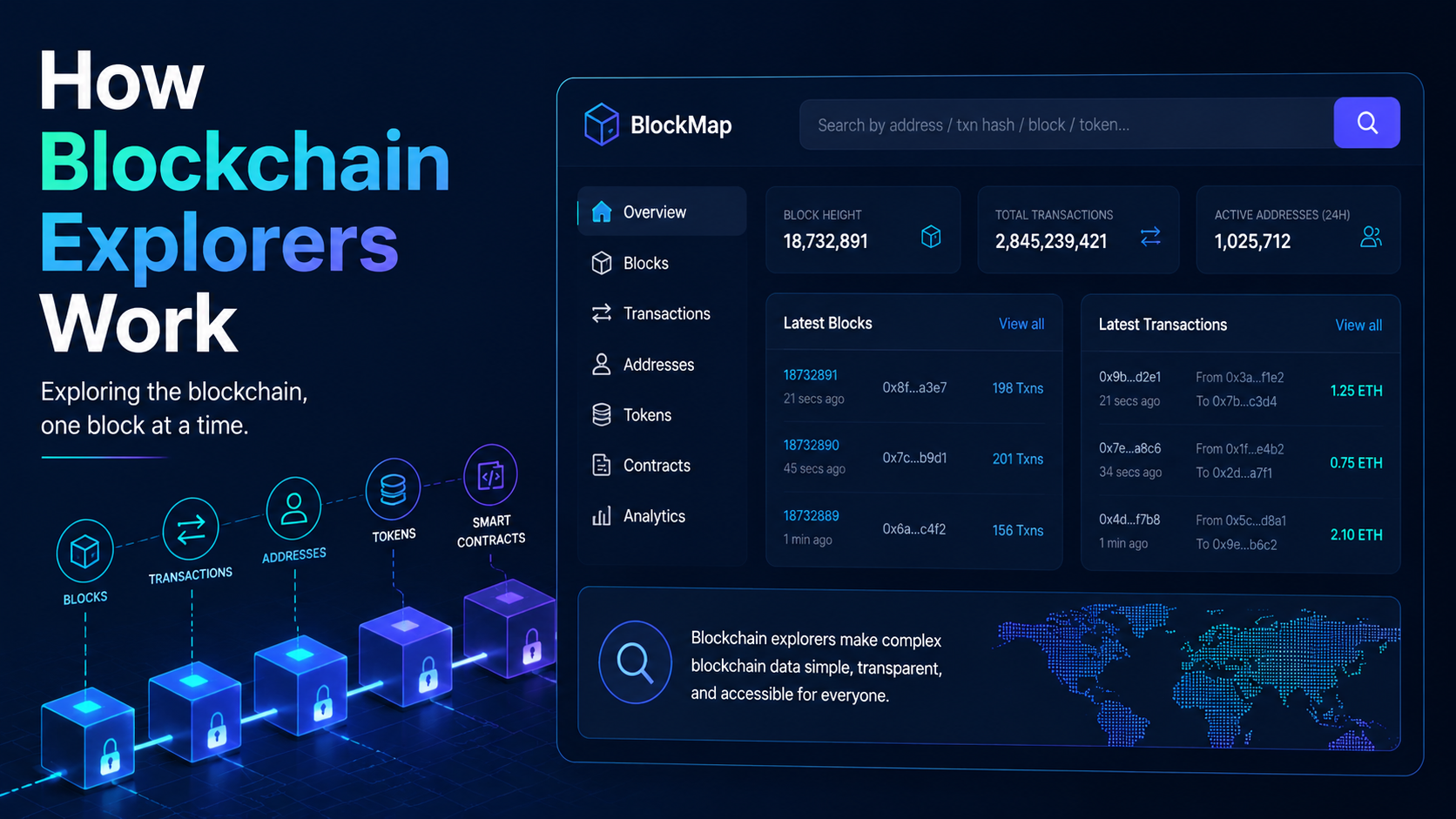
Blockchain explorers are essential tools for anyone who wants to understand what is happening on a blockchain network. They allow users to view transactions, check wallet activity, explore blocks, track tokens, and verify information directly from a blockchain’s public data.
Unlike traditional financial systems where transaction details are hidden behind banks and payment providers, blockchains are built around transparency. Blockchain explorers make this transparency accessible by turning complex blockchain data into an easy-to-understand interface.
Whether you are checking whether a crypto payment arrived, investigating a token transfer, analyzing network activity, or learning how a blockchain works, explorers provide a window into the decentralized world.
What Is a Blockchain Explorer?
A blockchain explorer is a web-based tool that allows users to search and view data stored on a blockchain. It works similarly to a search engine, but instead of searching websites, it searches blockchain records.
Every blockchain transaction creates a permanent record stored on the network. Explorers collect this information and display it in a human-readable format.
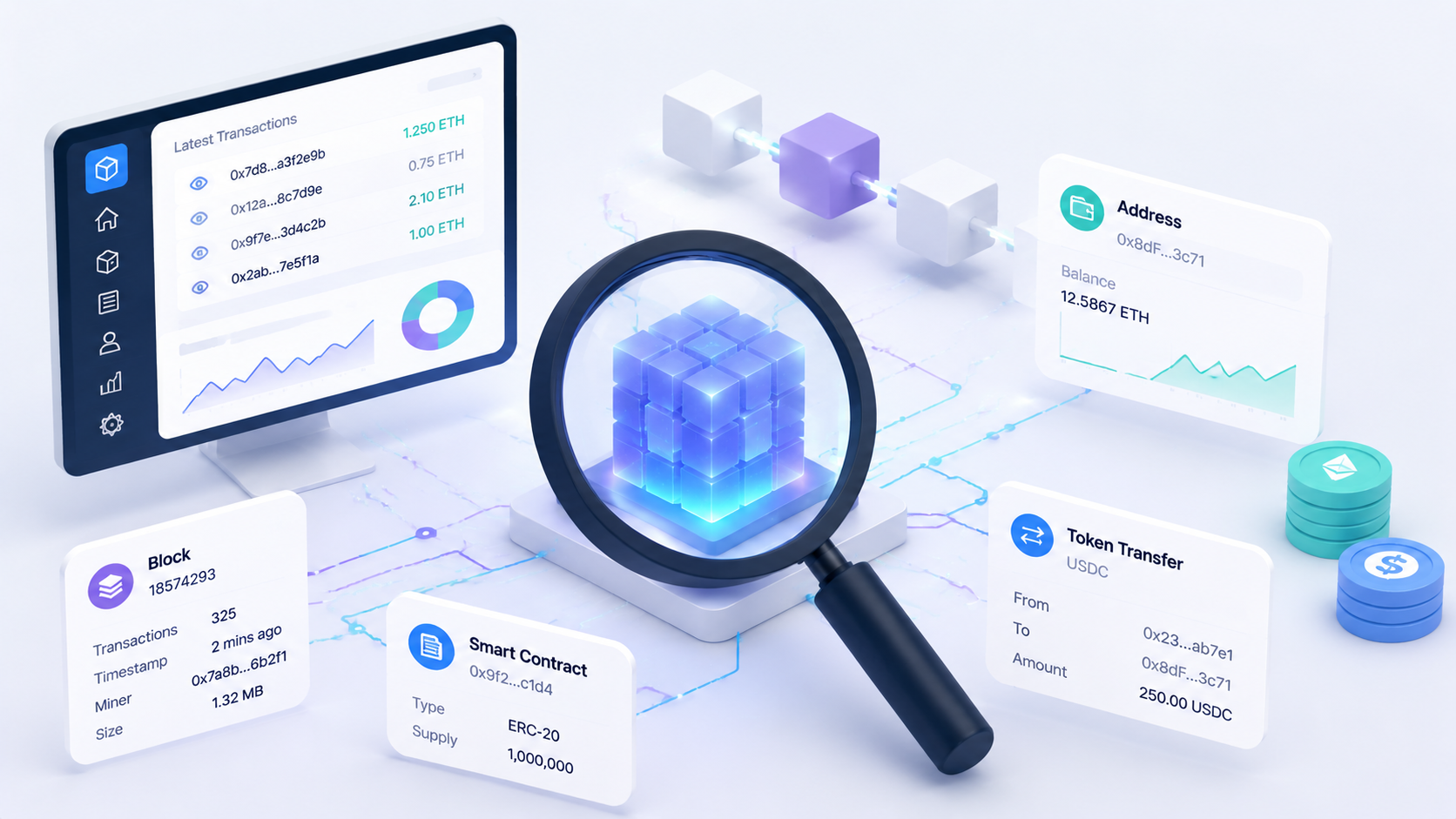
A blockchain explorer can show:
- Transaction history
- Wallet addresses and balances
- Block information
- Transaction confirmations
- Token transfers
- Smart contract activity
- Network statistics
- Validator or miner information
Popular examples include Ethereum explorers, Bitcoin explorers, and explorers created specifically for networks such as Solana, BNB Smart Chain, Polygon, and many others.
Why Blockchain Explorers Exist
Blockchains are transparent by design, but the raw data stored on them is difficult for humans to read.
A blockchain does not store information in a simple format like:
Alice sent 1 ETH to Bob on July 16.
Instead, it stores cryptographic records containing:
- Wallet addresses
- Transaction hashes
- Digital signatures
- Block numbers
- Timestamps
- Amounts transferred
- Smart contract instructions
Blockchain explorers translate this technical information into a format that people can understand.
They act as a bridge between the underlying blockchain technology and everyday users.
How Blockchain Explorers Collect Data
To understand how explorers work, it helps to understand the relationship between a blockchain explorer and the blockchain itself.
Connecting to Blockchain Nodes
A blockchain explorer connects to blockchain nodes, which are computers running blockchain software and maintaining a copy of the network data.
Nodes store information such as:
- Confirmed transactions
- Blocks
- Account states
- Smart contract data
The explorer continuously communicates with these nodes to retrieve updated information.
When a new block is added to a blockchain, connected nodes receive the update. The explorer then processes this information and makes it searchable.
Indexing Blockchain Data
Raw blockchain data is not designed for quick searches.
Imagine trying to find a specific transaction by scanning millions of blocks one by one. This would be extremely slow.
Blockchain explorers solve this problem through indexing.
Indexing means organizing blockchain data into searchable databases.
An explorer might create indexes for:
- Wallet addresses
- Transaction IDs
- Token contracts
- Block numbers
- Smart contract interactions
This allows users to instantly search:
Show me everything that happened with this wallet address.
without manually scanning the entire blockchain.
Understanding the Main Parts of a Blockchain Explorer
Blocks
Blocks are the building blocks of a blockchain.
A blockchain explorer displays information such as:
- Block number
- Time created
- Transactions included
- Block size
- Validator or miner responsible
- Previous and next blocks
Each block links to the previous one through cryptographic references, creating the chain structure.
Transactions
Transactions are one of the most commonly viewed parts of a blockchain explorer.
A transaction page usually includes:
- Transaction hash
- Sender address
- Receiver address
- Amount transferred
- Network fee
- Status
- Confirmation count
- Timestamp
The transaction hash acts like a unique receipt number. Anyone can use it to verify that a transaction exists and check its details.
Wallet Addresses
Blockchain explorers allow users to search any public wallet address.
A wallet page may show:
- Current balance
- Incoming transactions
- Outgoing transactions
- Token holdings
- NFT ownership
- Interaction with decentralized applications
However, explorers do not reveal personal identities. A wallet address is simply a public identifier unless someone has linked it to a real person or organization.
Tokens
Many blockchains support tokens created through smart contracts.
Explorers can display:
- Token balances
- Token transfers
- Token holders
- Contract information
- Supply statistics
For example, Ethereum explorers can track thousands of ERC-20 tokens and NFTs created through smart contracts.
How Blockchain Explorers Track Transactions
When a user sends cryptocurrency, several steps happen before the transaction appears in an explorer.
Transaction Creation
A wallet creates a transaction containing:
- Sender address
- Receiver address
- Amount
- Digital signature
The transaction is then broadcast to the blockchain network.
Network Verification
Nodes receive the transaction and check whether it is valid.
They verify things like:
- Does the sender have enough funds?
- Is the signature correct?
- Does the transaction follow network rules?
Valid transactions enter a waiting area often called the mempool.
Block Inclusion
A miner or validator selects transactions and includes them in a new block.
Once the block is accepted by the network, the transaction becomes confirmed.
Explorer Update
The explorer detects the new block, processes the transaction data, and updates its database.
The transaction then becomes searchable.
What Are Transaction Confirmations?
Blockchain explorers often show confirmation numbers.
A confirmation means that additional blocks have been added after the block containing your transaction.
More confirmations generally mean a transaction is more secure because reversing it becomes increasingly difficult.
For example:
- 0 confirmations: Transaction broadcast but not confirmed
- 1 confirmation: Included in a block
- Multiple confirmations: Increasingly secure
Different blockchains use different confirmation models depending on their consensus mechanisms.
Blockchain Explorers and Smart Contracts
Modern blockchain explorers do more than track payments.
They also provide insight into smart contract activity.
For smart contracts, explorers can show:
- Contract code
- Contract interactions
- Function calls
- Token creation
- Decentralized application activity
Developers often use explorers to debug applications and verify that smart contracts behave correctly.
Many explorers also allow verified contract code, meaning developers can publish their source code so users can inspect how a contract works.
The Role of Explorers in Transparency and Security
Blockchain explorers are important because they allow anyone to independently verify blockchain activity.
Verify Payments
Instead of trusting a screenshot or message claiming a payment was sent, users can verify the transaction directly on the blockchain.
This is especially useful for merchants, exchanges, donation campaigns, and community projects.
Investigate Suspicious Activity
Researchers and users can analyze:
- Large transfers
- Exchange movements
- Token distributions
- Possible scams
- Suspicious wallet activity
Because blockchain data is public, explorers make it possible to follow the movement of funds without relying on third parties.
Understand Network Health
Explorers provide statistics about blockchain activity, including:
- Transaction volume
- Network usage
- Fees
- Active addresses
- Block production
- Validator activity
These metrics help users understand how a network is being used.
Different Types of Blockchain Explorers
Not all explorers focus on the same information.
General Blockchain Explorers
General explorers provide basic blockchain information:
- Blocks
- Transactions
- Wallets
- Network statistics
They are useful for everyday users checking payments or learning how a blockchain operates.
Token Explorers
Token-focused explorers provide additional information about assets created on a blockchain.
They can show:
- Token transfers
- Holder distribution
- Total supply
- Contract details
DeFi Explorers
DeFi explorers focus on decentralized finance activity, including:
- Liquidity pools
- Lending platforms
- Decentralized exchanges
- Yield farming activity
They help users understand complex financial activity happening on-chain.
Multi-Chain Explorers
Multi-chain explorers support multiple blockchain networks from one interface.
They allow users to compare activity across different ecosystems and track assets moving between networks.
Are Blockchain Explorers Centralized?
Although blockchains themselves are decentralized, many explorers are operated by companies or organizations.
This creates an important distinction:
- Blockchain data is decentralized and publicly available.
- The explorer interface is usually maintained by a specific operator.
Anyone can technically create an explorer by running blockchain nodes, collecting data, building indexing systems, and creating a user interface.
Some blockchain communities maintain open-source explorers to provide independent access to network data.
How Blockchain Explorers Help Crypto Communities
For cryptocurrency communities, explorers are valuable educational and transparency tools.
Community members can use explorers to:
- Verify donations
- Track project wallets
- Monitor token activity
- Confirm transactions
- Learn how blockchain technology works
They also reduce dependence on centralized information sources because users can independently verify blockchain records.
For community managers, explorers can help demonstrate transparency by showing how funds, rewards, or community tokens are distributed.
The Future of Blockchain Explorers
As blockchain technology evolves, explorers are becoming more advanced.
Future explorers may include:
- Better analytics
- Artificial intelligence-powered insights
- Cross-chain tracking
- Improved privacy analysis
- More user-friendly interfaces
- Real-time blockchain monitoring
As more people interact with decentralized applications, explorers will continue to serve as an important gateway between blockchain technology and everyday users.
Final Thoughts
Blockchain explorers are one of the most important tools in the cryptocurrency ecosystem. They transform complex blockchain data into accessible information that anyone can verify.
From checking a simple payment to analyzing smart contracts and tracking entire ecosystems, explorers make blockchain transparency practical.
Understanding how blockchain explorers work is an important step for anyone learning about cryptocurrencies, decentralized networks, and the technology behind them.


Pick your reaction
Post your comment