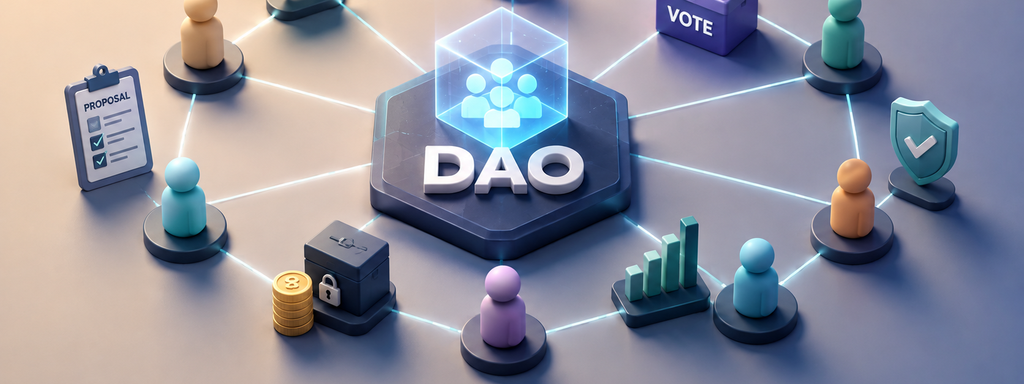

Decentralized Autonomous Organizations, better known as DAOs, are one of blockchain technology’s most ambitious experiments in online coordination. Instead of relying on a traditional management structure, a DAO allows a community to organize around shared rules, assets, and goals using blockchain-based tools.
But the word “autonomous” can be misleading. DAOs do not usually operate entirely by themselves, and they are rarely as simple as letting token holders vote on everything. Behind most successful DAOs are smart contracts, governance systems, treasuries, contributors, delegates, forums, and communities working together.
So how does a DAO actually work? To understand that, we need to look beyond the acronym and examine how decisions are proposed, discussed, voted on, funded, and ultimately carried out.
What Is a DAO?
A DAO is an organization that uses blockchain technology to coordinate participants and manage at least some of its rules or assets.
Traditional organizations generally rely on a hierarchy. A company might have shareholders, a board of directors, executives, managers, and employees. Authority flows through this structure, while important records and financial accounts are usually maintained by centralized systems.
A DAO approaches organization differently.
Instead of placing all authority in a small management group, a DAO can distribute decision-making rights among participants. Smart contracts may define how funds are controlled, governance tokens can represent voting power, and proposals allow members to suggest changes.
The blockchain provides a shared record of many of these activities.
This does not mean every DAO is completely decentralized. Some distribute power widely, while others rely heavily on founders, large token holders, committees, delegates, or development teams.
DAO is therefore better understood as a broad organizational model rather than one specific structure.
The Main Components of a DAO
Although DAOs can differ significantly, most contain several common components.
Smart Contracts
Smart contracts provide part of the technical foundation of many DAOs.
These blockchain programs can define rules governing activities such as voting, treasury management, token distribution, and proposal execution.
For example, a smart contract might specify that a proposal passes only when it receives enough votes and meets a minimum participation requirement.
Because smart contracts execute according to predefined code, they can reduce the need for a central administrator to enforce certain rules.
However, smart contracts cannot manage everything.
Community discussions, negotiations, research, development, communication, and many other activities still require human participation.
Governance Tokens
Many DAOs use governance tokens to distribute voting power.
A governance token may allow its holder to vote on proposals affecting the organization. Depending on the DAO, proposals might involve:
- Changing protocol parameters
- Spending treasury funds
- Funding community projects
- Electing representatives or committees
- Modifying governance rules
- Supporting ecosystem development
- Approving partnerships or initiatives
A common model is “one token, one vote,” meaning someone holding 10,000 governance tokens has more voting power than someone holding 100.
This model is simple, but it also creates an obvious problem: participants with large token holdings can have enormous influence.
For this reason, DAOs have experimented with alternatives such as delegation, reputation systems, councils, specialized voting systems, and mechanisms designed to reduce the dominance of large holders.
How DAO Proposals Work
Most DAO governance begins with a proposal.
Imagine a DAO controls a treasury containing $20 million in digital assets. A community member believes the DAO should spend $100,000 funding an educational program.
They may begin by discussing the idea in the DAO's community forum, Discord server, governance platform, or another communication channel.
Other members can question the proposal, suggest changes, request additional information, or oppose it.
If the idea receives enough support, it may become a formal governance proposal.
The exact requirements vary between DAOs. Some allow almost anyone to submit proposals, while others require participants to hold or delegate a certain number of governance tokens.
Discussion Often Happens Before Voting
One of the most important parts of DAO governance often happens outside the blockchain.
Before an official vote, communities may spend days or weeks discussing proposals.
This process can involve forum posts, community calls, research reports, social media discussions, delegate feedback, and informal polls.
These discussions help identify problems before a proposal reaches a binding vote.
For example, members might agree with the general idea behind a proposal but disagree with its budget. The proposer could then reduce the requested funding before submitting the final version.
DAO governance is therefore not simply a voting mechanism. It is also a social process.
The quality of that process can have a major impact on the quality of the decisions a DAO makes.
On-Chain and Off-Chain Voting
DAO voting generally falls into two broad categories: on-chain and off-chain voting.
On-Chain Voting
With on-chain voting, votes are recorded directly on a blockchain.
This provides strong transparency because anyone can inspect the transactions and verify the result.
Depending on the governance system, a successful proposal may also trigger smart contracts that automatically execute the approved action.
The disadvantage is that participants may need to submit blockchain transactions, potentially requiring network fees.
Off-Chain Voting
Off-chain governance records votes outside the blockchain, often using cryptographic signatures to prove that a particular wallet voted.
This can make participation faster and cheaper.
However, the result may still need to be executed separately. A multisignature wallet, governance committee, smart contract, or another mechanism may be responsible for implementing the decision.
Many DAOs combine on-chain and off-chain systems rather than relying entirely on one approach.
What Is a DAO Treasury?
One of the most important features of many DAOs is the treasury.
A DAO treasury is a pool of digital assets controlled according to the organization's governance rules.
These assets might come from token allocations, protocol fees, donations, investment returns, NFT sales, or other revenue sources.
Treasury funds can be used for activities such as development, marketing, grants, research, infrastructure, contributor compensation, security audits, events, and community programs.
The important difference from a traditional corporate bank account is that treasury activity can often be inspected publicly on the blockchain.
Anyone can potentially see which assets the DAO controls and where blockchain-based payments are going.
Transparency, however, does not automatically guarantee good financial management. A DAO can still make poor spending decisions even when every transaction is visible.
Multisignature Wallets and DAO Treasuries
Not every treasury transaction is automatically controlled by a governance smart contract.
Many DAOs use multisignature wallets, often called multisigs.
A multisig requires several authorized participants to approve a transaction before it can be executed.
For example, a DAO might appoint seven trusted signers and require four of them to approve any treasury transaction.
This provides additional security because one person cannot independently move the funds.
It also introduces a degree of human trust.
Even if the community approves a proposal, the multisig signers may still be responsible for executing the payment correctly. This is another example of why real-world DAOs are often less autonomous than their name suggests.
Delegation Makes Governance More Practical
Voting on every proposal can quickly become overwhelming.
A large DAO might have dozens of governance discussions happening simultaneously. Most token holders do not have the time or expertise to research every decision.
Delegation attempts to solve this problem.
Instead of voting directly, token holders can assign their voting power to another participant known as a delegate.
Delegates typically follow governance closely, research proposals, participate in discussions, and vote on behalf of people who have delegated tokens to them.
Importantly, delegation usually does not mean transferring ownership of the tokens themselves. The holder retains the assets while temporarily assigning their governance power.
This system begins to resemble representative democracy, although the exact mechanics differ significantly between DAOs.
Who Actually Does the Work?
A common misconception is that a DAO's smart contracts somehow operate the entire organization.
They do not.
People still need to write software, create content, manage communities, conduct research, negotiate partnerships, perform security reviews, organize events, manage infrastructure, and complete countless other tasks.
DAOs therefore often have contributors, working groups, committees, foundations, service providers, or development companies.
Governance determines what should happen, while these people and organizations actually make it happen.
Some contributors work voluntarily. Others receive grants, salaries, token allocations, or payments from the DAO treasury.
The organizational structure may be decentralized, but the work itself remains very human.
DAOs Are Not Always Fully Autonomous
The term “Decentralized Autonomous Organization” can create unrealistic expectations.
In practice, the three words exist on a spectrum.
Decentralized: Governance power may be distributed, but some participants often have much more influence than others.
Autonomous: Smart contracts can automate certain processes, but humans still perform most organizational work.
Organization: A DAO can coordinate people toward shared goals, but its legal and operational structure may differ significantly from a conventional company.
Some DAOs are highly decentralized communities with thousands of active participants. Others operate more like traditional organizations with blockchain-based voting attached.
The DAO label alone tells you relatively little about how decentralized an organization actually is.
The Problem of Voter Participation
One of the biggest challenges facing DAOs is voter apathy.
A DAO may have tens of thousands of token holders, yet only a small percentage may participate in governance.
There are several reasons for this.
Governance takes time. Proposals can be technical, frequent, or difficult to understand. Small token holders may also feel that their votes have little impact compared with large holders.
Low participation can create situations where a relatively small group effectively controls governance.
Delegation can help, but it creates another challenge: influential delegates can accumulate substantial voting power.
Designing governance that is both efficient and broadly representative remains an ongoing experiment.
Whales and Concentrated Voting Power
Token-based governance can also lead to plutocracy, where wealth translates directly into political power.
If one participant controls 20% of the governance tokens, their influence may be greater than thousands of smaller holders combined.
Even when no individual controls the DAO outright, several large holders may collectively dominate important votes.
Token distribution therefore matters enormously.
When evaluating a DAO, it can be useful to look beyond the number of token holders and examine how governance power is actually distributed.
A community with 100,000 wallets is not necessarily decentralized if a handful of addresses control most voting power.
Governance Attacks
Because DAO governance can control valuable assets and protocols, it can become a target for attackers.
An attacker who acquires sufficient voting power may be able to influence governance for personal benefit.
Depending on the design, this could potentially involve redirecting treasury assets, changing protocol parameters, or approving malicious proposals.
DAOs attempt to reduce these risks through mechanisms such as voting delays, proposal thresholds, timelocks, multisignature approvals, security councils, emergency mechanisms, and carefully designed governance contracts.
These safeguards introduce an important trade-off.
The more safeguards a DAO adds, the harder it may become for governance to act quickly. But removing safeguards can make governance more vulnerable.
What Happens After a Proposal Passes?
Winning a vote does not always mean a proposal is immediately executed.
Different DAOs handle successful proposals differently.
Some governance systems automatically execute approved changes through smart contracts.
Others place successful proposals into a timelock, creating a delay before execution. This gives participants time to review the result and react if something appears wrong.
In other systems, a development team, foundation, multisig group, or committee implements the decision manually.
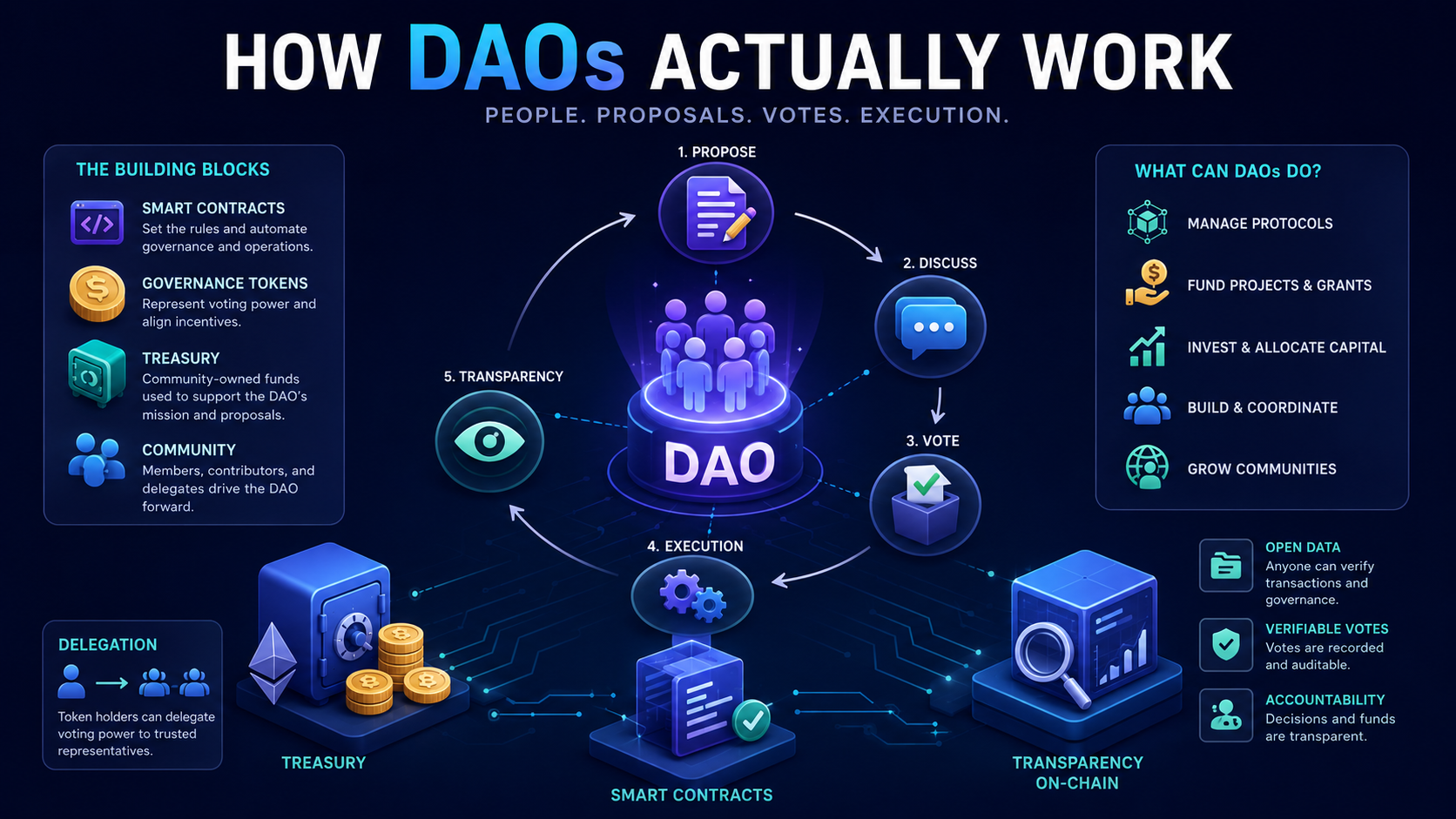
The full governance process might therefore look something like this:
Idea → Community discussion → Draft proposal → Formal proposal → Voting → Approval → Timelock → Execution
Not every DAO follows this exact sequence, but it illustrates how governance often involves multiple stages rather than a single vote.
DAOs and Legal Structures
Blockchain governance does not eliminate the traditional legal system.
DAOs may still need contracts, employees, bank accounts, intellectual property agreements, tax arrangements, or relationships with companies and service providers.
This creates difficult legal questions.
Who is legally responsible for decisions made by thousands of token holders? Who signs a traditional contract on behalf of a DAO? Can a DAO employ people? How should treasury income be taxed?
The answers depend heavily on jurisdiction and organizational structure.
As a result, some DAOs operate alongside foundations, companies, associations, or other legal entities that interact with the traditional economy on their behalf.
Different Types of DAOs
DAOs can be created for many different purposes.
Protocol DAOs govern decentralized blockchain protocols.
Investment DAOs pool capital and collectively evaluate investments.
Grant DAOs distribute funding to projects, developers, researchers, or community initiatives.
Collector DAOs coordinate groups that acquire NFTs, digital assets, or other collectibles.
Social DAOs organize communities around shared interests or membership.
Service DAOs coordinate groups of contributors who provide development, design, marketing, research, or other professional services.
The underlying governance concepts may be similar, but the practical structure can vary enormously depending on the DAO's purpose.
Transparency Is One of the Biggest Advantages
One of the most interesting properties of DAOs is their potential transparency.
Traditional organizations often keep voting records, financial information, and internal decisions private.
A blockchain-based organization can make much of this information publicly accessible.
Depending on the DAO, anyone may be able to examine:
- Treasury balances
- Treasury transactions
- Governance proposals
- Voting records
- Smart contracts
- Token distribution
- Delegate activity
- Protocol revenue
This makes it possible for outsiders to analyze how the organization actually operates rather than relying entirely on what it says about itself.
However, transparency should not be confused with decentralization.
A DAO can be completely transparent while still being controlled by a small number of participants.
Why Communities Matter So Much
Technology provides the infrastructure for a DAO, but the community determines whether that infrastructure becomes useful.
A DAO with excellent smart contracts but no active participants is unlikely to accomplish much.
Healthy DAO communities need people willing to propose ideas, challenge assumptions, research decisions, vote, delegate responsibly, contribute work, and hold decision-makers accountable.
This is why community platforms play such an important role in DAO governance.
Governance discussions frequently happen across forums, Discord servers, Telegram groups, social networks, community calls, and specialized voting platforms before anything reaches the blockchain.
For anyone trying to understand a DAO, following these communities can be just as important as examining its smart contracts.
How to Evaluate a DAO
When researching a DAO, do not simply ask whether it has a governance token.
Look at how governance works in practice.
Who can submit proposals? Who can vote? How concentrated is voting power? How many token holders actually participate? Can voting power be delegated? Who controls the treasury? Who executes successful proposals? Are there emergency administrators or security councils? Are governance discussions public?
It is also worth examining the community itself.
A DAO with active debates, transparent decision-making, clear documentation, and accountable contributors may function very differently from one where almost every important decision comes from a small group of insiders.
DAOs Are an Ongoing Experiment
DAOs represent a different way of thinking about organizations.
Instead of asking people to trust a central management structure completely, they attempt to encode some organizational rules into transparent software while distributing decision-making across a network of participants.
The model is far from perfect.
Low voter participation, concentrated token ownership, governance attacks, legal uncertainty, operational complexity, and slow decision-making remain significant challenges.
At the same time, DAOs have demonstrated that communities distributed around the world can collectively manage treasuries, fund projects, govern blockchain protocols, and coordinate contributors without relying entirely on traditional corporate structures.
The most important thing to understand is that a DAO is not simply a smart contract that runs an organization automatically.
It is a combination of code, capital, governance, and community.
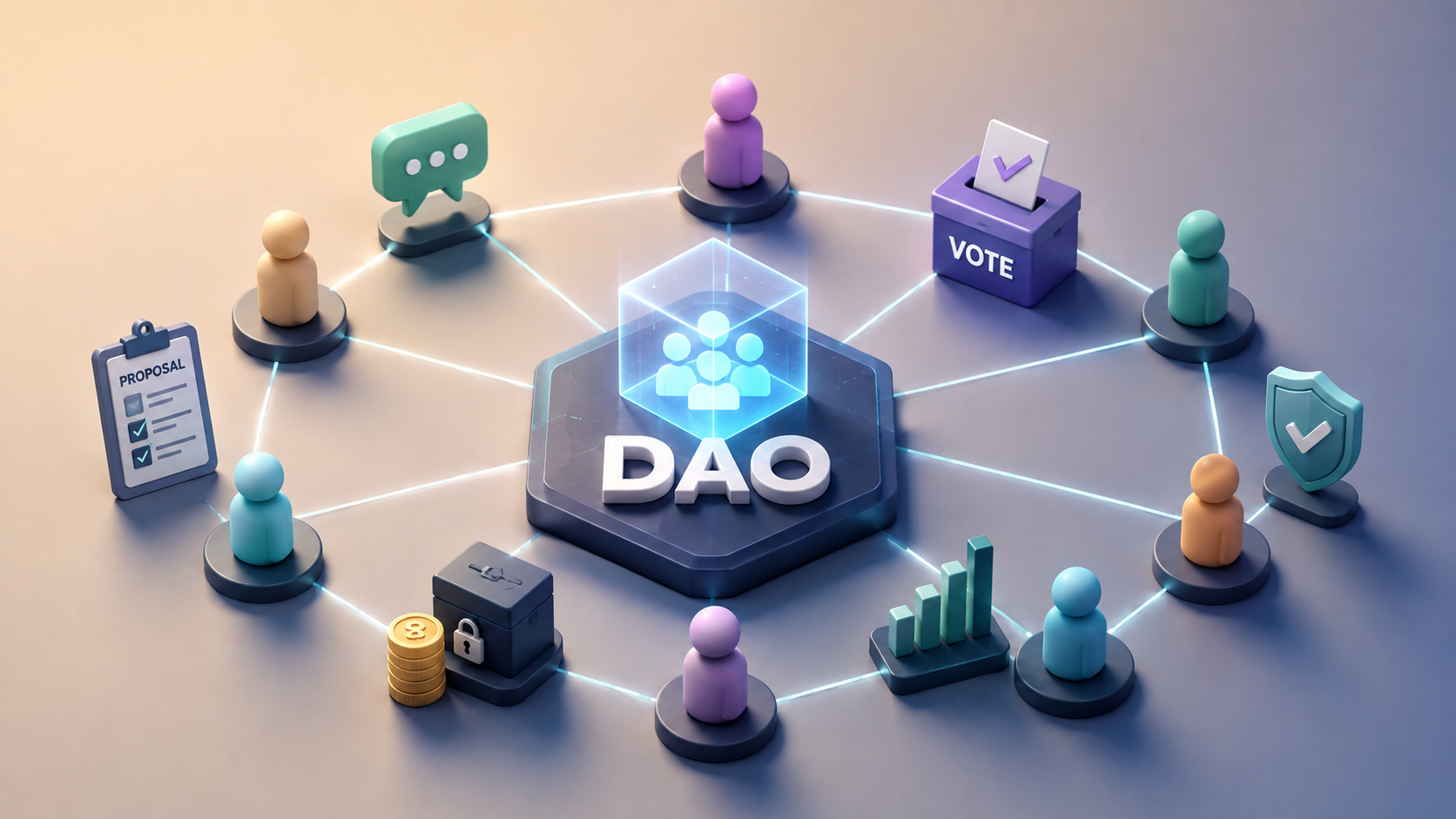
Smart contracts provide rules. Tokens or other mechanisms distribute influence. Governance processes turn ideas into decisions. Treasuries provide resources. Contributors perform the work. And communities ultimately determine whether the organization succeeds.
That combination is what makes DAOs interesting: they are not fully automated organizations, but evolving experiments in how people can coordinate, make decisions, and manage shared resources on the internet.
Pick your reaction
Post your comment