

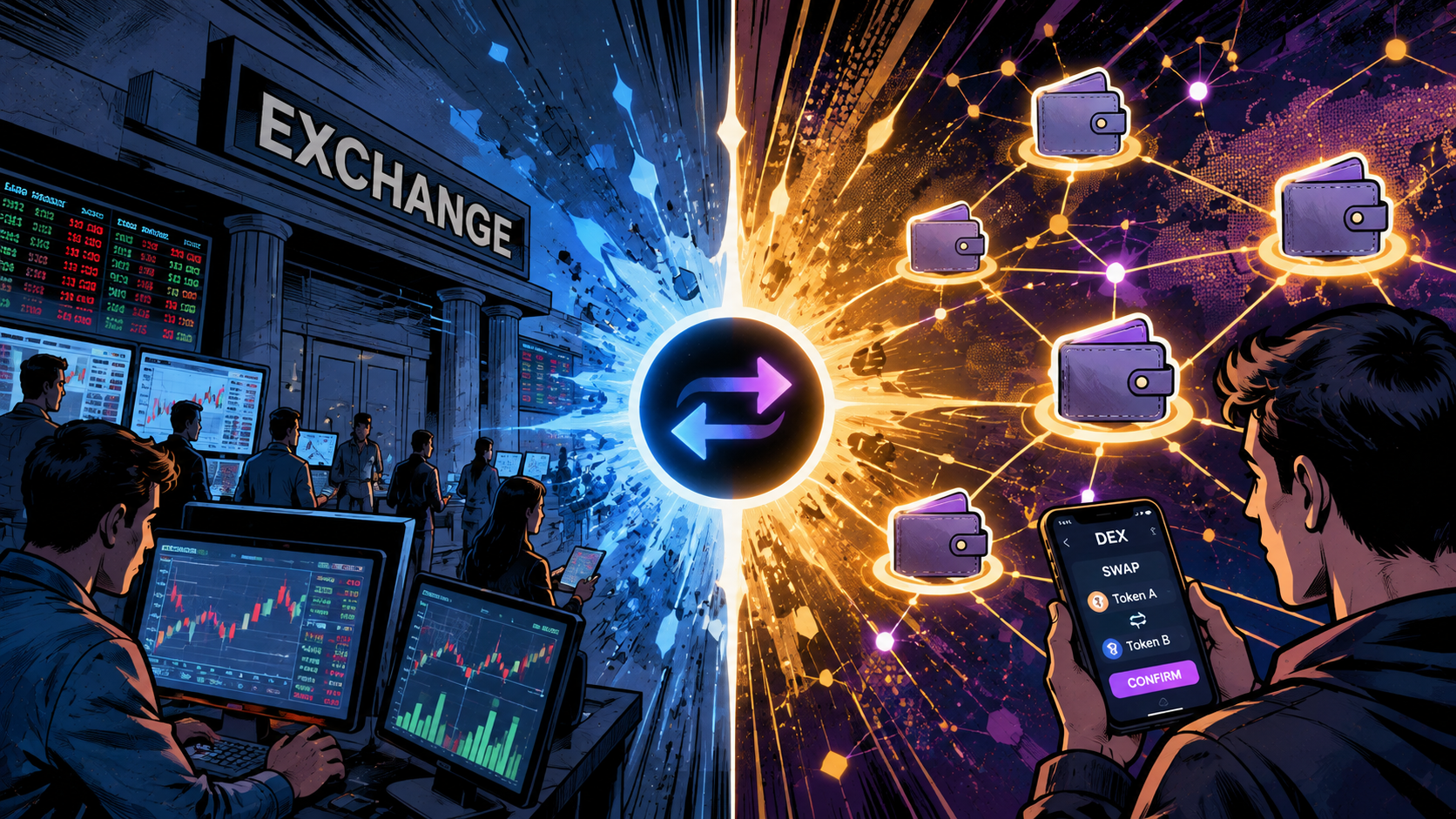
Decentralized exchanges have transformed the way people trade cryptocurrencies. Instead of relying entirely on centralized companies to hold funds, manage order books, and process transactions, DEXs allow users to trade directly through blockchain-based protocols.
What began as an experimental alternative to traditional crypto exchanges has grown into a major part of decentralized finance. Automated market makers, liquidity pools, permissionless token listings, cross-chain technology, and wallet-based trading have introduced entirely new ways to exchange digital assets.
But decentralization also changes where the responsibility lies. DEX users gain greater control over their assets, while taking on additional risks involving smart contracts, token selection, transaction fees, and wallet security.
What Is a Decentralized Exchange?
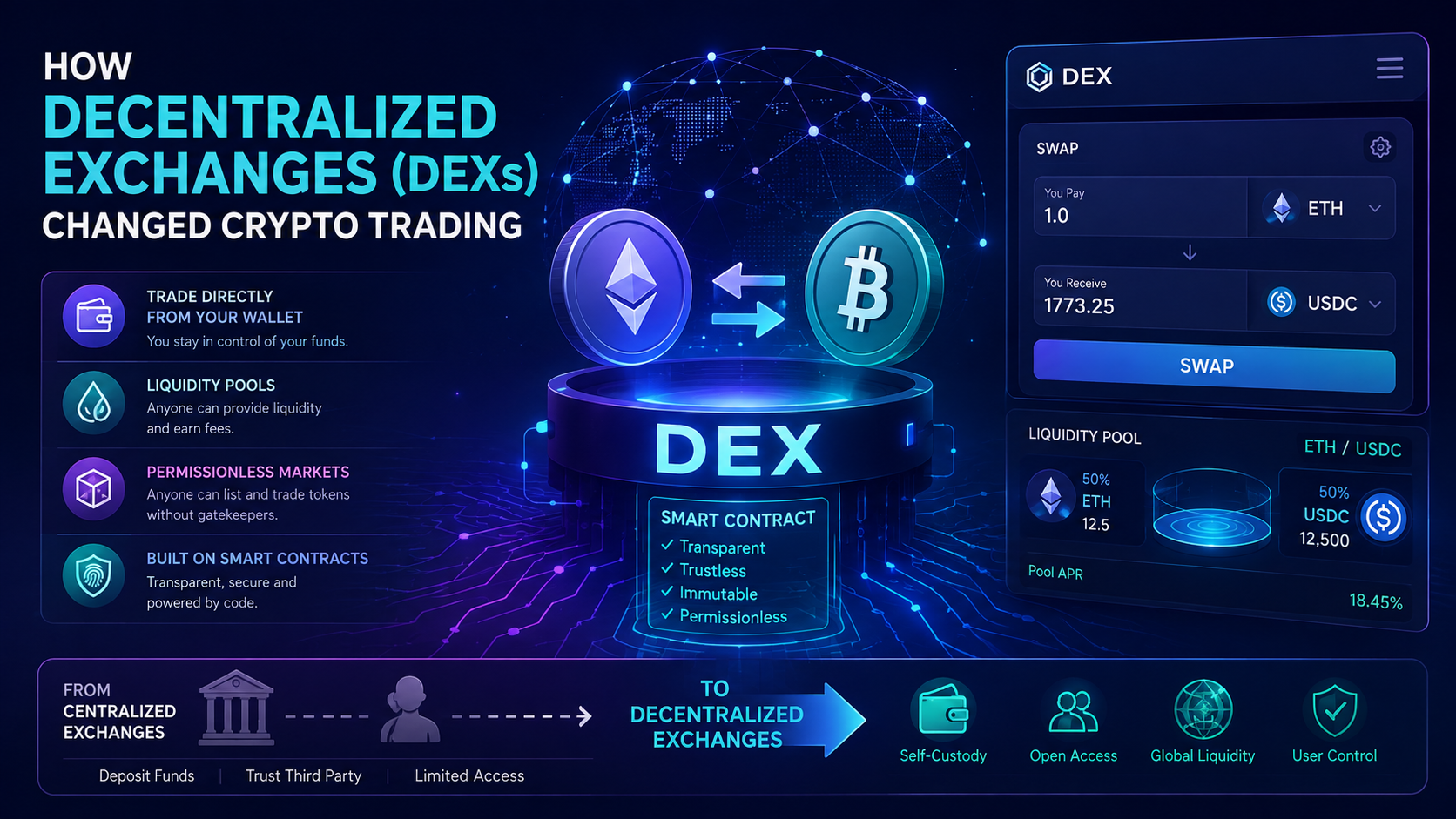
A decentralized exchange, commonly called a DEX, is a cryptocurrency trading platform that uses blockchain technology and smart contracts to facilitate trades.
Unlike a traditional centralized exchange, a DEX generally does not require users to deposit their cryptocurrency into an account controlled by the exchange. Instead, users connect a compatible wallet and interact directly with the protocol.
When a trade takes place, smart contracts execute the transaction according to predefined rules.
This creates an important distinction between the two exchange models.
On a centralized exchange, the company typically controls the infrastructure, maintains user balances, matches trades, and holds deposited assets on behalf of customers.
On a DEX, much of this functionality can be handled by smart contracts and blockchain transactions.
The result is a fundamentally different approach to crypto trading.
Crypto Trading Before DEXs
During the early years of cryptocurrency, centralized exchanges became the primary gateways into the market.
They offered an experience familiar to anyone who had previously used a stock trading platform. Users created accounts, deposited assets, placed buy and sell orders, and relied on the exchange to maintain their balances.
This model made cryptocurrency trading considerably more accessible, but it also created centralized points of control.
Users had to trust exchanges to protect deposited funds, maintain accurate records, process withdrawals, and keep their infrastructure secure.
The cryptocurrency industry has experienced numerous exchange failures, security breaches, withdrawal freezes, and insolvencies over the years. These events repeatedly highlighted one of the central problems with custodial trading: users may technically own cryptocurrency, but they do not directly control assets held by an exchange.
DEXs offered an alternative.
Trading Directly From a Crypto Wallet
One of the most significant changes introduced by decentralized exchanges is wallet-based trading.
Instead of transferring cryptocurrency into an exchange account before trading, users can typically connect their own wallet to a DEX.
The wallet remains under the user's control, and transactions require authorization from that wallet.
This dramatically changes the trading process.
A typical DEX transaction might look like this:
- The user opens a decentralized exchange.
- They connect a compatible crypto wallet.
- They select the assets they want to swap.
- The DEX calculates the expected exchange rate.
- The user reviews the transaction details.
- The user approves the transaction through their wallet.
- A smart contract executes the trade.
- The resulting assets are delivered to the user's wallet.
There is usually no need to create a traditional exchange account before making the swap.
This concept helped establish self-custody as an important component of decentralized finance.
Automated Market Makers Changed How Markets Work
Some of the most influential DEXs introduced a trading model known as the automated market maker, or AMM.
Traditional exchanges commonly use order books.
An order book contains buy and sell orders submitted by traders. A trade occurs when compatible orders can be matched.
AMMs take a different approach.
Instead of requiring a buyer and seller to submit matching orders, an automated market maker can allow users to trade against pools of tokens held in smart contracts.
These are known as liquidity pools.
For example, a pool might contain Token A and Token B. Traders can exchange one token for the other through the pool, while an algorithm determines the exchange rate according to the design of the protocol.
This meant decentralized markets could operate without relying entirely on traditional order-book infrastructure.
Liquidity Providers Became Market Participants
Liquidity pools introduced another major innovation: ordinary cryptocurrency holders could contribute assets to trading markets.
Users who deposit assets into liquidity pools are commonly known as liquidity providers.
In return for providing liquidity, they may receive a portion of trading fees or other protocol incentives.
This created an entirely new category of participation in crypto markets.
Previously, market making was largely associated with professional trading firms and specialized traders. DeFi protocols made certain forms of liquidity provision accessible to almost anyone with a compatible wallet and sufficient assets.
However, liquidity provision is not simply a way to earn passive returns.
Liquidity providers can face smart contract vulnerabilities, token price volatility, impermanent loss, protocol failures, and other risks. High advertised yields may also involve significant additional risk.
DEXs Made Token Markets More Permissionless
Centralized exchanges decide which cryptocurrencies they support.
Getting a token listed may involve technical reviews, legal considerations, commercial negotiations, liquidity requirements, and other approval processes.
Many decentralized exchanges work differently.
If the protocol permits permissionless pool creation, anyone may be able to create a market for a compatible token.
This significantly reduced the barriers to creating markets for new crypto assets.
For emerging projects, this was revolutionary. A project no longer necessarily needed approval from a major centralized exchange before its token could become tradable.
But permissionless markets have a downside.
If legitimate projects can create markets easily, scammers can too.
Fake tokens, impersonation tokens, manipulated liquidity pools, honeypots, and other malicious assets can appear on decentralized exchanges. A token being available on a DEX does not mean it has been reviewed or endorsed by the protocol.
Users must verify what they are trading.
DEXs Became a Foundation of DeFi
Decentralized exchanges eventually became much more than standalone trading applications.
They became infrastructure.
Other decentralized applications can interact with DEX smart contracts to exchange tokens, obtain liquidity, rebalance portfolios, execute strategies, and build more complex financial products.
This composability is one of the defining characteristics of decentralized finance.
A DeFi application might combine several independent protocols within a single transaction or service.
For example, an application could potentially use one protocol for lending, another for token swaps, and another for liquidity management.
DEXs therefore became important building blocks within a much larger financial ecosystem.
DEX Aggregators Improved the Trading Experience
As the number of decentralized exchanges increased, liquidity became fragmented across many different protocols and pools.
This created another innovation: DEX aggregators.
Rather than forcing users to manually compare prices across multiple exchanges, an aggregator can search different liquidity sources and determine a route for a trade.
In some cases, a single swap may even be divided across multiple liquidity pools to improve execution.
This introduced the concept of smart routing into everyday decentralized trading.
From the user's perspective, the experience can appear relatively simple. Behind the interface, however, the transaction may involve several protocols and smart contracts.
DEXs Expanded Across Multiple Blockchains
Early decentralized exchange activity was heavily concentrated on a relatively small number of blockchain networks.
That has changed dramatically.
Today, decentralized trading exists across numerous smart contract platforms and scaling networks.
This expansion has created more choice, but it has also fragmented the ecosystem.
Tokens on one blockchain cannot necessarily interact directly with tokens on another. Users may need bridges, wrapped assets, cross-chain protocols, or specialized exchange infrastructure to move value between networks.
As a result, cross-chain trading has become an important area of development.
The long-term goal is increasingly to make blockchain boundaries less noticeable to ordinary users.
DEXs Changed the Meaning of Market Access
Traditional financial markets are built around intermediaries.
Brokers, exchanges, banks, clearing systems, and other organizations determine how participants access markets and move assets.
DEXs demonstrated that some market infrastructure can instead exist as software deployed on public blockchain networks.
If someone has a compatible wallet, the required cryptocurrency, and access to the network, they may be able to interact directly with the protocol.
This is one reason DEXs are frequently described as permissionless.
However, the interfaces people use to access decentralized protocols may still be operated by companies or organizations and can potentially apply restrictions. The underlying smart contracts and the websites providing convenient access to them are not necessarily the same thing.
Self-Custody Comes With More Responsibility
DEX trading removes some risks associated with centralized custody, but it does not eliminate risk.
Instead, many risks shift from the exchange operator to the user.
When using a self-custodial wallet, users are responsible for protecting their private keys or recovery phrases.
There may be no customer support department capable of reversing a transaction if cryptocurrency is sent to the wrong address.
A malicious transaction approval can potentially give an attacker access to tokens.
Interacting with a compromised smart contract can result in lost funds.
Purchasing the wrong token may also be irreversible.
The freedom provided by decentralized trading therefore comes with significant personal responsibility.
Smart Contract Risk Cannot Be Ignored
A decentralized exchange is software, and software can contain vulnerabilities.
Smart contracts may have bugs or design flaws that attackers can exploit.
Even protocols that have undergone security audits are not guaranteed to be completely secure.
DEX users should therefore consider factors such as the protocol's history, security practices, smart contract audits, administrative controls, liquidity, and overall reputation before interacting with it.
New protocols offering unusually high incentives deserve particularly careful scrutiny.
Decentralized does not automatically mean safe.
Slippage and Price Impact Matter
DEX trading also introduced concepts that casual traders may not encounter as frequently on large centralized exchanges.
One is slippage.
Slippage is the difference between the expected price of a trade and the price at which it actually executes.
Another important concept is price impact.
A large trade relative to the available liquidity in a pool can significantly affect the exchange rate. As a result, trading a large amount in a small liquidity pool may produce a much worse price than expected.
Before confirming a swap, users should review the estimated output, price impact, minimum received amount, fees, and slippage settings.
Simply checking the displayed token price is not always enough.
Blockchain Fees Became Part of Trading
On many DEXs, trades are blockchain transactions.
That means users may need to pay network transaction fees in addition to any fees charged by the trading protocol.
During periods of heavy network activity, these fees can become significant.
This helped accelerate interest in lower-cost blockchain networks and scaling technologies capable of supporting decentralized trading with cheaper transactions.
It also changed how traders think about execution costs.
A small trade may appear profitable based on the exchange rate but become uneconomical once network and protocol fees are included.
DEXs Introduced New Trading Risks
Decentralized trading has also created or exposed several forms of market risk.
Low-liquidity tokens can experience extreme price movements. Liquidity can sometimes be removed suddenly. Fraudulent tokens may contain malicious smart contract functionality.
Public blockchain transactions can also create opportunities for sophisticated actors to observe pending trades and attempt to profit from transaction ordering.
These issues demonstrate an important principle: decentralization removes certain intermediaries, but it does not remove adversarial behavior.
Markets remain competitive environments.
Centralized and Decentralized Exchanges Can Coexist
DEXs did not make centralized exchanges obsolete.
Instead, the crypto market developed two major trading models with different advantages.
Centralized exchanges can provide convenient fiat deposits and withdrawals, customer support, familiar trading interfaces, high-performance order books, and other services that are difficult to reproduce entirely on-chain.
DEXs emphasize self-custody, blockchain-based settlement, open infrastructure, and direct interaction with decentralized markets.
Many cryptocurrency users rely on both.
Someone might purchase cryptocurrency through a centralized exchange, withdraw it to a personal wallet, use a DEX to access decentralized markets, and interact with additional DeFi applications.
The distinction is therefore not necessarily about choosing one model permanently.
It is about understanding how each works and what risks each introduces.
How DEXs Changed Crypto Trading
The biggest contribution of decentralized exchanges may not be any single technical feature.
It is the idea that an exchange can exist primarily as a protocol.
DEXs helped introduce wallet-based trading, automated market makers, liquidity pools, permissionless markets, decentralized liquidity provision, smart routing, and composable financial applications to millions of cryptocurrency users.
They also forced the industry to reconsider fundamental questions about custody and financial infrastructure.
Who should hold users' assets?
Who decides which markets can exist?
Does an exchange need to be operated by a central company?
Can financial applications interact with one another automatically?
DEXs provided practical answers to many of these questions.
The Future of Decentralized Trading
The next generation of decentralized exchanges is increasingly focused on making the technology less visible.
Users generally do not want to think about liquidity fragmentation, bridges, gas tokens, transaction routing, wrapped assets, or which blockchain contains a particular pool.
They simply want to exchange one asset for another efficiently and securely.
Improved interfaces, account abstraction, cross-chain infrastructure, better routing, cheaper blockchain networks, stronger security tools, and more efficient liquidity models could gradually make decentralized trading easier for mainstream users.
At the same time, regulation, protocol governance, security, and decentralization will remain important issues.
DEXs are still evolving.
Final Thoughts
Decentralized exchanges changed crypto trading by demonstrating that markets can operate through blockchain protocols rather than relying exclusively on centralized intermediaries.
They gave users the ability to trade directly from self-custodial wallets, opened token markets to a much wider range of projects, introduced liquidity pools and automated market makers, and became essential infrastructure for decentralized finance.
But these advantages come with trade-offs.
Self-custody means greater responsibility. Permissionless token listings require stronger due diligence. Smart contracts introduce technical risks, while blockchain transactions introduce considerations such as network fees, slippage, liquidity, and irreversible mistakes.
Understanding these differences is essential before using a decentralized exchange.
DEXs did not simply create another place to trade cryptocurrency. They changed the underlying idea of what a crypto exchange can be.

Pick your reaction
Post your comment