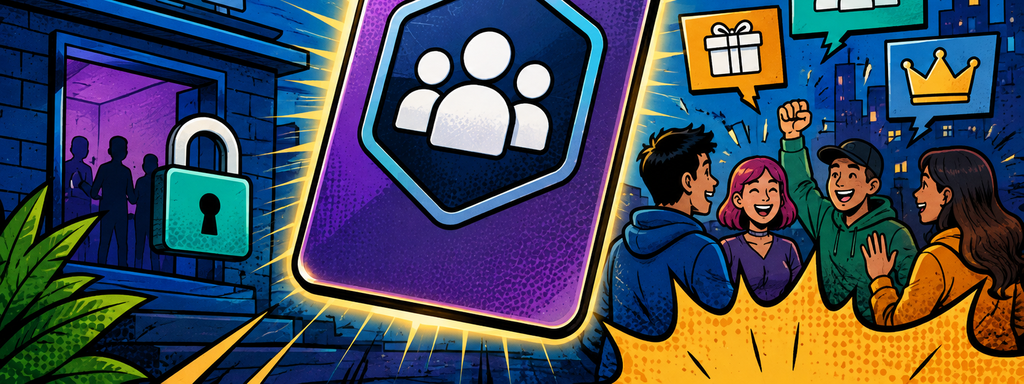

NFTs are often associated with digital art and collectibles, but the same technology can also be used for something much more practical: membership. An NFT membership pass is a blockchain-based token that proves its holder has access to a particular community, service, event, platform, or set of benefits.
Instead of relying entirely on traditional accounts, subscription databases, or physical membership cards, organizations can issue digital passes that users hold in their own crypto wallets. These passes can unlock private communities, events, content, discounts, voting rights, rewards, and other experiences.
But NFT membership passes also introduce new questions. What happens when a membership can be transferred or sold? How does a website know that someone owns the correct NFT? And why use a blockchain at all when a normal membership system already works?
Understanding those questions helps explain where NFT memberships can be useful and where they may simply add unnecessary complexity.
What Is an NFT Membership Pass?
An NFT membership pass is a non-fungible token used as proof of membership or access.
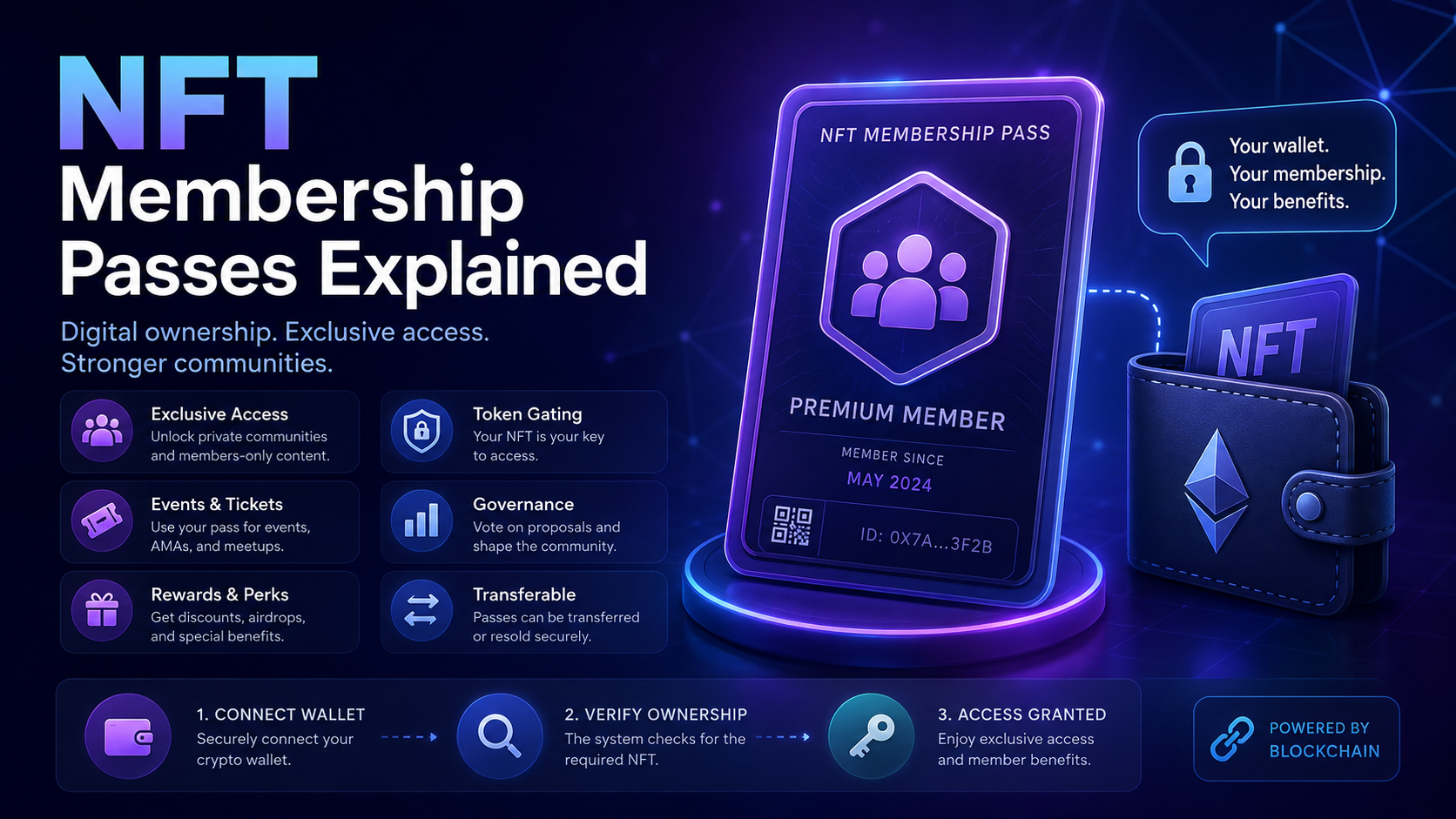
Each pass exists on a blockchain and is associated with a particular wallet address. When someone connects that wallet to a compatible website, application, or community platform, the system can check whether the wallet contains the required NFT.
If it does, access can be granted.
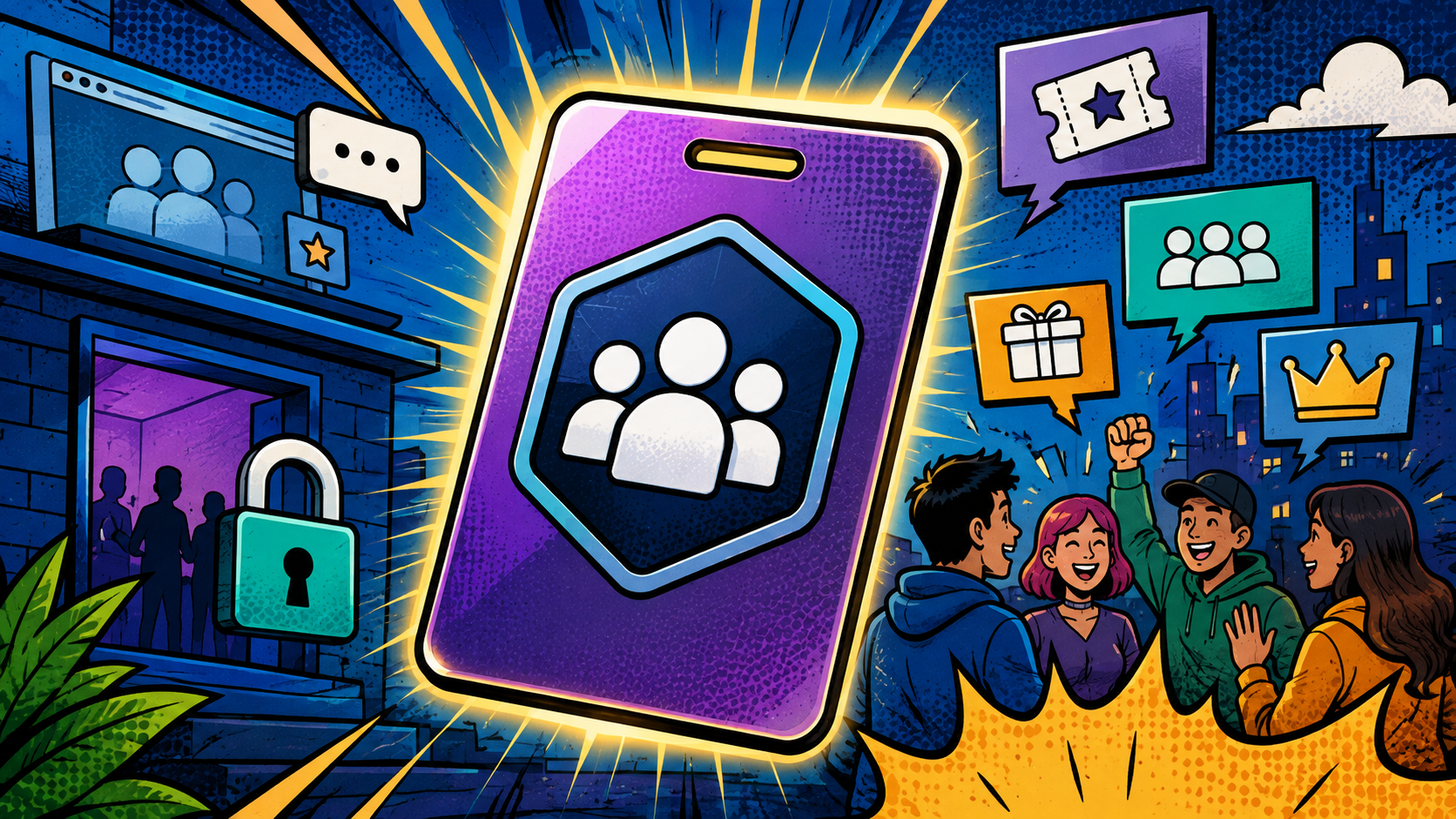
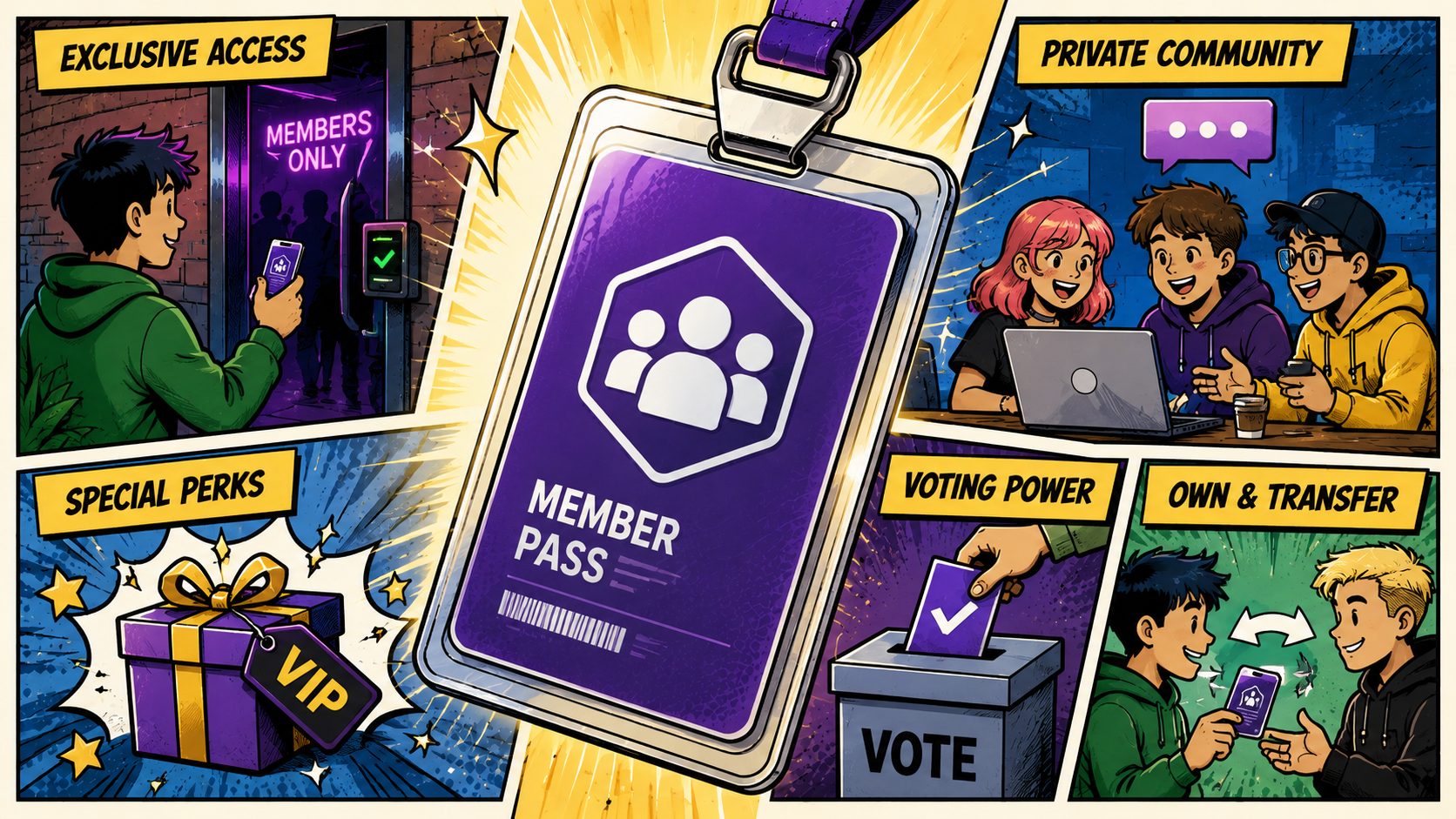
The NFT therefore acts like a digital membership card. Depending on how the project is designed, owning it might provide access to:
- Private online communities
- Exclusive Discord or Telegram channels
- Members-only websites
- Events and conferences
- Premium content
- Discounts
- Early product releases
- Games or digital experiences
- Voting and governance
- Loyalty rewards
The NFT itself does not necessarily contain all of these benefits. Instead, ownership of the token serves as the credential that other systems recognize.
How NFT Membership Passes Work
A typical NFT membership system begins when an organization creates a collection of membership tokens on a blockchain.
Imagine a community that wants to offer 2,000 lifetime memberships. It could create an NFT collection containing 2,000 passes and allow users to claim or purchase them.
After obtaining a pass, the member keeps it in a compatible crypto wallet.
When the member visits a protected website, the site may ask them to connect their wallet and sign a message. This cryptographic signature can prove that they control the wallet without requiring them to reveal their private key.
The application then checks the blockchain to determine whether the wallet owns one of the approved membership NFTs.
If ownership is confirmed, the user receives access.
This process is commonly known as token gating.
What Is Token Gating?
Token gating is the practice of restricting access to something based on ownership of a particular blockchain token.
For example, a community could create a private section of its website that is only visible to wallets holding its membership NFT.
The same concept can be applied to many different environments.
A Discord server could automatically assign a special role to verified NFT holders. An online store could provide discounts to members. A game could unlock special areas or items. An event organizer could use an NFT as an entry credential.
The blockchain provides a publicly verifiable ownership record, while the application decides what that ownership unlocks.
NFT Memberships vs Traditional Memberships
Traditional membership systems usually rely on centralized databases.
When you subscribe to a service, the company creates an account and records your membership status in its own system. The company controls the database and determines whether your membership is active.
NFT memberships change the location of the membership credential.
Instead of the organization simply recording that "Account 123 is a member," the user possesses a blockchain token representing that membership.
This creates an important difference: the membership can potentially exist independently of the platform that originally issued it.
Other applications can recognize the same NFT without needing direct access to the issuer's internal database.
That makes NFT memberships potentially interoperable.
Interoperability Is One of the Biggest Advantages
Imagine a blockchain community issues an NFT membership pass.
The community's website could recognize it and provide members-only articles. Its Discord bot could recognize the same NFT and assign a special role. A partner project could recognize it and offer a discount. An event organizer could recognize it and provide access to a private meetup.
All of these systems can independently verify ownership of the same blockchain asset.
The organization does not necessarily need to maintain separate membership databases for every integration.
This ability for different applications to recognize the same digital credential is one of the strongest arguments for blockchain-based memberships.
Memberships Can Be Transferable
Another major difference is that NFTs can be transferable.
Traditional memberships are usually tied permanently to an account or identity. If you stop using a service, you generally cannot sell your remaining membership to someone else.
An NFT membership can be designed differently.
If transfers are allowed, the owner could send or sell the membership pass to another wallet. The new holder would then receive whatever benefits are associated with the token.
This can create secondary markets for memberships.
For example, imagine an online community only issues 1,000 lifetime membership passes. If demand grows and all passes have already been distributed, new users might purchase existing passes from current members.
However, transferability is not automatically desirable.
Organizations may want memberships to remain connected to specific people. Transferable passes can also encourage speculation, potentially causing membership prices to rise far beyond their original cost.
Projects therefore need to decide whether membership should be transferable, restricted, temporary, or permanently linked to a particular wallet or identity.
NFT Membership Passes Can Have Different Tiers
NFT memberships do not have to provide identical benefits.
A project could create several membership tiers.
For example:
Standard Pass
Access to the private community and members-only content.
Premium Pass
Standard benefits plus discounts, special events, and early access to new features.
Founder Pass
All previous benefits plus governance rights, exclusive events, or permanent recognition as an early supporter.
Because each tier can use a different token collection or token property, applications can automatically determine which benefits should be available to each wallet.
Memberships can therefore become programmable rather than simply active or inactive.
Dynamic Membership NFTs
Some NFT memberships can also change over time.
The metadata associated with a token might evolve based on participation, achievements, membership duration, or other criteria.
For example, a member could begin with a basic pass. After participating in the community for a year, the membership could receive an upgraded status. Additional achievements might unlock new visual traits, benefits, or access levels.
This creates the possibility of membership credentials that reflect a person's history within a community.
Instead of simply showing whether someone belongs, the NFT can potentially represent how long they have participated or what they have accomplished.
NFT Passes for Online Communities
Online communities are a natural use case for NFT memberships because many already operate across several platforms.
A single community might have a website, Discord server, Telegram group, online events, governance system, and partner ecosystem.
A blockchain-based membership credential can potentially work across all of them.
For example, a wallet holding the membership NFT might receive a Discord role, access a private website, vote on community proposals, claim rewards, and receive discounts from partner communities.
This can help create a portable community identity that is not completely dependent on a single social platform.
For crypto communities in particular, wallet-based membership can integrate naturally with infrastructure members already use.
NFT Memberships for Events
NFT passes can also function as event memberships or tickets.
An organizer could issue passes that provide entry to a single event, a series of events, or recurring gatherings.
Unlike a traditional digital ticket, the NFT could continue to have utility after the event ends.
For example, attendees might later receive access to recordings, private discussion groups, future ticket presales, discounts, or commemorative digital items.
The pass can therefore become a persistent connection between the organizer and attendees rather than disappearing after someone enters the venue.
Membership Passes and DAOs
NFT memberships are also sometimes used by decentralized autonomous organizations, or DAOs.
Holding a particular NFT may determine who can participate in certain governance activities.
A membership pass could provide access to proposal discussions, voting systems, private communication channels, or community resources.
However, NFT ownership does not automatically create meaningful decentralization. A project can use NFTs while still being controlled by a small centralized team.
The governance structure depends on the rules surrounding the membership, not simply on the fact that an NFT is involved.
Membership NFTs Can Support Community Funding
Selling membership passes can provide organizations with an alternative way to fund development.
Instead of relying entirely on advertising, subscriptions, donations, or venture capital, a community might sell a limited number of memberships.
Supporters receive access or benefits while the organization receives funding.
This model can be particularly useful when early supporters want a closer connection to a project's development.
However, communities need to be careful about how these passes are marketed.
If people purchase memberships primarily because they expect the NFTs to increase in price, the focus can quickly shift away from community participation toward speculation.
A sustainable membership system should provide clear utility beyond the possibility of resale.
What Are Soulbound Membership Tokens?
Not every blockchain membership needs to be transferable.
A concept sometimes called a soulbound token refers to a token designed to remain associated with a particular wallet rather than being freely transferable.
This can be useful when the credential represents something personal.
Examples could include participation history, achievements, certifications, reputation, or memberships that organizations do not want users to sell.
Non-transferable membership credentials can preserve some advantages of blockchain verification while avoiding secondary-market speculation.
However, they introduce other challenges, particularly if a user loses access to the wallet holding the token.
Wallet Security Becomes Membership Security
NFT membership systems inherit many of the security challenges associated with cryptocurrency wallets.
If a membership pass is stored in a wallet and someone gains control of that wallet, they may also gain access to the membership.
Phishing websites can trick users into signing malicious transactions. Compromised wallets can lead to NFTs being stolen. Lost recovery phrases can make assets permanently inaccessible.
Organizations therefore need recovery procedures and security policies that account for these possibilities.
For valuable memberships, relying entirely on possession of a single wallet may not always be sufficient.
Privacy Is Another Consideration
Public blockchains make ownership easy to verify, but transparency can create privacy concerns.
If someone uses the same wallet for membership verification and financial transactions, observers may be able to connect different parts of that wallet's activity.
Users should understand that connecting a wallet to a membership service can reveal information about the assets and transaction history associated with that address.
Projects can reduce these concerns through privacy-conscious design, but blockchain-based membership is not automatically private.
Why Not Just Use a Normal Database?
This is one of the most important questions to ask.
Not every membership system needs a blockchain.
If a membership only works on one website, cannot be transferred, has no external integrations, and is completely controlled by one company, a traditional database may be simpler, cheaper, and easier for users.
Blockchain becomes more interesting when the membership benefits from characteristics such as:
- User ownership
- Transferability
- Public verification
- Interoperability
- Cross-platform access
- Programmable rules
- Integration with decentralized applications
Using NFTs simply because they are NFTs does not necessarily improve a membership program.
The technology should solve a real problem.
Challenges Facing NFT Membership Systems
Despite their potential, NFT membership passes still face significant obstacles.
Wallets remain unfamiliar to many mainstream users. Transaction fees can create friction on some blockchains. Losing access to a wallet can create complicated membership recovery problems.
Projects must also manage smart contract security, blockchain infrastructure, wallet compatibility, and changing technical standards.
There are legal and regulatory considerations as well, particularly when memberships are sold, traded, or promoted as assets that may gain value.
These challenges mean NFT memberships require more planning than simply minting a collection and adding a private Discord channel.
What Makes a Good NFT Membership Pass?
The strongest NFT membership systems tend to focus on utility rather than speculation.
The pass should provide benefits that people genuinely want.
That might include access to an active community, useful resources, exclusive events, educational material, governance participation, discounts, tools, or experiences.
Projects should also clearly explain what holders receive, whether benefits can change, whether the NFT can be transferred, and what happens if a wallet is lost or compromised.
Transparency is particularly important when users are paying significant amounts for membership.
A good NFT membership should still make sense even if nobody expects the token itself to become more valuable.
The Future of Digital Membership
NFT membership passes demonstrate how blockchain technology can be used for more than trading digital collectibles.
They allow membership credentials to become assets that users can hold directly, verify publicly, and potentially use across multiple platforms and services.
That does not mean every subscription, community, or loyalty program should become an NFT.
Traditional systems remain better suited to many situations.
But when portability, interoperability, digital ownership, or programmable access are important, blockchain-based membership can offer capabilities that conventional accounts cannot easily reproduce.
The most interesting future for NFT memberships may therefore have little to do with expensive profile pictures or speculative collectibles. Instead, NFTs could quietly become part of the infrastructure behind online communities, events, loyalty programs, digital identities, and access systems, functioning less like something people trade and more like a membership card they truly control.
Great article! It explains the difference between regular NFTs and a real membership system very clearly. In my project, VMax Cats on WAX, we use exactly this model (splitting into NanFT for OGs and Founding Cat for early supporters). I think this is the future for projects that prioritize community growth over a tokenization model focused mainly on token or coin price pumps. Best regards! 🐾