

Bitcoin has grown from an idea shared in an online cryptography mailing list into one of the world's most recognized financial innovations. What began as an experiment in decentralized digital money has influenced technology, finance, investing, regulation, and even politics.
Today, Bitcoin is held by individuals, companies, investment funds, and governments, while its underlying blockchain has inspired thousands of other cryptocurrency projects.
Understanding Bitcoin's history provides valuable context for its role today. From the publication of its whitepaper in 2008 to becoming a global asset worth hundreds of billions of dollars, Bitcoin's journey is filled with technological breakthroughs, dramatic price swings, community-driven innovation, and increasing mainstream adoption.
The Origins of Bitcoin
Before Bitcoin existed, many researchers attempted to create digital cash that could work without banks or central authorities. Projects such as DigiCash, Hashcash, Bit Gold, and b-money introduced important concepts, but none solved the challenge of creating a decentralized payment system that prevented double spending without relying on a trusted third party.
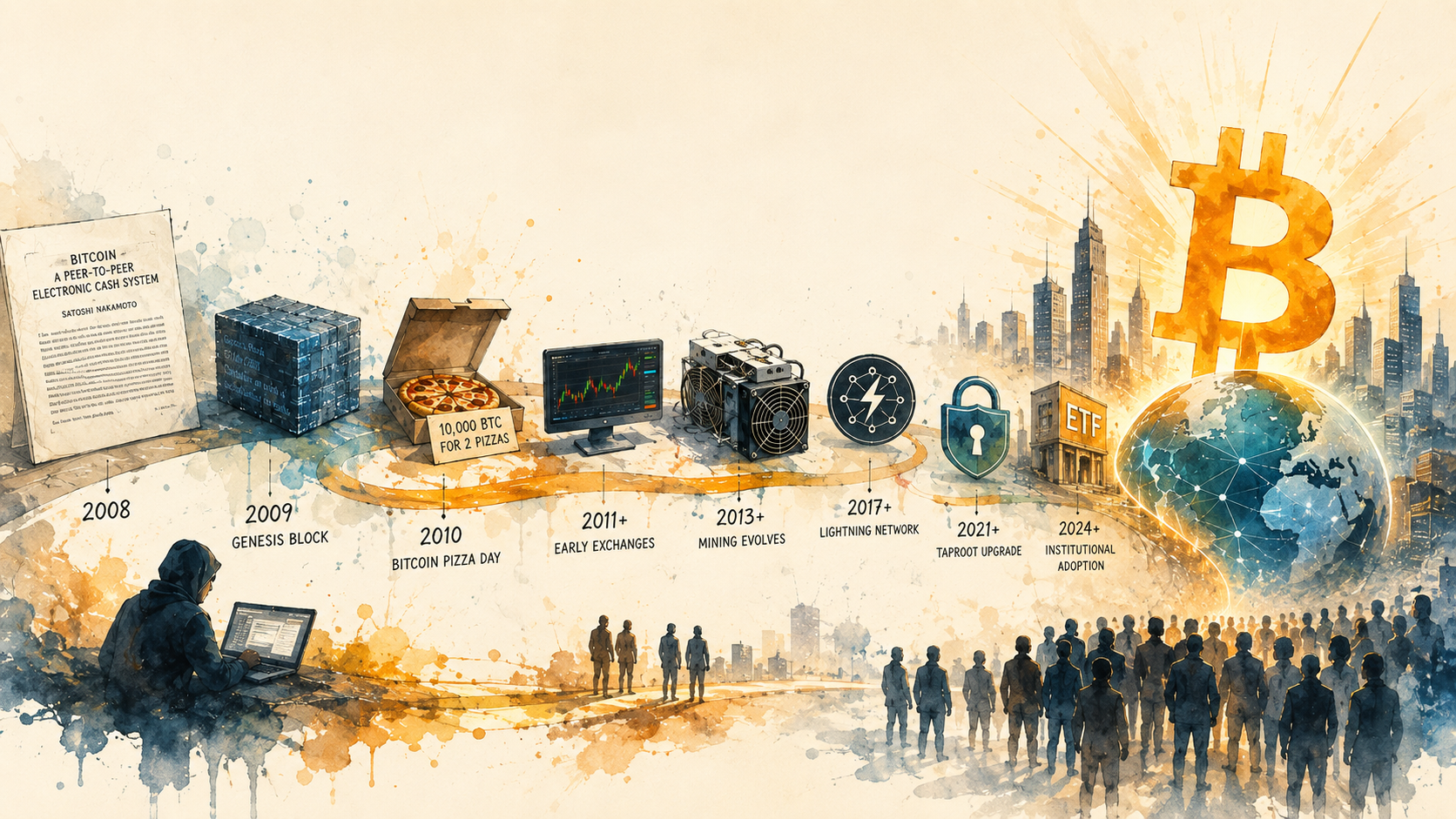
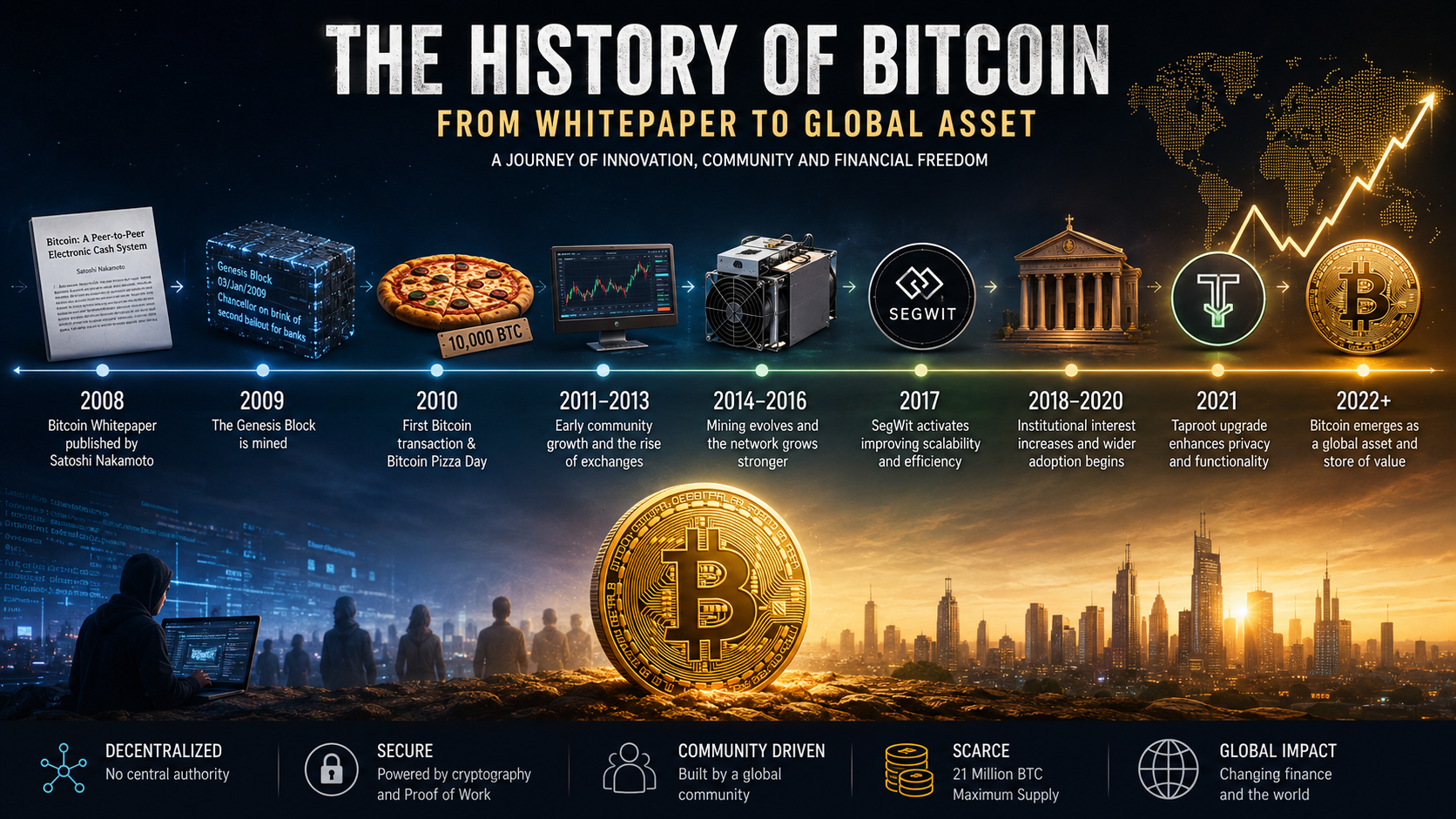
In October 2008, an individual or group using the pseudonym Satoshi Nakamoto published a nine-page document titled Bitcoin: A Peer-to-Peer Electronic Cash System. The paper described a decentralized network where participants could agree on transaction history through cryptographic proof instead of trusting a central organization.
The proposal combined several existing technologies in a new way:
- Cryptographic digital signatures
- Proof-of-Work mining
- Distributed consensus
- Blockchain-based transaction history
- Fixed monetary supply
Together, these innovations formed the foundation of Bitcoin.
The Genesis Block
On January 3, 2009, Satoshi Nakamoto mined Bitcoin's first block, known as the Genesis Block.
Embedded within the block was the famous message:
"The Times 03/Jan/2009 Chancellor on brink of second bailout for banks"
Many interpret this as both a timestamp proving when the block was created and a comment on the global financial crisis that inspired interest in alternatives to traditional banking.
The Genesis Block marked the official beginning of the Bitcoin network.
The First Bitcoin Transactions
Initially, Bitcoin had no market price. Early users mined coins using ordinary desktop computers simply because they found the technology interesting.
The first Bitcoin transaction occurred in January 2009 when Satoshi Nakamoto sent 10 BTC to cryptographer Hal Finney, one of Bitcoin's earliest supporters.
Throughout 2009 and early 2010, Bitcoin remained an experimental project discussed mainly within cryptography and open-source software communities.
Bitcoin Gets Its First Price
As more people joined the network, informal trading began.
One of the earliest recorded market prices valued Bitcoin at less than one US cent.
Since nobody knew whether Bitcoin would succeed, coins were often exchanged for tiny amounts or simply given away to encourage experimentation.
Bitcoin Pizza Day
One of Bitcoin's most famous milestones occurred on May 22, 2010.
Programmer Laszlo Hanyecz purchased two pizzas for 10,000 BTC, making it the first widely recognized real-world commercial Bitcoin transaction.
At the time, the purchase was worth around $41.
Years later, those same coins would become worth hundreds of millions of dollars, making Bitcoin Pizza Day an annual reminder of how dramatically Bitcoin's value has changed.
Early Growth and Community Development
Bitcoin's early success depended almost entirely on its community.
Developers improved the software, volunteers translated documentation, miners secured the network, and enthusiasts introduced new users to cryptocurrency.
Online forums such as Bitcointalk became central places for discussing software updates, technical improvements, wallets, mining hardware, and new ideas.
Many of today's largest cryptocurrency companies were founded by people active in these early communities.
The Rise of Cryptocurrency Exchanges
As Bitcoin attracted more attention, exchanges emerged to make buying and selling easier.
This significantly increased accessibility, allowing people to exchange national currencies for Bitcoin instead of mining it themselves.
Although several early exchanges eventually disappeared or failed, they demonstrated growing public demand for decentralized digital assets.
Over time, cryptocurrency exchanges evolved into sophisticated global platforms serving millions of users.
Mining Evolves
Bitcoin mining changed dramatically over the years.
Early miners used CPUs found in ordinary computers.
Soon, users discovered that graphics cards (GPUs) performed mining much faster.
Later came FPGA devices, followed by specialized ASIC miners designed exclusively for Bitcoin mining.
Today's mining industry consists of large-scale operations using highly efficient hardware, often powered by renewable or low-cost energy sources.
Despite these changes, mining continues to perform the same essential role: securing the network and validating new blocks.
Bitcoin Survives Challenges
Bitcoin has faced numerous obstacles throughout its history.
These include:
- Major exchange failures
- Security breaches affecting third-party services
- Government restrictions in some countries
- Market crashes exceeding 80%
- Public skepticism
- Technical debates within the community
Despite these challenges, the Bitcoin network itself has remained operational since its launch in 2009 without interruption.
This resilience has strengthened confidence among many supporters.
Scaling and Technological Improvements
As Bitcoin usage increased, developers sought ways to improve scalability without sacrificing decentralization.
Several important upgrades have shaped Bitcoin's evolution:
Segregated Witness (SegWit)
Activated in 2017, SegWit improved transaction efficiency while solving transaction malleability issues.
Lightning Network
Built as a second-layer solution, the Lightning Network enables fast, low-cost Bitcoin payments by processing many transactions off-chain before settling them on the main blockchain.
Taproot Upgrade
Activated in 2021, Taproot improved privacy, efficiency, and support for more advanced smart contract functionality.
These upgrades demonstrate that Bitcoin continues to evolve despite its intentionally conservative development approach.
Institutional Adoption
For many years, Bitcoin was primarily associated with technology enthusiasts and retail investors.
That perception gradually changed.
Publicly traded companies began adding Bitcoin to their balance sheets.
Large investment firms introduced Bitcoin investment products.
Financial institutions started offering Bitcoin custody services.
Eventually, spot Bitcoin exchange-traded funds (ETFs) in several markets further expanded access for traditional investors.
Institutional participation significantly increased Bitcoin's legitimacy in global financial markets.
Governments and Regulation
Governments have responded to Bitcoin in different ways.
Some countries embraced innovation by creating regulatory frameworks that support cryptocurrency businesses.
Others imposed strict regulations or outright bans.
Meanwhile, tax authorities around the world developed rules for reporting cryptocurrency gains, businesses implemented compliance procedures, and regulators focused on consumer protection and anti-money laundering requirements.
Although regulations continue to evolve, Bitcoin has become an established topic in financial policy worldwide.
Bitcoin as Digital Gold
Over time, many investors shifted their view of Bitcoin.
Rather than focusing primarily on everyday payments, they increasingly saw Bitcoin as a scarce digital asset.
With a maximum supply of 21 million coins, Bitcoin's predictable monetary policy distinguishes it from traditional currencies, whose supply can change over time.
This scarcity has led many supporters to compare Bitcoin with gold, referring to it as "digital gold."
Whether this comparison is fully justified remains debated, but it has become one of the dominant narratives surrounding Bitcoin.
Bitcoin's Global Impact
Bitcoin's influence extends far beyond its own network.
It inspired the creation of thousands of cryptocurrencies and blockchain projects.
It accelerated research into decentralized finance, cryptographic security, digital identity, tokenization, and distributed systems.
It also encouraged central banks to explore digital currencies and motivated businesses to develop blockchain-based applications across numerous industries.
Even people who never own Bitcoin are indirectly affected by the innovations it inspired.
Common Misconceptions
Several myths continue to surround Bitcoin.
"Bitcoin is anonymous."
Bitcoin transactions are recorded on a public blockchain. While addresses are pseudonymous, blockchain analysis can often connect activity to real-world identities.
"Bitcoin has no value."
Like many assets, Bitcoin derives value from supply, demand, scarcity, utility, security, and market confidence.
"Bitcoin can be hacked."
The Bitcoin protocol itself has never been successfully hacked. Most reported cryptocurrency thefts involve compromised exchanges, wallets, scams, or stolen private keys rather than flaws in Bitcoin's underlying blockchain.
"Bitcoin is controlled by one person."
Satoshi Nakamoto disappeared from public communication in 2011. Today, Bitcoin is maintained by an open-source community of developers, miners, node operators, businesses, and users around the world.
What the Future May Hold
Predicting Bitcoin's future is impossible, but its influence is already undeniable.
Future developments may include broader institutional participation, continued Lightning Network growth, additional technical improvements, evolving regulations, and increased adoption in regions seeking alternatives to unstable currencies or limited banking access.
At the same time, Bitcoin will continue facing competition, regulatory challenges, technological debates, and changing market conditions.
Whatever happens next, Bitcoin has already secured its place as one of the most significant financial and technological innovations of the 21st century.
Conclusion
Bitcoin's history is a story of persistence, innovation, and community collaboration. From a nine-page whitepaper published under a pseudonym to becoming a globally recognized digital asset, Bitcoin has transformed how millions of people think about money, ownership, and decentralized technology.
Whether viewed as digital cash, digital gold, an investment, or a technological breakthrough, Bitcoin continues to shape the future of finance. Its journey demonstrates how an open-source idea can evolve into a global network supported by people from every corner of the world, making Bitcoin one of the most remarkable innovations of the modern internet era.


Pick your reaction
Post your comment