

Cryptocurrency is often associated with blockchain technology, digital assets, and decentralized finance, but behind every successful crypto project is a community. Long before cryptocurrencies became mainstream, online communities played a critical role in discussing ideas, sharing knowledge, solving problems, and driving adoption.
From obscure internet forums to massive Discord servers with hundreds of thousands of members, crypto communities have shaped the industry from the very beginning.
Understanding the history of online crypto communities helps explain how cryptocurrency evolved from a niche experiment into a global movement. These communities have influenced technology development, market trends, governance decisions, and the culture of the entire blockchain ecosystem.
The Early Days: Cryptography and Cypherpunk Communities
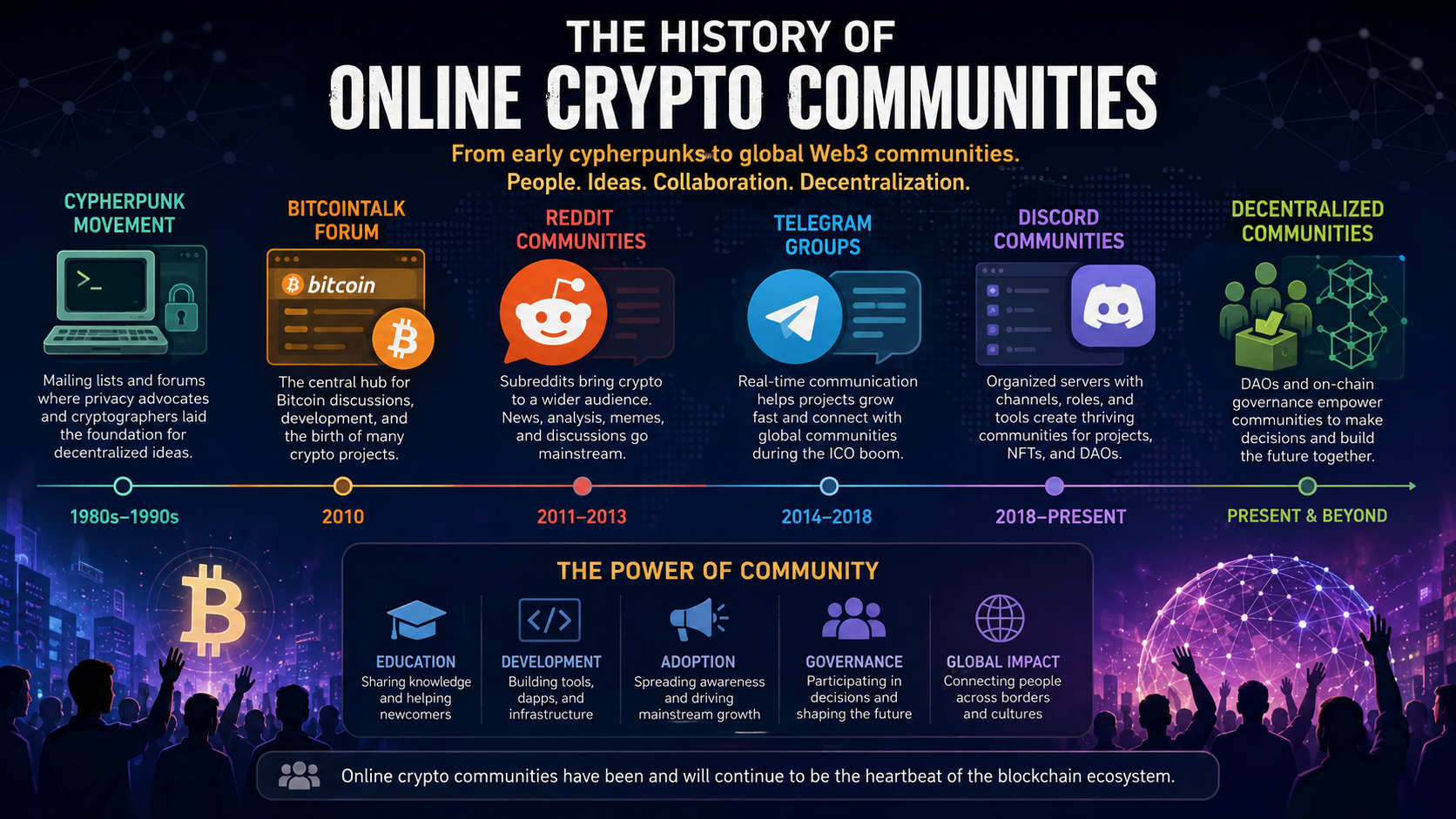
The roots of crypto communities can be traced back to the 1980s and 1990s, long before Bitcoin existed. During this period, groups of cryptographers, computer scientists, and privacy advocates gathered on mailing lists and internet forums to discuss digital privacy, encryption, and decentralized systems.
One of the most influential groups was the Cypherpunk movement. Members believed that strong cryptography could protect individual freedoms and reduce dependence on centralized institutions. Discussions often revolved around anonymous communication, digital cash, privacy technologies, and personal sovereignty.
These early online communities established many of the principles that would later inspire Bitcoin and other cryptocurrencies. Ideas such as decentralized money, censorship resistance, and trustless systems were already being debated years before the first blockchain was created.
BitcoinTalk and the Birth of Cryptocurrency Communities
The launch of Bitcoin in 2009 marked the beginning of a new era for online communities. While Bitcoin's creator, Satoshi Nakamoto, initially communicated through cryptography mailing lists, discussions quickly expanded to dedicated platforms.
In 2010, BitcoinTalk became the central hub for the growing Bitcoin community. Developers, miners, investors, and enthusiasts gathered to discuss software updates, technical challenges, and the future of digital currency.
BitcoinTalk served many important functions:
- Sharing technical knowledge about Bitcoin.
- Coordinating software development.
- Reporting bugs and vulnerabilities.
- Educating newcomers.
- Launching new cryptocurrency projects.
- Facilitating peer-to-peer transactions.
Many of the cryptocurrency projects that exist today first introduced themselves through BitcoinTalk announcements. For several years, it was the most important gathering place in the entire crypto ecosystem.
The Rise of Reddit and Social Discussion Platforms
As Bitcoin gained attention, communities began expanding beyond dedicated forums. Reddit emerged as one of the most influential platforms for cryptocurrency discussions.
Subreddits dedicated to Bitcoin, Ethereum, and countless other projects allowed users to share news, opinions, tutorials, and market analysis. The voting system helped surface popular content while creating active discussions around industry developments.
Reddit offered several advantages:
- Easier discovery for newcomers.
- Fast sharing of breaking news.
- Community-driven moderation.
- Dedicated spaces for individual projects.
- Broader reach beyond technical users.
Many major events in crypto history were discussed in real time on Reddit, making it one of the industry's primary information sources throughout the 2010s.
Telegram and Real-Time Community Building
As cryptocurrency projects multiplied, developers needed faster ways to communicate with users. Telegram became one of the most popular platforms for blockchain communities.
Telegram groups offered instant communication between project teams and community members. Users could ask questions, receive updates, and participate in discussions around the clock.
The platform became particularly popular during the Initial Coin Offering (ICO) boom of 2017 and 2018. Nearly every new project launched a Telegram group to attract supporters and communicate directly with investors.
This period demonstrated the power of real-time engagement. Communities could grow rapidly and attract thousands of members from around the world within days of a project's launch.
Discord and the Modern Community Era
While Telegram remained popular, Discord gradually became the preferred platform for many crypto communities. Originally designed for gaming communities, Discord offered advanced moderation tools, role systems, voice channels, and organized discussion spaces.
Discord allowed projects to create structured environments with separate channels for:
- Announcements.
- Technical support.
- Governance discussions.
- Developer collaboration.
- Community events.
- Educational content.
- Regional language groups.
The platform became especially important for NFT projects, blockchain gaming communities, decentralized autonomous organizations (DAOs), and emerging blockchain ecosystems.
Today, some crypto Discord servers contain hundreds of thousands of members and operate almost like digital nations, with their own culture, rules, events, and governance systems.
The Influence of Social Media
Social media platforms transformed how crypto communities communicate. Platforms such as X (formerly Twitter), YouTube, Twitch, and various livestreaming services enabled creators, developers, analysts, and community leaders to reach global audiences instantly.
These platforms introduced new forms of engagement:
- Livestream discussions.
- Educational content.
- Project announcements.
- Community spaces and voice chats.
- Market commentary.
- Governance debates.
- Interactive question-and-answer sessions.
Influencers and content creators became important members of the broader crypto ecosystem, helping educate newcomers and increase awareness of blockchain technologies.
The Emergence of Decentralized Communities
As blockchain technology matured, communities began experimenting with decentralized governance structures.
Decentralized Autonomous Organizations (DAOs) introduced new ways for communities to coordinate and make decisions. Instead of relying solely on project teams, community members could vote on proposals, funding decisions, and protocol changes.
These governance systems shifted communities from simple discussion groups into active participants in project development. Community members became stakeholders with real influence over the future direction of blockchain ecosystems.
This evolution blurred the line between users, contributors, and decision-makers.
Community-Driven Ecosystems
Many of today's most successful blockchain projects owe much of their success to their communities rather than technology alone.
Strong communities contribute by:
- Creating educational resources.
- Developing applications.
- Translating content.
- Organizing events.
- Moderating discussions.
- Supporting new users.
- Promoting adoption.
- Participating in governance.
In many cases, community contributions have accelerated growth far beyond what project teams could achieve on their own.
The Role of Community Directories and Discovery Platforms
As the number of crypto communities continues to grow, discovering trustworthy and active groups has become increasingly challenging.
Community directories and discovery platforms help users find relevant projects, compare communities, read reviews, and connect with people who share similar interests. These platforms improve transparency and make it easier for newcomers to navigate the increasingly complex blockchain ecosystem.
They also help communities gain visibility while creating centralized discovery tools for an otherwise decentralized industry.
Conclusion
The history of online crypto communities is closely intertwined with the history of cryptocurrency itself. From the Cypherpunk mailing lists of the 1990s to modern Discord servers, DAOs, and community discovery platforms, online communities have driven innovation, education, and adoption throughout the industry's evolution.
While blockchain technology provides the infrastructure, communities provide the people, ideas, and collaboration that allow ecosystems to thrive. As cryptocurrency continues to evolve, communities will remain one of the most important forces shaping the future of decentralized technology.



Pick your reaction
Post your comment