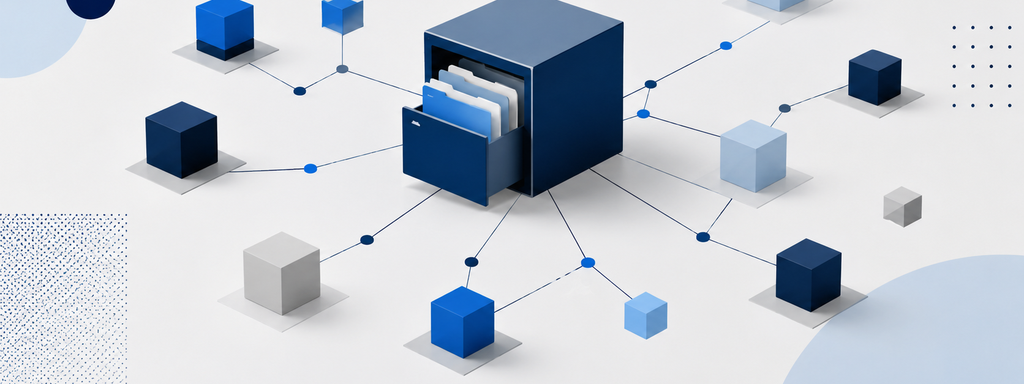

The internet depends on enormous amounts of stored data. Photos, websites, documents, application files, videos, and blockchain-related information all need somewhere to live. Traditionally, most of that data has been stored on servers controlled by companies, cloud providers, or other centralized organizations.
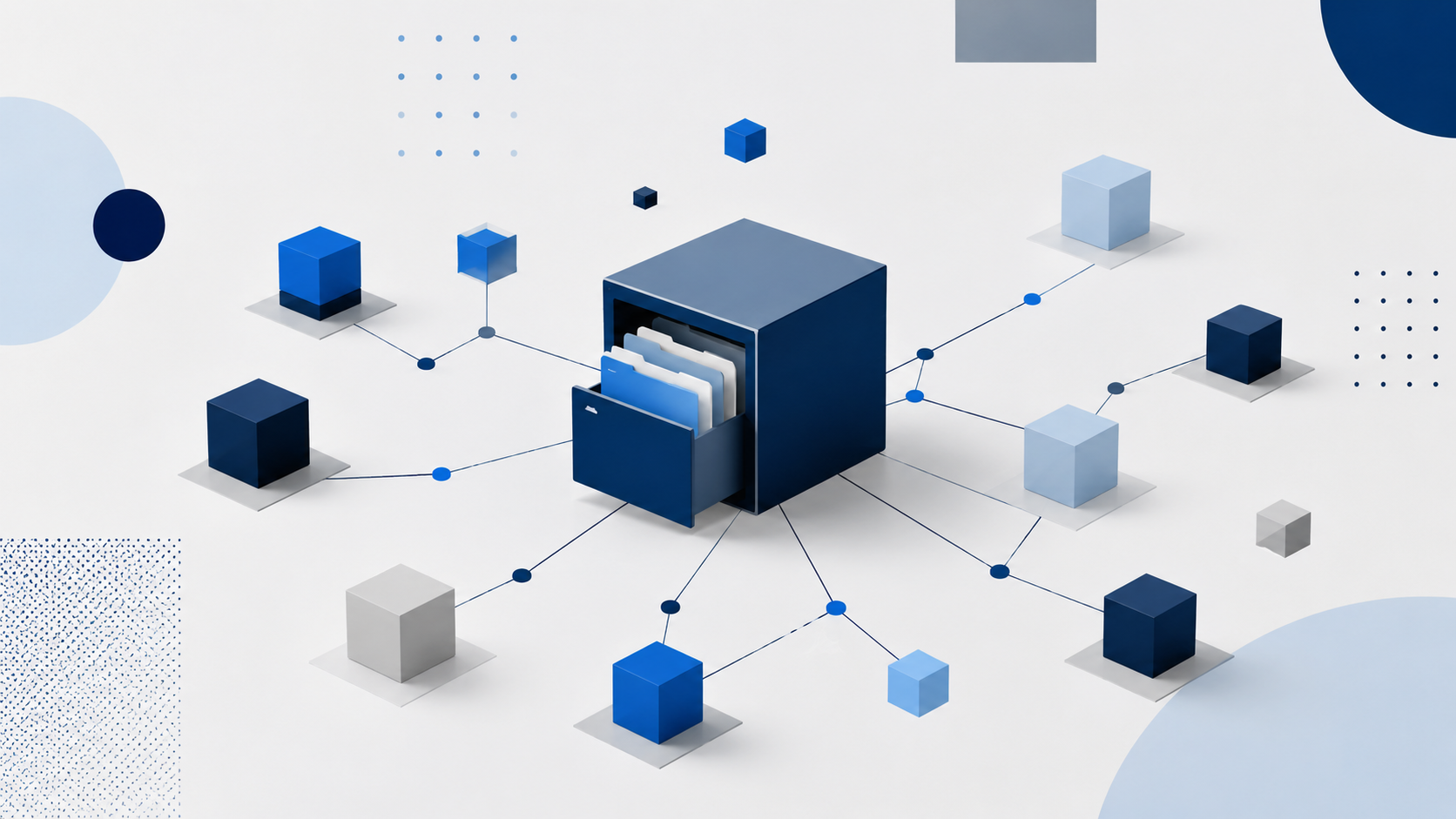
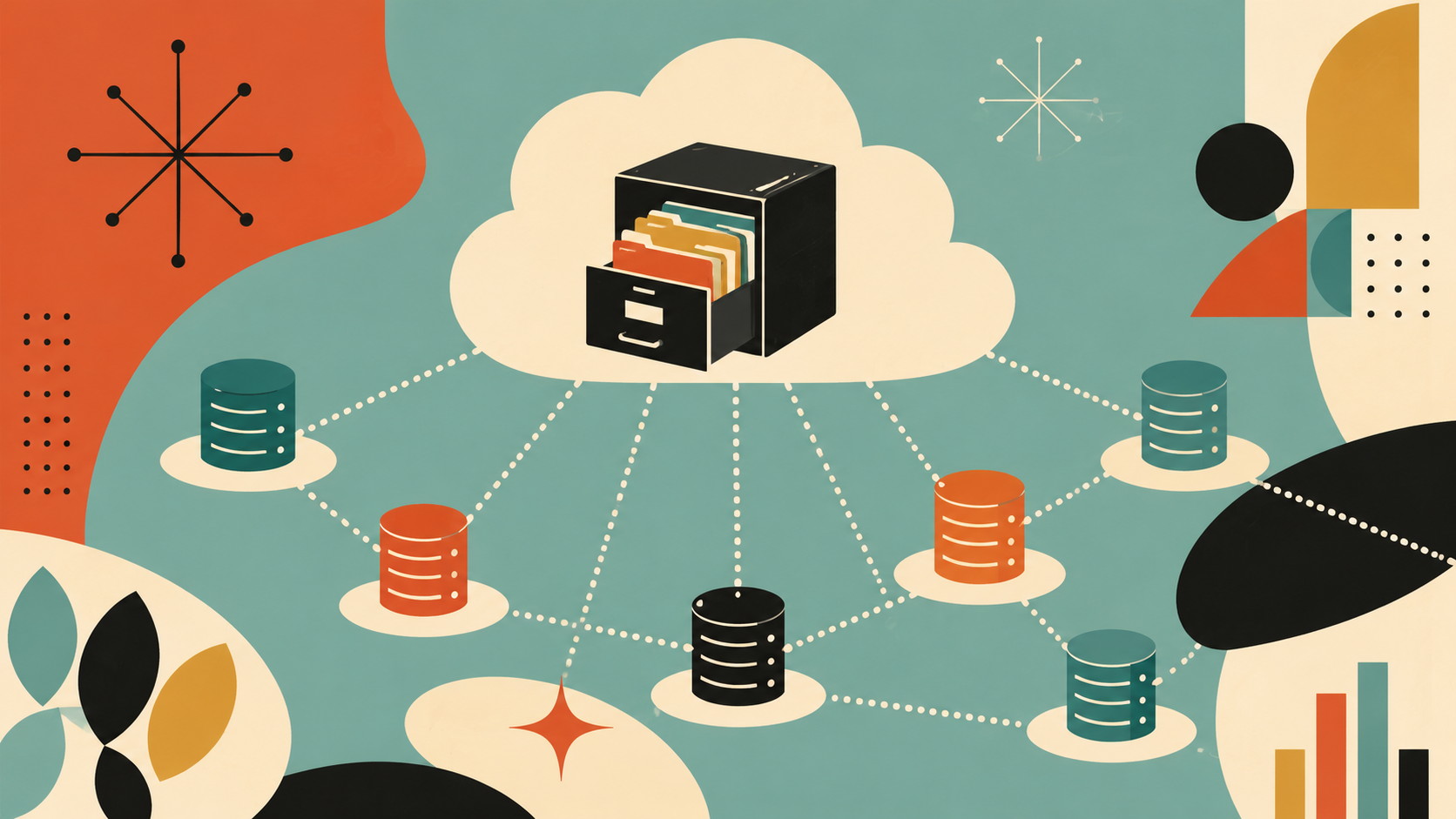
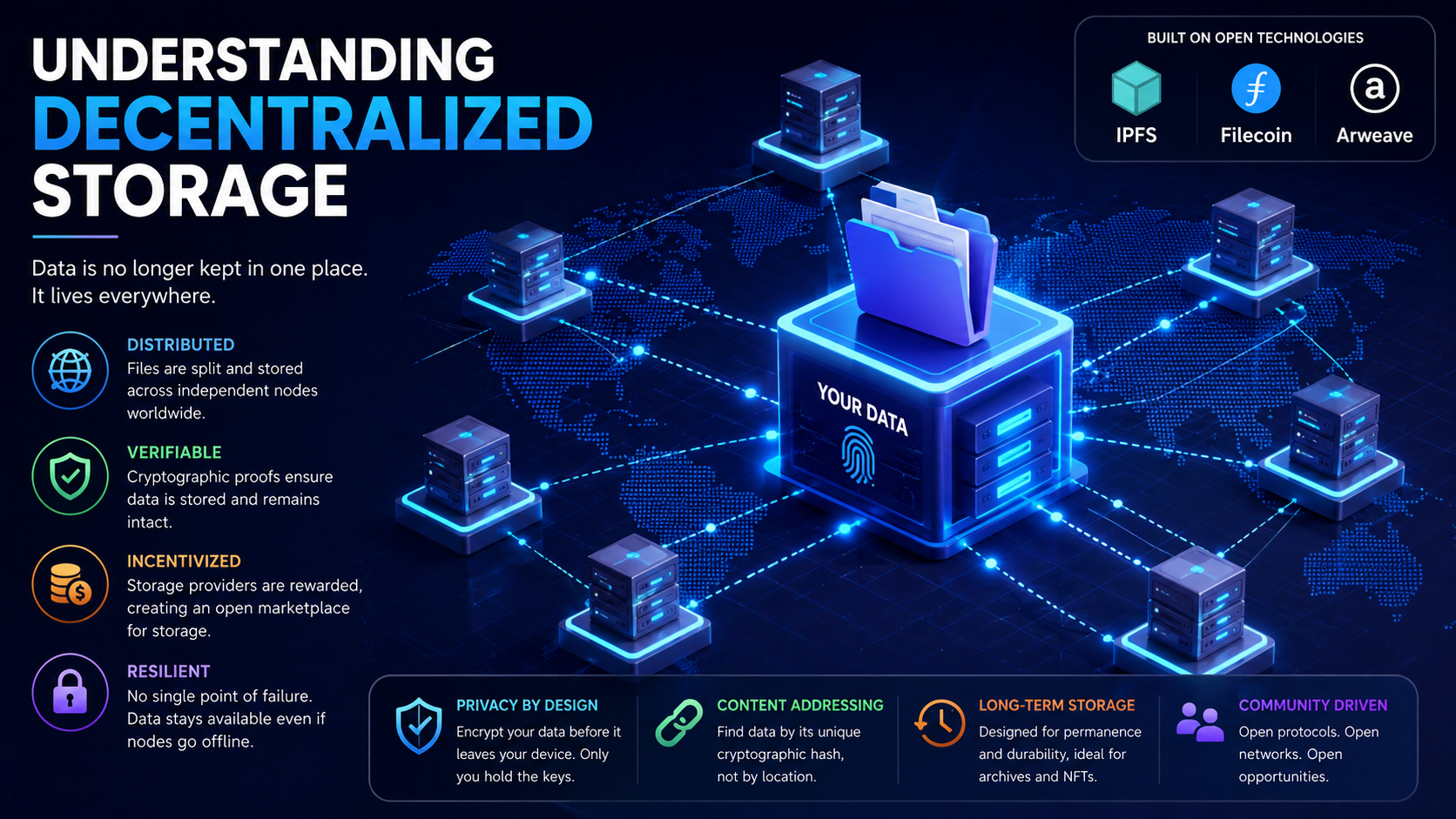
Decentralized storage takes a different approach. Instead of relying on a single provider or group of data centers, it distributes data across networks of independent participants. Cryptography, distributed systems, and economic incentives can then be used to keep that data available and verifiable.
But decentralized storage is not simply "cloud storage on a blockchain." Different networks use very different architectures, and understanding those differences is important when evaluating what decentralized storage can actually offer.
What Is Decentralized Storage?
Decentralized storage is a method of storing and retrieving digital information using a distributed network rather than depending entirely on infrastructure controlled by one organization.
In a conventional cloud storage system, a company operates the servers and determines how data is stored, replicated, accessed, and priced. Users interact with that company's infrastructure and trust it to keep their information available.
A decentralized storage network spreads these responsibilities among multiple independent participants.
Depending on the system, participants may contribute hard-drive space, operate storage nodes, retrieve files, verify that information remains available, or provide other resources needed by the network.
The basic idea is simple:
Instead of asking one organization to store your data, a distributed network coordinates storage across many independent machines.
How that coordination happens is where things become more interesting.
Centralized vs Decentralized Storage
Centralized cloud storage is extremely effective. Large providers operate sophisticated global infrastructure capable of delivering enormous amounts of data quickly and reliably.
However, centralization also creates dependencies.
If a provider experiences an outage, changes its policies, closes an account, increases prices, or stops offering a service, users may have limited alternatives. Infrastructure can also become a single point of control over who can store or access certain information.
Decentralized storage attempts to distribute some of that control.
Rather than depending entirely on one provider, data can be stored across multiple nodes operated by unrelated participants. The network's protocol determines how those participants interact.
This does not automatically make decentralized systems superior. Centralized and decentralized storage simply optimize for different properties.
Traditional cloud services often prioritize convenience, performance, support, and tight integration. Decentralized networks may place greater emphasis on distribution, verifiability, censorship resistance, or open participation.
How Decentralized Storage Works
There is no universal architecture for decentralized storage, but many networks use several common techniques.
When a file enters a decentralized storage system, it may first be processed cryptographically.
The file can be divided into smaller pieces, encrypted, encoded with redundancy, or replicated across multiple storage providers. Different pieces may then be distributed among nodes throughout the network.
Instead of relying solely on the physical location of a file, some systems identify data using cryptographic hashes.
A hash acts like a digital fingerprint. If the contents of a file change, its hash changes as well.
This makes it possible to request information according to what it is rather than simply where it is stored.
Location Addressing vs Content Addressing
The difference between location addressing and content addressing is one of the most important concepts behind decentralized storage.
The traditional web primarily uses location-based addressing.
When you enter a URL, you are essentially asking for information from a particular location. The server behind that address determines what content you receive.
Content-addressed systems work differently.
Instead of saying:
"Give me the file stored at this location."
you can effectively say:
"Give me the file that matches this cryptographic identifier."
If several computers have the requested data, it may be retrieved from any suitable source.
This approach can make data easier to verify because the identifier itself is derived from the content.
Why Blockchains Are Often Involved
Decentralized storage and blockchain technology are closely associated, but storing large files directly on a blockchain is usually impractical.
Blockchains are designed to maintain replicated consensus records. Every full node may need to process or retain blockchain data, making large-scale file storage expensive and inefficient.
Instead, decentralized storage networks often keep the actual files off-chain while using blockchains or similar distributed ledgers for coordination.
A blockchain might record storage agreements, payments, ownership information, proofs, or other network activity.
The storage layer handles the data itself, while the blockchain helps participants coordinate without requiring a central administrator.
This distinction is important:
Decentralized storage does not necessarily mean that the stored files themselves are placed on a blockchain.
Incentivizing People to Provide Storage
A decentralized network needs computers willing to store other people's data.
Some networks solve this problem using economic incentives.
Storage providers can contribute unused disk capacity and receive cryptocurrency or tokens in return. Users who need storage pay providers through the network.
This creates a decentralized marketplace for storage resources.
Instead of one company building every data center, the protocol attempts to coordinate independent suppliers and customers.
Prices can potentially emerge from supply and demand, although the exact mechanism differs considerably between networks.
Token incentives also introduce additional complexity. Storage economics may be influenced by cryptocurrency prices, reward structures, collateral requirements, speculation, and protocol changes.
Proving That Data Is Actually Being Stored
Paying someone to store a file creates another problem:
How do you know they are actually storing it?
A storage provider could accept payment and then delete the data unless the network has a way to verify that the provider continues fulfilling its obligations.
Some decentralized storage protocols therefore use cryptographic proofs.
Providers may periodically demonstrate that they possess the required data or have dedicated storage capacity to the network.
Different protocols implement this idea differently, using mechanisms such as storage proofs, challenges, audits, collateral, or reputation systems.
These verification mechanisms are important because they reduce the need to simply trust the storage provider.
Replication and Redundancy
Distributed storage does not mean that every node stores every file.
Doing so would be enormously inefficient.
Instead, systems typically distribute or replicate data strategically.
A file might be copied to several independent nodes so that the failure of one machine does not destroy the information. Other systems divide files into pieces and use erasure coding, allowing the original data to be reconstructed even when some pieces become unavailable.
Redundancy is essential because individual nodes can disappear at any time.
Storage providers may shut down computers, lose internet access, suffer hardware failures, or simply leave the network.
A robust decentralized storage system must assume that individual participants are unreliable while making the network as a whole resilient.
Encryption and Privacy
Distributing data among unknown computers naturally raises privacy concerns.
For that reason, encryption can play an important role in decentralized storage.
Files can be encrypted before being distributed so that storage providers hold data they cannot meaningfully read. Only someone with the appropriate cryptographic keys can reconstruct and decrypt the original information.
However, decentralized storage should not automatically be assumed to provide complete privacy.
Privacy depends on the protocol, application, encryption method, metadata exposure, key management, and how users interact with the network.
As with cryptocurrency wallets, control over cryptographic keys also creates responsibility. Losing an important encryption key could make stored information permanently inaccessible.
Permanent Storage vs Temporary Storage
Not every decentralized storage network makes the same promises about how long data will remain available.
Some systems operate more like storage marketplaces. Users purchase storage for a particular period, after which agreements may need to be renewed.
Others are designed around long-term or potentially permanent data preservation.
These are fundamentally different models.
A network advertising decentralized storage should therefore be evaluated based on its actual persistence guarantees rather than assuming that uploading something once means it will remain available forever.
IPFS and Distributed File Sharing
One of the best-known technologies associated with decentralized storage is the InterPlanetary File System, commonly known as IPFS.
IPFS uses content addressing to identify and distribute files across a peer-to-peer network.
Instead of retrieving a file exclusively from one server, users can retrieve content matching a particular identifier from peers capable of providing it.
However, IPFS itself does not automatically guarantee permanent storage.
Someone still needs to keep the content available, often described as "pinning" the data. If nobody retains the content, it can eventually become unavailable.
This illustrates an important distinction between decentralized file distribution and guaranteed long-term storage.
Filecoin and Storage Markets
Filecoin extends the decentralized storage concept by creating a marketplace where storage providers can offer capacity to users.
The network uses cryptographic mechanisms designed to verify storage commitments and coordinates payments through its blockchain-based system.
This demonstrates how decentralized storage can combine several technologies:
- Distributed storage providers
- Cryptographic verification
- Blockchain-based coordination
- Token incentives
- Open storage markets
Rather than building one enormous cloud provider, the goal is to create a protocol through which independent providers can compete to offer storage.
Arweave and Permanent Data
Arweave approaches decentralized storage from another direction.
Its ecosystem focuses heavily on long-term data preservation and what it describes as permanent information storage.
This model has attracted applications involving archives, websites, NFTs, historical records, and other information intended to remain accessible for extended periods.
It also highlights how different decentralized storage networks can pursue very different objectives.
Some compete with traditional cloud storage. Others focus on content distribution, archival preservation, Web3 application data, or specialized infrastructure.
Decentralized Storage and NFTs
Decentralized storage is particularly relevant to NFTs.
An NFT recorded on a blockchain often does not contain the actual image, video, or other media represented by the token. Storing large media files directly on-chain would frequently be too expensive.
Instead, the blockchain may contain metadata pointing to content stored elsewhere.
If that content exists only on a conventional server and the server disappears, the NFT could remain on the blockchain while its associated media becomes unavailable.
Content-addressed and decentralized storage systems can reduce this dependency.
However, using decentralized storage does not automatically guarantee permanence. Developers and collectors still need to understand how the underlying data is being maintained.
Decentralized Storage and Web3 Applications
Decentralized applications face a similar problem.
A supposedly decentralized application can still depend heavily on centralized infrastructure.
Its smart contracts might run on a decentralized blockchain while its website, images, user-generated content, databases, or application assets remain hosted by conventional providers.
Decentralized storage can reduce some of these dependencies.
Developers can use distributed storage networks for website assets, application data, NFT metadata, public datasets, backups, archives, or user-generated content.
The result can be an application whose infrastructure is distributed across multiple layers rather than decentralized only at the blockchain level.
Potential Advantages of Decentralized Storage
One of the biggest potential advantages is resilience.
When information exists across independent nodes, the failure of one machine or organization does not necessarily make the data unavailable.
Decentralized storage can also reduce reliance on centralized gatekeepers. Open protocols may allow anyone to participate as a user or storage provider without receiving permission from a single company.
Content addressing can provide another advantage by making information cryptographically verifiable.
Some systems may also create more competitive storage markets by allowing independent providers around the world to contribute unused capacity.
For certain applications, censorship resistance and long-term preservation can be particularly valuable.
The Challenges of Decentralized Storage
Despite its potential, decentralized storage has significant limitations.
Performance can be inconsistent because data may be distributed among independent nodes with different hardware and network connections.
Availability depends heavily on the protocol's replication, incentive, and persistence mechanisms.
User experience can also be more complicated than conventional cloud storage. Managing wallets, tokens, encryption keys, storage agreements, or unfamiliar addressing systems creates additional friction.
Economic sustainability is another challenge.
A network must ensure that storage providers are compensated enough to continue participating while keeping prices attractive to users. Token rewards can temporarily encourage participation, but long-term demand for the actual storage service remains important.
There are also difficult questions involving illegal content, copyright violations, moderation, privacy regulations, and data deletion.
A system designed to make information extremely difficult to remove inevitably creates both benefits and problems.
Decentralization Exists on a Spectrum
Calling a storage system "decentralized" does not reveal very much by itself.
A network could have thousands of storage nodes while depending on a small number of gateways.
Another might distribute data effectively but have concentrated governance.
A protocol could be decentralized while the applications people use to access it remain centralized.
When evaluating a decentralized storage project, it is useful to ask:
- Who operates the storage nodes?
- How geographically distributed are they?
- How is data replicated?
- What happens when nodes disappear?
- Who controls the protocol?
- How are storage providers paid?
- How is continued storage verified?
- Can users retrieve data without relying on one gateway?
- What happens when payments or incentives stop?
- Can stored information realistically be deleted?
These questions provide a much clearer picture than the "decentralized" label alone.
Decentralized Storage Is Not a Replacement for Everything
It is tempting to frame decentralized storage as a competitor that will eventually replace traditional cloud providers.
The reality is more nuanced.
Centralized cloud infrastructure is highly optimized, fast, convenient, and supported by mature tools. For many applications, those properties are more important than decentralization.
Decentralized storage becomes particularly interesting when applications need properties traditional infrastructure was not primarily designed to provide.
These might include censorship resistance, independently verifiable content, open storage markets, distributed ownership of infrastructure, or long-term preservation without relying on a single organization.
Hybrid systems may therefore become increasingly common.
An application could use conventional servers for high-performance services while using decentralized networks for backups, public assets, archives, or information that needs stronger persistence guarantees.
Why Decentralized Storage Matters
Blockchain technology introduced the idea that financial records could be maintained by distributed networks rather than a single institution.
Decentralized storage applies a related idea to data infrastructure.
The question is no longer simply:
"Which company should store this information?"
It can also become:
"Can a protocol coordinate independent computers to keep this information available?"
Solving that problem requires much more than distributing copies of files. Networks must handle verification, incentives, redundancy, encryption, retrieval, pricing, performance, and governance.
Projects such as IPFS, Filecoin, Arweave, and other distributed storage technologies are experimenting with different answers.
Final Thoughts
Decentralized storage represents an attempt to rethink one of the internet's most fundamental services: where information lives and who controls the infrastructure that keeps it available.
Instead of trusting a single storage provider, decentralized systems can distribute data and responsibility among independent participants. Cryptography can verify information, redundancy can protect against individual failures, and blockchain-based incentives can coordinate storage providers that may never know or trust one another.
That does not mean decentralized storage is automatically cheaper, faster, safer, more private, or permanent. Those properties depend on the design of each network.
The more useful way to think about decentralized storage is as another infrastructure model with a different set of trade-offs.
As Web3 applications, digital ownership, decentralized identity, public datasets, and blockchain-based services continue to develop, reliable storage outside traditional centralized systems may become an increasingly important part of the decentralized technology stack.

Pick your reaction
Post your comment