

Market capitalization helps put a cryptocurrency’s price into perspective. Learn how market cap is calculated, why token supply matters, and how to read it alongside liquidity and fully diluted valuation when exploring crypto projects.
A token priced at $0.01 can have a larger market capitalization than one trading at $100. The difference comes down to supply: how many tokens are in circulation.
Market capitalization, usually shortened to market cap, brings price and supply together. It provides a useful starting point for comparing cryptocurrencies, but understanding its limits is just as important as knowing the formula.
How market capitalization works
In cryptocurrency markets, market cap is generally calculated as:
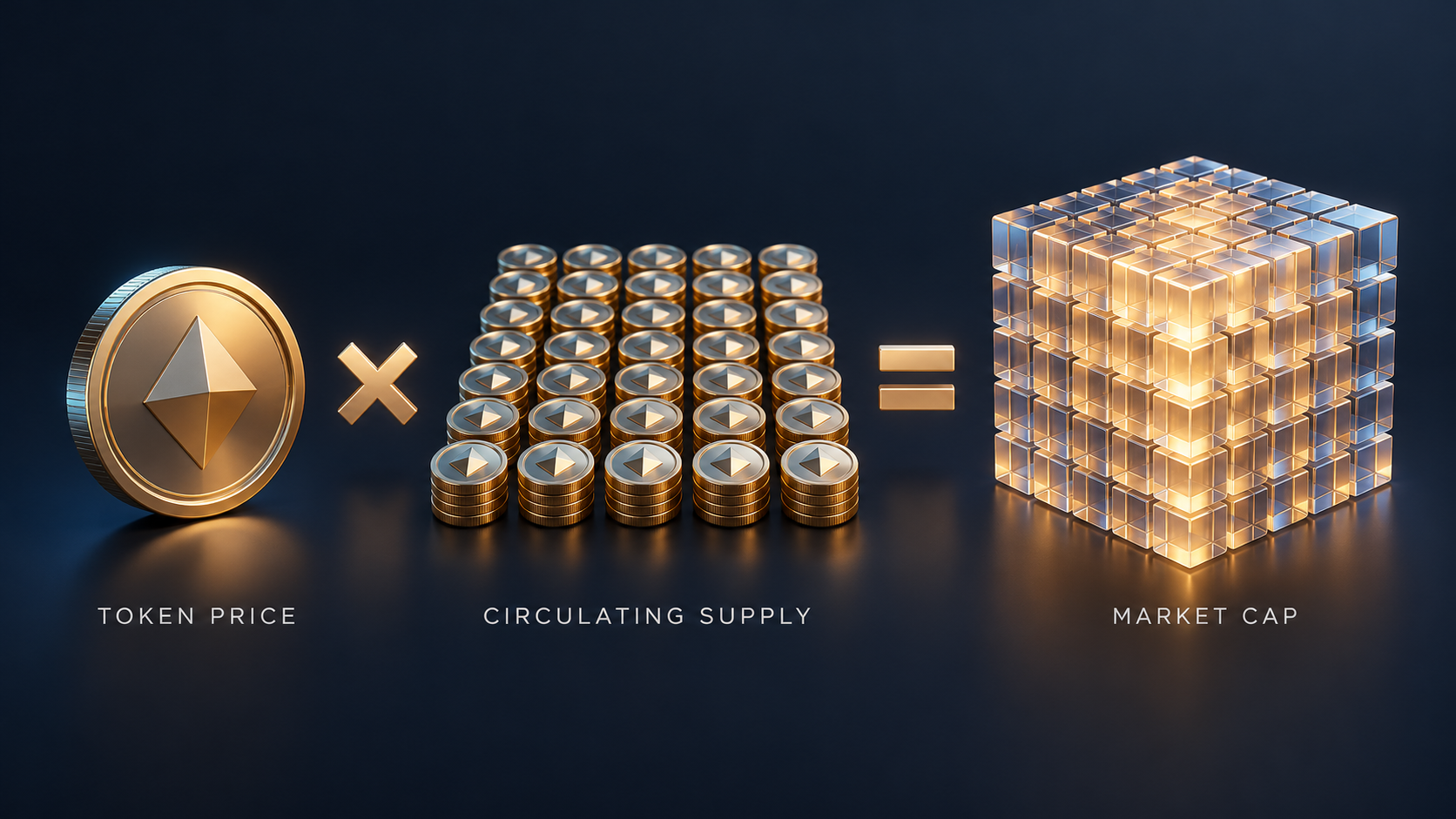
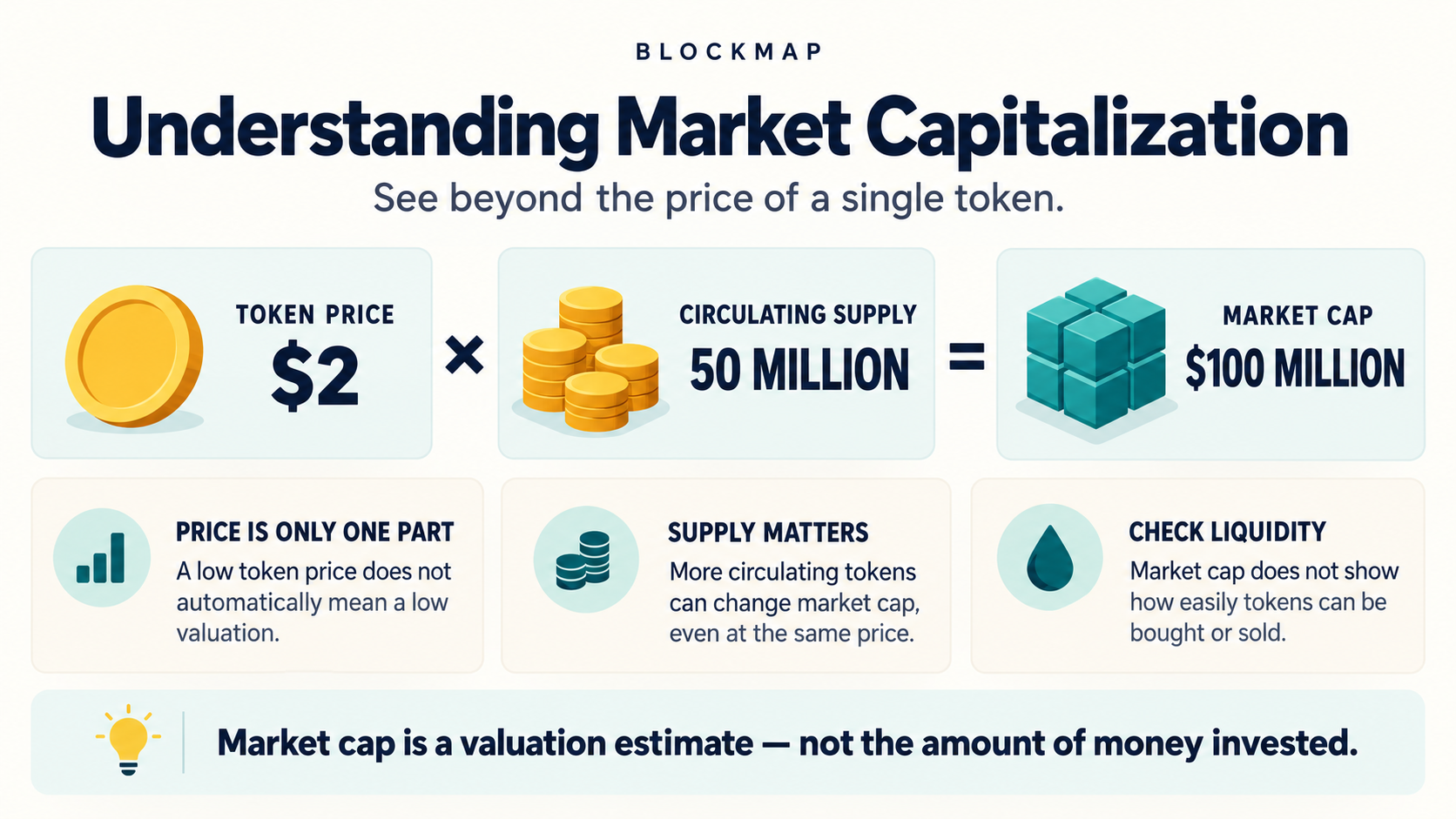
Market cap = Current token price × Circulating supply
If a cryptocurrency trades at $2 and has 50 million tokens in circulation, its market cap is $100 million.
This figure values the circulating supply at the current market price. It changes when the price moves, when circulating supply changes, or when both happen together.
In stock markets, market capitalization follows a similar principle: share price multiplied by outstanding shares. A crypto token, however, does not necessarily represent ownership in a company or a claim on its earnings.
Why token price alone can be misleading
Consider two fictional cryptocurrencies:
- Token A: $0.01 per token, with 100 billion tokens circulating. Its market cap is $1 billion.
- Token B: $100 per token, with 1 million tokens circulating. Its market cap is $100 million.
Although Token A has a much lower price per token, its market cap is ten times larger.
This explains why a low token price does not automatically mean a project is inexpensive or has more room to grow. The number of units matters.
The same calculation helps put price targets into perspective. If Token A reached $1 while its circulating supply remained unchanged, its market cap would reach $100 billion. That does not prove the price target is achievable; it shows the valuation the target implies.
Circulating, total, and maximum supply
Supply figures describe different things, and choosing the right one matters.
- Circulating supply estimates the tokens currently available to the market. Depending on the data provider’s methodology, it generally excludes certain locked, reserved, or restricted holdings.
- Total supply generally counts tokens already created, minus tokens permanently removed through burning. It can include tokens that are not circulating.
- Maximum supply is the upper limit on the number of tokens that can ever exist under the protocol’s rules, where such a limit exists.
Not every cryptocurrency has a fixed maximum supply. Some issue new tokens continuously, while others combine issuance with token burns.
Circulating supply is also not the same as the amount available for sale right now. Tokens counted as circulating may sit in inactive wallets or be held by people who have no intention of selling. Supply estimates can differ between data providers, so comparisons are more useful when their methodologies are consistent.
Market cap and fully diluted valuation
Fully diluted valuation, or FDV, extends the price calculation to a broader supply figure—commonly the maximum supply, though some providers use total supply.
Suppose a token has:
- A current price of $2.
- A circulating supply of 50 million tokens.
- A maximum supply of 500 million tokens.
Its circulating market cap would be $100 million, while its FDV based on maximum supply would be $1 billion.
The gap highlights how much supply remains outside circulation. Future token unlocks, staking rewards, mining rewards, or other distributions may increase circulating supply.
FDV applies today’s price to that broader supply. It does not predict the future market cap or assume that demand will grow enough to maintain the current price. An unlock also does not guarantee an immediate sell-off: its effect depends on the size, timing, recipients, and market conditions.
Market cap is not money invested
A $1 billion market cap does not mean that investors collectively deposited $1 billion into a cryptocurrency.
Market prices form through trading. Data providers use observed prices to estimate the value of the entire circulating supply, even though only a fraction of that supply may have traded at those prices.
For the same reason, an increase of $100 million in market cap does not require exactly $100 million in new buying. Relatively small trades can move prices substantially in a thin market.
Market cap also does not represent the amount holders could collectively withdraw. Selling a large quantity may push the price down, especially when few buyers are available.
Why liquidity matters
Liquidity describes how easily an asset can be bought or sold without significantly changing its price.
A token can display a large market cap while having limited liquidity. For example, a small amount of trading might establish a high price that is then multiplied by a large circulating supply. That headline valuation can look impressive even when selling a modest position would move the market sharply.
Trading volume provides additional context, but volume and liquidity are different measures. Volume records how much trading occurred during a period. Liquidity concerns the buying and selling capacity available around the current price.
Order-book depth, bid–ask spreads, and decentralized exchange liquidity pools can help explain whether a quoted price is practical for a particular trade.
What market cap tells you - and what it leaves out
Market cap helps compare the relative market size of cryptocurrencies. It can also help test the scale of a price claim and reveal how a project’s circulating valuation compares with its FDV.
It does not directly measure:
- Whether a network is secure or reliable.
- Whether people actively use the product.
- How concentrated token ownership is.
- Whether the token gives holders meaningful rights or benefits.
- How much revenue a protocol generates.
- Whether the current price is sustainable.
Descriptions such as “large-cap,” “mid-cap,” and “small-cap” are convenient groupings, but their boundaries vary. A larger market cap does not guarantee safety, and a smaller one does not guarantee growth.
When exploring a project on BlockMap, market cap can give you an initial sense of scale. Build on that number by examining supply schedules, liquidity, ownership concentration, and actual use. Together, those details offer a more useful picture of what the market is valuing and the assumptions behind it.


Pick your reaction
Post your comment