

Crypto markets rarely move in a straight line. Prices rise, enthusiasm grows, momentum eventually fades, and periods of decline or consolidation follow. These recurring patterns are commonly described as market cycles.
Understanding market cycles does not allow anyone to predict exactly when Bitcoin, Ethereum, or another cryptocurrency will rise or fall. However, recognizing the different phases of a cycle can provide useful context for price movements, investor behavior, and changing market sentiment.
What Is a Market Cycle?
A market cycle is a period during which a financial market moves through several recognizable phases before the process begins again.
Markets are influenced by countless factors, including supply and demand, economic conditions, technological developments, regulation, liquidity, investor expectations, and human psychology. Together, these forces can create broad patterns of expansion and contraction.
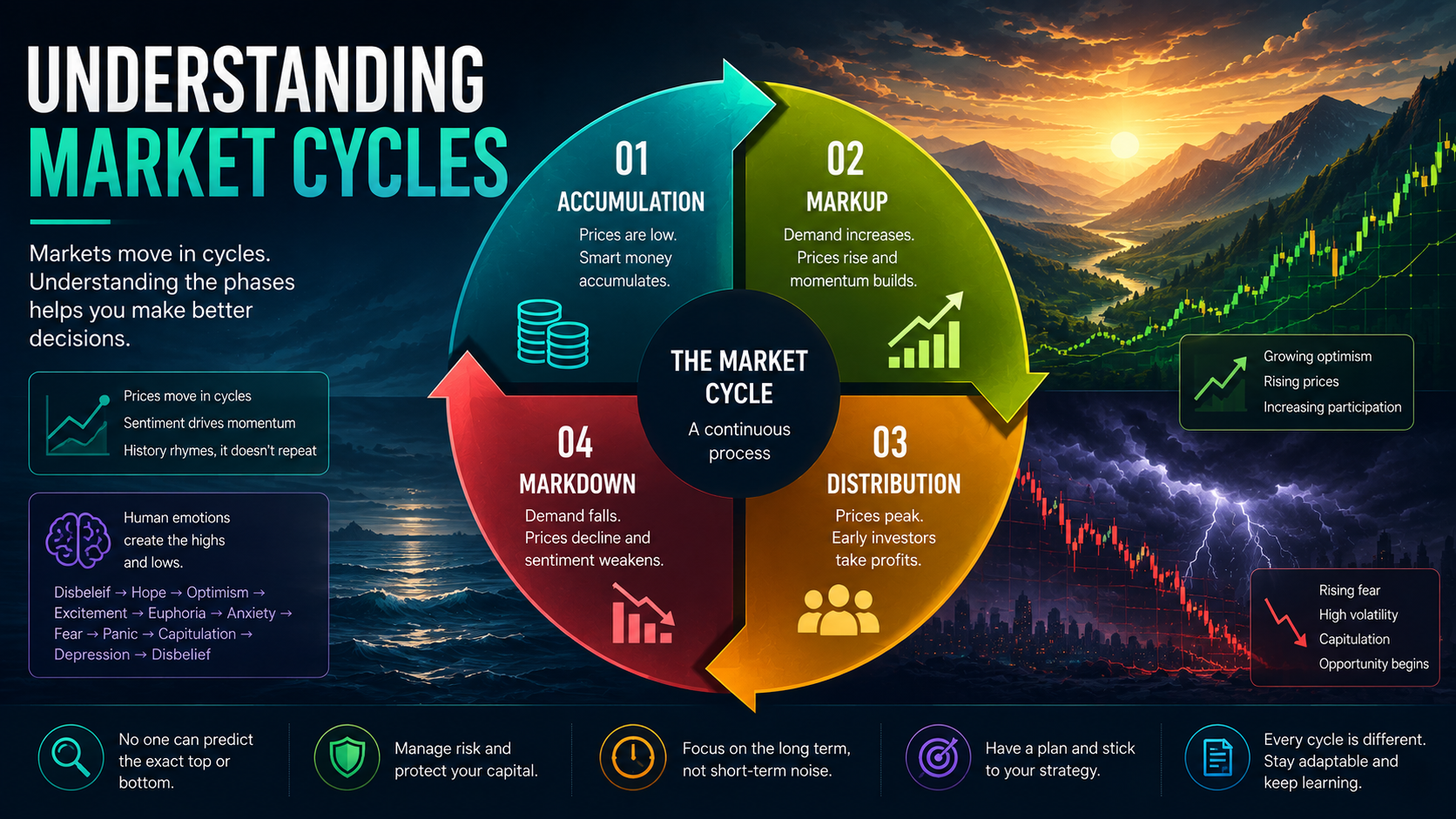
A simplified market cycle is often divided into four phases:
- Accumulation
- Markup
- Distribution
- Markdown
The exact boundaries between these phases are rarely obvious while they are happening. Markets can also move sideways, reverse unexpectedly, or experience smaller cycles within much larger ones.
Still, the four-phase model provides a useful framework for understanding how market conditions can evolve.
The Accumulation Phase
The accumulation phase typically develops after a significant market decline.
Prices may have fallen considerably from previous highs, and public interest in the market is often relatively low. News coverage may be negative, trading activity can decline, and many investors who participated during the previous boom may have lost interest.
Sentiment during this phase can range from pessimism to indifference.
At the same time, some investors may begin buying assets because they believe prices have become attractive relative to their long-term expectations. This gradual buying activity is why the phase is called accumulation.
Typical characteristics can include:
- Relatively stable or sideways prices
- Lower public interest
- Reduced trading activity
- Negative or neutral market sentiment
- Gradual buying by long-term investors
- Less speculative excitement
An important challenge is that accumulation is usually easier to identify in hindsight. What appears to be accumulation could simply be a temporary pause before prices decline further.
The Markup Phase
If demand begins consistently exceeding supply, the market may enter the markup phase.
Prices start trending upward, and confidence gradually returns. Initially, the recovery may receive relatively little attention. As prices continue rising, however, more investors begin noticing the trend.
Positive sentiment can then reinforce the price movement.
Rising prices attract attention. Increased attention attracts new buyers. Additional demand can push prices higher, creating even more interest.
During stronger markup phases, this feedback loop can become particularly powerful.
Common characteristics include:
- Sustained upward price trends
- Increasing trading volume
- Growing media attention
- Improving investor confidence
- More participation from retail investors
- Increasing speculation
- Greater interest in smaller or riskier assets
In cryptocurrency markets, strong markup periods are frequently described as bull markets.
When Optimism Turns Into Euphoria
As a bull market progresses, investor psychology can change significantly.
Early caution may turn into optimism. Optimism can become excitement, and excitement can eventually become euphoria.
During euphoric periods, rapidly rising prices may create the impression that further gains are almost inevitable. Investors may become more willing to take risks, and speculative assets can experience dramatic increases.
Fear of missing out, commonly known as FOMO, can become an important market force.
Some warning signs of excessive speculation can include extremely optimistic price predictions, rapidly increasing leverage, widespread interest from people who previously ignored the market, and the assumption that traditional valuation or risk considerations no longer matter.
None of these signals guarantees that a market peak has arrived. Euphoria can continue much longer than expected.
The Distribution Phase
Eventually, the upward trend begins losing momentum.
During the distribution phase, prices may remain relatively high, but buyers and sellers become more evenly matched. Investors who accumulated assets earlier may begin taking profits while newer participants continue buying.
The result can be a volatile period in which prices move sideways or repeatedly attempt to reach new highs.
Market sentiment may still appear highly optimistic, making the transition difficult to recognize.
Possible characteristics include:
- High but increasingly unstable prices
- Strong volatility
- Failed attempts to establish new highs
- Continued public optimism
- Heavy speculative activity
- Early investors taking profits
- Increasing disagreement about the market's direction
Distribution does not always lead to a major decline. Sometimes markets consolidate and continue higher. In other cases, however, weakening demand marks the beginning of a broader reversal.
The Markdown Phase
When selling pressure begins consistently exceeding buying demand, the market can enter the markdown phase.
Prices decline, confidence weakens, and investors who bought near the top may begin selling.
At first, some participants may view falling prices as a temporary correction. If the decline continues, optimism can gradually turn into concern, fear, and eventually capitulation.
A prolonged markdown phase is commonly associated with a bear market.
Typical characteristics include:
- Sustained declining prices
- Increasing pessimism
- Reduced speculative activity
- Falling interest in weaker projects
- Liquidations of leveraged positions
- Declining trading activity after periods of intense volatility
- Investors abandoning the market
Eventually, selling pressure can weaken. Prices may stabilize, attention disappears, and the conditions for another accumulation phase may gradually emerge.
The cycle can then begin again.
Market Cycles and Investor Psychology
One reason market cycles appear repeatedly is that markets involve people.
Human emotions can amplify both upward and downward movements.
A simplified emotional cycle might look something like this:
Disbelief → Hope → Optimism → Excitement → Euphoria → Anxiety → Fear → Panic → Capitulation → Depression → Disbelief
This pattern illustrates an important contradiction.
When prices are rising rapidly and optimism is widespread, perceived risk can feel unusually low even though valuations may already be elevated. Conversely, after a major decline, perceived risk can feel extremely high even though prices are significantly lower.
Recognizing this psychological component can help investors separate market sentiment from the underlying characteristics of an asset.
Crypto Market Cycles
Cryptocurrency markets have historically experienced particularly dramatic cycles.
Bitcoin, for example, has experienced multiple periods of rapid appreciation followed by substantial declines. Broader crypto markets have often followed similar patterns, although individual cryptocurrencies can behave very differently.
Crypto cycles can be influenced by factors such as:
- Bitcoin's supply dynamics
- Global liquidity and interest rates
- Institutional investment
- Regulatory developments
- Technological innovation
- New blockchain applications
- Stablecoin liquidity
- Exchange activity
- Leverage and derivatives
- Retail speculation
No single factor determines the entire cycle.
The Bitcoin Halving and Market Cycles
One event frequently discussed in relation to cryptocurrency market cycles is the Bitcoin halving.
Approximately every four years, the reward Bitcoin miners receive for producing a block is reduced by half. This reduces the rate at which new bitcoins enter circulation.
Historically, major Bitcoin bull markets have occurred in periods following halvings, leading some investors to use the roughly four-year halving schedule as a framework for thinking about crypto market cycles.
However, historical correlation does not guarantee that future cycles will follow the same pattern.
As Bitcoin has matured, factors such as institutional participation, global monetary conditions, exchange-traded investment products, derivatives markets, regulation, and broader economic developments have become increasingly important.
The halving is therefore better understood as one influence among many rather than a reliable market timer.
Bitcoin Dominance and Altcoin Cycles
Not every cryptocurrency moves through a market cycle at exactly the same time.
During some crypto bull markets, capital initially concentrates in Bitcoin. If confidence increases, investors may gradually move into larger alternative cryptocurrencies and eventually into smaller, more speculative assets.
This behavior is sometimes described as capital rotation.
A simplified example might look like:
Bitcoin → Large-cap altcoins → Mid-cap altcoins → Small-cap speculative assets
Periods in which many alternative cryptocurrencies significantly outperform Bitcoin are often called altcoin seasons.
However, this pattern is not guaranteed. Thousands of cryptocurrencies compete for capital, and many assets from previous cycles never recover their former valuations.
Smaller Cycles Exist Within Larger Cycles
Market cycles occur across different timeframes.
A cryptocurrency could be experiencing a short-term bearish cycle while remaining in a long-term upward trend. Similarly, a strong rally can occur during a broader bear market.
For example, markets can experience:
- Intraday cycles
- Weekly cycles
- Multi-month cycles
- Multi-year cycles
This is one reason statements such as "the market is bullish" can be ambiguous. The answer may depend heavily on the timeframe being examined.
Corrections Do Not Automatically End Bull Markets
Even strong bull markets experience declines.
A correction generally describes a meaningful price decline occurring within a larger trend. Crypto corrections can be particularly sharp because of the market's volatility.
A sudden decline therefore does not necessarily mean that a long-term bull market has ended.
Likewise, a sharp rally during a prolonged decline does not necessarily indicate the beginning of a new bull market. Temporary rallies within bear markets are sometimes called bear market rallies.
Looking at broader trends rather than individual price movements can provide more useful context.
The Role of Leverage
Leverage can intensify cryptocurrency market cycles.
Traders using leverage borrow capital or use derivatives to gain greater exposure than their available funds would otherwise allow.
During rising markets, leverage can amplify buying pressure. But it also creates liquidation risk.
If prices suddenly decline, leveraged long positions may be automatically liquidated. Those forced sales can push prices lower, triggering additional liquidations.
The same mechanism can operate in reverse when heavily leveraged short positions are liquidated during rapidly rising markets.
These cascading liquidations are one reason crypto markets can experience unusually violent price movements.
Macroeconomic Conditions Matter
Crypto markets do not exist separately from the global financial system.
Interest rates, inflation, economic growth, monetary policy, currency movements, and global liquidity can all affect investor appetite for risk.
When capital is inexpensive and liquidity is abundant, investors may become more willing to purchase speculative assets. When financial conditions tighten, demand for higher-risk investments can weaken.
As cryptocurrency has become increasingly integrated with traditional financial markets, understanding the broader economic environment has become more relevant when evaluating crypto market cycles.
Why Identifying the Exact Top or Bottom Is Difficult
Market cycles look surprisingly clear on historical charts.
In real time, they are much harder to interpret.
A decline that appears to mark the beginning of a bear market could become a temporary correction followed by new highs. A price level that appears to be the bottom could be followed by another major decline.
There is no indicator that can consistently identify exact market tops and bottoms.
Trying to perfectly time both can therefore introduce substantial risk.
Rather than asking, "Is this definitely the bottom?" it can be more useful to evaluate broader questions:
- Has the long-term trend changed?
- How extreme is current sentiment?
- Is speculation increasing or decreasing?
- How much leverage is present?
- What are broader economic conditions?
- Has the fundamental investment thesis changed?
- What would happen if the market moved sharply in the opposite direction?
These questions focus on conditions and risk rather than attempting to predict a precise price.
Market Cycles and Risk Management
Understanding market cycles is most useful when combined with risk management.
During periods of extreme optimism, it can be tempting to increase exposure because prices appear likely to continue rising. During periods of extreme pessimism, investors may feel pressure to abandon a strategy entirely.
A predetermined approach can reduce the influence of these emotional extremes.
Depending on individual circumstances and objectives, risk-management practices may include position sizing, diversification, maintaining sufficient liquidity, avoiding excessive leverage, setting investment limits, taking profits according to a plan, or using strategies such as dollar-cost averaging.
The objective is not to predict every market movement. It is to remain prepared for multiple possible outcomes.
Every Market Cycle Is Different
The phrase "this time is different" is often treated skeptically in financial markets, but every cycle really does contain unique elements.
Technology changes. Regulations evolve. New investors enter the market. Financial products develop. Economic conditions shift.
The crypto market of today is structurally different from the market that existed during Bitcoin's earliest cycles.
Historical patterns can provide useful context, but they should not be treated as fixed rules.
A cycle can last longer or shorter than expected. Prices can move far beyond previous assumptions. Established relationships between different assets can weaken or disappear entirely.
Understanding Cycles Without Trying to Predict Them
The greatest value of studying market cycles may not be predicting what happens next.
Instead, market-cycle awareness can provide perspective.
When markets rise rapidly, understanding previous cycles can serve as a reminder that enthusiasm does not continue forever. When markets fall sharply, the same historical perspective shows that pessimism can also reach extremes.
Markets continuously respond to changing expectations, liquidity, technology, economics, and human behavior.
Recognizing accumulation, markup, distribution, and markdown as broad market phases can help investors understand those changes without assuming that any particular pattern guarantees what comes next.
Final Thoughts
Market cycles are a natural feature of financial markets, and cryptocurrency has demonstrated some of the most dramatic examples.
Periods of optimism and expansion can produce extraordinary growth, while periods of fear and contraction can erase much of those gains. Between them are quieter phases where sentiment, positioning, and expectations gradually change.
Understanding these cycles cannot tell you exactly when to buy or sell. It can, however, help explain why markets behave differently at different times and why investor psychology matters so much.
For crypto participants, the most valuable lesson may be simple: market conditions change.
Recognizing that reality, managing risk accordingly, and avoiding the assumption that the current trend will continue forever can provide a stronger foundation for navigating the unpredictable world of cryptocurrency.



Pick your reaction
Post your comment