

When you send cryptocurrency, the transaction usually does not appear in a confirmed block immediately. Between clicking “send” and seeing a confirmation, there is often an important intermediate stage: the transaction mempool.
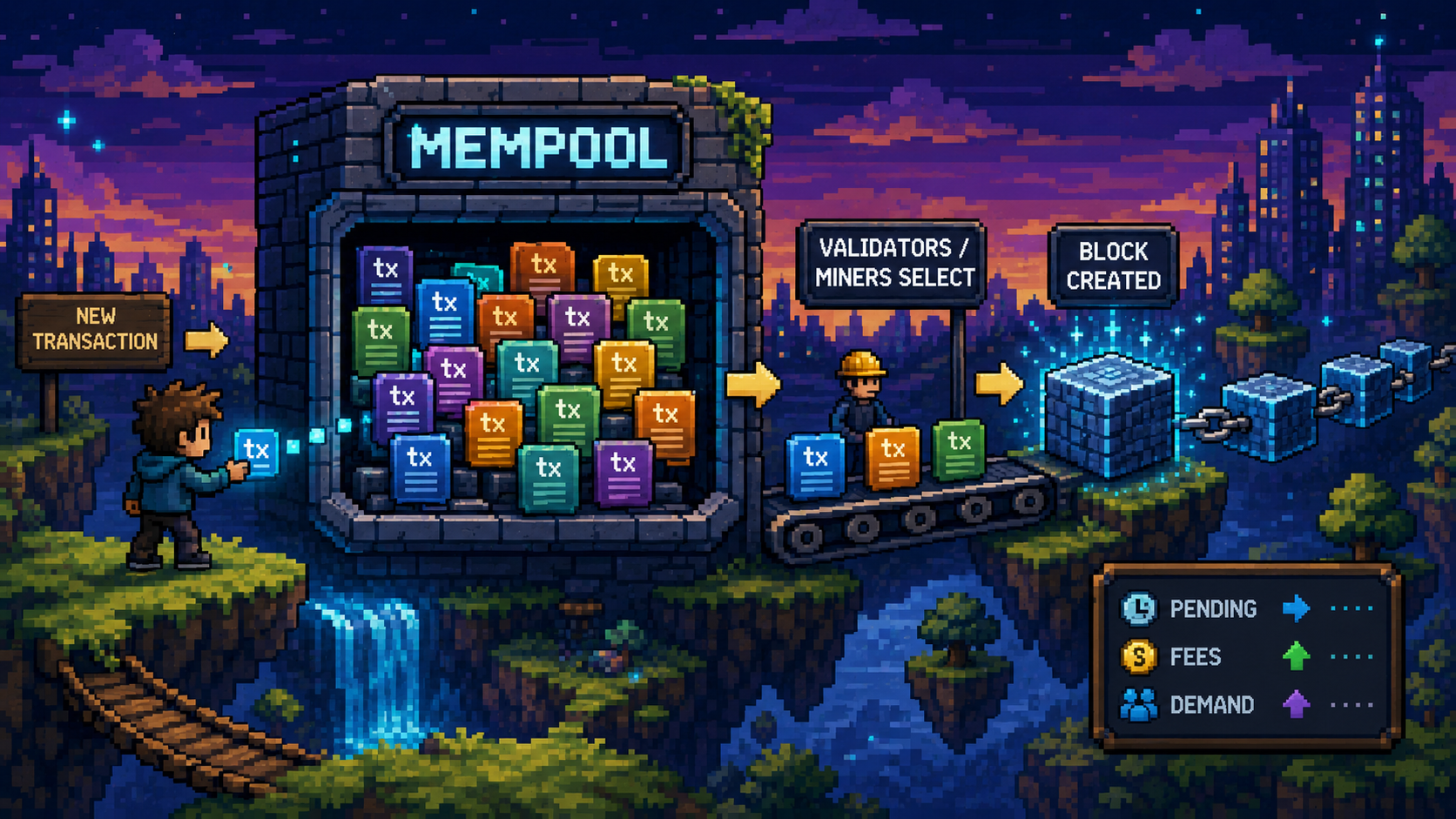
A mempool, short for “memory pool,” is a temporary collection of valid transactions that have been broadcast to a blockchain network but have not yet been included in a block. It acts as a waiting area where transactions compete for limited block space.
Understanding how mempools work helps explain why some transactions confirm almost instantly while others take longer, why network fees can suddenly rise, and why a transaction may occasionally appear to be stuck.
What Is a Transaction Mempool?
A transaction mempool is a temporary storage area maintained by blockchain nodes for transactions that have been received and validated but not yet confirmed on the blockchain.
When you create and broadcast a transaction, participating nodes check whether it follows the network's rules. Depending on the blockchain, these checks can include verifying digital signatures, ensuring the sender has sufficient funds, confirming that inputs have not already been spent, and checking that the transaction is correctly formatted.
If the transaction passes the necessary checks, a node may add it to its local mempool.
From there, miners or validators can select transactions for inclusion in future blocks.
The important word here is local. A blockchain does not necessarily have one single universal mempool shared identically by every participant. Individual nodes maintain their own transaction pools, and those pools can differ slightly because transactions propagate across the network over time and nodes may use different configuration or resource limits.
The Journey of a Blockchain Transaction
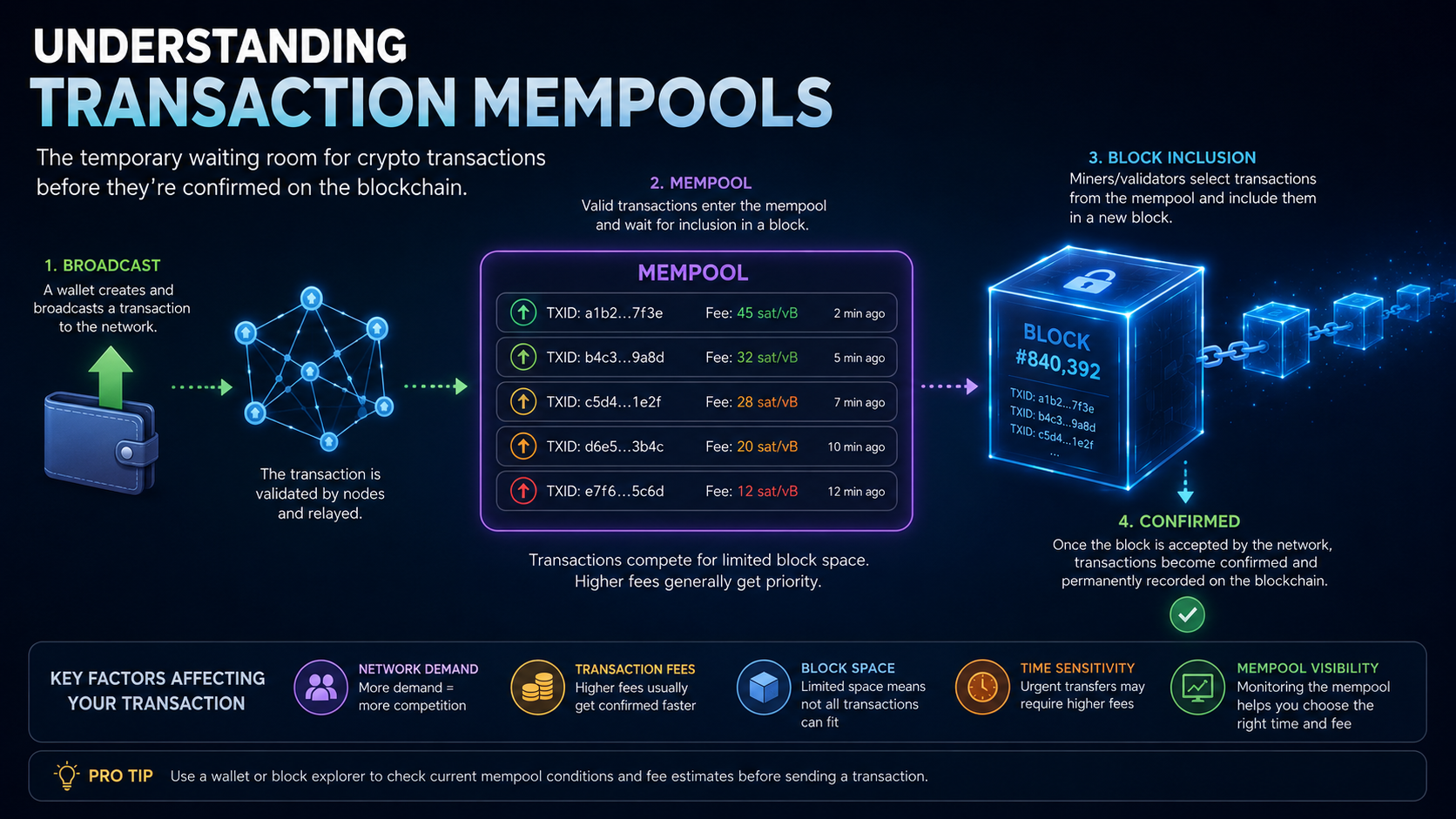
A typical transaction goes through several stages before it becomes part of the blockchain.
First, a wallet constructs the transaction. The user specifies details such as the destination, amount, and, on networks where applicable, the transaction fee.
The transaction is then digitally signed using the appropriate private key. This signature proves that the transaction was authorized without revealing the private key itself.
Next, the wallet broadcasts the signed transaction to one or more nodes on the network.
Those nodes validate the transaction. If it is considered valid and meets their policies, they can place it in their mempools and relay it to other nodes.
The transaction then waits for a miner, validator, block producer, or other relevant network participant to include it in a block.
Once the block containing the transaction is accepted by the network, the transaction becomes confirmed.
The mempool therefore sits between broadcasting and confirmation.
Why Do Transactions Need to Wait?
Blockchains generally have limited transaction capacity.
A block can only contain a certain amount of data, computation, or transactions, depending on the network's design. At the same time, users may be broadcasting thousands of transactions competing for that capacity.
If incoming demand is lower than the available capacity, transactions can move through the mempool quickly.
When demand becomes greater than the network can immediately process, a backlog develops.
Imagine a train station where hundreds of passengers are waiting but each train has a limited number of seats. If passengers arrive faster than trains can carry them away, the station becomes increasingly crowded.
A busy mempool works in a similar way.
How Transaction Fees Affect the Mempool
On many blockchain networks, transaction fees influence which transactions receive priority.
Bitcoin provides a well-known example. Miners have an economic incentive to construct blocks using transactions that generate attractive fees relative to the amount of block space they consume.
This means that during periods of congestion, users offering higher competitive fee rates may receive confirmation before transactions offering lower rates.
A transaction with a low fee is not necessarily invalid. It may simply remain unconfirmed because other transactions are more attractive to miners.
As demand for block space increases, users may compete by increasing their fees. This creates what is often called a fee market.
The mempool consequently provides a useful indication of current demand for blockchain capacity.
Transaction Size Matters Too
A common misconception is that transaction priority is determined entirely by the absolute amount of the fee.
On networks such as Bitcoin, the relationship between the fee and transaction size is particularly important.
A transaction that pays a relatively large total fee may still be less attractive than another transaction if it consumes considerably more block space.
This is why Bitcoin fees are commonly discussed using a fee rate measured in satoshis per virtual byte, or sat/vB.
For example, two transactions might both pay the same total fee, but if one requires half as much block space, its fee rate will be higher.
Wallet software typically estimates appropriate fee rates based on current network conditions and the user's desired confirmation speed.
What Happens When the Mempool Becomes Congested?
During periods of heavy blockchain activity, the number of unconfirmed transactions can increase substantially.
This can happen during major market movements, token launches, NFT activity, sudden increases in trading, popular applications attracting large numbers of users, or other events that generate significant transaction demand.
As the mempool grows, several things may happen.
Average confirmation times can increase. Competitive transaction fees may rise. Wallets may recommend higher fees, and transactions submitted with unusually low fees may remain pending for longer than expected.
Congestion does not necessarily mean that the blockchain has stopped working. In many cases, it simply means that demand for block space temporarily exceeds available capacity.
Why Can a Transaction Get Stuck?
A transaction may appear “stuck” when it remains in mempools for a long time without being confirmed.
One common reason is that the transaction fee was too low relative to current network demand.
Suppose a user broadcasts a transaction when recommended fees are relatively low. Shortly afterward, network activity increases sharply and users begin paying substantially higher fees.
Miners may repeatedly select those higher-paying transactions, leaving the original transaction waiting.
Depending on the blockchain and wallet being used, there may be mechanisms for dealing with this situation.
Bitcoin, for example, supports techniques such as Replace-by-Fee (RBF), where an eligible unconfirmed transaction can be replaced with another version offering a higher fee.
Another technique is Child Pays for Parent (CPFP). In this situation, a new transaction spends an output from an unconfirmed transaction while offering a sufficiently attractive fee. A miner may then have an incentive to confirm both transactions together.
Support for these methods depends on the transaction, wallet, node policies, and network.
Can Transactions Disappear From a Mempool?
Yes.
Being accepted into a mempool does not guarantee that a transaction will eventually appear on the blockchain.
Nodes have limited resources and establish policies governing how long transactions remain in their mempools. Transactions may eventually be removed if they remain unconfirmed for too long, conflict with another accepted transaction, fall below changing policy requirements, or need to be discarded because a node's mempool has reached its configured capacity.
Because nodes maintain their own mempools, one node may remove a transaction while another continues storing it.
A transaction disappearing from a particular node's mempool also does not automatically mean that the funds have been lost. If the transaction was never confirmed, the blockchain's confirmed state ultimately determines which funds remain spendable.
Mempools Are Not Identical Across Every Blockchain
The term “mempool” is commonly associated with Bitcoin, but many blockchain systems have some form of temporary storage for pending transactions.
However, the exact mechanism can vary significantly.
Ethereum, for example, also has pending transaction pools, but its account-based architecture and fee system create different transaction-selection dynamics from Bitcoin's UTXO-based model.
Other blockchain architectures may handle pending transactions differently or use terminology such as transaction pool, pending pool, or transaction queue.
Some networks are designed around architectures where the traditional Bitcoin-style concept of a mempool is less central or operates very differently.
For this reason, it is better to understand a mempool as a general concept rather than assume that every blockchain implements one in exactly the same way.
The Mempool and Blockchain Transparency
Public mempool data can provide interesting insights into network activity.
Blockchain explorers and specialized monitoring services can show information such as the number of pending transactions, estimated transaction fees, backlog size, transaction fee distribution, and recent changes in network demand.
This information can help users decide whether to send a transaction immediately or wait for congestion to decrease.
It can also provide researchers and analysts with a near-real-time view of transaction demand before transactions are permanently recorded in blocks.
However, mempool information should not be treated as a perfect representation of the entire network because individual nodes may observe different sets of pending transactions.
Mempools and Privacy
Public transaction propagation also has privacy implications.
Before transactions are confirmed, they are broadcast across a peer-to-peer network. Researchers and sophisticated observers may analyze how transactions propagate between nodes in an attempt to learn information about their possible origins.
Privacy-focused techniques and network-layer protections can make this type of analysis more difficult, but mempool activity is an important reminder that blockchain privacy involves more than simply what eventually appears in a block.
The way a transaction reaches the network can matter too.
Mempools and Double-Spending
Mempools also play a role in how nodes handle conflicting transactions.
Imagine that two transactions attempt to spend the same funds.
Both cannot ultimately be valid in the confirmed blockchain state. Nodes use consensus rules and local transaction policies to determine how conflicting transactions are handled before confirmation.
This is one reason an unconfirmed transaction should not always be treated as equivalent to a confirmed transaction.
For low-risk situations, businesses may sometimes choose to recognize unconfirmed transactions, but doing so involves different security assumptions than waiting for blockchain confirmation.
What Mempools Tell Us About Blockchain Scalability
Mempools provide a visible demonstration of one of the fundamental challenges facing blockchain systems: limited capacity.
When transaction demand exceeds the rate at which a network can process transactions, something has to determine which transactions receive scarce resources.
On some networks, fees become the primary mechanism.
Other systems attempt to increase capacity through larger or more frequent blocks, alternative consensus architectures, Layer 2 networks, rollups, payment channels, parallel execution, or other scaling technologies.
A growing mempool is therefore more than a collection of delayed transactions. It can reveal the relationship between network demand, available capacity, and the economic mechanisms used to allocate blockchain resources.
Should You Check the Mempool Before Sending Crypto?
For networks where transaction fees fluctuate significantly, checking current network conditions can be useful before sending a transaction.
If the transfer is not urgent, waiting for a quieter period may reduce the required fee. If confirmation speed matters, current mempool conditions can help determine whether a wallet's suggested fee is appropriate.
Modern wallets often perform this analysis automatically by estimating fees based on recent blocks and pending transactions.
Even so, understanding what happens behind the scenes makes those fee options much easier to interpret.
Choosing between options such as “slow,” “normal,” and “fast” often means choosing how competitively your transaction will be positioned against other transactions waiting for limited block space.
The Mempool Is the Blockchain's Waiting Room
The mempool is one of the less visible but essential parts of how many blockchain networks operate.
It connects the moment a transaction is broadcast with the moment that transaction becomes part of the blockchain. While a transaction waits there, it competes with other transactions for limited network capacity.
Understanding this process explains many everyday crypto experiences: fluctuating fees, pending transactions, confirmation delays, fee estimation, and network congestion.
The next time a wallet displays “Pending” instead of “Confirmed,” the transaction has not necessarily gone wrong. It may simply be waiting in the network's transaction queue for its opportunity to be included in a block.


Pick your reaction
Post your comment