
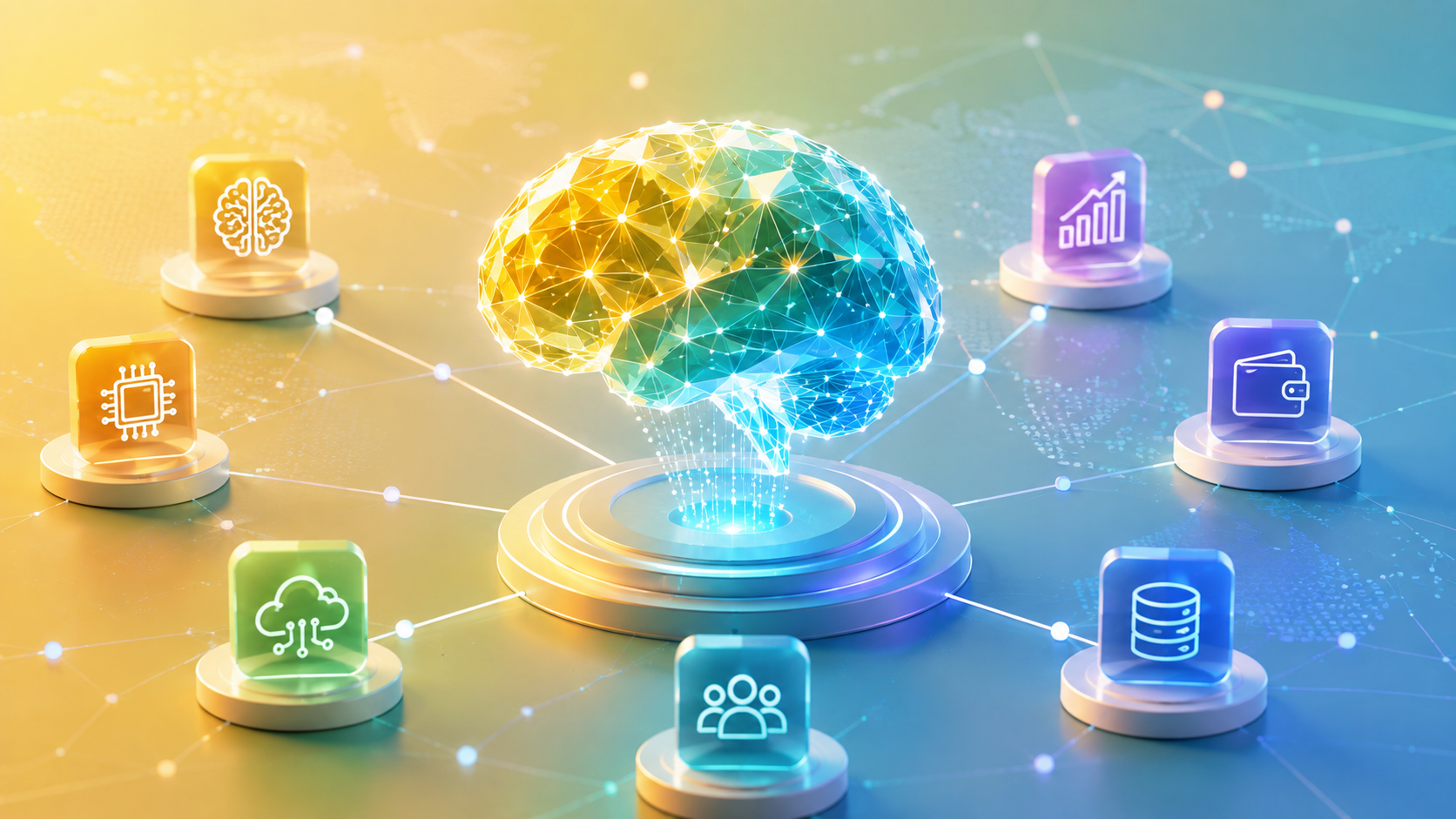
Artificial intelligence and blockchain are two of the most discussed technologies of the past decade, and increasingly, projects are attempting to combine them. This has led to the growth of so-called AI crypto tokens: digital assets connected to platforms, networks, applications, and services that use artificial intelligence in some way.
But the label "AI token" can be misleading. A token does not become intelligent simply because it is associated with AI. In most cases, the token provides access, incentives, governance, payments, or coordination within a blockchain-based ecosystem where AI performs a separate function.
Understanding what these tokens actually do is therefore more useful than simply looking at which cryptocurrencies are categorized as "AI."
What Is an AI Crypto Token?
An AI crypto token is a cryptocurrency or blockchain-based digital token associated with a project that integrates artificial intelligence into its products, infrastructure, or services.
There is no single technical standard that defines an AI token. Two projects described as AI crypto projects may operate in completely different ways.
One project might create a decentralized marketplace where developers can buy access to AI models. Another might allow people to contribute computing resources for AI workloads. Others may use blockchain tokens to coordinate autonomous AI agents, reward data providers, govern AI infrastructure, or pay for machine learning services.
The important distinction is that the blockchain and AI components usually perform different jobs.
Blockchain can provide mechanisms for payments, ownership, incentives, governance, and transparent transactions. AI can provide capabilities such as prediction, language processing, image generation, automation, optimization, or autonomous decision-making.
The token often connects these different parts of the ecosystem.
Why Combine AI With Blockchain?
AI systems require resources. Depending on the application, those resources can include computing power, data, models, storage, APIs, and human contributions.
Traditionally, these resources are provided through centralized companies and cloud platforms. Blockchain projects explore whether some of them can instead be coordinated through open networks.
A blockchain can provide a shared economic layer where participants exchange value without every transaction being managed by one central operator.
For example, a network could allow someone with unused computing hardware to provide processing power to an AI application. The application pays for that resource using the network's token.
Another network could allow developers to publish AI models that other users can access for a fee. Blockchain transactions could record payments and distribute rewards to the model providers.
In this sense, crypto tokens can function as economic coordination tools for decentralized AI infrastructure.
Paying for AI Services
One of the simplest uses of an AI token is payment.
A platform might require users to spend its token when accessing AI models, requesting predictions, running inference, purchasing datasets, or using other services.
Imagine a decentralized marketplace containing hundreds of specialized AI models. A user could request a translation, image analysis, market prediction, or another AI service and pay the provider directly through the platform.
Tokens can provide a common payment mechanism across the network.
However, requiring a proprietary token is not automatically beneficial. If a platform could perform exactly the same function using conventional payments or established cryptocurrencies, it is reasonable to ask why another token is necessary.
Token utility matters.
Decentralized Computing for AI
Modern AI can require enormous amounts of computing power, particularly when training large models.
Most advanced AI infrastructure is currently concentrated among large technology companies and specialized cloud providers because high-performance GPUs and data center infrastructure are expensive.
Some crypto projects attempt to create decentralized computing marketplaces.
In these systems, individuals or businesses can contribute unused computing resources to a network. Customers that need processing power can rent those resources, while providers receive tokens as compensation.
This model is not limited to AI, but growing demand for AI computing has made decentralized GPU and compute networks particularly relevant.
If these networks can operate efficiently, they could provide an alternative marketplace for accessing expensive computational resources.
AI Model Marketplaces
AI models themselves can also become digital services traded through blockchain-based marketplaces.
Developers might publish machine learning models to a decentralized network and allow others to access them.
A model could specialize in tasks such as:
- Text analysis
- Image recognition
- Translation
- Financial forecasting
- Scientific research
- Recommendation systems
- Fraud detection
- Data classification
Users pay for access, while developers receive compensation when their models are used.
Blockchain can provide the payment and ownership infrastructure surrounding these interactions, while the actual AI computations may happen on-chain, off-chain, or through specialized infrastructure.
AI Agents and Machine-to-Machine Payments
One of the more experimental areas combining AI and crypto involves autonomous AI agents.
An AI agent is software capable of performing tasks with varying degrees of independence. Depending on its design, an agent might search for information, interact with applications, execute workflows, purchase services, manage resources, or communicate with other agents.
Blockchain-based assets can potentially give these agents a way to transact economically.
For example, an AI agent might have its own blockchain wallet. It could receive cryptocurrency, pay for API access, purchase computing resources, or compensate another agent for completing a task.
This creates the possibility of machine-to-machine economies in which software can exchange services without requiring a human to manually approve every individual transaction.
The technology is still developing, but autonomous agents are one of the areas where the combination of programmable money and AI could become particularly significant.
Decentralized Data Marketplaces
AI systems depend heavily on data.
Training useful machine learning models often requires large datasets, but collecting high-quality data can be expensive and complicated. There are also questions surrounding ownership, licensing, privacy, and compensation.
Blockchain projects have experimented with decentralized data marketplaces where individuals and organizations can make datasets available under defined conditions.
Tokens can be used to reward participants who contribute valuable data.
In theory, this could create markets where data providers receive compensation when their information contributes to AI applications.
In practice, however, blockchain does not automatically solve problems involving data quality, privacy, consent, or legality. These challenges still require careful technical and organizational solutions.
Incentivizing Network Participation
Tokens can also be used to encourage people to contribute resources to an AI network.
Participants might receive tokens for providing:
- Computing power
- Storage
- Training data
- AI models
- Model evaluation
- Human feedback
- Network validation
- Specialized knowledge
This is similar to how cryptocurrencies have historically used economic incentives to encourage people to provide resources required by decentralized networks.
The difference is that AI-focused projects may be attempting to coordinate a much broader range of resources.
Governance
Some AI crypto tokens function as governance tokens.
Token holders may be able to vote on decisions affecting a decentralized protocol or organization. These decisions could involve network parameters, treasury spending, development priorities, incentive structures, supported services, or protocol upgrades.
The idea is to distribute at least some control over the network among its participants.
Governance tokens, however, do not guarantee meaningful decentralization. If a small number of wallets control most of the voting power, decision-making can remain highly concentrated.
Users should therefore look beyond the existence of governance features and examine how token distribution and voting actually work.
Ownership and Provenance
Generative AI has created new questions about digital ownership and the origin of online content.
Blockchain can potentially help create verifiable records showing when certain digital assets, models, datasets, or credentials were registered or transferred.
For example, blockchain systems could record information related to AI-generated content, licensing rights, model ownership, or dataset provenance.
This does not prove that every piece of recorded information is truthful. Blockchain can preserve records, but it cannot independently verify whether incorrect information was entered in the first place.
Still, transparent and difficult-to-alter records may become useful components of broader systems for tracking digital provenance.
Are AI Tokens Running Artificial Intelligence on the Blockchain?
Usually not.
Running sophisticated AI models directly on conventional blockchains would often be extremely inefficient because AI computations can require enormous amounts of processing power.
Instead, many projects use hybrid architectures.
The blockchain handles functions such as payments, ownership, staking, governance, identity, or transaction settlement. The computationally intensive AI workloads happen elsewhere.
Those computations might take place on decentralized compute networks, specialized nodes, traditional servers, or other off-chain infrastructure.
This distinction is important when evaluating AI crypto projects. A project can legitimately combine AI and blockchain without actually executing its AI model on-chain.
The "AI" Label Can Also Be Marketing
The popularity of artificial intelligence has inevitably attracted speculative projects.
Adding "AI" to a cryptocurrency's branding does not mean that artificial intelligence is essential to the project.
Some tokens may have genuine technical integrations, while others may have only a weak connection to AI. In extreme cases, AI terminology can simply be used to attract attention during periods when AI-related investments are popular.
Before evaluating an AI crypto token, it helps to ask several basic questions:
- What does the AI component actually do?
- Why does the project need blockchain?
- Why does the ecosystem need its own token?
- Who actually uses the product?
- Where does demand for the token come from?
- Is the technology operational or mainly described in a roadmap?
- Who controls the network and token supply?
- Could the same service work without cryptocurrency?
These questions can quickly separate practical utility from marketing language.
Utility Does Not Automatically Mean Value
Another important distinction is the difference between a useful network and a valuable token.
A project might build a genuinely useful AI product without its token necessarily becoming a good investment.
Token prices are influenced by many factors, including supply, emissions, liquidity, speculation, market sentiment, competition, and the way value flows through the network.
For example, a decentralized compute platform might experience increasing usage while its token still faces substantial inflation from rewards distributed to hardware providers.
Similarly, users might be able to access a platform without holding the token for long periods, limiting the relationship between network adoption and token demand.
Understanding the product is therefore only one part of evaluating a crypto asset.
Examples of AI Crypto Use Cases
The AI crypto sector covers a surprisingly broad range of applications. Instead of treating every project as part of one category, it is more useful to think about the specific problem each network is attempting to solve.
Some of the most common categories include decentralized GPU marketplaces, AI model marketplaces, data networks, autonomous agent infrastructure, machine-to-machine payment systems, prediction networks, decentralized AI training, AI-powered blockchain applications, and governance systems for shared AI resources.
Different projects can overlap across several of these categories.
As the industry develops, entirely new use cases may also emerge.
What Could AI and Crypto Look Like in the Future?
AI is increasingly capable of performing tasks independently, while blockchain provides infrastructure for transferring digital assets without relying on traditional payment systems.
Combining these capabilities creates interesting possibilities.
Future AI agents could potentially own wallets, purchase computing resources, subscribe to datasets, hire other agents, sell digital services, and automatically distribute revenue.
Decentralized networks could also allow thousands of independent participants to contribute computing resources, models, and data to shared AI infrastructure.
Whether these systems can compete with centralized AI platforms will depend on factors such as cost, speed, reliability, usability, regulation, and technical scalability.
The technology alone does not guarantee that decentralization will be the better solution.
The Bottom Line
AI crypto tokens are not cryptocurrencies that somehow "contain artificial intelligence." They are generally economic tools used within blockchain ecosystems that incorporate AI technologies or provide infrastructure for AI applications.
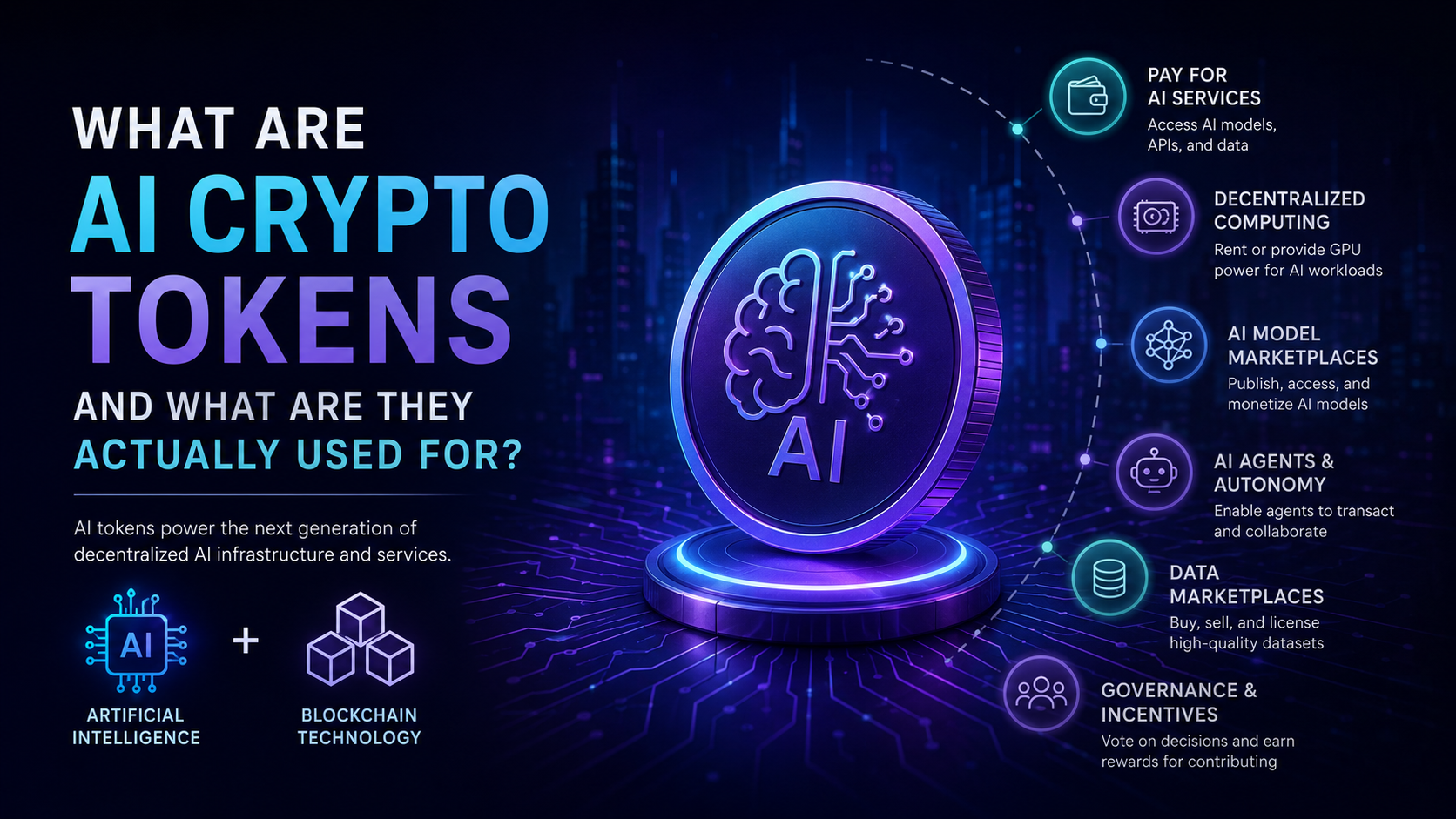
Their real-world functions can include paying for AI services, rewarding compute providers, accessing models, purchasing data, coordinating autonomous agents, participating in governance, and incentivizing contributions to decentralized networks.
Some of these applications could become important parts of the emerging AI economy. Others may struggle to justify why they need blockchain or a dedicated cryptocurrency at all.
For anyone researching an AI token, the most useful question is therefore not simply, "Does this project use AI?"
It is: What does the token actually do, and would the system still make sense without it?
That question cuts through much of the hype and gets directly to the utility behind the project.
Pick your reaction
Post your comment