

Blockchain technology enables decentralized applications to operate without relying on central authorities. However, blockchains have one important limitation: they cannot directly access information from the outside world. This is where blockchain oracles come in.
They act as bridges between blockchains and external data sources, making many of today's decentralized applications possible.
Understanding Blockchain Oracles
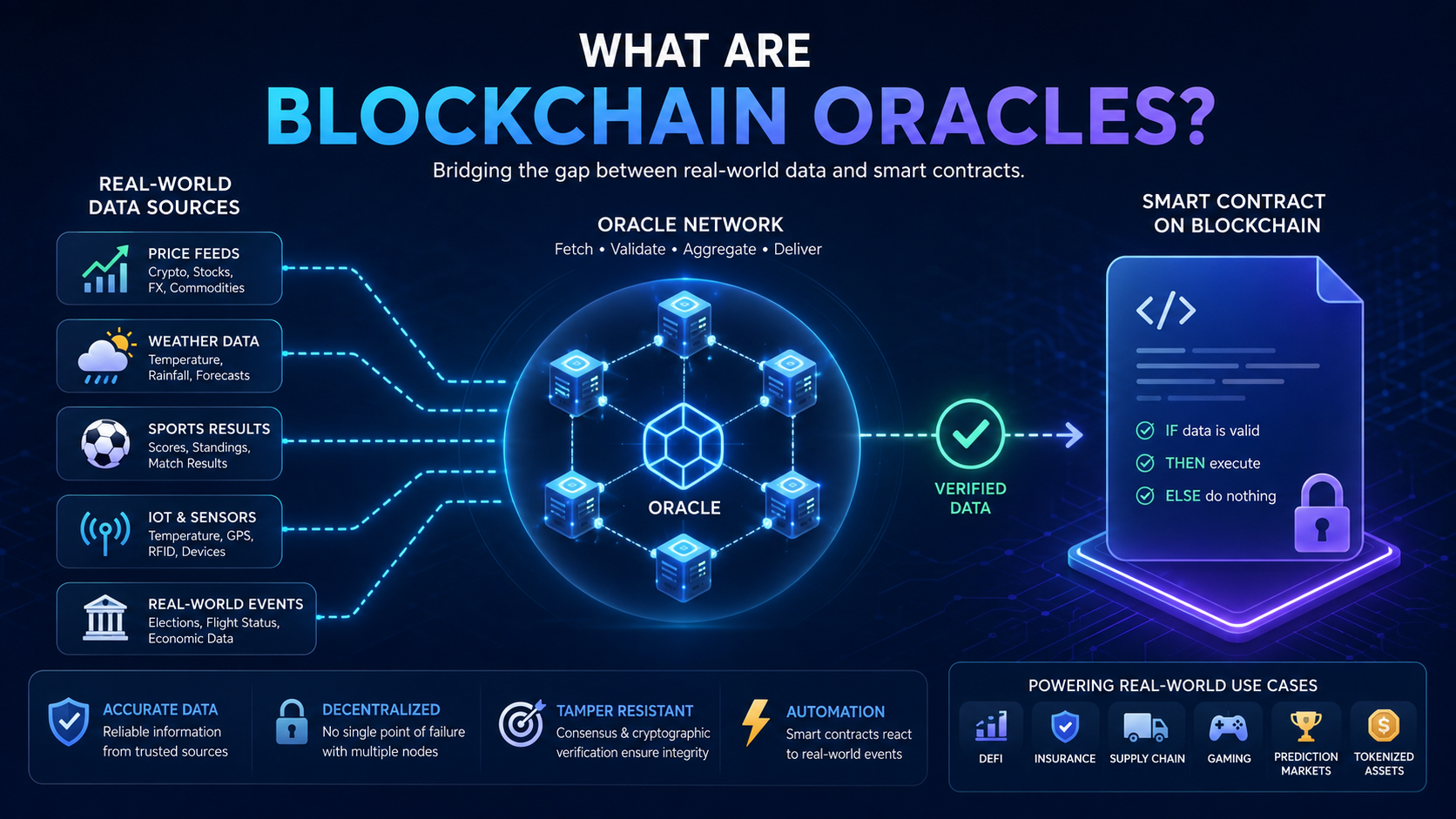
A blockchain oracle is a service that provides external data to smart contracts. Smart contracts are self-executing programs stored on a blockchain, but they can only access data that already exists on that blockchain. They cannot browse websites, check weather reports, retrieve stock prices, or verify sports results on their own.
Blockchain oracles solve this problem by securely collecting information from external sources and delivering it to smart contracts. This allows decentralized applications (dApps) to react to real-world events while maintaining the automation and transparency that blockchain technology provides.
Without oracles, smart contracts would be limited to blockchain-only information, making many practical use cases impossible.
Why Can't Blockchains Access the Internet Directly?
The inability to access external information is a deliberate design choice.
Every node on a blockchain must independently verify every transaction. If smart contracts could freely access websites or APIs, different nodes might receive different responses, causing disagreements about the blockchain's state.
Instead, blockchain networks rely on specialized oracle systems that gather external information, verify it, and submit it to the blockchain in a consistent way.
This preserves the blockchain's consensus while still allowing smart contracts to interact with the real world.
How Blockchain Oracles Work
Although implementations vary, the general process follows several steps:
- A smart contract requests specific external information.
- An oracle network receives the request.
- The oracle retrieves data from one or more trusted sources.
- Multiple oracle nodes may compare and verify the information.
- The verified result is submitted to the blockchain.
- The smart contract automatically executes based on the received data.
For example, a decentralized insurance application could automatically pay compensation when an oracle confirms that a flight has been delayed by more than four hours.
Types of Blockchain Oracles
There are several kinds of blockchain oracles, each designed for different situations.
Software Oracles
Software oracles retrieve digital information from online sources.
Examples include:
- Cryptocurrency prices
- Foreign exchange rates
- Stock market data
- Sports scores
- Election results
- Weather forecasts
- Traffic information
These are the most common type of oracle used in decentralized finance (DeFi).
Hardware Oracles
Hardware oracles collect information from physical devices and sensors.
Examples include:
- Temperature sensors
- RFID scanners
- GPS devices
- Smart locks
- Manufacturing equipment
- IoT sensors
These oracles help connect blockchain technology with real-world infrastructure.
Inbound Oracles
Inbound oracles deliver information from outside the blockchain into smart contracts.
Examples include:
- Asset prices
- Weather conditions
- Flight status
- Election outcomes
- Identity verification
Most oracle services fall into this category.
Outbound Oracles
Outbound oracles allow smart contracts to trigger actions outside the blockchain.
Examples include:
- Unlocking a hotel room
- Opening a warehouse door
- Sending payment instructions
- Activating industrial equipment
- Triggering IoT devices
They enable blockchain applications to interact with physical systems.
Centralized Oracles
A centralized oracle is operated by a single organization.
Advantages include:
- Simple architecture
- Fast updates
- Easy maintenance
However, they introduce a single point of failure. If the oracle provides incorrect data or becomes unavailable, smart contracts relying on it may behave incorrectly.
Decentralized Oracles
Decentralized oracles use multiple independent data providers and validation mechanisms.
Instead of trusting one organization, they aggregate information from numerous sources and often use consensus to determine the correct result.
This significantly improves reliability and reduces the risk of manipulation.
Common Oracle Use Cases
Blockchain oracles support a wide range of industries.
Decentralized Finance (DeFi)
DeFi protocols rely heavily on accurate price feeds.
Oracles provide:
- Cryptocurrency prices
- Exchange rates
- Interest rates
- Liquidity information
Without reliable oracles, lending platforms, decentralized exchanges, and derivatives markets could not function safely.
Insurance
Insurance smart contracts can automatically verify external events.
Examples include:
- Flight delays
- Extreme weather
- Natural disasters
- Crop conditions
Once verified by an oracle, claims can be processed automatically without manual intervention.
Supply Chain Management
Oracles can track goods throughout global supply chains by reporting:
- GPS locations
- Storage temperatures
- Delivery confirmations
- Customs updates
This increases transparency and helps automate logistics.
Gaming
Blockchain games use oracles for:
- Random number generation
- Tournament results
- Esports statistics
- External achievements
This enables more dynamic gameplay and reward systems.
Prediction Markets
Prediction platforms depend on trustworthy event outcomes.
Oracles can confirm:
- Election results
- Sports winners
- Economic reports
- Financial indicators
Once verified, smart contracts distribute rewards automatically.
Tokenized Real-World Assets
Assets like real estate, commodities, or bonds often require external information.
Oracles can provide:
- Property valuations
- Commodity prices
- Interest rates
- Market indices
This helps keep tokenized assets aligned with real-world values.
The Oracle Problem
One of the biggest challenges in blockchain is known as the Oracle Problem.
Even if a blockchain itself is highly secure, it still depends on the accuracy of external information.
If incorrect data enters the blockchain, the smart contract may execute exactly as programmed—but based on false information.
For example:
- An incorrect cryptocurrency price could trigger unnecessary liquidations.
- False weather data could cause invalid insurance payouts.
- Incorrect sports results could distribute rewards to the wrong users.
Because of this, securing oracle systems is just as important as securing the blockchain itself.
How Decentralized Oracles Improve Security
Modern oracle networks reduce risk through several techniques.
Multiple Data Sources
Instead of relying on one API, oracle networks collect information from many providers.
Multiple Oracle Nodes
Independent operators retrieve and verify data separately.
Consensus Mechanisms
The final result is often calculated using majority agreement or weighted averages.
Economic Incentives
Many oracle networks reward honest behavior while penalizing malicious or inaccurate reporting.
These mechanisms make manipulation significantly more difficult.
Popular Blockchain Oracle Networks
Several projects specialize in decentralized oracle infrastructure.
Some of the best-known include:
- Chainlink
- Pyth Network
- Band Protocol
- API3
- RedStone
- UMA Oracle
- Chronicle Protocol
- Supra
Each focuses on different blockchain ecosystems, data types, and performance characteristics.
Challenges Facing Blockchain Oracles
Although oracle technology has advanced considerably, challenges remain.
These include:
- Data accuracy
- Source reliability
- Latency
- Network outages
- Cost of updates
- Cross-chain compatibility
- Resistance to manipulation
Developers continue improving oracle designs to make decentralized applications more secure and efficient.
The Future of Blockchain Oracles
As blockchain adoption grows, oracle technology will become increasingly important.
Emerging areas include:
- Artificial intelligence integration
- Machine-to-machine communication
- Autonomous vehicles
- Smart cities
- Internet of Things (IoT)
- Cross-chain interoperability
- Real-world asset tokenization
Future oracle networks are expected to become faster, more decentralized, and capable of supporting increasingly complex decentralized applications.
Conclusion
Blockchain oracles connect decentralized networks with the real world. By securely delivering external information to smart contracts, they enable applications that would otherwise be impossible, from decentralized finance and insurance to gaming, supply chain management, and tokenized assets.
While they introduce unique security challenges, modern decentralized oracle networks have made significant progress in improving reliability through distributed data sources, consensus mechanisms, and economic incentives. As blockchain technology continues to expand into new industries, oracles will remain a critical piece of the infrastructure that allows smart contracts to interact with real-world events and data.



Pick your reaction
Post your comment