

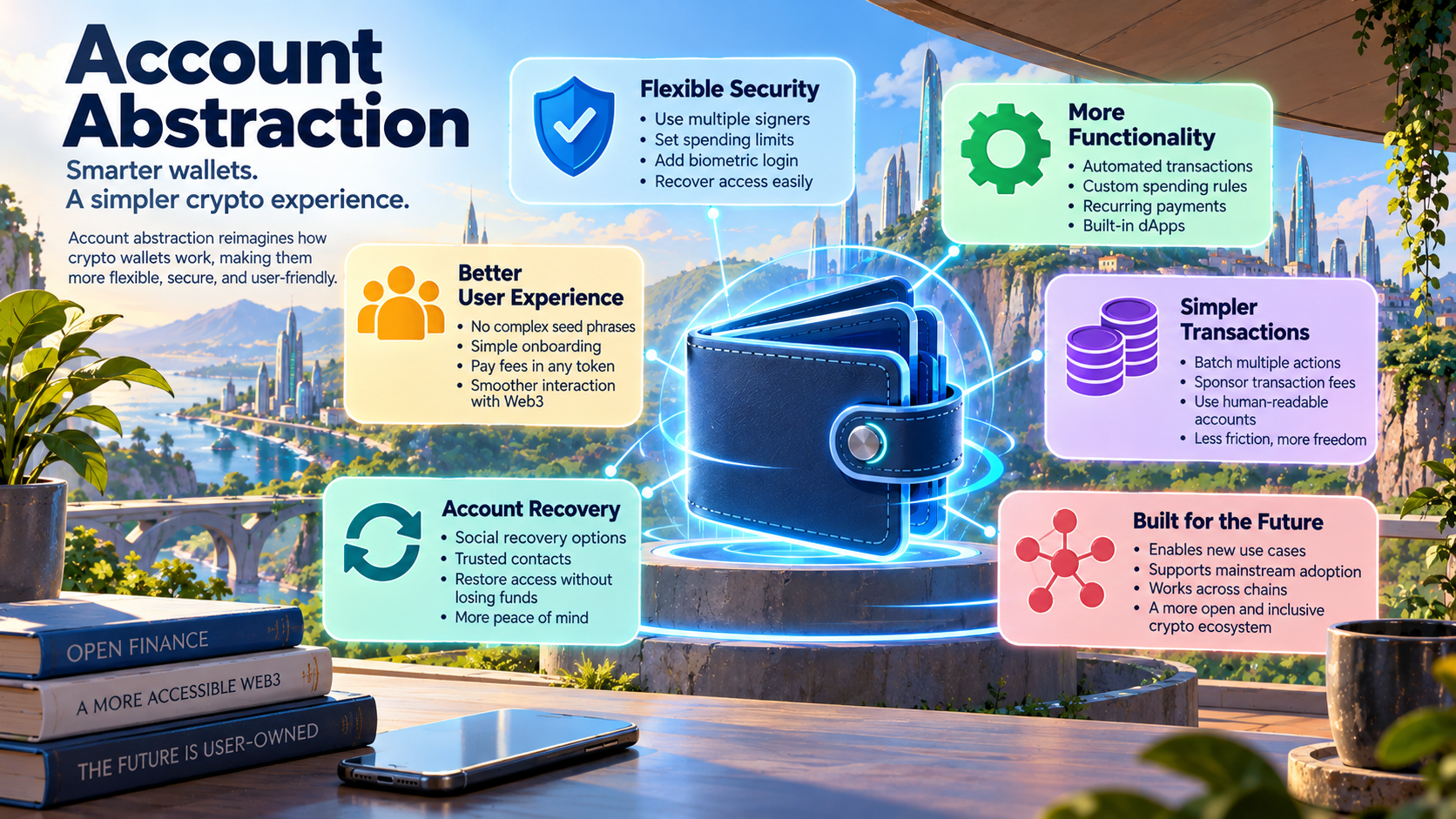
Managing cryptocurrency has traditionally required users to protect private keys, store recovery phrases, and pay transaction fees using a blockchain's native token. While these requirements support decentralization and self-custody, they can also make cryptocurrency difficult to use, especially for newcomers. Account abstraction offers a different approach by making blockchain accounts more flexible, programmable, and user-friendly.
Through smart contract functionality, account abstraction allows wallets to support features such as alternative authentication methods, account recovery, automated transactions, and flexible fee payments. These improvements could make interacting with decentralized applications (dApps) feel more like using familiar digital services without necessarily sacrificing control over digital assets.
What Is Account Abstraction?
Account abstraction (AA) is a blockchain technology concept that separates how an account is controlled from the traditional rules governing transaction authorization.
On Ethereum, standard user accounts have historically relied on private keys to authorize transactions. Account abstraction makes it possible to use programmable logic to determine how transactions are approved, executed, and paid for.
Instead of relying exclusively on a single private key, a wallet can support additional security measures, multiple authorization methods, and customizable transaction rules.
For example, an account abstraction wallet might allow users to recover access through trusted contacts, approve transactions using a passkey, or set daily spending limits.
The goal is not to eliminate cryptography or private keys entirely. Rather, it is to make account management more adaptable while reducing the complexity users experience when interacting with blockchain technology.
Account abstraction is especially associated with Ethereum and Ethereum-compatible networks, where smart contracts provide the foundation for programmable accounts.
Understanding Traditional Blockchain Accounts
To understand account abstraction, it helps to examine how Ethereum accounts traditionally work.
Ethereum distinguishes between two main types of accounts.
Externally Owned Accounts (EOAs)
Externally Owned Accounts are controlled by private keys. Most traditional Ethereum wallets use this account model.
With an EOA, users typically need to:
- Secure the private key or recovery phrase associated with their wallet.
- Sign transactions using that private key.
- Hold ETH to cover transaction fees on Ethereum.
- Manually approve certain interactions with smart contracts.
- Accept that losing access to their private key may mean permanently losing access to their assets.
This model is relatively simple and provides direct control over funds, but its limited flexibility creates challenges.
A single compromised private key can give an attacker extensive control over an account. Similarly, losing the key without a backup may leave the owner unable to access their cryptocurrency.
Smart Contract Accounts
Smart contract accounts are controlled by code deployed on the blockchain rather than directly by a private key.
The code defines which actions are permitted and under what conditions.
For example, a smart contract wallet might require two separate approvals before transferring a large amount of cryptocurrency.
Another wallet might permit smaller transactions automatically while requiring stronger authentication for larger transfers.
Smart contract accounts can implement more sophisticated security and authorization features than traditional EOAs.
However, standard Ethereum transaction processing historically depended on EOAs to initiate transactions. Account abstraction technologies help overcome this limitation by introducing additional ways to authorize and execute operations.
How Does Account Abstraction Work?
Account abstraction introduces programmable transaction validation and execution, allowing developers to customize wallet behavior.
One of the most important implementations is ERC-4337, a standard that enables smart contract wallets without requiring changes to Ethereum's underlying consensus protocol.
ERC-4337 introduces several components that work together to process user operations.
1. Smart Contract Wallets
Instead of relying solely on a traditional EOA, users interact with a programmable smart contract wallet.
The wallet contains rules that determine how transactions can be authorized.
These rules might support multiple signatures, spending limits, recovery mechanisms, or alternative authentication methods.
2. UserOperations
ERC-4337 introduces objects called UserOperations.
A UserOperation describes an action that a user wants their smart account to perform.
Unlike a traditional Ethereum transaction, it can be validated according to the programmable rules of the user's smart contract wallet.
For example, a UserOperation might request a token transfer that requires authorization from a specific device or account.
3. Bundlers
Bundlers collect UserOperations, check their validity, and package them into regular blockchain transactions.
They submit these transactions to a special smart contract called the EntryPoint.
The blockchain ultimately processes the bundled operations through its normal transaction execution mechanisms.
4. EntryPoint Contract
The EntryPoint is a central component of the ERC-4337 architecture.
It coordinates the validation and execution of UserOperations, interacting with individual smart contract wallets to determine whether requested actions are authorized.
The EntryPoint also helps manage transaction fee payments.
5. Paymasters
Paymasters are optional smart contracts that can cover transaction fees on behalf of users.
For example, a decentralized application might sponsor its users' transaction fees to simplify onboarding.
Paymasters can also enable arrangements where users pay fees using supported tokens other than the blockchain's native asset.
The network still requires transaction fees to be settled in its native currency, but the user does not necessarily need to hold that currency directly.
Together, these components make it possible to create more flexible wallet experiences while retaining blockchain-based transaction verification.
Ethereum Improvement Proposals+2
The Main Benefits of Account Abstraction
Account abstraction introduces several capabilities that could make cryptocurrencies easier and safer to use.
Easier Account Recovery
One of the biggest challenges in cryptocurrency is recovering access to a wallet after losing a private key or recovery phrase.
Traditional non-custodial accounts generally cannot be recovered if their keys are permanently lost.
Smart contract wallets can provide alternative recovery mechanisms.
For example, social recovery allows users to designate trusted individuals, devices, or other entities as guardians.
If the primary authentication method becomes unavailable, the guardians can participate in a recovery process according to predefined rules.
This approach can reduce dependence on a single recovery phrase.
However, recovery features must be implemented carefully. Poorly configured guardians or compromised recovery mechanisms can introduce additional security risks.
Flexible Transaction Fees
Traditional Ethereum transactions normally require users to hold ETH to pay gas fees.
This can create an inconvenient situation for someone who holds tokens but does not have enough ETH to transfer or exchange them.
Account abstraction can simplify fee payments through paymasters and other supporting infrastructure.
Depending on the wallet and application, users may be able to pay transaction costs using supported tokens or have fees sponsored entirely.
For example, a blockchain game might cover transaction fees for new players during onboarding.
This could allow users to begin interacting with the game without first purchasing the network's native cryptocurrency.
Importantly, sponsored transactions are not truly free at the network level. Someone still pays the underlying transaction costs.
Transaction Batching
Many blockchain activities require multiple transactions.
For example, swapping tokens on a decentralized exchange may require one transaction to approve token spending and another to execute the swap.
With account abstraction, compatible wallets can combine multiple operations into a single transaction flow.
This can reduce the number of separate confirmations users must complete.
Batching can also enable atomic execution, where several related operations either succeed together or revert together.
Although batching may improve convenience and sometimes reduce costs, it does not guarantee lower transaction fees in every situation.
Customizable Security Rules
Account abstraction allows developers to implement security policies tailored to different users and applications.
Possible features include:
- Spending limits: Restrict how much cryptocurrency can be transferred during a given period.
- Multi-signature approvals: Require multiple authorized parties to approve transactions.
- Session keys: Allow temporary or restricted access for specific activities.
- Trusted addresses: Limit transfers to approved destinations.
- Time-based restrictions: Permit certain actions only under predefined conditions.
- Emergency controls: Provide mechanisms for restricting activity or updating compromised credentials.
These features can be particularly useful for businesses, decentralized organizations, and users managing significant digital assets.
Simpler Authentication
Traditional wallets rely heavily on cryptographic signatures and recovery phrases.
Account abstraction allows compatible smart wallets to support alternative authentication methods.
For example, a wallet might use a passkey associated with a user's smartphone or computer.
Depending on the implementation, users could authorize transactions through their device's existing authentication system rather than manually managing a conventional wallet key.
This can make crypto applications feel more familiar without necessarily transferring custody of funds to a centralized service.
However, the security and recovery properties depend on how the wallet and authentication system are implemented.
ERC-4337 and EIP-7702: Two Important Approaches
Although ERC-4337 is one of the best-known implementations, account abstraction is not limited to a single technical approach.
Two important Ethereum standards illustrate how the technology is developing.
ERC-4337: Smart Accounts Without Consensus Changes
ERC-4337 provides infrastructure for smart contract accounts through UserOperations, bundlers, and an EntryPoint contract.
Rather than requiring changes to Ethereum's underlying consensus rules, it operates through smart contracts and supporting transaction infrastructure.
This approach allows developers to create programmable accounts with advanced authorization and fee-payment capabilities.
ERC-4337 has also become an important foundation for account abstraction across Ethereum-compatible ecosystems.
EIP-7702: Bringing Smart Account Features to EOAs
EIP-7702 takes a different approach.
Introduced on Ethereum mainnet through the Pectra upgrade on May 7, 2025, EIP-7702 allows traditional EOAs to delegate execution to smart contract code.
This enables existing accounts to gain smart contract functionality without necessarily requiring users to transfer their assets to a newly deployed smart contract wallet.
Potential capabilities include transaction batching, sponsored transactions, and more restricted authorization permissions.
However, EIP-7702 does not automatically make every wallet a fully featured smart account. The capabilities available depend on the delegated contract and wallet implementation.
It also introduces security considerations because users must carefully evaluate which contracts they authorize to control their accounts.
ERC-4337 and EIP-7702 are complementary approaches rather than direct replacements for one another.
Ethereum Improvement Proposals+2
Real-World Applications of Account Abstraction
Account abstraction has potential applications across many areas of the blockchain ecosystem.
Decentralized Finance (DeFi)
DeFi platforms often involve complex interactions between wallets, tokens, and smart contracts.
Account abstraction can simplify these interactions through transaction batching and customizable permissions.
For example, a user might approve a token swap and execute it through a single wallet interaction.
Advanced accounts could also introduce spending restrictions or additional authentication requirements for high-value operations.
These capabilities can make DeFi applications more accessible while giving users more control over how their funds are managed.
Blockchain Gaming
Blockchain games frequently involve numerous transactions for acquiring, transferring, or using digital assets.
Requiring players to approve every individual action can interrupt gameplay.
Account abstraction can support session-based permissions that allow specified in-game actions without repeated manual confirmations.
Developers can also sponsor transaction fees, removing another obstacle for players who are unfamiliar with cryptocurrency.
Together, these features can help blockchain games provide smoother experiences.
NFT Platforms
NFT marketplaces and applications can benefit from simplified wallet interactions.
Instead of requiring separate approvals for every action, compatible wallets can combine certain operations into more convenient transaction flows.
Account abstraction can also support restricted permissions for applications that manage NFT-related activities.
For example, users might authorize an application to interact with a specific collection without granting unrestricted control over their entire wallet.
DAOs and Community Treasuries
Decentralized autonomous organizations (DAOs) frequently manage shared funds and require collective authorization.
Account abstraction can support programmable treasury controls, including multi-signature approvals and spending policies.
A community treasury might permit small operational payments under predefined conditions while requiring multiple approvals for larger transfers.
These capabilities can reduce administrative complexity and support more sophisticated on-chain governance processes.
They do not, however, replace governance rules or guarantee that treasury decisions are secure.
Web3 Onboarding
One of the biggest obstacles to Web3 adoption is the complexity of setting up and funding a wallet.
Account abstraction can help applications offer simpler onboarding through passkeys, sponsored transactions, and other user-friendly features.
For example, a new user might create an application account without immediately needing to purchase ETH or manage a traditional seed phrase.
If the account is implemented as a self-custodial smart wallet, the user can still retain control over their assets according to the wallet's security model.
This creates opportunities for Web3 services to attract users who might otherwise find cryptocurrency too complicated.
Account Abstraction and Crypto Security
While account abstraction can improve wallet security, it does not automatically make every smart wallet safer than a traditional account.
Programmable wallets introduce additional components, permissions, and smart contract logic.
Each of these elements can create potential vulnerabilities.
A poorly designed smart contract might contain bugs that allow unauthorized transactions.
Similarly, compromised recovery guardians or overly permissive session keys could expose user funds.
EIP-7702 also requires particular care because authorizing malicious delegated code may give an attacker dangerous control over an existing account.
Other considerations include the reliability of bundlers, paymasters, and the services that provide wallet functionality.
Users should evaluate whether a wallet has undergone credible security audits, how its recovery mechanisms work, which permissions applications receive, and whether the wallet can be upgraded.
Developers must also carefully balance convenience against security.
For example, allowing automatic transactions might improve the user experience, but overly broad permissions can increase the damage caused by a compromised application.
Account abstraction provides tools for stronger security, but the actual protection depends on how those tools are designed and used.
Challenges and Limitations
Despite its benefits, account abstraction introduces several challenges.
Greater Technical Complexity
Smart contract wallets require more complicated infrastructure than traditional EOAs.
Developers must manage transaction validation, wallet deployment, contract interactions, and potentially additional services such as bundlers and paymasters.
This complexity can increase development costs and introduce additional points of failure.
Smart Contract Vulnerabilities
Programmable wallets depend on smart contract code.
If that code contains serious vulnerabilities, attackers may be able to exploit them.
Security audits, careful permission management, and reliable recovery mechanisms are important, but they cannot eliminate every risk.
Transaction Costs
Account abstraction does not eliminate blockchain transaction fees.
Smart contract wallet operations can require additional computation, and some activities may cost more than equivalent operations from traditional accounts.
Although fee sponsorship and batching can improve the user experience, the underlying cost of blockchain execution remains.
Compatibility Between Wallets and Applications
Not every wallet, decentralized application, or blockchain network supports the same account abstraction features.
Some applications may assume that users operate traditional EOAs, while others may not fully support smart contract-based signature validation.
Wallet developers and application providers must account for these differences.
Dependence on Supporting Infrastructure
Implementations such as ERC-4337 depend on additional components, including bundlers and sometimes paymasters.
Poor infrastructure availability can affect how reliably users can submit transactions.
Centralized service providers may also introduce additional dependencies, even when the underlying smart contracts remain non-custodial.
The degree of decentralization therefore depends on the specific implementation and its supporting ecosystem.
Account Abstraction vs. Traditional Wallets
The differences between traditional EOAs and account abstraction wallets become clearer when comparing their typical capabilities.
Feature
Traditional EOA
Account Abstraction Wallet
Authorization
Private-key signature
Programmable authorization rules
Account recovery
Depends on external key backups
Can support social recovery or key rotation
Transaction fees
Normally paid in the native token
Can support sponsorship or alternative token payments
Transaction batching
Limited without additional mechanisms
Can combine multiple actions
Spending limits
Not built into the account
Can enforce custom restrictions
Multi-signature control
Requires additional infrastructure
Can be implemented directly
Authentication
Traditional cryptographic signatures
Can support passkeys and other methods
Complexity
Simpler account structure
More flexible but more complex
Security
Primarily depends on key protection
Depends on keys, smart contracts, and configuration
These differences do not mean that account abstraction is always the better option.
Traditional EOAs remain useful because of their simplicity, compatibility, and relatively straightforward security model.
Account abstraction wallets offer additional functionality, but their advantages depend on the user's needs and the quality of the implementation.
The Future of Account Abstraction
Account abstraction is an important part of the broader effort to improve blockchain usability.
For many users, interacting with cryptocurrencies still involves unfamiliar processes such as storing recovery phrases, managing gas tokens, approving smart contract transactions, and understanding wallet permissions.
Account abstraction can move much of this complexity into programmable wallet infrastructure.
Future wallet experiences may increasingly resemble familiar digital applications, where users authenticate with trusted devices, recover accounts through secure procedures, and interact with services without managing every individual blockchain transaction.
Developers may also create more advanced automation tools, subscription systems, and permission models that allow applications to perform specific actions within clearly defined boundaries.
Ethereum's introduction of EIP-7702 represents another important development because it extends smart account capabilities to existing EOAs.
At the same time, continued improvements in wallet interoperability, security standards, and infrastructure decentralization will be necessary for broader adoption.
The long-term significance of account abstraction lies not only in making transactions easier but also in making self-custody more practical for a wider audience.
Conclusion
Account abstraction changes how blockchain wallets can authorize transactions, manage security, and interact with decentralized applications.
By introducing programmable account behavior, it enables capabilities such as flexible fee payments, social recovery, transaction batching, spending limits, and alternative authentication methods.
Standards such as ERC-4337 and EIP-7702 are helping bring these capabilities into the Ethereum ecosystem, offering developers new ways to build accessible and sophisticated Web3 applications.
However, increased flexibility also introduces complexity. Smart contract vulnerabilities, permission management, and infrastructure dependencies remain important considerations.
As blockchain technology develops, account abstraction could play a major role in making cryptocurrencies more accessible without requiring users to surrender control of their assets.
Ultimately, the promise of account abstraction is simple: blockchain wallets should adapt to the needs of their users, rather than forcing users to adapt to the limitations of their wallets.



Pick your reaction
Post your comment