

Thousands of cryptocurrency projects have launched over the past decade. Some have grown into thriving ecosystems with millions of users, while countless others have disappeared after raising funds or generating short-lived hype. For newcomers, distinguishing between legitimate projects and questionable ones can seem overwhelming.
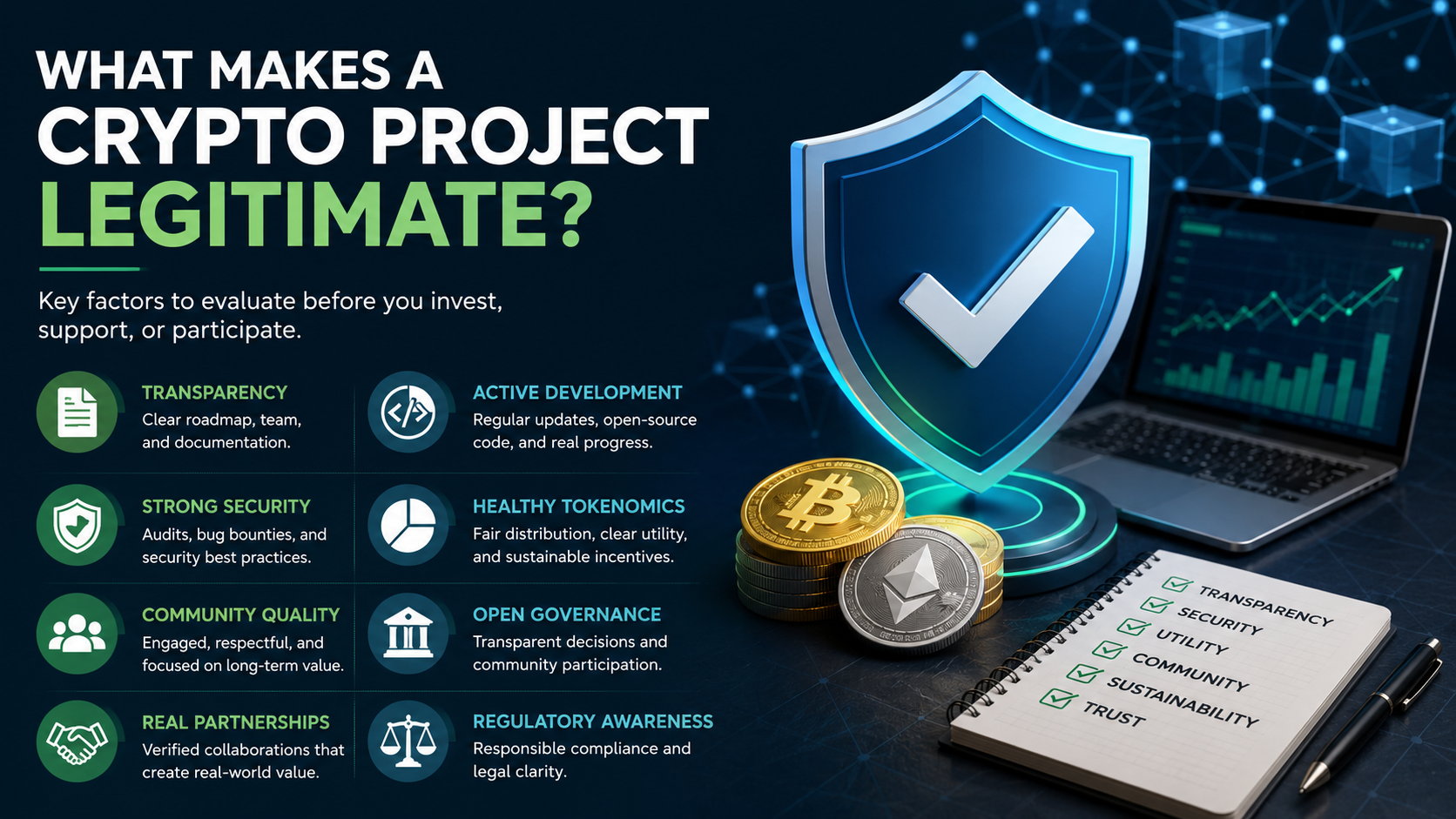
A legitimate crypto project is not defined by flashy marketing, celebrity endorsements, or a rapidly increasing token price. Instead, credibility is built through transparency, consistent development, strong security practices, and an engaged community. Understanding these factors helps investors, developers, and community members make more informed decisions and avoid unnecessary risks.
Legitimacy Starts with Transparency
One of the strongest indicators of a trustworthy project is transparency. Legitimate teams openly communicate their goals, technology, roadmap, and challenges instead of making unrealistic promises.
Transparency often includes:
- A detailed website explaining the project's purpose
- Public documentation or whitepaper
- Clear tokenomics
- Regular development updates
- Public communication channels
- Honest discussion of setbacks and limitations
No project is perfect, but legitimate teams acknowledge problems rather than pretending they do not exist.
A Real Problem Should Be Solved
Successful blockchain projects usually exist to solve genuine problems instead of creating tokens for speculation alone.
Ask questions like:
- Does this project solve an existing problem?
- Why does blockchain improve this solution?
- Who actually benefits from using it?
- Would people use it even if the token price stayed flat?
Projects built around real utility generally have stronger long-term potential than those focused purely on hype.
The Development Team Matters
Many successful blockchain projects have public teams with proven technical experience.
While anonymous developers are not automatically suspicious—Bitcoin itself was created anonymously—modern projects should demonstrate competence through:
- Open development activity
- Professional backgrounds
- Previous blockchain experience
- Consistent communication
- Technical expertise
A team that disappears after launching a token is rarely a good sign.
Active Development Is Essential
Crypto projects require continuous improvement. Technology evolves quickly, vulnerabilities are discovered, and user needs change.
Signs of healthy development include:
- Frequent software updates
- Bug fixes
- New features
- Public changelogs
- Open-source repositories
- Community testing programs
Projects that have shown no meaningful development for months or years may struggle to remain relevant.
Strong Security Practices
Security should always be a priority.
Legitimate projects invest heavily in protecting users through:
- Independent smart contract audits
- Bug bounty programs
- Multi-signature treasury management
- Responsible vulnerability disclosure
- Secure wallet integrations
Even audited projects can experience issues, but organizations that prioritize security usually respond quickly and communicate openly when problems arise.
Healthy Tokenomics
A token should have a clear purpose within its ecosystem.
Good tokenomics explain:
- Total supply
- Distribution
- Inflation or emission schedule
- Utility
- Governance rights
- Incentives for participants
Be cautious if:
- Large percentages belong to insiders.
- Vesting schedules are unclear.
- Utility is vague or nonexistent.
- Token creation appears designed only to generate speculation.
Sustainable token economies encourage long-term participation rather than short-term price spikes.
Community Quality Over Community Size
A large social media following does not automatically indicate legitimacy.
Healthy communities typically feature:
- Helpful discussions
- Educational resources
- Active moderators
- Respectful debate
- Developer interaction
- Constructive feedback
Warning signs include:
- Spam-filled chat rooms
- Constant "price only" discussions
- Personal attacks
- Artificial engagement
- Paid promotion disguised as community enthusiasm
Strong communities contribute ideas, report bugs, create educational content, and help new users.
Open Governance Builds Trust
Many decentralized projects allow their communities to participate in governance.
Governance may include:
- Improvement proposals
- Voting systems
- Treasury decisions
- Protocol upgrades
- Community funding
Even projects with centralized leadership can build trust by explaining how decisions are made and involving their communities whenever possible.
Real Partnerships Matter
Many projects advertise partnerships to gain credibility.
Before being impressed, ask:
- Is the partnership confirmed by both organizations?
- Does it involve actual technical integration?
- Is there evidence of ongoing collaboration?
- Does it create real value for users?
Simply mentioning well-known companies without meaningful collaboration should be viewed cautiously.
Regulatory Awareness
Legitimate projects generally acknowledge the evolving regulatory environment.
This may include:
- Compliance where appropriate
- Transparent corporate structures
- Legal documentation
- Risk disclosures
- Responsible communication with users
No crypto project can guarantee future regulatory outcomes, but responsible teams prepare rather than ignore these challenges.
Financial Sustainability
Running a blockchain ecosystem requires funding.
Healthy projects explain:
- Treasury management
- Development funding
- Revenue sources
- Operational expenses
- Long-term sustainability
Projects that rely entirely on attracting new investors without generating ongoing value may struggle over time.
Watch for Common Red Flags
Several warning signs frequently appear in fraudulent or low-quality projects:
- Guaranteed investment returns
- Pressure to buy immediately
- Anonymous teams with no track record
- Copied whitepapers
- Unrealistic roadmaps
- Fake partnerships
- Locked communication channels that suppress criticism
- Heavy influencer marketing with little technical substance
- Poor documentation
- No working product after long fundraising periods
One warning sign alone does not necessarily indicate fraud, but multiple red flags deserve careful attention.
Build Your Own Research Process
Experienced crypto users rarely rely on a single source of information.
A thorough evaluation may include:
- Reading the documentation
- Reviewing development activity
- Examining tokenomics
- Joining community discussions
- Looking at governance participation
- Comparing competing projects
- Following independent security researchers
- Testing the product personally when possible
Developing a consistent research process is one of the best ways to reduce emotional decision-making.
Long-Term Reputation Takes Time
Legitimacy cannot be created overnight. It is earned through years of consistent delivery, honest communication, secure technology, and community trust.
The most respected blockchain projects have survived market crashes, security challenges, regulatory uncertainty, and changing technology because they continued building regardless of short-term market conditions.
While no project is entirely risk-free, focusing on transparency, real utility, active development, security, sustainable tokenomics, and healthy communities provides a strong framework for identifying projects that are built to last. In the fast-moving world of cryptocurrency, careful research remains one of the most valuable investments anyone can make.



Pick your reaction
Post your comment