

Most crypto tokens are designed to move. They can be bought, sold, traded, transferred between wallets, or sent to another person. Soulbound Tokens take a very different approach.
Soulbound Tokens, often shortened to SBTs, are digital tokens designed to remain permanently or semi-permanently connected to a specific blockchain account. Instead of representing something you can trade, an SBT can represent something about you: a qualification, membership, achievement, reputation, participation history, or other credential.
The idea introduces an interesting possibility for blockchain technology. Rather than using blockchains primarily to track ownership of transferable assets, Soulbound Tokens could help create persistent digital identities and reputations.
What Is a Soulbound Token?
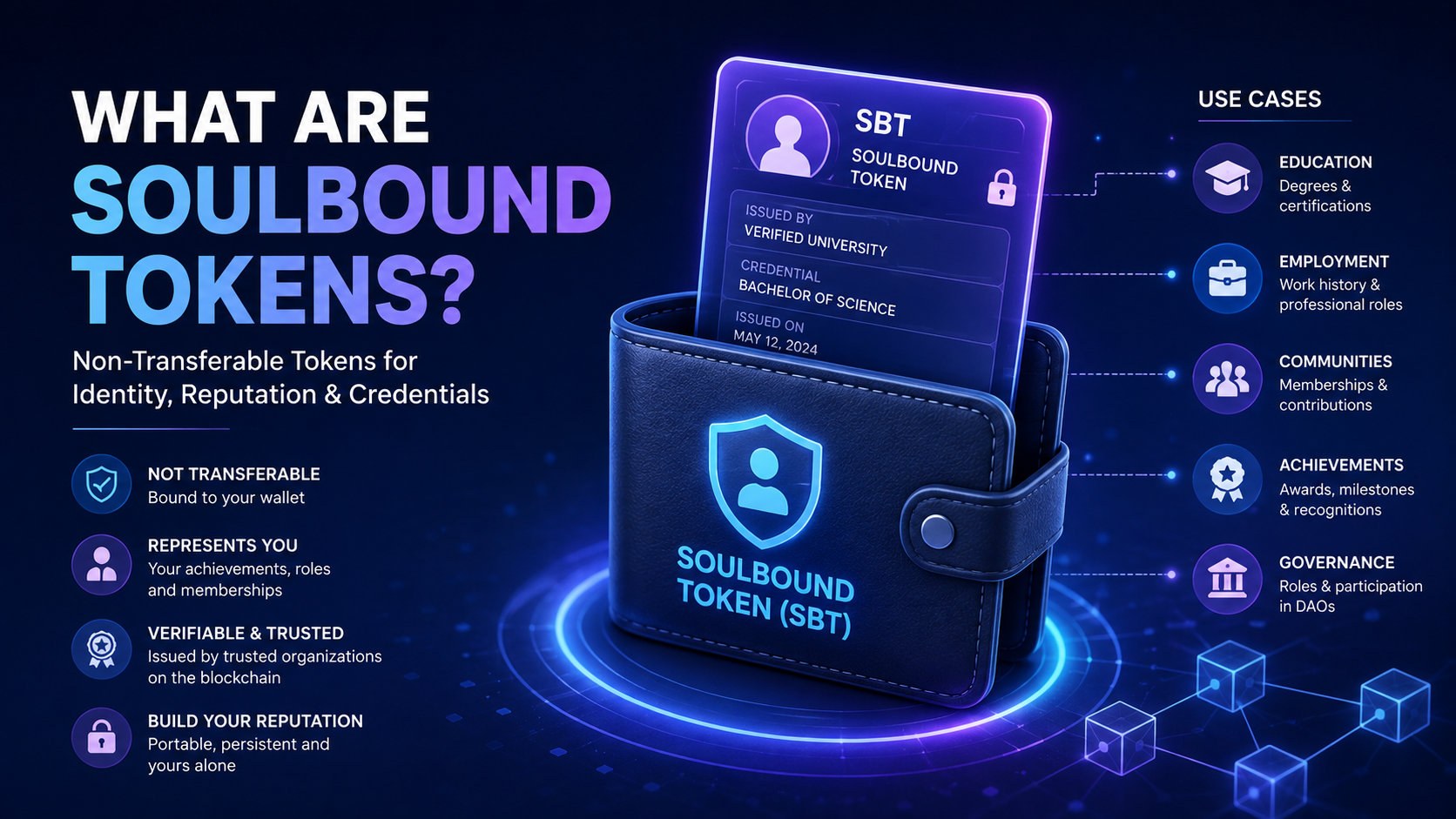
A Soulbound Token is a blockchain-based token that generally cannot be transferred from one wallet to another once it has been issued.
This is the fundamental difference between SBTs and conventional cryptocurrencies or NFTs.
If you own a typical NFT, you can usually send it to another wallet or sell it on a marketplace. If you receive an SBT representing a university degree, community achievement, professional certification, or governance role, transferring that token to somebody else would defeat its purpose.
The token is valuable because of its connection to the account that received it.
In simple terms:
NFT: "This wallet owns this digital asset."
Soulbound Token: "This wallet has this credential, achievement, relationship, or reputation."
This distinction opens the door to applications that would be difficult to build using ordinary transferable tokens.
Where Did the Idea of Soulbound Tokens Come From?
The term "Soulbound" was inspired by the concept of soulbound items found in games, particularly massively multiplayer online role-playing games. These items are permanently associated with a character and cannot normally be traded to another player.
The blockchain concept became widely known in 2022 through the paper "Decentralized Society: Finding Web3's Soul," written by E. Glen Weyl, Puja Ohlhaver, and Ethereum co-founder Vitalik Buterin.
The authors proposed a decentralized society in which blockchain accounts, described as "Souls," could accumulate non-transferable tokens representing credentials, affiliations, commitments, and relationships.
Instead of a wallet simply showing what someone owns, it could potentially demonstrate aspects of what that person has done.
How Do Soulbound Tokens Work?
Technically, an SBT can resemble an NFT implemented through a smart contract, but its transfer functionality is restricted or removed.
An organization, protocol, educational institution, employer, community, or other entity could issue an SBT directly to a user's blockchain account.
Imagine that someone completes a blockchain development course.
The organization running the course could issue an SBT containing or referencing information about the qualification. Because the token cannot simply be transferred to someone else's wallet, another person could not legitimately purchase the credential and pretend to have completed the course.
The receiving wallet gradually becomes a collection of verifiable credentials and achievements.
Depending on the implementation, an SBT might also be revocable, expire after a certain period, contain limited metadata, or provide links to information stored elsewhere.
There is no single universal implementation of Soulbound Tokens, so their exact behavior depends on the system that issues them.
Soulbound Tokens vs NFTs
Soulbound Tokens are frequently described as a type of NFT, but their purpose is fundamentally different.
Traditional NFTs are usually built around ownership and transferability. Digital artwork, collectibles, game items, virtual land, and tokenized assets can often be transferred or sold.
SBTs focus on identity, reputation, and credentials.
Consider a digital concert collectible. Being able to sell it later might be part of its appeal, making an NFT appropriate.
Now consider a token proving that you personally volunteered at a conference. Allowing that token to be sold would make the credential significantly less meaningful. An SBT would make more sense.
Transferability is therefore not always an advantage. For certain types of information, preventing transfer is exactly what gives the token meaning.
Digital Identity and Credentials
One of the most discussed applications for Soulbound Tokens is decentralized digital identity.
Today, much of your online identity is fragmented across centralized services. Your professional history might exist on one platform, academic qualifications somewhere else, community reputation on another service, and social activity across several different networks.
SBTs could potentially allow some of these credentials to become associated with an identity controlled through blockchain technology.
A wallet might contain tokens demonstrating:
- Academic qualifications
- Professional certifications
- Employment history
- Conference attendance
- Community participation
- Governance contributions
- Completed training programs
- Awards and achievements
Instead of relying entirely on a profile created by the individual, applications could verify credentials issued by trusted organizations.
The important question then becomes not simply whether an SBT exists, but who issued it.
A token claiming that someone has a medical degree means little if anybody can create it. A credential issued by a recognized university has a very different level of credibility.
Building Reputation On-Chain
Cryptocurrency wallets typically reveal financial activity reasonably well but provide limited context about the person or organization behind that activity.
Soulbound Tokens could introduce another layer: reputation.
For example, a decentralized autonomous organization could issue SBTs to members who consistently participate in governance. An open-source project could recognize long-term contributors. A community could issue credentials to moderators, organizers, educators, or trusted members.
Over time, these tokens could form an on-chain reputation history.
This could be particularly useful in decentralized ecosystems where participants frequently interact with people they have never met.
Instead of trusting an anonymous account purely because it claims to have experience, users could potentially inspect verifiable credentials issued by organizations they recognize.
Soulbound Tokens in Online Communities
Community applications are especially interesting because online communities already depend heavily on reputation.
Members gradually establish trust by helping others, organizing events, creating content, moderating discussions, participating in governance, or simply remaining active over long periods.
Most of that reputation currently exists inside individual platforms.
Leave the platform and much of it disappears.
SBTs could make certain achievements more portable across the wider internet while still preventing those achievements from being sold.
A crypto community might issue Soulbound Tokens for participating in its earliest days, organizing community events, completing educational programs, contributing to development, winning competitions, or serving as a moderator.
Another application could then recognize those credentials.
This could eventually allow community reputation to become more interoperable instead of remaining trapped inside individual Discord servers, forums, or social platforms.
SBTs and Governance
Soulbound Tokens could also influence how decentralized governance systems operate.
Many DAOs currently use token-based voting. Someone who owns more governance tokens may have more voting power.
While straightforward, this system can sometimes turn governance influence into something that can simply be purchased.
SBTs offer alternative possibilities.
A DAO could potentially give additional voting privileges to wallets containing credentials representing long-term participation, previous contributions, particular expertise, or verified roles.
Governance could therefore consider reputation and contribution alongside financial ownership.
However, such systems would need careful design. Reputation-based governance introduces its own questions about fairness, transparency, credential issuers, and how users can challenge incorrect information.
Proof of Attendance and Participation
Another straightforward use case involves proving that someone participated in an event or activity.
An organization could issue non-transferable credentials to people who attended conferences, workshops, community meetings, hackathons, educational sessions, or online events.
Unlike a transferable collectible, the token would specifically indicate that this particular account participated.
Accumulating these credentials could eventually create a verifiable participation history.
For communities, this could provide an interesting alternative to conventional badges and platform-specific achievement systems.
Lending and On-Chain Credit
Decentralized finance has historically relied heavily on collateral because blockchain protocols often know very little about the people borrowing money.
Traditional financial institutions use credit histories and identity information when evaluating borrowers. DeFi protocols frequently cannot do the same.
Soulbound Tokens have been proposed as one possible component of decentralized reputation systems.
A wallet could potentially accumulate credentials representing previous loans, repayment history, employment, income verification, participation in financial protocols, or other relevant information.
Protocols might then use these signals when evaluating risk.
That does not mean SBTs automatically create decentralized credit scores, nor does it eliminate the significant privacy and discrimination concerns surrounding financial profiling. But they could provide infrastructure for experimenting with reputation-based financial systems.
The Privacy Problem
The same features that make Soulbound Tokens interesting also create one of their biggest challenges.
A permanent public record of someone's achievements sounds useful.
A permanent public record of someone's entire life sounds considerably less appealing.
If an SBT reveals employment history, memberships, qualifications, financial relationships, political activity, health information, or other sensitive details, publicly associating that information with a blockchain address could create serious privacy problems.
Blockchain records can also be difficult or impossible to remove completely.
For that reason, practical identity systems may need privacy technologies that allow someone to prove a fact without publicly revealing all of the underlying information.
Zero-knowledge proofs and related cryptographic techniques could play an important role here.
Instead of exposing a credential directly, someone might prove that they possess a valid qualification without revealing unnecessary information about themselves.
What Happens If Your Wallet Is Compromised?
Non-transferability creates another major problem: account recovery.
If your cryptocurrency is stored in a wallet and you lose access to it, losing the assets is bad enough. If the same wallet contains years of education credentials, professional achievements, memberships, and reputation, the consequences become much greater.
A practical SBT ecosystem therefore needs ways to recover identity.
Different approaches could include social recovery, trusted guardians, credential reissuance, smart contract wallets, or mechanisms allowing an old identity to migrate to a new account.
This illustrates an important difference between financial assets and identity.
A cryptocurrency wallet can sometimes be treated as disposable. A digital identity containing years of accumulated reputation cannot.
Unwanted Soulbound Tokens
Another problem is surprisingly simple:
What if someone sends you an SBT that you do not want?
If tokens are permanently attached to wallets, malicious actors could potentially issue embarrassing, misleading, offensive, or harmful credentials to other people.
That means sensible SBT implementations need mechanisms for handling unwanted tokens.
Users may need the ability to hide, reject, dispute, or destroy certain credentials. Issuers may also need the ability to revoke tokens that were issued incorrectly or that represent qualifications that are no longer valid.
"Non-transferable" therefore should not necessarily mean "impossible to remove under any circumstances."
Trust Still Matters
Blockchain technology can prove that a particular wallet issued a token.
It cannot automatically prove that the issuer is trustworthy.
This is one of the most important limitations of Soulbound Tokens.
Suppose two wallets contain tokens claiming that their owners completed professional cybersecurity training. One was issued by a respected university. The other was issued by an unknown account created yesterday.
Technically, both tokens might be equally valid blockchain records.
Socially, they are completely different.
SBT systems therefore still require ways to establish trust in issuers. Blockchain technology can make credentials easier to verify, but it cannot eliminate the human question of who deserves to be trusted.
Are Soulbound Tokens Actually "Soulbound" Forever?
Not necessarily.
The name can make SBTs sound permanently locked to a wallet, but real-world implementations may require much more flexibility.
Credentials may expire. Organizations may need to revoke certifications. Users may need to recover compromised accounts. Incorrect credentials may need to be removed.
Different systems can therefore implement different rules.
The defining characteristic is generally that the token cannot be freely transferred or sold like a normal asset, rather than that it must remain attached to one blockchain address for eternity.
Soulbound Tokens and the Future of Web3
Soulbound Tokens represent a broader shift in thinking about what blockchain technology can record.
The first generation of cryptocurrencies primarily demonstrated digital ownership and transfer of value.
NFTs expanded that concept to unique digital assets.
SBTs explore something different: digital relationships, credentials, achievements, and reputation.
That could make blockchain accounts more expressive. Instead of showing only what someone owns, an account could potentially demonstrate where they have participated, what they have achieved, which organizations have recognized them, and what roles they have held.
At the same time, identity is considerably more sensitive than digital ownership.
Privacy, account recovery, unwanted credentials, issuer trust, interoperability, revocation, and user consent all need to be addressed before systems based on Soulbound Tokens can become widely useful.
More Than an NFT You Cannot Sell
It is tempting to describe a Soulbound Token simply as an NFT that cannot be transferred.
Technically, that captures much of the basic idea.
Conceptually, however, SBTs are more interesting because they change the purpose of tokenization.
A conventional token usually represents something you have.
A Soulbound Token can represent something you have done, earned, joined, contributed to, or been recognized for.
That makes SBTs potentially useful for education, employment, decentralized governance, online communities, reputation systems, event participation, and digital identity.
Whether Soulbound Tokens become a major part of Web3 remains uncertain. But the concept highlights an important evolution in blockchain technology: digital tokens do not necessarily have to be financial assets or tradable collectibles.
Sometimes, the fact that something cannot be sold is precisely what gives it meaning.



Really interesting topic ❤️🔥