

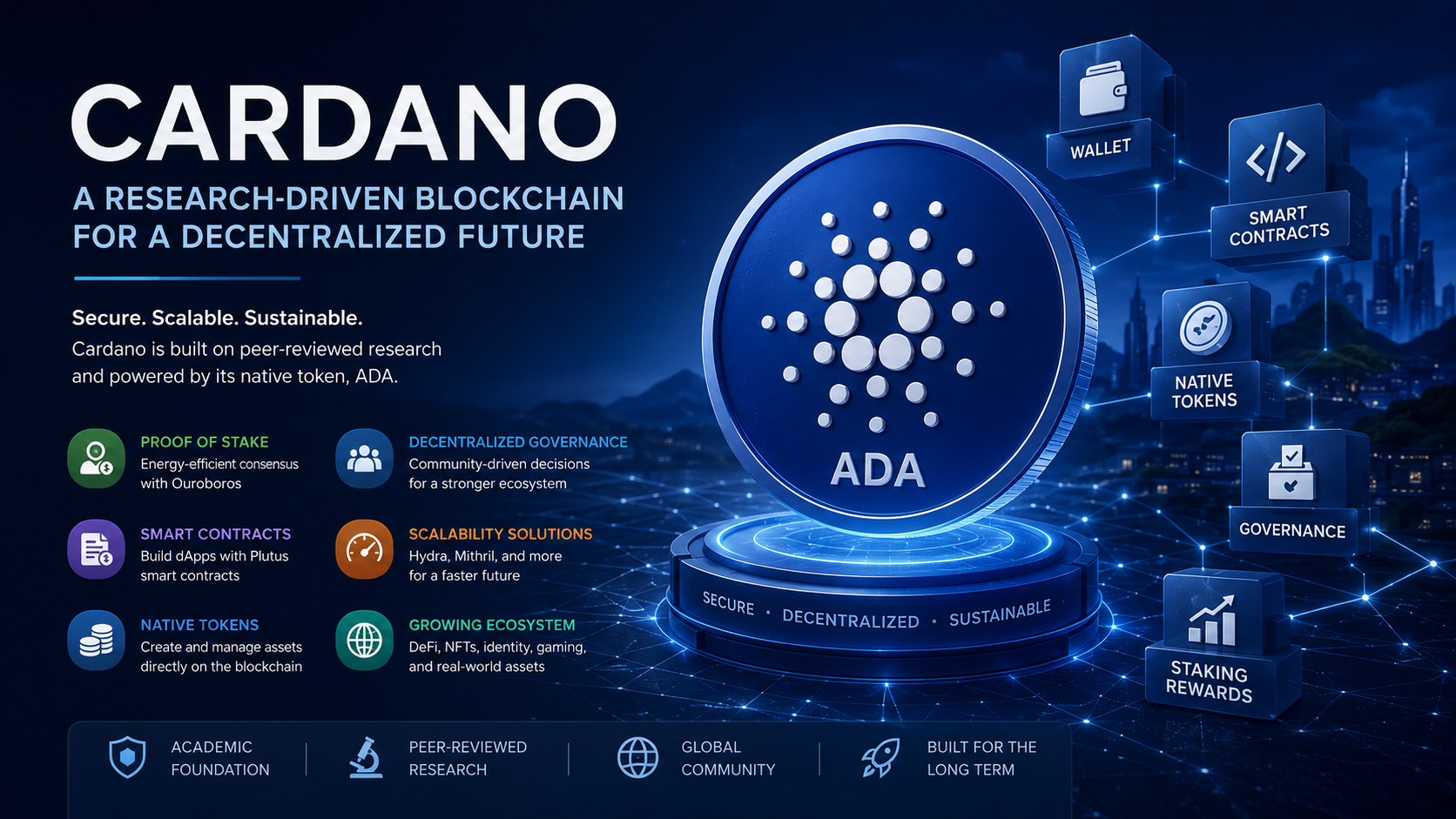
Cardano is one of the world's most well-known blockchain platforms, designed to provide a secure, scalable, and sustainable foundation for decentralized applications (dApps), digital assets, and financial services. Powered by its native cryptocurrency, ADA, Cardano takes a research-driven approach to blockchain development, emphasizing peer-reviewed technology, formal verification, and long-term sustainability.
Since its launch in 2017, it has grown into a global ecosystem with developers, businesses, educators, and community members building applications across finance, identity, gaming, governance, and beyond.
What Is Cardano?
Cardano is a Layer 1 blockchain that enables developers to create decentralized applications, issue digital assets, and deploy smart contracts without relying on centralized intermediaries. Unlike many blockchain projects that prioritize rapid development, Cardano follows a scientific methodology where many protocol upgrades are based on academic research and undergo peer review before implementation.
The project was founded by Charles Hoskinson, one of Ethereum's co-founders, with the goal of building a blockchain that combines security, scalability, and decentralization while remaining energy efficient.
ADA is the native cryptocurrency of the Cardano network. It is used for transaction fees, staking, governance participation, and transferring value between users.
The History of Cardano
Development of Cardano began in 2015, and the network officially launched in 2017.
From the beginning, the project followed a phased roadmap that introduced new capabilities over time:
- Byron introduced the basic blockchain and ADA transactions.
- Shelley brought decentralized staking and validator pools.
- Goguen added smart contract functionality through the Plutus programming platform.
- Basho focuses on scalability and network optimization.
- Voltaire introduces decentralized governance and community-driven decision making.
Rather than releasing all features at once, Cardano has gradually expanded while prioritizing stability and security.
How Cardano Works
Cardano uses a Proof of Stake (PoS) consensus mechanism called Ouroboros.
Instead of miners competing with expensive hardware, network participants stake their ADA to help secure the blockchain. Users can either:
- Run their own stake pool.
- Delegate ADA to an existing stake pool.
- Simply hold ADA without participating in staking.
Stake pool operators validate transactions and create new blocks, while delegators receive staking rewards without giving up custody of their coins.
This approach dramatically reduces energy consumption compared to Proof of Work blockchains.
Ouroboros: Cardano's Consensus Protocol
Ouroboros is one of the first Proof of Stake protocols developed using academic research.
Time on Cardano is divided into:
- Epochs
- Slots
During each slot, a selected validator creates the next block.
The protocol is designed to provide:
- Strong security guarantees
- High decentralization
- Energy efficiency
- Predictable block production
- Resistance against many common network attacks
Several versions of Ouroboros have been introduced over the years, each improving performance and functionality.
Smart Contracts on Cardano
Cardano supports smart contracts through the Plutus platform.
Smart contracts allow developers to build decentralized applications including:
- Decentralized exchanges (DEXs)
- Lending platforms
- NFT marketplaces
- Identity systems
- Voting applications
- Supply chain tracking
- Gaming platforms
- Asset tokenization
Unlike simple cryptocurrency transactions, smart contracts automatically execute predefined logic without requiring trusted intermediaries.
Native Tokens
One unique feature of Cardano is support for native assets.
Unlike some blockchains where custom tokens require smart contracts to exist, Cardano allows tokens to be issued directly at the protocol level.
Projects can create:
- Stablecoins
- Utility tokens
- Governance tokens
- Loyalty points
- NFTs
- Tokenized real-world assets
Native assets inherit many of the same security properties as ADA transactions.
Staking ADA
Staking is one of Cardano's most popular features.
Unlike some Proof of Stake networks, staking on Cardano does not lock your coins permanently.
Users generally:
- Store ADA in a compatible wallet.
- Choose a stake pool.
- Delegate their ADA.
- Continue using their funds while earning rewards.
This flexibility has encouraged millions of ADA holders to participate in network security.
Cardano Governance
Cardano is gradually transitioning toward decentralized governance.
Rather than relying entirely on a central organization, ADA holders increasingly participate in decisions affecting the future of the network.
Governance includes:
- Voting on proposals
- Treasury funding
- Community improvements
- Protocol upgrades
- Ecosystem development
This governance model aims to make Cardano increasingly self-sustaining over time.
Scalability Improvements
Scalability has been one of Cardano's major development priorities.
Several technologies help improve network performance, including:
Hydra
Hydra is a Layer 2 scaling solution that processes many transactions off-chain before settling results on the main blockchain.
Potential benefits include:
- Faster transactions
- Lower costs
- Higher throughput
- Improved user experience
Mithril
Mithril improves blockchain synchronization.
It allows new users and infrastructure providers to verify blockchain state much faster than downloading and validating the complete history.
Input Endorsers
Future protocol improvements aim to increase transaction throughput while maintaining decentralization and security.
The Cardano Ecosystem
Over the years, Cardano has grown into a large ecosystem.
Popular categories include:
DeFi
Cardano supports decentralized finance applications such as:
- Decentralized exchanges
- Lending protocols
- Liquidity pools
- Stablecoins
NFTs
NFT creators use Cardano to issue:
- Digital artwork
- Collectibles
- Gaming assets
- Music
- Membership tokens
Identity
Projects are developing decentralized identity systems for:
- Education
- Government services
- Digital credentials
- Enterprise authentication
Real-World Assets
Cardano is increasingly used for tokenizing assets such as:
- Property
- Commodities
- Financial instruments
- Carbon credits
Cardano Wallets
Users can manage ADA using many wallets.
Popular options include:
- Lace
- Daedalus
- Yoroi
- Eternl
- Vespr
Hardware wallets such as Ledger and Trezor also support Cardano for enhanced security.
Advantages of Cardano
Many users choose Cardano because of its:
- Energy-efficient Proof of Stake
- Strong academic foundation
- Peer-reviewed development
- Decentralized staking
- Native token support
- Active global community
- Expanding developer ecosystem
- Long-term governance vision
Challenges
Like every blockchain, Cardano faces challenges.
These include:
- Competition from other smart contract platforms
- Adoption by developers
- Scaling complex decentralized applications
- User experience improvements
- Regulatory uncertainty
- Maintaining decentralization while growing
Continued development aims to address many of these areas.
Common Uses for ADA
ADA serves multiple purposes across the ecosystem.
Users can use ADA to:
- Pay transaction fees
- Send money worldwide
- Stake for rewards
- Participate in governance
- Interact with decentralized applications
- Purchase NFTs
- Provide liquidity in DeFi protocols
- Support ecosystem growth
The Cardano Community
One of Cardano's greatest strengths is its global community.
Developers, educators, content creators, stake pool operators, businesses, researchers, and volunteers contribute to the ecosystem every day.
Community members organize:
- Online discussions
- Local meetups
- Educational workshops
- Hackathons
- Conferences
- Developer events
Platforms like BlockMap make it easier to discover Cardano communities, educational resources, news, and projects from around the world.
Is Cardano Right for You?
Cardano appeals to users who value sustainability, security, and long-term development. Its research-first philosophy sets it apart from many other blockchain projects, while its expanding ecosystem offers opportunities for developers, businesses, investors, and everyday users alike. Whether you're interested in staking ADA, exploring decentralized finance, creating digital assets, or simply learning about blockchain technology, Cardano provides a mature and continuously evolving platform worth exploring.
Final Thoughts
Cardano has established itself as one of the most influential blockchain networks by combining scientific research with practical blockchain technology. Through Proof of Stake, smart contracts, decentralized governance, and ongoing scalability improvements, it aims to support a wide range of decentralized applications while remaining secure and energy efficient.
As the ecosystem continues to grow, Cardano remains an important part of the broader blockchain landscape, attracting developers, organizations, and communities working to build the next generation of decentralized technologies.



Pick your reaction
Post your comment