

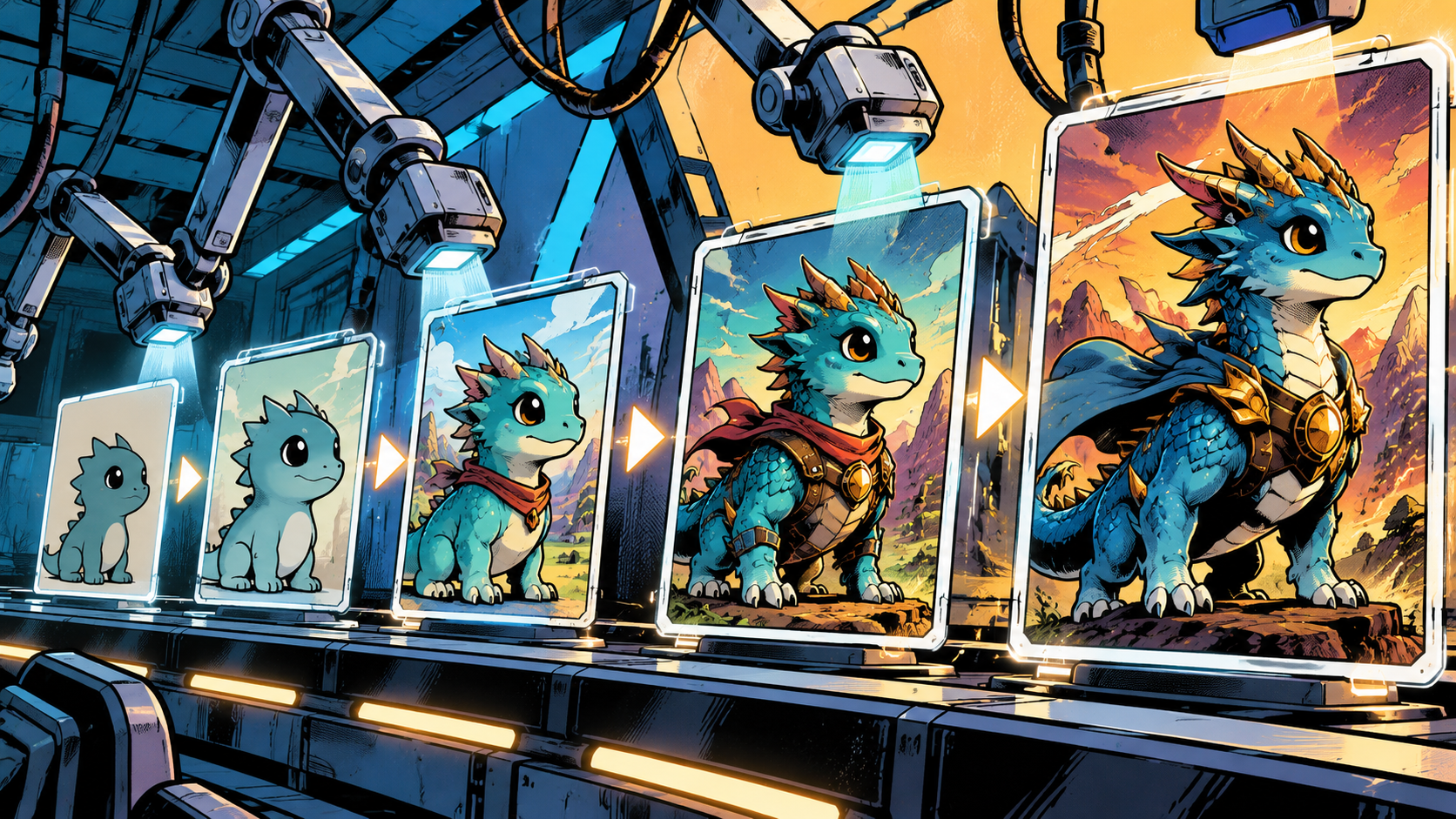
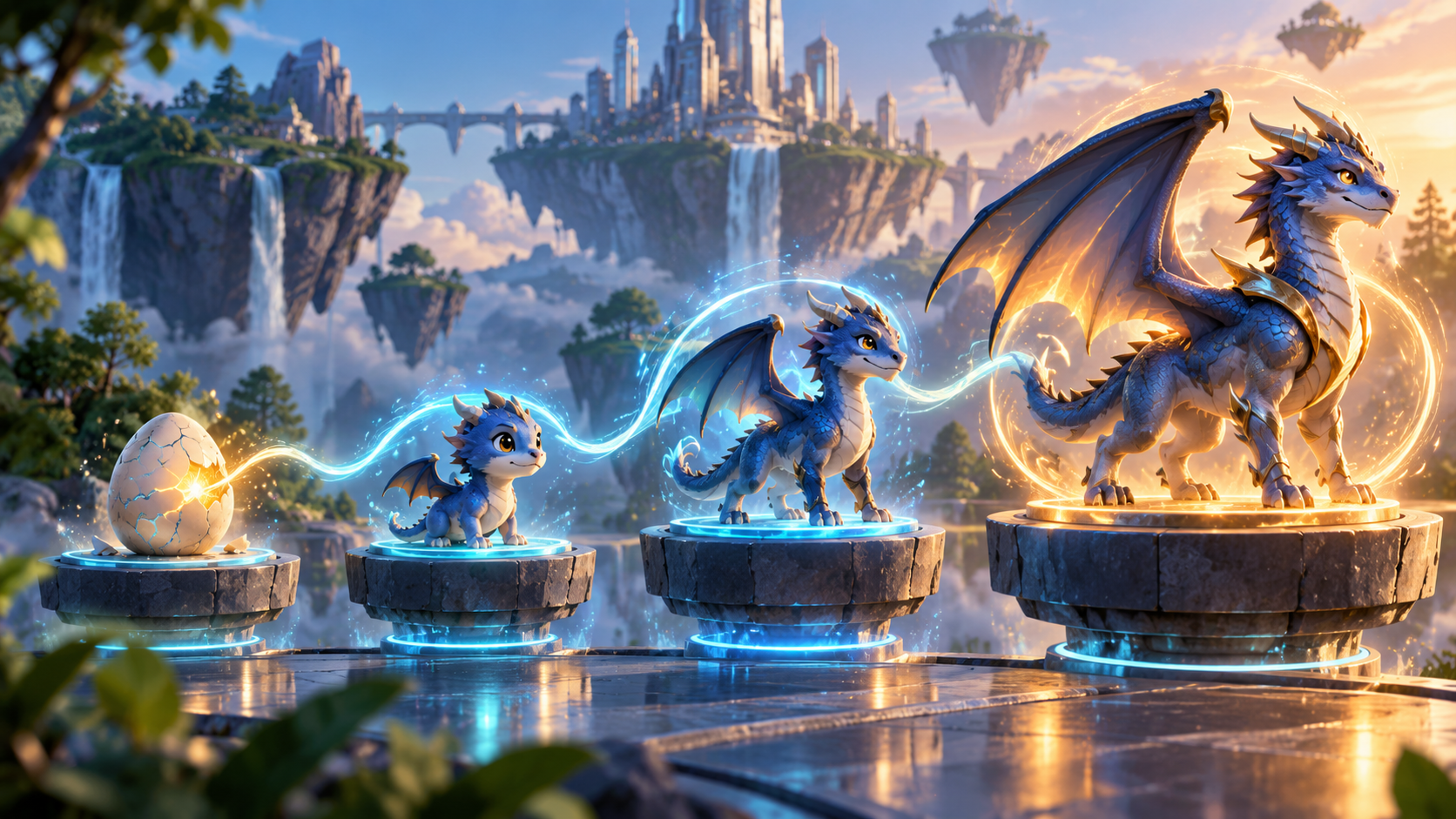
Most NFTs are known for representing something fixed: an image, collectible, membership token, or other digital asset whose defining characteristics remain largely unchanged after it is created. Dynamic NFTs take a different approach. They can evolve as circumstances change, allowing their appearance, metadata, attributes, or functionality to respond to new information.
This ability turns an NFT from a static record into a programmable digital asset. A dynamic NFT might change when a player reaches a new level, update according to real-world data, reflect the status of a physical object, or unlock new capabilities when certain conditions are met.
Dynamic NFTs expand what blockchain-based assets can represent. But their flexibility also introduces additional technical complexity, dependencies, and risks. Understanding how they work helps explain why NFTs can be useful for much more than digital collectibles.
What Is a Dynamic NFT?
A dynamic NFT, often abbreviated as dNFT, is a non-fungible token whose characteristics can change after it has been created.
Like a conventional NFT, it has a unique token identity recorded on a blockchain. The important difference is that some of the information associated with the token can be updated according to predefined rules.
These changes might affect:
- Visual appearance
- Metadata
- Traits and attributes
- Status or ranking
- Utility
- Access permissions
- In-game statistics
- Information linked to real-world events
The NFT itself does not necessarily disappear or become a new token when something changes. Its blockchain identity can remain the same while its associated state evolves.
This makes dynamic NFTs particularly useful when the thing represented by the NFT is not static.
Static NFTs vs. Dynamic NFTs
Traditional NFTs are generally designed around relatively stable metadata.
Imagine an NFT representing a digital trading card. The card might have attributes such as:
Character: Nova
Level: 1
Strength: 25
Class: Explorer
With a static NFT, these properties would normally remain unchanged unless the project had specifically implemented some external mechanism for updating them.
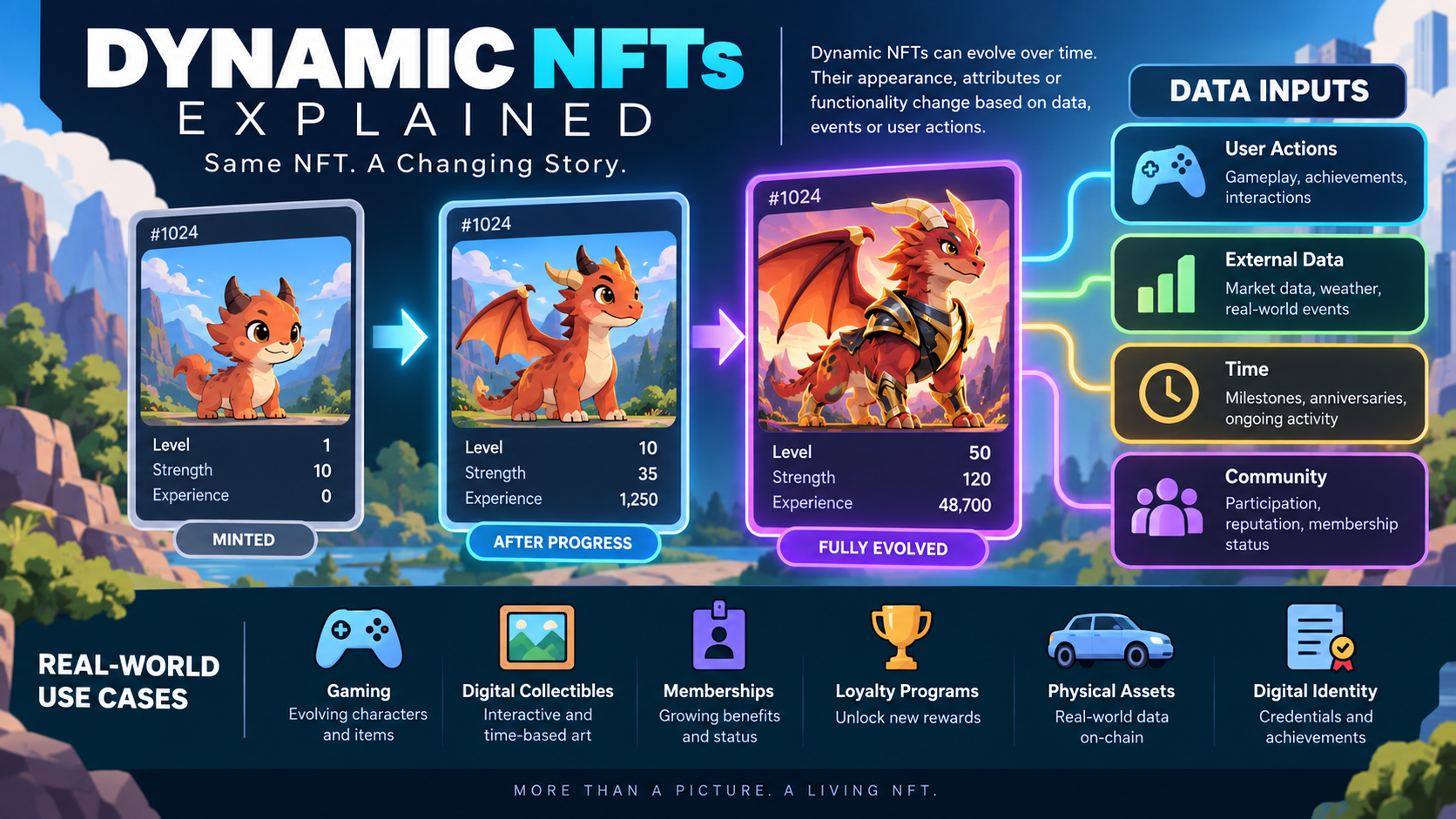
A dynamic NFT could automatically evolve as the owner uses it.
After completing certain achievements, the same NFT might become:
Character: Nova
Level: 12
Strength: 68
Class: Elite Explorer
Its artwork could also change to reflect the character's progression.
The token remains identifiable as the same NFT, but its state tells an evolving story.
How Do Dynamic NFTs Work?
Dynamic NFTs typically combine smart contracts, updateable metadata, and data inputs.
The exact architecture varies considerably between projects.
A smart contract defines the rules governing the NFT. These rules can specify what information may change, what conditions trigger an update, and who or what has permission to initiate that update.
For example, a smart contract could contain logic stating:
If the character earns 10,000 experience points, increase its level and update its metadata.
Once the relevant condition has been verified, the NFT's state can be changed accordingly.
Some dynamic properties may be stored directly on-chain. Others may rely on metadata stored elsewhere and referenced by the token.
The Role of Metadata
Metadata describes the characteristics associated with an NFT.
It can contain information such as a name, description, image location, attributes, statistics, rarity traits, or other properties.
For static NFTs, this information is often intended to remain unchanged.
Dynamic NFTs require some mechanism that allows selected metadata or state to be updated.
Suppose an NFT represents a virtual race car. Its metadata might initially contain:
Wins: 0
Races: 0
Engine Level: 1
Condition: New
After participating in dozens of races, it could display:
Wins: 14
Races: 38
Engine Level: 4
Condition: Experienced
The history and identity of the NFT remain connected to the same token, while its current characteristics reflect what has happened to it.
Using Oracles to Bring External Data On-Chain
Blockchains generally cannot independently access arbitrary information from outside their own networks.
This creates a challenge for dynamic NFTs that need to react to real-world events.
Oracles can provide a bridge between external data and blockchain applications. They can supply smart contracts with information such as:
- Asset prices
- Weather conditions
- Sports results
- Event outcomes
- Sensor readings
- Dates and timestamps
- Market information
Imagine an NFT representing a digital landscape whose appearance changes depending on actual weather conditions in a particular city.
An external data source could report the weather to an oracle. The oracle makes the relevant information available to the blockchain application, and the NFT's state or displayed artwork could then change accordingly.
This creates NFTs that can react to events beyond the blockchain itself.
Dynamic NFTs in Gaming
Gaming is one of the most intuitive applications for dynamic NFTs.
Game items and characters naturally evolve.
A sword might become stronger. A character might gain experience. A vehicle could receive upgrades. A creature could develop new abilities.
If these assets are represented using dynamic NFTs, their blockchain-linked attributes can potentially reflect this progression.
For example, a Level 1 character NFT might gradually become a Level 50 character with different abilities, equipment, achievements, and visual characteristics.
This creates an important distinction between two otherwise identical starting NFTs.
Their histories can make them completely different assets over time.
One player might develop a character around speed, while another focuses on strength. Even if both NFTs started with identical properties, their eventual attributes could be very different.
Evolving Digital Collectibles
Dynamic NFTs can also make digital collectibles interactive.
Instead of purchasing a finished collectible and simply holding it, the owner might influence how it develops.
An artwork could change according to how long it has been held. A collectible could evolve on anniversaries. New visual elements might appear after particular community events.
This introduces time, participation, and external events into the collectible itself.
Rather than representing a single moment, the NFT can become a record of an ongoing experience.
Dynamic Membership NFTs
NFTs can also represent memberships, subscriptions, credentials, or access rights.
Dynamic properties make these applications more flexible.
Consider a community membership NFT with several participation levels:
New Member → Active Member → Contributor → Veteran
Instead of issuing a new NFT every time the member's status changes, the existing NFT could update.
Its attributes could reflect factors such as participation, membership duration, completed activities, or community roles.
The NFT could potentially unlock additional benefits as its status evolves.
If implemented carefully, this creates a portable membership asset that reflects more than simple ownership.
Loyalty and Reward Programs
Dynamic NFTs could also be used in loyalty programs.
A business might issue a membership NFT that changes according to customer activity.
For example:
Bronze → Silver → Gold → Platinum
Reaching a new tier could modify the NFT and unlock different benefits.
Because the NFT is programmable, rewards could potentially be connected directly to its current state.
This concept can extend beyond conventional shopping rewards to online communities, events, games, creator ecosystems, and decentralized applications.
NFTs Connected to Physical Assets
Dynamic NFTs can potentially represent information about physical objects.
Imagine an NFT linked to a vehicle.
Its attributes could include:
- Manufacturing date
- Mileage
- Service history
- Inspection status
- Warranty information
- Ownership-related records
As the vehicle ages, relevant information associated with its digital representation could be updated.
Similar concepts could be applied to machinery, luxury goods, real estate, supply-chain items, or equipment.
However, this introduces an important limitation: blockchain data is only as trustworthy as the process used to connect the physical world to the blockchain.
If incorrect information is submitted, putting that information on-chain does not automatically make it true.
Dynamic NFTs and Digital Identity
Dynamic NFTs can also be used to represent changing credentials, achievements, or reputation.
A token could accumulate information as someone completes courses, participates in a community, contributes to a project, or reaches particular milestones.
For example, an educational NFT could begin by showing enrollment in a course and later update to indicate completion.
Additional achievements could then become associated with the same digital credential.
Privacy becomes especially important in these applications. Permanently linking personal information to public blockchain activity can create serious privacy concerns, so identity-oriented systems need to carefully consider what information belongs on-chain.
Who Can Change a Dynamic NFT?
One of the most important questions when evaluating a dynamic NFT is simple:
Who controls the updates?
The answer depends entirely on how the project is designed.
Updates might be controlled by:
- The NFT owner
- A smart contract
- The project's developers
- A decentralized governance system
- An oracle
- An authorized third party
- A combination of several mechanisms
This matters because "dynamic" does not automatically mean "decentralized."
If a project administrator can arbitrarily modify an NFT's metadata, users are effectively trusting that administrator.
A well-designed dynamic NFT should clearly explain what can change, under which conditions, and who has authority over those changes.
Are Dynamic NFTs Fully On-Chain?
Not necessarily.
An NFT's token ownership may exist on a blockchain while some of its metadata, images, or other resources are stored elsewhere.
Dynamic NFTs can use several different approaches.
Some store important attributes directly on-chain. Others generate metadata dynamically. Some reference decentralized storage networks, while others depend on conventional servers.
These architectural choices affect permanence and reliability.
If an NFT depends heavily on a centralized server controlled by its creator, the project may stop functioning correctly if that server disappears.
For users, it is therefore useful to distinguish between the NFT's blockchain record and the infrastructure supporting everything displayed around it.
Benefits of Dynamic NFTs
The major advantage of dynamic NFTs is adaptability.
They allow blockchain assets to represent things that naturally change.
Potential benefits include:
Greater interactivity: NFTs can react to user actions rather than simply existing as passive collectibles.
Persistent progression: Games and applications can attach evolving characteristics to a consistent token identity.
Real-world integration: External data can influence blockchain-based assets.
Programmable utility: Benefits or functionality can change according to the NFT's current state.
Personalization: Two NFTs that begin identically can evolve differently according to their individual histories.
Ongoing engagement: Projects can create experiences that continue developing after the initial NFT is issued.
These capabilities significantly broaden the design space available to NFT developers.
Risks and Limitations
Dynamic NFTs also introduce challenges that simpler NFTs may avoid.
Smart Contract Risk
More complicated functionality generally means more opportunities for bugs or vulnerabilities.
A mistake in the update logic could cause incorrect attributes, unexpected behavior, or security problems.
Oracle Risk
If an NFT depends on external information, the reliability of that information matters.
Incorrect or manipulated data could produce incorrect updates.
Centralization
A project may advertise an NFT as dynamic while retaining complete control over its metadata.
Users should understand whether changes are governed by transparent smart-contract rules or by decisions made by a centralized operator.
Storage Dependencies
Dynamic NFT content may rely on external infrastructure.
If that infrastructure becomes unavailable, the NFT may no longer display or behave as intended.
Long-Term Maintenance
Dynamic systems may require ongoing infrastructure, data feeds, servers, contracts, or developer support.
A static NFT can potentially remain unchanged indefinitely. A complicated dynamic application may become partially unusable if the surrounding project shuts down.
Can Dynamic NFTs Become Static?
Yes, depending on their design.
A project could allow an NFT to evolve during a certain period and then permanently freeze its state.
For example, a gaming NFT might change throughout a tournament. Once the tournament ends, its final statistics and appearance could become permanent.
This creates an interesting hybrid model.
The NFT is dynamic while events are unfolding but eventually becomes a permanent record of the final outcome.
Dynamic NFTs Are More Than Changing Pictures
It is easy to think of dynamic NFTs simply as NFTs with artwork that changes.
The concept is much broader.
The important feature is that the state associated with the NFT can evolve.
A dynamic NFT might look exactly the same while its permissions, statistics, reputation, status, or utility change behind the scenes.
Conversely, an NFT might visibly transform while retaining the same underlying identity.
The visual component is only one possible expression of its changing state.
What to Check Before Using a Dynamic NFT
Before buying or interacting with a dynamic NFT, it is worth understanding how the system actually works.
Ask questions such as:
- What exactly can change?
- What triggers those changes?
- Who has permission to update the NFT?
- Is important state stored on-chain?
- Where are images and metadata stored?
- Does the NFT rely on an oracle?
- Can developers manually modify its properties?
- What happens if the project shuts down?
- Can the NFT eventually be frozen?
- Are the smart contracts publicly verifiable?
These questions reveal much more about a dynamic NFT than its appearance alone.
The Future of Dynamic NFTs
Dynamic NFTs illustrate how non-fungible tokens can function as programmable objects rather than simply certificates attached to digital images.
Games can use them for evolving characters and equipment. Communities can create memberships that develop with participation. Loyalty systems can represent changing status. Digital collectibles can react to events. Physical assets can have blockchain-linked representations that update as their circumstances change.
The concept also fits into a broader shift toward digital assets that respond to data and activity instead of remaining permanently fixed.
Whether dynamic NFTs become widely used will depend less on novelty and more on whether they solve practical problems better than simpler alternatives. For many applications, a conventional database may still be the easier solution. Blockchain-based dynamic assets become most interesting when persistent ownership, interoperability, transparent rules, or verifiable state provide meaningful benefits.
Conclusion
Dynamic NFTs add something that conventional NFTs often lack: the ability to evolve.
Instead of representing a fixed digital object, a dynamic NFT can change according to user actions, blockchain activity, external information, time, achievements, or predefined smart-contract rules.
That flexibility opens possibilities across gaming, digital collectibles, memberships, loyalty programs, credentials, physical assets, and other blockchain applications.
At the same time, dynamic behavior creates new dependencies. Oracles can provide unreliable information, metadata can depend on centralized infrastructure, smart contracts can contain vulnerabilities, and project administrators may retain considerable control.
For that reason, understanding a dynamic NFT means looking beyond what it currently displays. The more important questions are what can change, why it changes, and who controls the change.
Those answers determine whether a dynamic NFT is simply an interesting visual experiment or a genuinely useful programmable digital asset.

Pick your reaction
Post your comment