

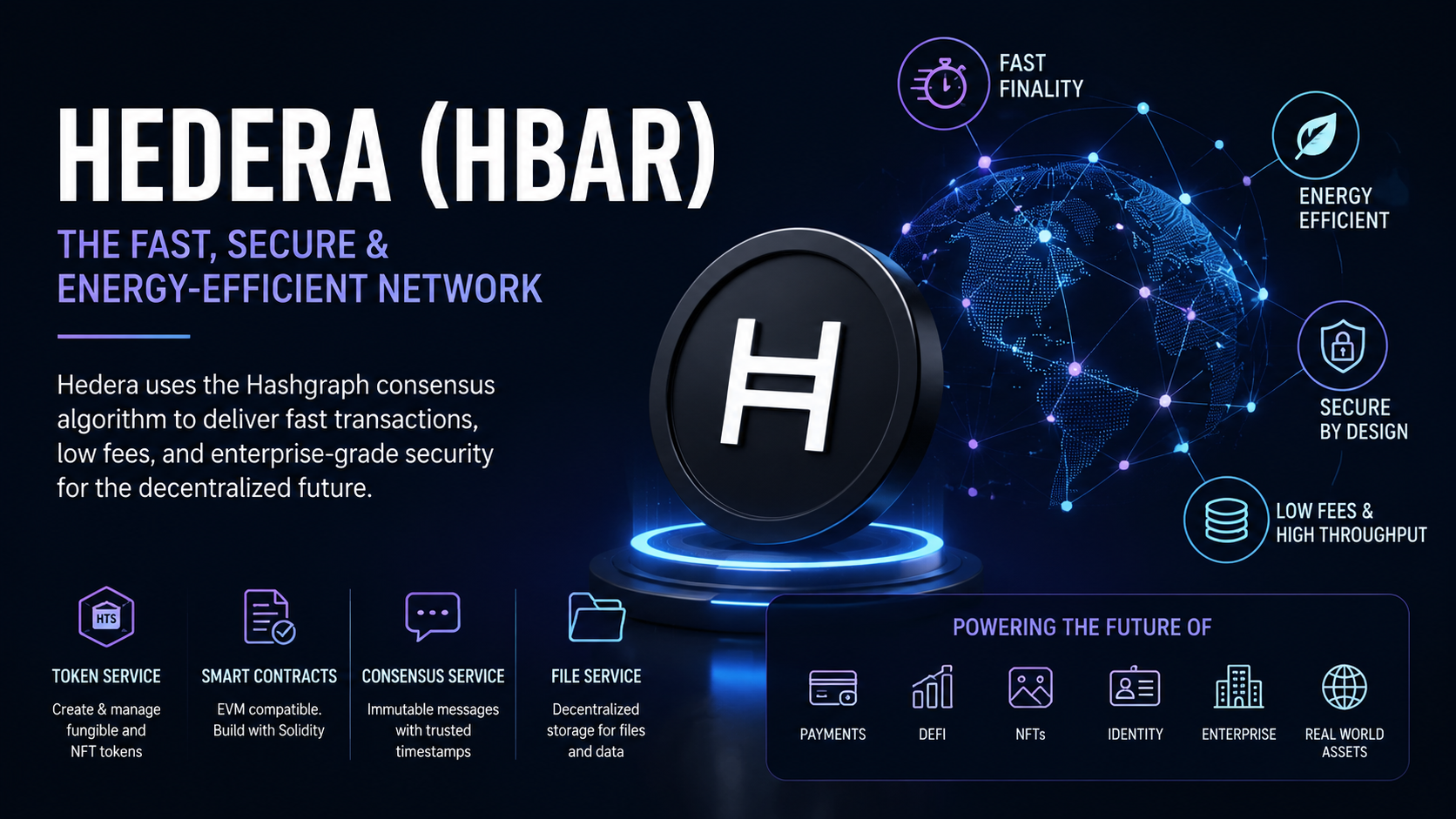
Cryptocurrency and blockchain technology continue to evolve, with new platforms offering different approaches to speed, security, and scalability. While many projects rely on traditional blockchain architectures, Hedera takes a different path by using a technology called the Hashgraph consensus algorithm.
This unique design allows the network to process transactions quickly, efficiently, and with low energy consumption.
In this guide, you'll learn what Hedera is, how it works, what HBAR is used for, and why many businesses and developers are building applications on the network.
What Is Hedera?
Hedera is a public distributed ledger designed for decentralized applications (dApps), digital assets, payments, identity solutions, and enterprise software. Unlike Bitcoin or Ethereum, Hedera does not use a traditional blockchain. Instead, it is powered by the Hashgraph consensus algorithm, which provides fast transaction finality and high throughput.
The project launched its mainnet in 2019 after several years of development by Swirlds, the company that originally created the Hashgraph technology.
Hedera aims to solve the so-called "blockchain trilemma" by offering:
- High performance
- Strong security
- Fair consensus
- Low fees
- Sustainable energy usage
The native cryptocurrency of the network is HBAR.
How Does Hedera Work?
Instead of grouping transactions into sequential blocks, Hedera uses a Directed Acyclic Graph (DAG) combined with the Hashgraph consensus algorithm.
Two important concepts make this possible:
Gossip About Gossip
Nodes constantly share information with each other in a process called "gossip." Every message also contains information about where it came from.
This allows the network to quickly learn the history of communication between nodes without requiring every participant to communicate directly with everyone else.
Virtual Voting
Rather than broadcasting votes across the network, Hedera uses the communication history to mathematically determine how nodes would have voted.
This significantly reduces network traffic while maintaining consensus and security.
The result is:
- Very high transaction throughput
- Fast confirmation times
- Fair ordering of transactions
- Efficient bandwidth usage
What Makes Hedera Different from Traditional Blockchains?
Traditional blockchains build one block after another.
Hedera's Hashgraph allows transactions to spread across the network simultaneously before consensus is reached.
Some key differences include:
Traditional BlockchainHedera HashgraphSequential blocksDirected Acyclic Graph (DAG)Mining or staking determines blocksVirtual voting consensusCan experience congestionHigh throughputVariable confirmation speedFast finalityHigher energy usage (depending on network)Extremely energy efficient
What Is HBAR?
HBAR is the native cryptocurrency of the Hedera network.
It serves several purposes:
Paying Transaction Fees
Every action on the network requires a small fee paid in HBAR.
Examples include:
- Sending tokens
- Executing smart contracts
- Creating NFTs
- Storing files
- Registering decentralized identities
Network Security
HBAR is used in staking, helping secure the network and participate in consensus.
Fuel for Applications
Developers building decentralized applications use HBAR to pay for network resources.
Hedera Services
Instead of offering only smart contracts, Hedera provides multiple native services.
Hedera Token Service (HTS)
Allows developers to create fungible and non-fungible tokens directly on the network.
Features include:
- Native token issuance
- Token minting and burning
- Custom supply controls
- Compliance features
- Low-cost transfers
Hedera Smart Contract Service (HSCS)
Supports Ethereum-compatible smart contracts using Solidity.
This allows many Ethereum developers to migrate applications with relatively small changes.
Hedera Consensus Service (HCS)
Applications can submit messages to the network and receive trusted timestamps.
This is useful for:
- Supply chain tracking
- Audit logs
- Voting systems
- Event verification
Hedera File Service (HFS)
Provides decentralized storage for files and network configuration data.
Smart Contracts on Hedera
Hedera supports the Ethereum Virtual Machine (EVM), making it easier for Ethereum developers to build or migrate decentralized applications.
Popular application categories include:
- Decentralized finance (DeFi)
- NFT marketplaces
- Gaming
- Identity solutions
- Tokenized assets
- Enterprise applications
Governance
One unique aspect of Hedera is its governance model.
Instead of relying entirely on anonymous validators, Hedera is governed by the Hedera Governing Council, which consists of globally recognized organizations from various industries.
Council members have equal voting rights and are responsible for overseeing software updates, network governance, and strategic decisions. Membership rotates over time, with term limits designed to encourage decentralization and prevent any single organization from maintaining permanent control.
This governance approach is intended to provide stability, transparency, and balanced decision-making while the network continues to grow.
Staking on Hedera
HBAR holders can stake their tokens to support network security.
Unlike proof-of-work mining, staking consumes very little energy.
Benefits may include:
- Network participation
- Potential staking rewards
- Improved decentralization
The exact rewards depend on network conditions and protocol parameters.
Hedera and Sustainability
One of Hedera's major goals is sustainability.
The network is designed to consume very little energy compared to many traditional blockchain systems.
Because Hashgraph does not rely on mining, electricity consumption remains low even as transaction volume increases.
This makes Hedera attractive for organizations that prioritize environmental considerations.
Common Use Cases
Developers and businesses use Hedera for a wide range of applications, including:
- Cross-border payments
- Stablecoins
- Asset tokenization
- Supply chain tracking
- Digital identity
- Loyalty and rewards programs
- Healthcare records
- Carbon credit markets
- NFT platforms
- Enterprise data verification
Advantages of Hedera
- Very fast transaction finality
- Low transaction fees
- High scalability
- Energy-efficient consensus
- EVM compatibility
- Native token services
- Enterprise-focused governance
- Strong developer ecosystem
- Secure consensus mechanism
- Suitable for both businesses and public applications
Disadvantages of Hedera
- Uses Hashgraph instead of a traditional blockchain, which may be unfamiliar to new users
- Governance differs from fully permissionless blockchain models
- Smaller DeFi ecosystem than Ethereum
- Fewer developers than some larger blockchain ecosystems
- Some crypto users prefer fully community-governed networks
Is Hedera a Blockchain?
Technically, no.
Hedera uses a distributed ledger powered by the Hashgraph consensus algorithm rather than a blockchain.
However, for most users, the experience is very similar:
- You own a wallet.
- You send HBAR.
- You interact with decentralized applications.
- You use smart contracts.
- You pay transaction fees.
The underlying technology is simply different.
The Hedera Ecosystem
Over the years, Hedera has attracted developers, enterprises, startups, and open-source communities building a diverse ecosystem of applications and services.
The network supports:
- Wallets
- DeFi protocols
- NFT platforms
- Developer tools
- Bridges
- Oracles
- Stablecoins
- Identity solutions
- Analytics platforms
- Educational resources
As adoption grows, the ecosystem continues to expand with new applications exploring both consumer and enterprise use cases.
Final Thoughts
Hedera takes a unique approach to distributed ledger technology by replacing the traditional blockchain with the Hashgraph consensus algorithm. Its focus on speed, low costs, energy efficiency, and enterprise-grade reliability has made it an attractive platform for developers and organizations building decentralized applications.
Whether you're interested in payments, tokenization, NFTs, decentralized finance, or enterprise solutions, Hedera offers a modern infrastructure designed to support a wide variety of use cases. As the ecosystem continues to evolve, HBAR remains at the center of the network, powering transactions, staking, and the growing range of applications built on Hedera.



Pick your reaction
Post your comment