

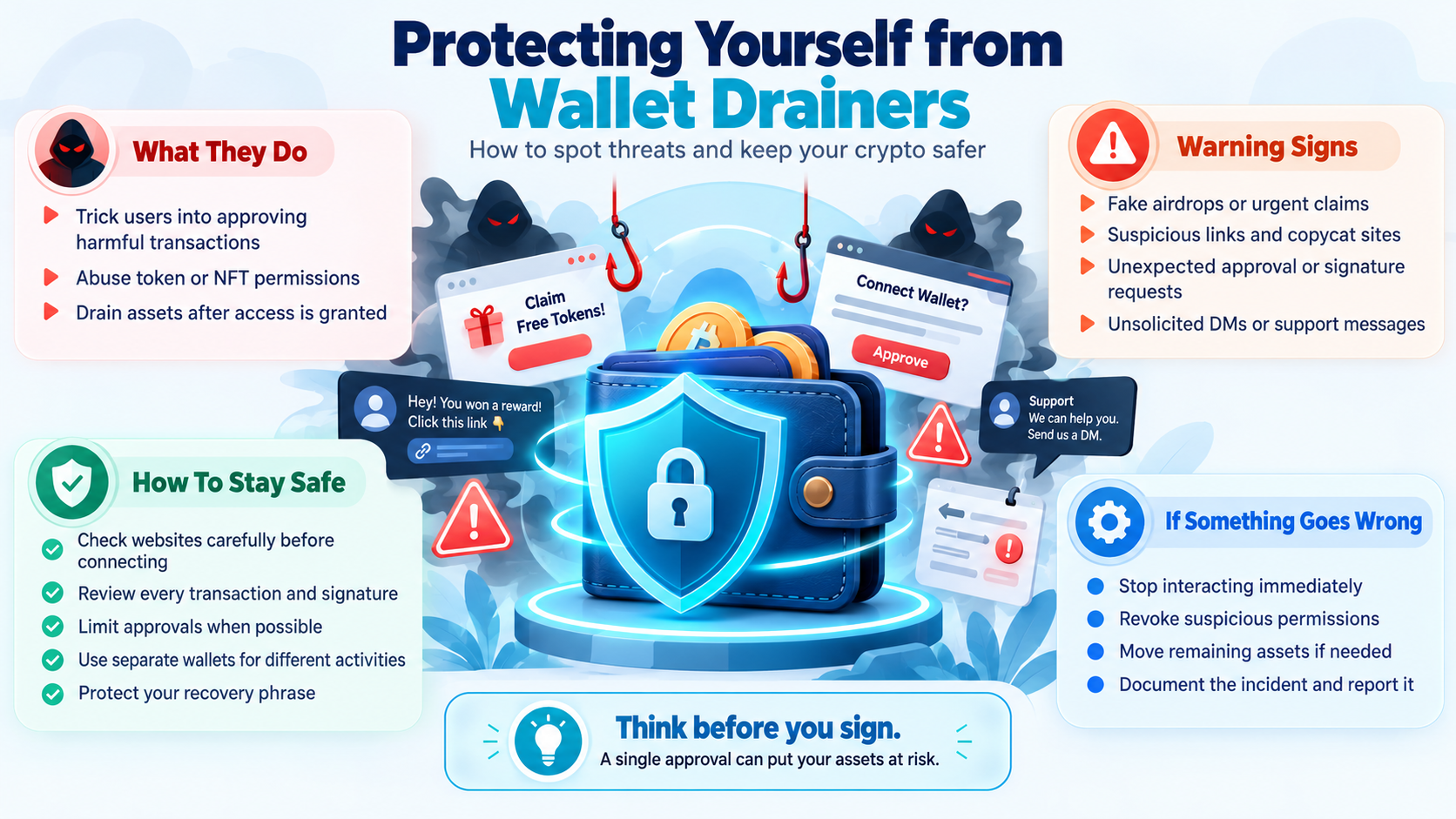
Wallet drainers are among the most dangerous threats in the cryptocurrency ecosystem. These malicious tools can steal tokens, NFTs, and other digital assets by tricking users into approving harmful transactions or signing deceptive messages. Unlike traditional hacks, wallet drainers often exploit permissions willingly granted by their victims, making them particularly difficult to recognize.
Understanding how wallet drainers operate, identifying suspicious interactions, and adopting safer wallet habits can significantly reduce the risk of losing your cryptocurrency. This guide explains the techniques attackers use, the warning signs to watch for, and the practical steps you can take to protect your digital assets.
What Is a Wallet Drainer?
A wallet drainer is a malicious tool or collection of smart contracts designed to transfer cryptocurrency and other digital assets from a victim's wallet to an attacker-controlled address.
Rather than directly hacking into a blockchain, wallet drainers typically exploit the way users interact with decentralized applications (dApps), smart contracts, and cryptocurrency wallets.
Many blockchain applications require users to authorize specific actions. For example, a decentralized exchange may request permission to access certain tokens before executing a swap.
While these permissions are essential for many legitimate blockchain operations, attackers can abuse them to gain control over valuable assets.
Wallet drainers often appear as seemingly legitimate applications, promotional websites, or interfaces offering rewards. Once a user grants the requested permissions, attackers may be able to transfer supported assets without requiring further confirmation.
Importantly, a wallet drainer does not always need access to a wallet's private keys or recovery phrase. A malicious approval or authorization signature can sometimes provide sufficient access to steal assets.
How Do Wallet Drainers Work?
Wallet drainer attacks generally rely on social engineering combined with malicious blockchain interactions.
Although the exact techniques vary, a typical attack follows several stages.
1. Attracting the Victim
Attackers first attempt to direct potential victims toward a malicious website or application.
Common methods include:
- Fake cryptocurrency airdrops promising free tokens.
- Fraudulent NFT minting events or giveaways.
- Impersonation of established cryptocurrency projects.
- Fake staking platforms advertising unusually high rewards.
- Compromised social media accounts promoting malicious links.
- Direct messages on Discord, Telegram, or other community platforms.
- Sponsored search results leading to fraudulent websites.
Some attackers create convincing copies of legitimate websites, including their branding, navigation, and wallet connection interfaces.
The objective is to make the malicious website appear trustworthy enough that visitors proceed with a wallet interaction.
2. Requesting Wallet Access
After visiting the malicious website, users may be prompted to connect their cryptocurrency wallets.
Connecting a wallet generally allows a website to view a public wallet address and request further interactions. Simply connecting a conventional wallet does not normally grant permission to transfer assets.
The danger arises when the website requests additional permissions, transactions, or signatures.
For example, a fraudulent airdrop website might display a button labeled "Claim Tokens" while requesting authorization to spend tokens already held in the connected wallet.
Users who do not carefully examine the wallet confirmation screen may unintentionally approve the malicious request.
3. Obtaining Dangerous Permissions
Many wallet drainers exploit token approvals, particularly on Ethereum and other Ethereum Virtual Machine (EVM) compatible networks.
An approval gives a designated smart contract or address permission to spend a specified amount of a token on behalf of the wallet owner.
A malicious application might request an unlimited token allowance, giving the attacker the ability to transfer the approved tokens up to the authorized limit.
NFTs can face similar risks when users grant broad permissions through functions such as setApprovalForAll, which can authorize an operator to transfer NFTs from a particular collection.
Some attacks also use off-chain signatures and token authorization mechanisms. These signatures may appear less intimidating than a normal blockchain transaction, but they can still authorize valuable asset transfers.
The precise consequences depend on the signed message, existing allowances, token contracts, and wallet capabilities.
4. Draining the Wallet
Once attackers obtain usable permissions, they can attempt to transfer authorized assets into wallets under their control.
In some cases, assets disappear almost immediately. In others, attackers deliberately delay the transfers or wait until additional funds become available.
More sophisticated drainers may combine multiple transfers and target various tokens or NFTs supported by the malicious authorization.
Because these transfers can be executed using permissions granted by the wallet owner, blockchain networks may process them as technically valid transactions.
This makes recovering stolen cryptocurrency extremely difficult.
Common Wallet Drainer Scams
Wallet drainers can appear in different forms, but several approaches are particularly common.
Fake Airdrops and Token Giveaways
Airdrops are frequently used by legitimate cryptocurrency projects to distribute tokens and attract new users.
Attackers exploit their popularity by creating fake distribution campaigns that promise free cryptocurrency.
Victims may be asked to visit a website, connect their wallets, and approve a transaction to claim their rewards.
Instead of receiving tokens, they may grant a malicious contract access to existing assets.
Even experienced cryptocurrency users can fall for these scams when attackers impersonate projects they already follow.
Malicious NFT Minting Websites
NFT collectors are another attractive target.
Fraudulent websites may advertise exclusive collections, limited minting opportunities, or free NFTs associated with popular projects.
The minting process can conceal malicious transactions or approval requests.
Some attacks specifically target NFT collection approvals, potentially allowing multiple NFTs to be transferred without separate confirmations.
Compromised Social Media Accounts
Attackers sometimes gain access to the social media accounts of established cryptocurrency projects, influencers, or community administrators.
They then publish convincing announcements containing malicious links.
Because the message originates from a familiar account, community members may assume the announcement is legitimate.
A compromised Discord announcement channel or social media profile can therefore expose a large audience to a wallet drainer within minutes.
Fake Security Warnings
Not every wallet drainer promises free rewards.
Some attacks rely on fear rather than excitement.
A fraudulent website might claim that a user's wallet is compromised and urgently requires verification, migration, or a security update.
The supposed security procedure may involve signing a malicious authorization.
This tactic is particularly dangerous because users believe they are protecting their funds when they are actually exposing them.
Warning Signs of a Potential Wallet Drainer
Although no single warning sign proves that a website is malicious, certain patterns should raise suspicion.
Unexpected Approval Requests
A website requesting unlimited access to valuable tokens should be examined carefully.
Legitimate applications sometimes use unlimited allowances for convenience, but users should understand why the permission is needed and which contract will receive it.
If a website requests access to unrelated assets, the interaction may be malicious.
Urgent Calls to Action
Scammers frequently create artificial deadlines.
Messages such as "Claim your tokens within 10 minutes" or "Verify your wallet immediately to prevent losing funds" are designed to discourage careful verification.
Legitimate security decisions should not depend on responding to unexpected pressure.
Suspicious Website Addresses
Fraudulent websites often imitate legitimate domain names.
Attackers may substitute characters, add misleading words, or use unfamiliar domain extensions.
A convincing visual appearance does not establish authenticity.
Users should independently verify website addresses through trusted official channels instead of relying solely on links supplied in messages or advertisements.
Unusual Wallet Signature Requests
Wallet confirmation screens deserve close attention.
Be suspicious when a simple action unexpectedly requires broad token approvals, NFT operator permissions, or signatures involving unfamiliar contracts.
A message labeled "Sign" is not automatically harmless.
Some signatures can authorize asset transfers even without immediately submitting an on-chain transaction.
Unsolicited Messages
Unexpected messages offering exclusive rewards, technical support, or urgent account assistance are common entry points for scams.
Treat unsolicited wallet-related links cautiously, even when they appear to come from familiar community members.
Their accounts may have been compromised.
How to Protect Your Wallet from Drainers
Effective protection involves several security habits rather than relying on a single tool.
1. Verify Websites Before Connecting
Always confirm that you are interacting with the intended application.
Whenever possible, access decentralized applications using previously verified bookmarks or addresses independently obtained from official project resources.
Do not assume that a website is trustworthy simply because it appears in search results or resembles a familiar platform.
2. Review Every Transaction and Signature
Before approving any wallet interaction, examine the information displayed by your wallet.
Pay attention to:
- The requested action and its actual purpose.
- The smart contract or spender receiving permissions.
- The token or NFT collection involved.
- The spending limit or quantity being authorized.
- Any expiration dates or additional authorization conditions.
If the request is confusing, unexpected, or unrelated to the action you intended to perform, reject it until you understand what it does.
Some wallets offer transaction simulations or security warnings that can help identify suspicious behavior. However, these features are additional safeguards rather than guarantees of safety.
3. Limit Token Approvals
Avoid granting unlimited token allowances unnecessarily.
When supported, authorize only the amount required for a particular interaction.
For example, if you intend to swap 50 tokens, granting permission to spend only those 50 tokens can reduce the potential damage from that specific approval.
Smaller allowances may require additional approval transactions later, but they help limit exposure.
4. Regularly Revoke Unnecessary Approvals
Token approvals can remain active long after you stop using an application.
Reviewing and revoking unnecessary permissions is an important wallet security practice.
Wallet interfaces, blockchain explorers, and dedicated permission-management services may provide ways to inspect and manage existing allowances on supported networks.
Before using any service to manage permissions, verify that it is legitimate and understand the transactions it requests.
Revoking an approval typically requires an on-chain transaction and a network fee.
Remember that disconnecting your wallet from a website does not automatically revoke previously granted on-chain permissions.
Also, not every authorization is a conventional token allowance. Some signature-based permissions require additional investigation or specific revocation procedures.
5. Separate Your Wallets by Purpose
Using the same wallet for long-term savings, experimental applications, NFT minting, and everyday transactions increases the potential impact of malicious interactions.
A safer approach is to separate assets across wallets with different purposes.
For example:
- Long-term storage wallet: Holds valuable assets and rarely interacts with smart contracts.
- Everyday wallet: Handles transactions with established applications.
- Experimental wallet: Contains only limited funds for exploring unfamiliar projects.
This separation reduces the amount potentially exposed when a wallet grants harmful permissions.
However, wallets should use independent recovery phrases or appropriate account isolation when meaningful separation is required. Creating several accounts under one compromised recovery phrase does not protect those accounts from private-key compromise.
6. Consider Using a Hardware Wallet
Hardware wallets keep private keys isolated from ordinary software environments and can reduce exposure to certain forms of key theft.
However, they do not automatically protect against malicious smart contract approvals.
If a user authorizes a harmful transaction using a hardware wallet, the resulting permissions can still be exploited.
Hardware wallets are valuable security tools, but users must continue reviewing the transactions they authorize.
7. Protect Your Recovery Phrase
Your recovery phrase provides access to the private keys associated with your wallet.
Never enter it into websites claiming to offer airdrops, technical support, wallet synchronization, or emergency security verification.
Store recovery information securely and avoid exposing it through screenshots, cloud notes, chat messages, or untrusted applications.
A legitimate decentralized application generally does not need your recovery phrase to connect to your wallet.
8. Keep Your Devices and Wallet Software Secure
Wallet security also depends on the device used to access it.
Keep your operating system, browser, and wallet applications updated.
Install browser extensions only from trustworthy sources and remove unnecessary extensions that could access sensitive information.
Avoid installing unverified software, especially tools promoted through unsolicited community messages.
Malware and compromised browser extensions can introduce threats beyond traditional approval-based wallet drainers.
What to Do If You Interact with a Wallet Drainer
If you suspect that you have approved a malicious transaction or signed a dangerous message, acting quickly may limit further losses.
Step 1: Stop Interacting with the Website
Immediately stop using the suspicious application.
Do not approve additional requests, including those claiming to reverse the original interaction or secure your wallet.
Simply disconnecting the website does not eliminate existing on-chain permissions, but it helps prevent further accidental interactions.
Step 2: Determine What Was Compromised
There is an important distinction between granting a malicious approval and exposing your private keys or recovery phrase.
If the problem is limited to a token approval, revoking that permission may prevent additional unauthorized transfers.
If your recovery phrase or private keys have been exposed, the wallet must be treated as fully compromised.
This distinction determines which protective actions are appropriate.
Step 3: Secure Remaining Assets
If your recovery phrase has been compromised, create a completely new wallet using a fresh recovery phrase on a trusted device and transfer remaining assets when safely possible.
Do not import the compromised recovery phrase into another wallet application and assume that doing so makes it secure.
If you suspect a malicious approval, identify and revoke the relevant permissions promptly using trusted methods. Consider moving valuable remaining assets to a new wallet, particularly when you cannot confidently determine the scope of the exposure.
Some compromises involve automated sweepers that immediately transfer incoming funds. In such situations, adding cryptocurrency to pay transaction fees can result in further losses, and ordinary recovery attempts may fail.
Step 4: Review Other Permissions
Inspect the wallet's remaining approvals on all relevant networks.
Attackers may have obtained multiple permissions, and removing just one may leave other assets exposed.
Remember that revocation cannot reverse transactions that have already been completed.
Step 5: Document and Report the Incident
Save relevant information, including:
- Suspicious website addresses.
- Transaction hashes and contract addresses.
- Destination wallet addresses.
- Screenshots of fraudulent messages.
- Relevant communications and timestamps.
Report the incident to affected platforms, project administrators, and appropriate authorities.
Providing accurate information can help security researchers and community moderators identify scams and warn other users.
Be especially cautious of anyone offering guaranteed cryptocurrency recovery in exchange for an upfront payment or wallet access. Such offers are frequently secondary scams.
Why Cryptocurrency Communities Are Important for Wallet Security
Cryptocurrency communities play an important role in identifying and reducing wallet drainer threats.
Discord servers, Telegram groups, forums, and other community platforms often provide an early opportunity to warn users about fraudulent websites, compromised accounts, and suspicious campaigns.
Active community moderation can reduce exposure by removing malicious links, monitoring impersonation attempts, and publishing clear security guidance.
Project administrators should also protect their own accounts with strong authentication, restrict sensitive administrative permissions, and establish procedures for verifying important announcements.
Community members can contribute by reporting suspicious activity, sharing verified security information, and encouraging others to examine wallet permissions before approving transactions.
Community directories such as BlockMap can help users discover cryptocurrency communities, explore reviews, and learn more about the projects and groups they interact with.
However, a community listing, positive review, or familiar project name should never be treated as a guarantee of safety.
Independent verification and careful wallet management remain essential.
The Future of Wallet Drainer Threats
Wallet drainers continue to evolve alongside decentralized applications and blockchain infrastructure.
Attackers increasingly use sophisticated phishing websites, automated asset transfers, malicious signatures, and coordinated social engineering campaigns.
Improved transaction simulations, threat detection systems, and wallet permission interfaces can help users recognize suspicious activity before authorizing it.
However, attackers may adapt their methods to avoid known detection techniques.
As blockchain applications become more complex, understanding the permissions associated with wallet interactions will remain an essential part of cryptocurrency security.
Users who combine technical safeguards with careful decision-making are better positioned to recognize and avoid these threats.
Conclusion
Wallet drainers demonstrate that cryptocurrency security involves more than protecting passwords and private keys. Malicious approvals, deceptive signatures, and convincing phishing websites can expose digital assets even when a wallet's recovery phrase remains private.
The most effective defense is a combination of careful verification, limited permissions, regular approval reviews, secure wallet separation, and awareness of common social engineering tactics.
Before interacting with an unfamiliar application, take the time to understand what your wallet is being asked to authorize.
A few moments spent reviewing a transaction can prevent the irreversible loss of valuable cryptocurrency.
Sharing security knowledge, reporting suspicious activity, and supporting well-informed cryptocurrency communities can help make the wider ecosystem safer for everyone.


Pick your reaction
Post your comment