

Cryptocurrency offers exciting opportunities, but it also comes with significant risk. Prices can move quickly, projects can fail, exchanges can run into trouble, and simple mistakes can result in permanent losses. For anyone entering the crypto market, understanding how to manage these risks is just as important as understanding which assets to buy.
Risk management is not about eliminating risk entirely. That is impossible. Instead, it is about making deliberate decisions that limit potential losses, protect your capital, and prevent a single bad trade or unexpected event from causing serious financial damage.
What Is Risk Management in Crypto?
Risk management is the process of identifying potential risks and deciding how much exposure you are willing to accept.
In crypto, this can involve questions such as:
- How much money should you invest?
- How much should you put into a single cryptocurrency?
- Where should you store your assets?
- What happens if the market falls by 50%?
- What happens if an exchange freezes withdrawals?
- How do you protect yourself from scams or compromised wallets?
- When should you sell an investment?
Good risk management means thinking about these questions before something goes wrong.
The goal is not to predict every market movement. It is to build a strategy that can survive when your predictions are wrong.
Only Invest What You Can Afford to Lose
One of the most important principles in crypto is also one of the simplest: do not invest money that you may need for essential expenses.
Crypto markets can be extremely volatile. Even established cryptocurrencies can experience large declines, sometimes losing a substantial percentage of their value within weeks or months.
Money intended for rent, food, bills, taxes, emergency expenses, or other important obligations generally should not depend on the short-term performance of a cryptocurrency.
A useful question to ask before investing is:
If this investment lost most or all of its value, would it seriously affect my financial situation?
If the answer is yes, the position may be too large.
Decide Your Risk Budget Before Investing
Instead of starting with the question "How much can I make?", consider starting with "How much am I prepared to lose?"
This creates a risk budget.
For example, someone may decide that only a relatively small portion of their available investment capital should be exposed to highly volatile cryptocurrencies. Within that allocation, they may further limit how much can be invested in any individual asset.
There is no universal percentage that is appropriate for everyone. Income, savings, debt, financial responsibilities, investment experience, and personal risk tolerance all matter.
What is important is that the decision is made deliberately rather than emotionally.
Avoid Putting Everything Into One Cryptocurrency
Concentrating your entire crypto portfolio in a single asset creates significant risk.
Even a project that appears strong can encounter unexpected problems, including:
- Technical vulnerabilities
- Regulatory challenges
- Development delays
- Loss of community support
- Governance disputes
- Security incidents
- Competition from other networks
- Declining adoption
- Liquidity problems
Diversification can reduce the impact of one investment performing badly.
However, diversification does not simply mean owning dozens of random tokens. Many cryptocurrencies are highly correlated and may fall together during broader market declines.
The purpose of diversification is to avoid allowing the failure of one project or one type of investment to determine the fate of your entire portfolio.
Understand What You Are Buying
Buying a cryptocurrency because its price is rising is not the same as understanding the investment.
Before committing money, research what the asset actually represents.
Consider questions such as:
What problem does the project attempt to solve?
How does the network work?
What gives the token value or utility?
How is the token supply distributed?
Who develops the project?
How decentralized is it?
Is there meaningful usage or adoption?
What are the major risks?
Community discussions can be valuable during this process, but they should not replace independent research. Crypto communities naturally tend to contain people who are optimistic about the projects they follow.
Look for opposing arguments as well as supportive ones.
Volatility Is Normal
Large price movements are a normal feature of cryptocurrency markets.
An asset can rise dramatically and then lose much of that gain. A broader bull market can quickly turn into a prolonged decline.
Beginners sometimes underestimate this because they enter the market during periods of strong price growth.
Imagine buying an asset for $1,000.
If its value falls by 20%, the position is worth $800.
A 50% decline leaves $500.
An 80% decline leaves just $200.
Recovering from large losses becomes increasingly difficult because the percentage gain required to return to the original value becomes much larger. After an 80% decline, for example, the remaining $200 must increase by 400% to return to $1,000.
Understanding this relationship helps explain why limiting major losses can be more important than chasing maximum returns.
Position Sizing Matters
Position sizing means deciding how much capital to allocate to a particular investment.
Suppose you have $5,000 available for investing. Putting all $5,000 into one speculative token exposes the entire amount to the risks associated with that project.
Allocating a much smaller amount limits the potential damage if the investment fails.
Position size can also reflect risk. A person might choose larger positions for assets they consider relatively established and much smaller positions for highly speculative projects.
The important principle is that the potential failure of one investment should not destroy the entire portfolio.
Be Careful With Leverage
Leverage allows traders to control positions larger than the amount of capital they actually provide.
It can amplify profits, but it also amplifies losses.
For example, using 10x leverage means that relatively small price movements can have a very large effect on your position. A sharp movement in the wrong direction may cause the position to be automatically liquidated.
Crypto markets can experience sudden price swings, making leveraged trading particularly dangerous for inexperienced participants.
Beginners do not need leverage to participate in cryptocurrency markets. Understanding ordinary spot buying, wallets, market cycles, and portfolio management first can dramatically reduce unnecessary complexity and risk.
Have a Plan Before You Buy
Many poor investment decisions happen because people enter a position without knowing what they will do next.
Before buying, consider defining:
- Why you are buying the asset
- How much you are willing to invest
- How long you expect to hold it
- What would invalidate your original investment thesis
- Under what circumstances you would sell
- Whether you intend to take profits gradually
This does not mean your plan can never change. New information may justify changing it.
The important distinction is between changing a strategy because the facts have changed and changing it because the market suddenly made you emotional.
Avoid FOMO
Fear of missing out, commonly called FOMO, is one of the most powerful psychological risks in crypto.
When an asset rises rapidly, social media can make it seem as though everyone except you is becoming wealthy.
That pressure can encourage people to buy after a large price increase without considering whether the investment still makes sense.
Rapidly rising prices can continue rising, but they can also reverse quickly.
Before buying something because it is trending, ask yourself:
Would I still want to own this asset if I had not seen its recent price performance?
If the answer is no, the decision may be driven more by momentum and emotion than research.
Do Not Panic During Market Declines
The opposite of FOMO is panic selling.
When prices collapse, fear can make investors abandon carefully considered strategies at exactly the wrong moment.
This does not mean you should never sell an asset that is falling. Sometimes selling is the correct decision, particularly when the fundamental reasons for owning it have changed.
The goal is to distinguish between:
"The price is falling."
and
"The reasons I bought this asset are no longer valid."
Those are very different situations.
Having a plan before volatility arrives makes that distinction easier.
Consider Dollar-Cost Averaging
Dollar-cost averaging, or DCA, involves investing fixed amounts at regular intervals rather than investing a large amount all at once.
For example, instead of investing $1,200 immediately, someone might choose to invest $100 per month over twelve months.
This reduces dependence on choosing the perfect entry point and can make investing more systematic.
DCA does not guarantee profits or protect against an asset permanently declining in value. It is simply one method of managing timing risk and reducing the influence of short-term emotions.
Take Profits Deliberately
People often think carefully about when to buy but give much less thought to when to sell.
During strong bull markets, rapidly rising portfolio values can create unrealistic expectations. Investors may repeatedly delay taking profits because they believe prices will continue rising indefinitely.
One approach is gradual profit-taking.
Instead of trying to identify the exact market top, an investor might sell portions of a position at predetermined levels or when the position becomes too large relative to the rest of the portfolio.
Taking profits does not necessarily mean abandoning an investment entirely. It can simply reduce exposure and convert some unrealized gains into realized gains.
Rebalance Your Portfolio
Even if you begin with a diversified portfolio, price movements can change its risk profile.
Imagine that one cryptocurrency originally represents 20% of your portfolio. If its price rises dramatically while your other holdings remain relatively stable, it might eventually represent 50% or more.
You now have much greater exposure to that single asset than you originally intended.
Rebalancing involves periodically adjusting positions to restore the desired allocation.
This can help prevent successful investments from unintentionally turning into dangerously concentrated positions.
Protect Against Exchange Risk
Market volatility is not the only risk in crypto.
Holding assets on a centralized exchange means relying on that company to safeguard and return those assets.
Exchanges can experience:
- Hacks
- Insolvency
- Withdrawal suspensions
- Operational failures
- Account restrictions
- Regulatory intervention
For assets intended to be held long term, some users choose self-custody rather than leaving everything on an exchange.
Self-custody introduces its own risks, however. Losing a recovery phrase or exposing private keys can result in permanent loss.
There is no risk-free storage method. The important point is to understand which risks you are accepting.
Protect Your Wallets and Accounts
Security is part of risk management.
A successful investment strategy means little if your assets are stolen.
Basic precautions include using strong, unique passwords, enabling appropriate two-factor authentication, verifying websites before connecting wallets, keeping recovery phrases offline, and never sharing private keys or seed phrases.
Be especially cautious with unsolicited messages.
Scammers may impersonate:
- Exchange support staff
- Wallet developers
- Project administrators
- Community moderators
- Influencers
- Friends or community members
Legitimate support representatives should never need your recovery phrase.
Treat High Yields as High Risk
Crypto platforms sometimes advertise unusually high yields through staking, lending, liquidity pools, or other decentralized finance products.
High returns are rarely free.
Yield may involve risks related to:
- Smart contracts
- Token inflation
- Impermanent loss
- Counterparty failure
- Stablecoin depegging
- Protocol exploits
- Low liquidity
- Unsustainable token incentives
Instead of asking only "What is the APY?", ask:
Where does the yield come from?
If you cannot explain how the return is generated, you probably do not fully understand the risk.
Stablecoins Are Not Risk-Free
Stablecoins are designed to maintain a relatively stable value, often around $1, but "stable" does not mean guaranteed.
Different stablecoins rely on different mechanisms, reserves, issuers, collateral structures, or algorithms.
Potential risks include:
- Loss of the intended price peg
- Reserve problems
- Issuer failure
- Smart contract vulnerabilities
- Regulatory action
- Counterparty risk
Holding money in a stablecoin therefore involves a different set of risks than holding money in a traditional bank account.
Keep an Emergency Fund Outside Crypto
One way to reduce the pressure created by market volatility is to keep emergency savings separate from crypto investments.
If unexpected expenses occur during a major market downturn, relying on cryptocurrency for emergency funds may force you to sell at an unfavorable time.
Separating short-term financial needs from long-term speculative investments gives you greater flexibility.
Watch Out for Scams and Social Engineering
Crypto transactions are often irreversible, which makes the industry attractive to scammers.
Common warning signs include:
- Guaranteed returns
- Pressure to act immediately
- Requests for recovery phrases
- Fake giveaways
- Impersonated support accounts
- Suspicious wallet connections
- Unexpected investment opportunities
- Requests to send crypto before receiving a larger amount back
If something creates urgency, slowing down is often one of the best defenses.
Verify information through independent channels before sending funds, signing transactions, or connecting your wallet.
Keep Records
Good recordkeeping is another overlooked part of risk management.
Keep track of purchases, sales, transfers, fees, staking rewards, and other relevant transactions.
Accurate records can help you understand your actual performance and may also be necessary for tax reporting.
Do not rely on remembering everything months or years later.
Review Your Strategy Regularly
Risk management is not something you establish once and forget.
Your circumstances may change. The market may change. A project's fundamentals may change.
Periodically review:
- Your total crypto exposure
- Portfolio concentration
- Storage methods
- Account security
- Investment assumptions
- Profit-taking strategy
- Personal financial circumstances
A portfolio that was appropriate a year ago may no longer fit your situation today.
Risk Management Is About Staying in the Game
Crypto markets naturally attract attention to extraordinary gains. Stories about people making huge returns are far more exciting than stories about someone carefully limiting their downside.
But long-term participation depends heavily on avoiding catastrophic mistakes.
You do not need to catch every rally.
You do not need to own every promising token.
You do not need to perfectly predict market tops and bottoms.
You need a strategy that allows you to make mistakes without those mistakes becoming financially devastating.
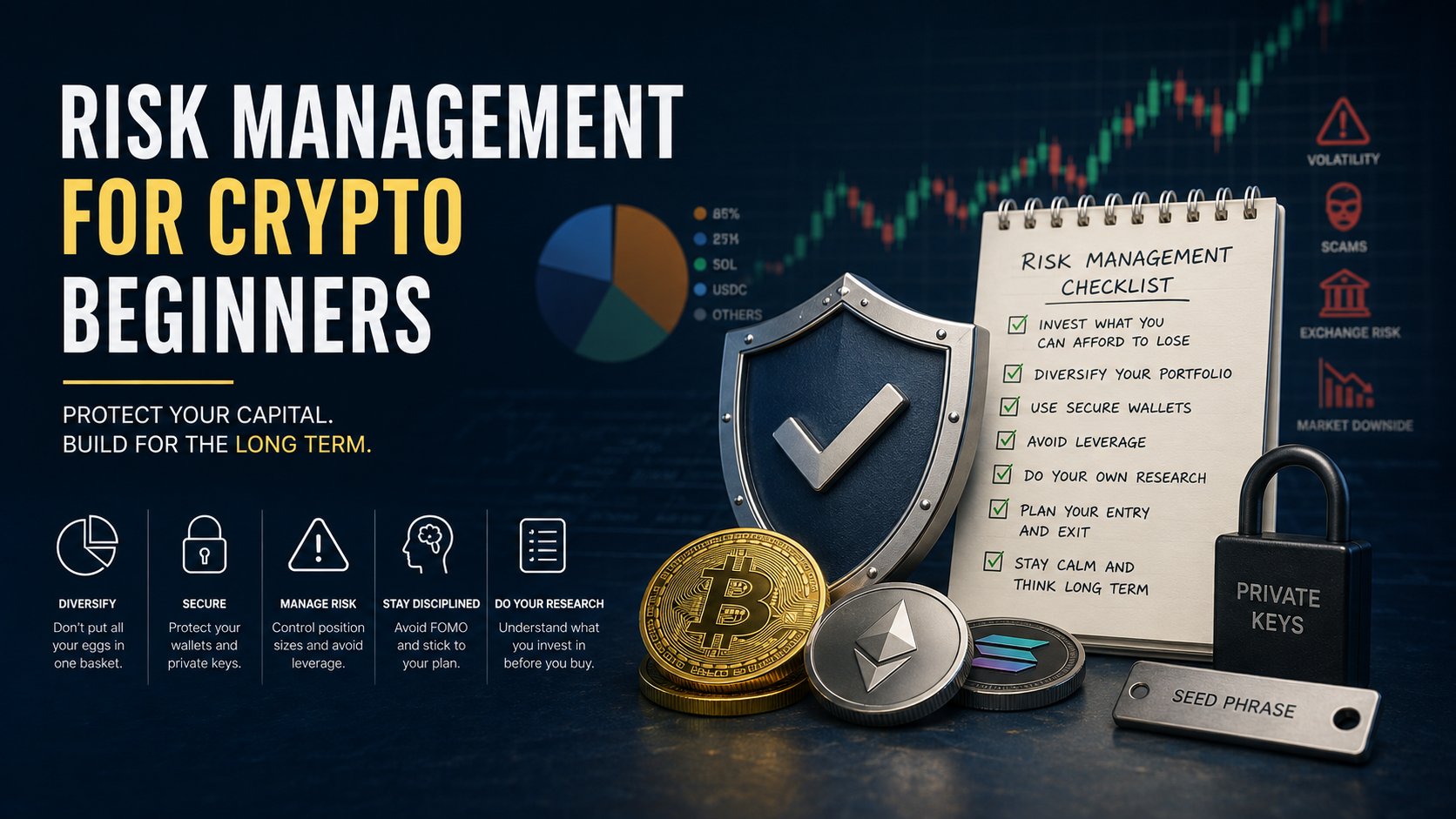
For beginners especially, good risk management often comes down to a few fundamental principles: invest only what you can afford to lose, keep position sizes reasonable, diversify thoughtfully, avoid unnecessary leverage, protect your accounts and wallets, research before investing, and make decisions according to a plan rather than emotion.
Crypto will always involve uncertainty. Good risk management determines how much that uncertainty can hurt you.


Pick your reaction
Post your comment