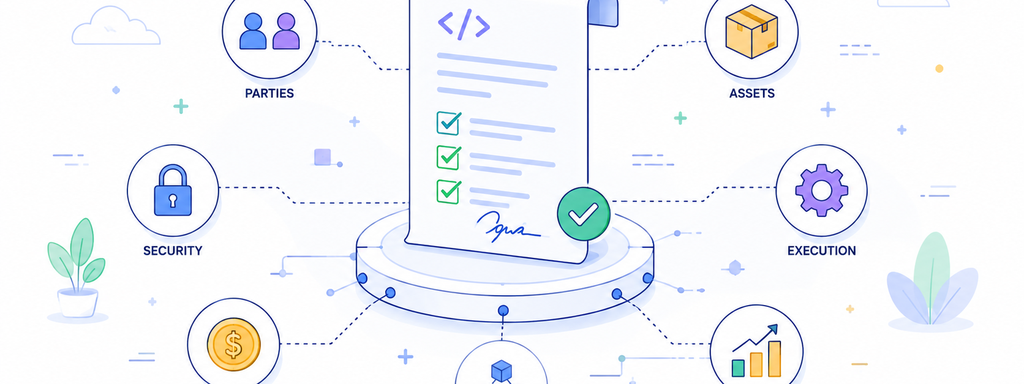

Smart contracts are one of the most important innovations introduced by blockchain technology. While cryptocurrencies like Bitcoin made decentralized digital money possible, smart contracts expanded blockchain networks into platforms capable of running applications, services, and automated agreements without relying on banks, companies, or other intermediaries.
Today, smart contracts power decentralized finance (DeFi), NFT marketplaces, blockchain games, supply chain systems, and countless other applications across networks like Ethereum, Solana, and many others.
What Is a Smart Contract?
A smart contract is a program stored on a blockchain that automatically executes when certain conditions are met.
Instead of relying on a person or organization to enforce an agreement, the rules are written directly into code. Once deployed, the smart contract operates exactly as programmed and cannot easily be changed.
A simple way to think about a smart contract is as a digital “if-this-then-that” system:
- If payment is received, release the product
- If a loan is repaid, unlock the collateral
- If a vote reaches the required threshold, execute the proposal
Because the contract runs on a blockchain, every transaction and action can be verified publicly and cannot be secretly altered afterward.
How Smart Contracts Work
Most smart contracts are deployed on programmable blockchains. The most well-known platform for this is Ethereum, which introduced a large ecosystem of decentralized applications (dApps).
Here’s a simplified overview of how the process works:
- A developer writes the smart contract code
- The contract is deployed to the blockchain
- Users interact with the contract through wallets or applications
- The blockchain network validates the actions
- The contract automatically executes its programmed logic
Once deployed, the smart contract exists across the blockchain network rather than on a single server. This makes it decentralized and highly resistant to downtime or censorship.
Why Smart Contracts Matter
Smart contracts remove the need for many traditional intermediaries. Instead of relying on banks, brokers, payment processors, or centralized platforms, users can interact directly with blockchain-based systems.
This creates several important advantages:
Automation
Smart contracts execute automatically once conditions are met. This reduces delays and minimizes human error.
Transparency
The code and transaction history are often publicly viewable on the blockchain, allowing anyone to verify how the system works.
Security
Because smart contracts are stored across decentralized blockchain networks, altering them is extremely difficult after deployment.
Lower Costs
Removing intermediaries can reduce transaction fees and operational costs.
Global Accessibility
Anyone with an internet connection and a crypto wallet can interact with many smart contract applications without needing approval from a centralized authority.
Real-World Uses of Smart Contracts
Smart contracts are already used across many sectors of the crypto industry.
Decentralized Finance (DeFi)
DeFi platforms use smart contracts to provide services like lending, borrowing, staking, and token swapping without traditional banks.
Popular DeFi applications include decentralized exchanges, liquidity pools, and automated lending protocols.
NFTs and Digital Ownership
NFT marketplaces use smart contracts to verify ownership, handle transfers, and distribute royalties automatically to creators.
Gaming
Blockchain games use smart contracts to manage in-game assets, rewards, and digital economies.
DAOs
Decentralized Autonomous Organizations (DAOs) use smart contracts to allow communities to vote on proposals and manage shared resources collectively.
Supply Chains
Some businesses use smart contracts to track products, automate deliveries, and verify authenticity throughout supply chains.
Limitations and Risks
Despite their potential, smart contracts are not perfect.
Bugs in the Code
If a smart contract contains programming errors, those bugs may be exploited by attackers. Since blockchain transactions are usually irreversible, mistakes can become extremely costly.
Difficult to Modify
Many smart contracts are intentionally immutable, meaning they cannot easily be changed once deployed.
Scalability Challenges
Some blockchain networks experience congestion and high transaction fees during periods of heavy usage.
Dependence on External Data
Certain smart contracts require outside information, such as price feeds or weather data. These external systems, called oracles, can introduce additional risks.
Smart Contracts and the Future
Smart contracts continue to evolve rapidly as blockchain technology matures. Developers are working on making them faster, cheaper, more secure, and easier to use.
As adoption grows, smart contracts could increasingly influence industries far beyond cryptocurrency, including finance, insurance, logistics, gaming, identity verification, and digital governance.
While the technology is still developing, smart contracts have already become one of the core foundations of the decentralized internet and modern blockchain ecosystems.
Final Thoughts
Smart contracts transformed blockchain technology from simple digital payments into programmable decentralized systems. By automating agreements and removing intermediaries, they enable entirely new ways for people to exchange value, share ownership, and build online communities.
Although challenges remain, smart contracts are likely to remain a central part of the growing Web3 ecosystem and the broader future of digital technology.


Pick your reaction
Post your comment