

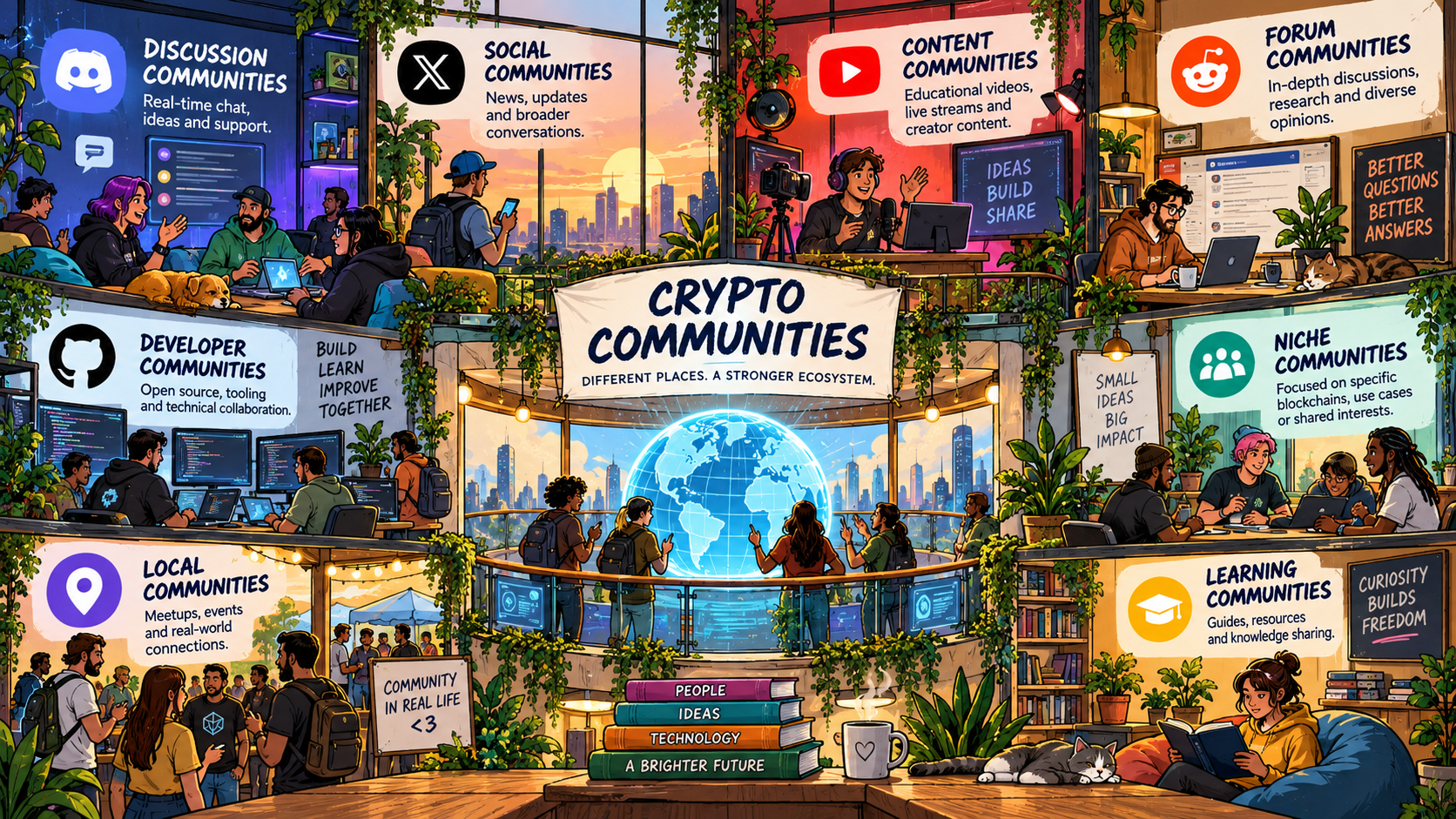
Crypto communities come in many different forms. Some are built around a specific blockchain, others focus on trading, development, NFTs, gaming, education, governance, or simply bringing people with similar interests together.
The platform a community uses also shapes how people interact. A fast-moving Telegram group can feel completely different from a structured Discord server, a technical GitHub community, or a discussion-focused subreddit.
Understanding the different types of crypto communities can help you find spaces that match your interests, goals, and preferred way of participating.
Blockchain and Ecosystem Communities
Many crypto communities form around a particular blockchain or ecosystem.
These communities bring together people interested in the technology, applications, tokens, development, governance, and future of a specific network. Members may include developers, investors, validators, node operators, application builders, content creators, and regular users.
Discussions commonly cover topics such as:
- Network upgrades
- Wallets
- Decentralized applications
- Staking or validation
- Ecosystem projects
- Governance
- Developer tools
- Adoption
- Technical problems
- Events and announcements
Large blockchain ecosystems often have several separate communities rather than one central group. There may be dedicated spaces for developers, traders, regional users, node operators, NFT projects, and individual applications.
This can make ecosystem communities particularly diverse.
Project Communities
Project communities are centered around a specific cryptocurrency, protocol, application, platform, or Web3 project.
They are often among the most active communities in crypto because members share a direct interest in the development of the project.
A project community might discuss:
- Product updates
- New features
- Development progress
- Partnerships
- Token utility
- Governance proposals
- Bugs and technical support
- Community events
- Roadmaps
- Ecosystem integrations
These communities can also provide an important communication channel between project teams and users.
However, members should remember that official project communities naturally tend to contain people who are already interested in or supportive of the project. For research purposes, it can therefore be useful to compare discussions across multiple independent sources.
Trading Communities
Trading communities focus primarily on cryptocurrency markets.
Members discuss topics such as price movements, technical analysis, market structure, trading strategies, indicators, derivatives, liquidity, and risk management.
Some communities concentrate on short-term trading, while others focus on longer-term market analysis.
Common topics include:
- Chart analysis
- Market trends
- Support and resistance levels
- Trading indicators
- Futures and options
- Market sentiment
- Risk management
- Trading psychology
Trading communities can be useful places for discussing different interpretations of the market, but they also require caution.
No trader can reliably predict every market movement. Claims of guaranteed returns, secret signals, or risk-free opportunities should be treated with skepticism.
It is generally better to use trading communities as sources of ideas and discussion rather than blindly copying trades.
Investment Communities
Investment communities overlap with trading communities but usually take a longer-term perspective.
Instead of concentrating primarily on short-term price movements, members may discuss fundamentals such as technology, adoption, token economics, development activity, competition, governance, and long-term potential.
Discussions may include:
- Token supply
- Token distribution
- Revenue models
- Protocol usage
- Development activity
- Network growth
- Competitive ecosystems
- Governance structures
- Long-term risks
Some investment communities specialize in particular areas of the market, such as decentralized finance, infrastructure, gaming, artificial intelligence, privacy technology, or real-world assets.
As with trading communities, investment discussions should be treated as research material rather than financial advice.
Developer Communities
Developer communities are some of the most technically focused spaces in crypto.
They bring together programmers, protocol engineers, application developers, researchers, infrastructure providers, and people learning how to build blockchain applications.
Typical discussions include:
- Smart contract development
- APIs and SDKs
- Protocol architecture
- Security
- Testing
- Node infrastructure
- Libraries and frameworks
- Bug reports
- Code reviews
- Developer documentation
GitHub, Discord, forums, and developer-focused chat platforms are especially common for these communities.
Developer communities can also provide valuable insight into the health of an ecosystem. Active technical discussions, open-source contributions, documentation improvements, and ongoing development can reveal aspects of a project that are difficult to see from marketing material alone.
DeFi Communities
Decentralized finance communities focus on protocols and applications involving financial services built on blockchain networks.
Topics can include:
- Decentralized exchanges
- Lending and borrowing
- Liquidity pools
- Stablecoins
- Yield strategies
- Derivatives
- Tokenized assets
- Cross-chain liquidity
Some DeFi communities are dedicated to individual protocols, while others discuss the wider DeFi ecosystem.
Because decentralized finance can involve complex smart contracts and significant financial risk, reputable communities often spend considerable time discussing security, protocol mechanics, and risk.
Users should be especially cautious about unsolicited links, fake support accounts, and unknown smart contracts in DeFi-related communities.
NFT Communities
NFT communities form around digital collectibles, art projects, gaming assets, memberships, creators, marketplaces, and other uses of non-fungible tokens.
Some communities exist primarily around a particular NFT collection, while others focus more broadly on NFT technology and culture.
Conversations may involve:
- Digital art
- Collectibles
- Community events
- NFT utilities
- Creator projects
- Marketplaces
- Gaming assets
- Intellectual property
- Token-gated experiences
Many NFT projects place a strong emphasis on community identity. Holding a particular NFT may sometimes provide access to private channels, events, governance, games, or other benefits.
At the same time, the NFT sector has attracted considerable speculation, making it important to distinguish between genuine community activity and communities focused almost entirely on price.
Gaming and Metaverse Communities
Blockchain gaming communities combine elements of traditional gaming communities with crypto and digital ownership.
Members may discuss:
- Gameplay
- In-game economies
- Digital items
- NFTs
- Tournaments
- Game development
- Player strategies
- Token rewards
- Virtual worlds
These communities are often highly social because people are not only discussing crypto but also playing games together.
Discord is particularly common in gaming communities because it supports voice channels, roles, events, announcements, and separate discussion areas.
DAO and Governance Communities
Decentralized autonomous organizations, or DAOs, rely heavily on communities because collective decision-making is often a central part of how they operate.
DAO communities may discuss:
- Governance proposals
- Treasury spending
- Protocol changes
- Grants
- Partnerships
- Community initiatives
- Voting procedures
- Contributor roles
Discussions often begin informally before becoming formal governance proposals.
For someone interested in how decentralized organizations actually make decisions, governance communities can offer a direct view into the process.
Participation levels vary considerably. Some DAOs have thousands of token holders but only a relatively small number of regular governance participants.
Mining, Staking, and Validator Communities
Some communities focus on the infrastructure required to operate cryptocurrency networks.
Proof-of-work communities may discuss mining hardware, electricity costs, mining pools, software, network difficulty, and equipment configuration.
Proof-of-stake communities may instead focus on:
- Validators
- Staking
- Delegation
- Node operation
- Hardware
- Uptime
- Network upgrades
- Validator economics
These communities tend to attract technically experienced users, although many also provide guides for people setting up infrastructure for the first time.
They can be particularly useful when troubleshooting network-specific software or hardware.
Privacy Communities
Privacy-focused communities discuss technologies designed to improve financial or digital privacy.
Topics may include:
- Privacy-focused cryptocurrencies
- Transaction privacy
- Metadata
- Wallet security
- Network privacy
- Cryptography
- Self-custody
- Digital identity
These communities sometimes overlap with cybersecurity and open-source communities because privacy technologies often involve complex technical systems.
Discussions can range from practical wallet usage to highly technical conversations about cryptographic protocols.
Security Communities
Security communities focus on protecting cryptocurrency users, applications, wallets, and protocols.
Members may discuss:
- Wallet security
- Phishing
- Smart contract exploits
- Hardware wallets
- Browser security
- Malware
- Social engineering
- Seed phrase protection
- Security audits
Some security communities are highly technical, while others focus on helping everyday users recognize common threats.
Given the irreversible nature of many cryptocurrency transactions, security education plays an especially important role in the crypto ecosystem.
Educational Communities
Educational crypto communities are built around learning rather than a single project or investment opportunity.
They may help people understand subjects such as:
- Blockchain fundamentals
- Wallets
- Smart contracts
- DeFi
- NFTs
- Token economics
- Security
- Development
- Governance
Some educational communities organize workshops, courses, question-and-answer sessions, study groups, or live discussions.
The quality of educational communities can vary, so it is worth checking who produces the material, whether sources are provided, and whether different perspectives are represented.
News and Research Communities
News and research communities focus on following developments across the cryptocurrency industry.
Members may share and discuss:
- Industry news
- Protocol updates
- Regulation
- Research reports
- Market data
- Security incidents
- New projects
- Technology developments
Some communities emphasize fast-moving news, while others concentrate on detailed research and long-form analysis.
These spaces can be useful for discovering information, but members should still verify important claims through primary sources.
Fast-moving crypto news can easily spread before all the facts are known.
Meme Coin Communities
Meme coin communities are usually built around humor, internet culture, memes, and a shared identity surrounding a token.
They are often among the most energetic communities in crypto.
Activities may include:
- Meme creation
- Social media campaigns
- Community competitions
- Events
- Giveaways
- Community-created artwork
The strength of the community itself can become a major part of the project's identity.
However, meme coin communities can also become heavily focused on speculation and promotion. New participants should be particularly cautious when communities encourage aggressive buying, promise unrealistic returns, or discourage critical questions.
Regional and Local Crypto Communities
Not every crypto community is organized around a technology or project.
Some are organized geographically.
There are communities for individual:
- Countries
- Cities
- Regions
- Languages
These groups can be especially useful for discussing local events, regulations, businesses, meetups, tax questions, and educational opportunities.
Local communities can also connect online participation with real-world events such as conferences, workshops, hackathons, and informal meetups.
Creator and Influencer Communities
Many crypto content creators have built communities around their videos, livestreams, podcasts, newsletters, or social media channels.
These communities often discuss the same topics covered by the creator.
Depending on the creator, the focus might include:
- Market commentary
- Education
- Technology
- Interviews
- Project analysis
- Trading
- News
Creator communities can develop strong social connections between regular members.
At the same time, it is useful to separate the creator's personal opinions from independently verified information.
Social Communities
Some crypto communities are not particularly technical or investment-focused.
Their main purpose is simply bringing people together.
Members might talk about crypto alongside music, gaming, technology, hobbies, everyday life, or current events.
These communities demonstrate an important aspect of the crypto ecosystem that is sometimes overlooked: communities do not have to revolve entirely around tokens or markets.
Long-lasting communities are often built around relationships and shared interests rather than constant discussion of prices.
Communities Can Belong to Several Categories
These categories are not mutually exclusive.
A single Discord server could simultaneously be:
- A blockchain ecosystem community
- A developer community
- A governance community
- An educational community
- A social community
Similarly, an NFT project might combine gaming, governance, art, and DeFi features.
It is therefore often more useful to think about communities in terms of their primary focus rather than trying to place every community into one strict category.
The Platform Also Shapes the Community
The type of platform a community uses can strongly influence how it operates.
Discord
Discord works particularly well for larger communities that need multiple channels, roles, moderation tools, bots, voice chat, events, and structured discussions.
It is widely used by blockchain projects, gaming communities, NFT projects, DAOs, and developer communities.
Telegram
Telegram is popular for fast-moving group conversations and announcements.
It is commonly used by project communities, trading groups, token communities, and regional crypto groups.
Large Telegram groups can move extremely quickly, making them useful for real-time discussion but sometimes difficult to follow.
Reddit is well suited to longer discussions where individual topics can remain visible for longer periods.
Subreddits often act as semi-independent communities surrounding blockchains, cryptocurrencies, technologies, or broader crypto subjects.
The voting system also helps surface discussions that the community finds interesting.
X
X is less structured than Discord or Reddit but plays an important role in crypto communication.
Developers, founders, researchers, traders, projects, and community members frequently use it to share announcements, opinions, research, and discussions.
Many communities on X form informally through networks of accounts rather than through clearly defined groups.
YouTube and Twitch
Video platforms create communities around livestreams, educational videos, interviews, market discussions, gaming, and other content.
Livestream chat can make these communities especially interactive.
Forums
Traditional forums remain important for some cryptocurrency communities.
They are particularly useful for technical discussions, governance proposals, research, development conversations, and topics that benefit from organized long-form discussion.
Unlike fast-moving chats, forum discussions can remain searchable and useful for years.
GitHub
GitHub is technically a software development platform rather than a traditional social network, but it is an important community space for open-source crypto projects.
Developers use repositories to submit code, report bugs, discuss changes, review contributions, and collaborate on software.
For technically oriented users, GitHub activity can provide a direct view into how a project is being developed.
Public and Private Crypto Communities
Crypto communities can also be divided into public and private spaces.
Public communities allow anyone to browse or participate, making them easier to discover and evaluate.
Private communities may require:
- An invitation
- Token ownership
- NFT ownership
- A subscription
- Approval from moderators
- Membership in another organization
Private communities are not automatically better than public communities. Access restrictions simply create a different type of environment.
Some communities use a combination of both, with public channels for general discussion and restricted areas for contributors, holders, developers, or governance participants.
What Makes a Healthy Crypto Community?
The number of members alone says very little about the quality of a community.
A smaller community with active discussions can be far more useful than a server with hundreds of thousands of inactive accounts.
Healthy communities often have several characteristics in common.
Members can ask reasonable questions without immediately being attacked or removed. Moderators deal with spam, scams, impersonation, and harassment. Important information can be verified through official sources. Discussions are not exclusively focused on token prices.
It is also a positive sign when disagreement is possible.
Communities where every critical question is treated as hostility can make it difficult to evaluate projects objectively.
Warning Signs to Watch For
Crypto communities can be extremely useful, but they can also be targeted by scammers or used to promote questionable projects.
Some warning signs include:
- Guaranteed profit claims
- Constant pressure to buy
- Unsolicited direct messages
- Fake support accounts
- Requests for seed phrases or private keys
- Unknown wallet connection links
- Claims that criticism is always malicious
- Artificial engagement
- Excessive referral promotion
- Impersonation of administrators
Legitimate wallet support will never require your seed phrase or private key.
When dealing with links shared inside crypto communities, especially those involving wallets or transactions, verifying the destination independently is one of the most important security habits you can develop.
Finding the Right Crypto Community
There is no single type of crypto community that is right for everyone.
A developer may prefer GitHub repositories and technical Discord servers. Someone researching a blockchain might prefer Reddit, forums, and ecosystem communities. A gamer might spend most of their time in Discord, while someone following industry developments may rely more heavily on X, research groups, and news communities.
Many people participate in several types of communities at the same time.
Exploring different communities also helps provide a broader perspective. Instead of relying entirely on one group, you can compare information, opinions, and experiences across different platforms and communities.
Crypto Is Built Around Communities
Cryptocurrency is often described in terms of blockchains, tokens, wallets, and protocols, but communities are just as important to the ecosystem.
They help people learn, collaborate, build software, govern protocols, discover projects, organize events, solve problems, and form relationships.
The enormous variety of crypto communities reflects the diversity of the industry itself.
Whether you are interested in blockchain development, decentralized finance, gaming, NFTs, trading, governance, privacy, security, or simply meeting people who share your interests, there is likely a community built around it.
The challenge is finding the right one.
That is where platforms such as BlockMap can help. By bringing crypto communities from different platforms and categories together in one directory, BlockMap makes it easier to discover communities, explore what they offer, and find places where you actually want to participate.



Pick your reaction
Post your comment